
Pinhole Leaks in Copper Pipes: Repair, Reline, or Repipe?
Key Takeaways
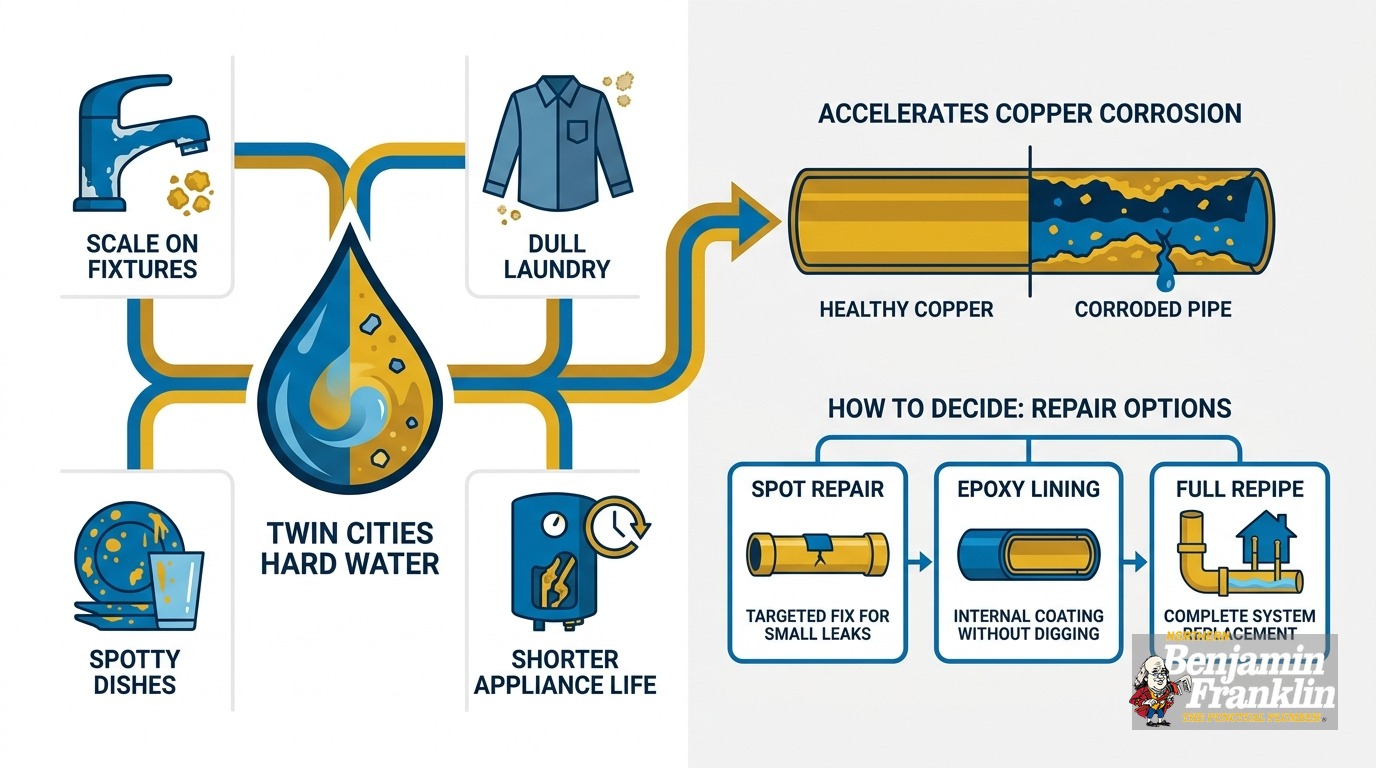
- Pinhole leaks in copper pipes result from pitting corrosion that works from the inside out. By the time water appears on the outside of a pipe, the wall has already failed at that spot.
- Twin Cities homes built between the 1950s and 1970s commonly have thin-wall Type M copper, which degrades faster than the thicker Type L or Type K alternatives.
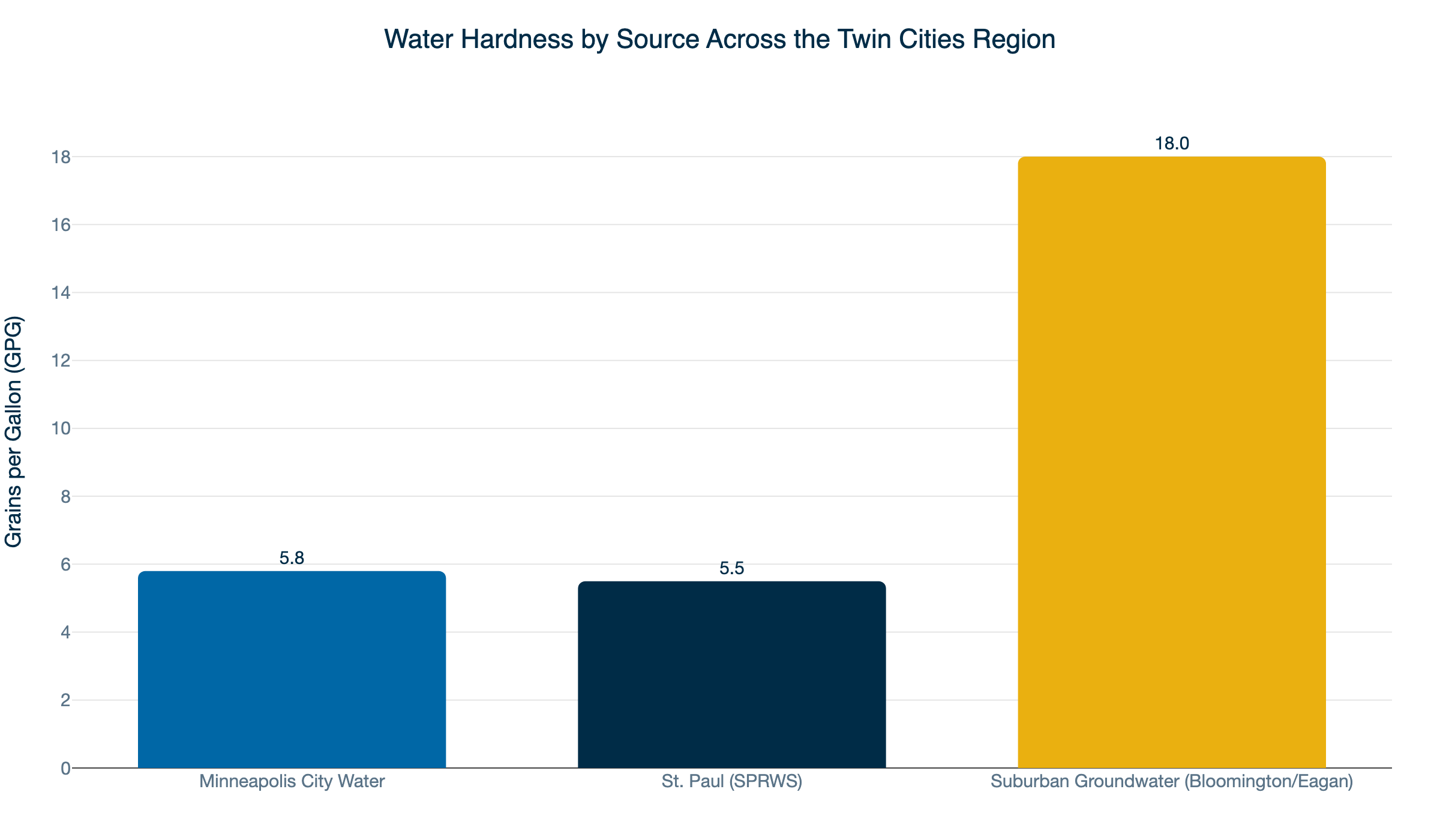
- Minneapolis and St. Paul finished water measures only 5-6 grains per gallon in hardness, but chloramine disinfection, high pH, and Minnesota’s freeze-thaw cycles make copper corrosion common here even without extreme hardness.
- Suburban homeowners on groundwater in Bloomington, Eagan, and Eden Prairie face hardness near 18 GPG with no municipal softening, a significantly higher-risk environment for copper.
- Three repair paths exist: spot repair, epoxy pipe lining, and full repipe. Each has clear disqualifying criteria. A camera inspection decides which one applies to your home.
- Minnesota requires a permit for any residential repiping. Work concealed before inspection is a code violation.
- Blue-green stains on fixtures, unexplained drops in water pressure, and damp spots in walls are the early warnings. Do not wait for a flood.
What Causes Pinhole Leaks in Copper Pipes?
Pitting corrosion eats copper from the inside out. By the time a leak is visible on the outside of a pipe, corrosion has already worked through the full pipe wall at that spot. Sila Plumbing
The process begins at weak points on the inner pipe wall. Elbows and fittings are the most common starting locations because that is where water changes direction abruptly. Turbulence at those spots is high. Hard water minerals and water pressure wear away the thin copper oxide layer that normally protects the metal, and once that layer is compromised, corrosion accelerates fast. Halpin Plumbing
Once a pit forms, the failure can compound itself. The pit disrupts flow and creates a localized low-oxygen zone at that point on the interior wall. Oxygen differentials drive further corrosion. That is why pinhole leaks often cluster: finding one is a reason to suspect others nearby.
Water velocity is a second, separate mechanism called erosion corrosion. Fast-moving water strips the protective cupric oxide layer mechanically, regardless of mineral content. Water pressure above 80 PSI is a documented risk factor on its own.
Chlorine and chloramine, the disinfectants most municipal water systems use, are also documented accelerants of copper corrosion. Both Minneapolis and St. Paul use chloramine, a combination of chlorine and ammonia, as a secondary disinfectant. Its presence in the supply is a risk factor even when measured hardness is moderate.
Pipe age and wall thickness matter significantly. Residential copper has an estimated service life of 20-50 years, depending on type. Type M copper, the thinnest-wall version, was the most common choice in Minnesota homes built from the 1950s through the 1970s. It degrades faster than the heavier-wall Type L or Type K. Sila Plumbing
If your home is from that era, your pipes may be at or past the end of their service life. A camera inspection tells you how much wall is left.
Why Does Twin Cities Water Chemistry Accelerate the Problem?
It is not just hardness. Minneapolis and St. Paul deliver moderate-hardness water, but three other factors combine with local conditions to make copper corrosion common here.
Minneapolis finished water measured approximately 5.8 grains per gallon (GPG) total hardness and a pH of 9.04 in January 2026. Minneapolis January 2026 Monthly Plant Effluent Water Analysis That pH sits on the high end of the typical range. High-pH water raises the calcium carbonate scaling potential at fittings and inside water heaters, adding stress exactly where corrosion tends to start.
St. Paul Regional Water Services draws from the Mississippi River in Fridley, where raw source water runs around 12.5 GPG. SPRWS uses lime-softening clarifiers to reduce that to approximately 5-6 GPG in the finished supply. The utility also adds orthophosphate as a corrosion control measure. That addition was implemented primarily to reduce lead leaching from service lines and fixtures installed before 2014, not specifically to address copper pitting. About Your Water, St. Paul Regional Water Services
Chloramine is the third compounding factor. Both cities use it as a secondary disinfectant. It accelerates copper corrosion separately from hardness or pH. When you combine moderate hardness with high pH and chloramine in the water supply, the risk picture looks different from what the hardness number alone suggests.
Suburban groundwater is a different situation entirely. Communities drawing from the Prairie du Chien-Jordan aquifer, including parts of Bloomington, Eagan, and Eden Prairie, see hardness near 18 GPG with no municipal treatment softening it. Minnesota Water Quality City-by-City Analysis, Range Water Conditioning At that level, mineral deposits inside pipes compound every other risk factor.
Minnesota’s climate adds one more layer. Freeze-thaw cycles stress pipe walls that already carry pitting damage. A pipe that might hold for another few seasons in a southern climate can crack in a Minnesota winter. That is why spring inspections in older neighborhoods like Nokomis, Hamline-Midway, and St. Anthony Park regularly surface leaks that started forming the previous fall.
Our post on water hardness across Minneapolis and St. Paul goes deeper on the city-by-city breakdown if you want to understand exactly what your utility delivers.
What Are the Warning Signs of Pinhole Leaks?
Blue-green staining around faucet bases and in sink basins, unexplained drops in water pressure, and damp spots or bubbling paint on walls and ceilings are the main early warnings. If you see any of these, call a licensed plumber before the situation worsens.
The blue-green staining is not cosmetic. It is copper leaching into your water as the pipe walls corrode internally. That staining appears on fixtures and porcelain long before the pipe wall gives way completely. Treating it as a cleaning problem is how small leaks become large ones.
Unexplained low water pressure can mean a pinhole leak is already releasing water inside a wall cavity. By the time you feel the pressure drop at the faucet, water may have already soaked framing, insulation, or subflooring nearby.
Damp drywall, soft spots in the ceiling, and the sound of dripping inside walls all indicate an active leak. At that stage, turn off the main water supply immediately and call. Our guide on how to find and test your main water shutoff valve walks you through exactly where to look and how to confirm the valve works before you need it in an emergency.
Other signs worth noting: a sudden spike in your water bill without any change in usage, water with a faint metallic taste, or discolored water from the hot tap. All of these point to pipe corrosion that has advanced past the early stage.
When you do call a plumber, document what you have seen. Note where the staining appears, whether it is worse on the hot or cold side, and how long it has been visible. That information helps narrow the inspection quickly.
Are Pinhole Leaks a Health Risk?
Yes, under certain conditions. Corroding copper pipes leach copper into your drinking water. The EPA action level is 1,300 micrograms per liter. When more than 10 percent of tap samples from a public water system exceed that threshold, the utility must take corrective action. Copper in Drinking Water, MN Department of Health
At elevated levels, copper causes nausea, vomiting, diarrhea, and stomach cramps. High or prolonged exposure can damage the liver and kidneys. Infants under one year old and people with Wilson’s disease are especially vulnerable to copper toxicity.
Hot water leaches significantly more copper from corroded pipes than cold water does. If your plumbing has been sitting unused for several hours, run the cold tap for a minute before using the water for drinking or cooking.
The blue-green deposits on your sink basin are corrosion made visible. They tell you the same process is happening inside the pipe walls, where you cannot see it. Do not wait for a pinhole to announce itself with a puddle.
Spot Repair, Epoxy Lining, or Full Repipe: How to Choose
Most guides give you three options and leave you to decide alone. Here is a decision framework with clear disqualifying criteria for each path.
Spot repair
A licensed plumber cuts out the failed section and replaces it with new pipe. This is the right answer when the leak is genuinely isolated, the surrounding pipe is in good condition, and a camera inspection confirms no widespread corrosion elsewhere in the system.
Spot repair is the wrong answer when the cause is systemic. If chloramine, chronic high pressure, or aging Type M copper is behind the failure, corrosion is happening at multiple points. You are buying time, not solving the problem. Most plumbers will tell you this directly after the camera inspection. If a contractor wants to patch without looking at the broader picture, that is a reason to ask more questions.
Epoxy pipe lining (CIPP)
Cured-in-place pipe lining applies an epoxy barrier to the interior of existing pipes. It seals active pinholes and slows future corrosion without opening walls or excavating anything. According to NuFlow Midwest, all-in costs run $80-$250 per linear foot, with a projected lifespan of 35-50 years. That is a NuFlow figure, not our quote. There is no drywall demo, no landfill disposal, and no restoration work after the job.
The disqualifying criteria are firm. Epoxy lining requires a minimum remaining pipe wall thickness to seat the liner properly. It does not work on collapsed sections, severely deteriorated pipe, or pipe geometry that cannot support the curing process. The camera inspection is the prerequisite before recommending lining. Without it, there is no responsible way to tell you whether lining is even an option on your system.
Full repipe
When corrosion is widespread, when pipe age makes repeated spot repairs uneconomical, or when the camera shows insufficient wall thickness for lining, a full repipe is the correct path.
Repiping means opening walls, removing the old copper, and running new supply lines throughout the affected areas. It is disruptive. It takes time. It is also a permanent solution, and it is the right answer when the corrosion has advanced far enough that lining would just be sealing a system that is already compromised.
According to NuFlow Midwest, traditional repipe project costs typically include $4-$15 per linear foot for pipe material, labor at $45-$200 per hour, a camera inspection beforehand ($250-$1,200), and drywall repair after ($200-$1,000). Those are NuFlow’s figures, not our numbers. For an accurate estimate on your home, call (763) 296-1844.
When you are facing a repipe, the material choice matters. Our post on PEX vs. copper for a whole-house repipe breaks down the tradeoffs in detail. For larger jobs, financing is available. Ask about it when you schedule.
For an overview of how we approach the assessment through inspection sign-off, see our repiping service page.
In every case, the camera inspection is the decision gate. It reveals remaining wall thickness, pipe geometry, and whether epoxy lining can be properly seated. Schedule the inspection before committing to any repair path.
Do Pinhole Leaks in Copper Pipes Require a Minnesota Permit?
Yes. Any residential repiping requires a permit under the 2020 Minnesota Plumbing Code, Chapter 4714, which has been in effect since December 17, 2021. Minnesota DLI Plumbing Code FAQ
For a one- or two-family owner-occupied home, a homeowner affidavit permit is available under MN Statute 326.46, Subd. 1(a). But all work must still be inspected by a licensed plumbing inspector before the walls are closed. Minnesota DLI Minor Remodel Plumbing Projects
Any plumbing installed before permitting is a code violation. Work concealed without inspection must be reopened. This is not a formality. The inspection step exists to verify that the new installation meets code before it is hidden inside your walls for the next several decades.
A licensed plumber handles the permit application and inspection scheduling as part of the project scope. If a contractor offers to skip the permit to save time or money, find a different contractor.
Can a Water Softener Prevent Pinhole Leaks?
A water softener reduces hardness and removes some of the minerals that accelerate pitting corrosion. It addresses one risk factor. It does not address chloramine, pH, water pressure, or pipe age.
If you are on Minneapolis or St. Paul city water, your supply already runs at 5-6 GPG after treatment. A softener may help at the margins, but it will not reverse corrosion that has already started, and it will not stop a leak that is forming right now.
If you are on groundwater in Bloomington, Eagan, or Eden Prairie at 18 GPG, a softener is a meaningful intervention. At that hardness level, the mineral deposits inside your pipes are a significant accelerant, and reducing hardness makes a real difference to remaining pipe life over the long run.
If you have already found pinhole leaks, start with the plumbing inspection, not the softener. Address the existing pipe damage first. Then ask us whether a softener makes sense for protecting what is left.
Our water softener page covers the units we install and service across the Twin Cities, and how to choose the right size for your household.
What to Expect When You Call Northern Benjamin Franklin Plumbing
We are locally owned and operated in the Twin Cities. When you call about pinhole leaks in copper pipes, we start with a plumbing inspection and, when the situation warrants it, a camera inspection of the affected line. From there, we give you a clear assessment: isolated spot repair, a candidate for epoxy lining, or a system that needs repiping.
We do not hand you three options and walk away. We tell you which one fits your home, why, and what comes next.
We schedule around your timeline. Our On-Time Guarantee(R) means we arrive in the window you choose. If we are late, we pay you $5 for every minute we are delayed, up to $300. “If there is any delay, it’s you we pay!”
For larger projects like a full repipe, ask about financing when you book. We want the right fix to be accessible.
Call (763) 296-1844 or book online. Do not wait for a pinhole to become a flooded wall.
Frequently Asked Questions
What causes pinhole leaks in copper pipes? +
Do I need a permit to repipe my Minnesota home? +
What is the first step when I find a pinhole leak? +
Need a technician now?