
Blue Green Water From Faucet Minnesota: Causes and Fixes
Key Takeaways
- Blue-green water or staining usually means dissolved copper from your home’s own plumbing.
- Copper plumbing less than three years old may release more copper because it has not built a protective coating yet.
- The Minnesota Department of Health sets the health-risk level at more than 1,300 micrograms per liter (µg/L) for everyone.
- Infants and people with Wilson’s disease may need an even lower level, so talk with a doctor.
- Pinhole leaks and pitting inside pipes are the real signals that pipes are wearing out.
- Run the water 30 to 60 seconds after six hours of no use. Use cold water for drinking and cooking.
- A certified lab test gives you a real number. Do not guess.
- You do not need to panic, but you should not ignore it either. Use the action ladder below.
What does blue green water from a faucet mean in Minnesota?
Blue-green water means copper has dissolved into your water, usually from copper pipes or fittings inside your home. The Minnesota Department of Health notes that water with a lot of dissolved copper may taste or smell bad, or look blue. Investigate it, but don’t panic.
Most homeowners notice it in one of two ways. Either the water has a blue or green tint, or a blue-green stain builds up around a drain, a faucet base, or inside a tub or sink.
Both point to the same thing: something in your water is pulling copper off the inside of your plumbing. We can help you find out how much, why, and what to do about it.
Here in the Twin Cities, many homes have copper supply lines. Some are decades old. Some went in last year. The age of the copper changes the answer, and so does the way your water behaves in the pipes.
What causes blue-green staining on fixtures and in the water?
Blue-green staining comes from copper. The most common causes are corrosive water, new copper pipes that have not built a protective coating, and water that sits still in the pipes. Each one releases copper in a slightly different way, so the cause shapes the fix.
Corrosive water. The Minnesota Department of Health says pinhole leaks, pitting inside pipes, or blue-green stains on plumbing fixtures may be signs of corrosive water. Corrosive water slowly eats at metal. Copper ends up in the water and leaves stains where the water dries.
New copper plumbing. The same agency explains that plumbing with copper parts less than three years old usually has not built up a protective coating, so it may release more copper. This is a common and fairly benign cause. If you just remodeled or repiped, start here.
Standing water. Water that sits in copper pipes overnight or while you are away picks up more copper. The first draw of the morning is often the bluest.
Hot water. The health department also notes that hot water releases more copper. If the color shows up only on the hot side, that is a clue.
Natural deposits. The EPA lists the source of copper in drinking water as corrosion of household plumbing systems and erosion of natural deposits. In a city home, plumbing corrosion is the likelier culprit.
Other factors can play a part. Fittings and solder can contribute. Mixed metals in a plumbing system can speed up wear. A plumber can look at all of this on site.
The city main is not on this list. The next section explains why.
Why does my home have blue-green water when the city treats its water?
City utilities treat water to protect pipes, but your home’s plumbing is its own system. New copper, standing water, or corroding pipes inside your walls can add copper at your tap even when the city water leaving the plant is well controlled.
Twin Cities utilities work on this problem on purpose. Minneapolis says the normal pH of its tap water is 9, which is slightly alkaline. The city also adds a small amount of orthophosphate, which it says helps keep lead out of drinking water.
St. Paul Regional Water Services also adds orthophosphate, which forms a protective layer inside pipes. It softens water to what it calls balanced hardness that protects plumbing.
So the utilities are doing corrosion control. That is why blue-green water at one home often points to that home’s plumbing rather than the neighborhood.
A public system reports copper results in its Consumer Confidence Report. The health department cautions that your home may still be higher than the sampled homes. The report is a good starting point, but it does not test your tap.
If your neighbors see the same color at the same time, call your utility. If only your house sees it, look inward. Check how old your copper is, whether you have a recent repipe, and whether the color shows up after the water sits.
Is blue-green water safe to drink?
It depends on how much copper is in the water. The Minnesota Department of Health says the health-risk level for everyone is more than 1,300 µg/L, and infants and people with Wilson’s disease may need a lower level. Color alone does not tell you the number. A lab test does.
The EPA lists copper with a treatment technique and an action level of 1.3 mg/L. That is the same amount as 1,300 µg/L, written in different units. The EPA says short-term exposure above that level can cause gastrointestinal distress. Long-term exposure can cause liver or kidney damage.
The agency also says people with Wilson’s disease should consult a doctor. If anyone in your home has that condition, or if you mix baby formula with tap water, take extra care. Talk to your doctor and get a test.
The action level also works as a system trigger. If more than 10% of tap samples exceed it, the water system must take additional steps. That rule applies to utilities, not to your individual home. Treat it as a benchmark, not a pass or fail grade for your tap.
Until you know your number, take simple steps:
- Use cold water for drinking, cooking, and baby formula.
- Flush the line before use if the water has sat.
- Skip the hot tap for anything you will swallow.
Those steps match the health department’s guidance. They cost nothing, and they lower your exposure while you sort out the cause.
Corrosive water can also bring lead. The same health department page flags it. If your home is older, read our guide on lead service line replacement in the Twin Cities and ask about testing for both.
What does blue-green water mean for the life of your pipes?
Blue-green water can mean your pipes are being slowly eaten away from the inside, but color alone does not tell you how much life is left. Pinhole leaks and pitting are the stronger signs. Stains tell you copper is moving. Leaks tell you the metal is failing.
We did not find a reliable source that gives a single lifespan for copper pipe, so we will not give you one. Pipe life depends on water chemistry, pipe quality, installation, and how the system has been used.
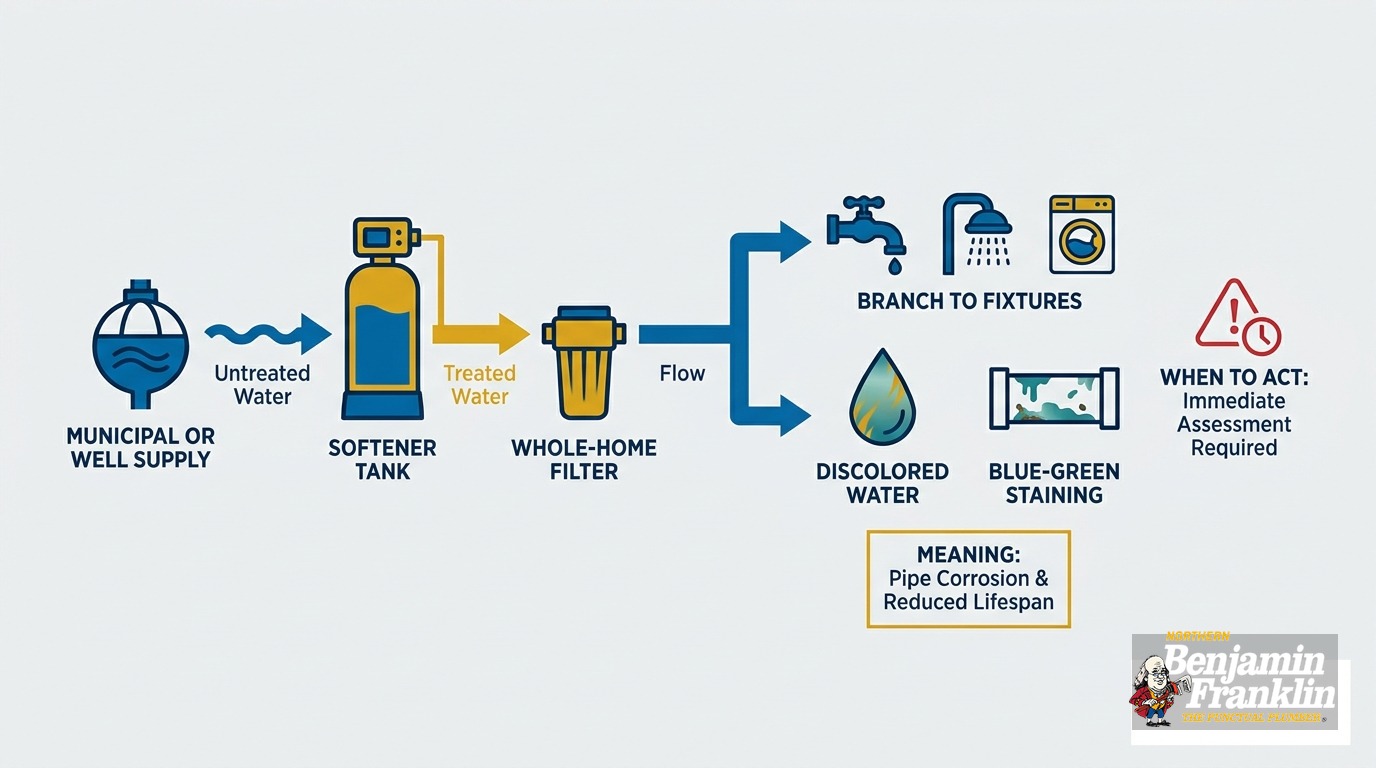
Here is what to watch for. The health department lists three warning signs together: pinhole leaks, pitting inside pipes, and blue-green stains. Think of them as a ladder.
- Stains only. Copper is moving, but the pipes may be fine. This is common with new copper.
- Stains plus recurring color in the water. Corrosion may be ongoing. Test the water.
- Pinhole leaks. A pinhole is a tiny hole worn through the pipe wall. This is the real pipe-life signal.
One pinhole does not always mean the whole house is done. Sometimes a single failure is local. A second or third pinhole in a short span usually means the water is attacking the pipe everywhere. Our guide to copper pipe pinhole leaks in Minnesota shows what to look for and how repairs work.
Pinholes can hide. They often leak behind walls or above ceilings, and a small leak can run a long time before it shows. Watch for damp drywall, musty smells, and a water bill that creeps up.
For a bigger picture of pipe age and materials, read how long home pipes last. It explains why age, material, and water all matter.
How do you know when to act on blue-green water?
Use a tiered approach. Flush and watch for minor staining on new copper. Test the water if color keeps coming back. Call a plumber right away for pinhole leaks, wet walls, or a lab result above 1,300 µg/L after flushing.
Many posts online call every blue tint an emergency. That is not helpful. Here is a calmer ladder you can follow.
Tier 1: Watch and flush. Use this tier if:
- Your copper plumbing is less than three years old.
- You see light staining but no leaks.
- The color fades after you run the tap.
What to do: flush, use cold water for drinking, and keep an eye on it for a few weeks. New copper often settles down as it builds its coating.
Tier 2: Test the water. Use this tier if:
- The color keeps coming back.
- Your plumbing is older and you have never tested.
- Anyone at home is an infant or has Wilson’s disease.
- The water tastes metallic or bitter.
What to do: book a certified lab test. We cover how below.
Tier 3: Call a plumber now. Use this tier if:
- You find a pinhole leak or a wet spot you cannot explain.
- You see pitting or crusty green buildup on pipes.
- A lab result comes back above 1,300 µg/L after flushing.
- You have more than one pinhole in a short time.
What to do: call us. We inspect the pipes, find the leak, and talk through repair, treatment, and repipe options.
Staining alone is a reason to look. Leaks are a reason to act. A high lab result is a reason to treat the water or fix the source.
What can you do right now at home?
Start with free, simple steps. Flush the line after the water sits, use cold water for drinking and cooking, clean stains gently, and look for leaks. These steps lower your exposure and help you gather clues before a plumber or lab visit.
- Flush before use. The health department says to run the water 30 to 60 seconds if it has not been used in over six hours. Do it first thing in the morning and after trips.
- Use cold water. Drink, cook, and mix baby formula with cold water. Hot water releases more copper.
- Note where the color shows up. Check the kitchen, bathroom, hot side, and cold side. Write it down. A plumber will ask.
- Check pipes you can see. Look under sinks, near the water heater, and along basement runs. Watch for green crust, damp spots, and drips.
- Check your water meter. If you suspect a hidden leak, our guide on reading your water meter to find leaks shows how.
- Review your water report. Find your utility’s Consumer Confidence Report. It shows system-wide results, which is a useful baseline.
- Think about recent work. Did someone repipe, add a bath, or swap a water heater lately? New copper is a common cause.
Do not boil the water to fix it. Boiling does not remove copper. It can concentrate it slightly as water evaporates. Do not ignore a leak either, even a small one.
Blue-green stains on fixtures wipe off with a mild cleaner and a soft cloth. Skip harsh abrasives, which scratch finishes. Cleaning the stain does not fix the cause, so the stain will return until the source is addressed.
How does lab testing work and what do the results mean?
Collect a sample the way the lab tells you, send it to a certified lab, and compare the result to 1,300 µg/L. The health department advises a certified lab test and says to consider home water treatment if results exceed that level after flushing.
A home test strip is not the same thing. For copper, use a certified lab.
Here is how to approach it.
- Ask the lab for copper. Ask whether they want a first-draw sample or a flushed sample. Follow their instructions exactly.
- Think about lead. Corrosive water can carry lead, too. Ask about adding it to the order.
- Test the right tap. Use the tap where you notice the problem or where your family drinks.
Then read the result.
- Below 1,300 µg/L after flushing: the water is under the health-risk level for the general population. If you have an infant or a household member with Wilson’s disease, ask a doctor what level is right for you.
- Above 1,300 µg/L after flushing: the health department suggests considering home water treatment. Call a plumber to look at the source, too.
We cover the basics in our guide to tap water quality testing in the Twin Cities. It explains what to test for and how to choose a lab.
Repeat testing helps, because a single sample is a snapshot. If you change something, such as flushing habits, treatment, or a section of pipe, test again to see if it worked.
What are your options to fix blue-green water?
Your fix depends on the cause. New copper often needs time and flushing. Corrosive water may call for water treatment. Failing pipes may need repair or replacement. A plumber can match the fix to your home so you do not pay for work you do not need.
Wait and flush (new copper). If the copper is under three years old and tests low, patience may be enough. Keep flushing and watch the color.
Treat the water. If a lab test shows copper above 1,300 µg/L after flushing, home water treatment is worth a look. The right system depends on your water and your results. We can talk through options and keep the answer tied to your test, not a sales script. You can read more about whole-home water filtration and our home water testing services.
Repair a section. If one section has a pinhole or failed fitting, a targeted repair may solve it. Be honest with yourself about the trend, though. If you see more than one pinhole, repairs can turn into a cycle.
Repipe. When pipes are pitting and leaking in several places, replacement can make sense. Our repiping service covers the process. Repiping is a bigger job, and we offer financing to help spread out the cost. We can walk you through the options and the timeline.
A few notes on that choice:
- Your water chemistry still matters. New pipes in the same corrosive water can face the same problem, so ask about the cause as well as the material.
- Permits matter. The Minnesota Department of Labor and Industry says plumbing inspection permits must be applied for by a licensed plumbing contractor, a licensed water conditioning contractor, or an authorized license holder performing the work. If you hire us, we handle that part.
Ask for a second look before any big job. Have your plumber show you the pipe, the leak, or the test result. A good plumber explains the why, not just the price.
What about other discolored water colors?
Blue-green points to copper, but other colors point to other causes. Brown or orange often suggests rust or sediment. Cloudy water may be trapped air. Yellow can come from many sources. A color that shows up in one tap or only on the hot side helps narrow the cause.
Here is a quick map.
- Brown, orange, or rust-colored: often rust from older steel or iron pipes, or sediment stirred up in the lines. Read our guide on sediment and discolored hot water.
- Cloudy or milky: often tiny air bubbles. It usually clears from the bottom of the glass up.
- Black specks: can come from worn fittings or parts inside appliances.
- Hot side only: points to the water heater or the hot side plumbing.
- All taps at once: points to something at the main or the utility.
Private wells need a caution. Blue-green water from a well or cistern can have other causes that we have not verified here. If you are on a private well, get the water tested by a certified lab and ask a professional.
When in doubt, pull a clear glass of water, hold it against a white sheet of paper, and look. Then note the tap, the temperature, and the time of day. That small record saves a lot of guesswork on a service call.
Who can help with blue-green water in the Twin Cities?
Northern Benjamin Franklin Plumbing can. We are a locally owned and operated Twin Cities plumbing company. We inspect your pipes, find leaks, talk through water treatment, and explain your options plainly. Call (763) 296-1844 or book online to get started.
We know the homes here. Minneapolis, St. Paul, Blaine, Bloomington, Brooklyn Park, Coon Rapids, Maple Grove, and the rest of the metro all have a mix of older and newer plumbing. Older housing stock often means older pipes. Newer builds can mean new copper still settling in.
When you call, here is what to expect.
- A real conversation. Tell us what you see, where, and when. Bring your notes.
- An on-site look. We check visible pipes, fixtures, and the water heater, and we look for signs of leaks or corrosion.
- Clear options. We explain what is urgent and what can wait. We will tell you if the best next step is a lab test.
- A written plan for bigger work. For a repipe or treatment system, you get the details and financing options up front.
We also stand behind our timing. Our On-Time Guarantee(R) means we arrive in the window you pick, or we pay you $5 for every minute we are late, up to $300. As we put it: “If there is any delay, it’s you we pay!”
You should not have to wait around all day when you have a leak or a health question. We are backed by a 100% satisfaction guarantee, too.
To learn how to pick a plumber, read our guide on choosing the right plumbing service in the Twin Cities. It lists what to ask and what to watch for.
If you find pinholes, wet spots, or a high lab result, call (763) 296-1844 or book online. We will help you sort out the cause and the fix.
Frequently Asked Questions
Is blue-green water from my faucet dangerous? +
Why is only my home getting blue-green water when the city treats its water? +
Does blue-green staining mean I need to replace my pipes? +
How long should I run the water before using it? +
Need a technician now?