
Repipe House PEX or Copper: Minneapolis Pre-1970 Homes
Key Takeaways
- Pre-1970 Twin Cities homes commonly have galvanized steel supply lines, copper joined with lead-tin solder, or both. Each carries a different problem.
- Homes with steam or hot-water boiler systems face a specific risk from standard PEX: oxygen permeation that corrodes cast-iron components over decades.
- Minneapolis finished water has a pH of roughly 9.0. That level drives calcium carbonate scaling on heated surfaces, even at moderate hardness.
- Any repipe in Minnesota requires a dedicated plumbing permit under MN Statute 326B, separate from a general building permit.
- Balloon-frame and plaster-wall homes often have supply pipes in uninsulated exterior cavities. A repipe is the right time to fix that.
- The better pipe choice - PEX-A or copper - depends on your heating system first, water chemistry second, and budget third. There is no universal answer.
Is Your Pre-1970 Minneapolis Home Running on Failing Pipes?
The short answer: If your home was built before 1970 and the supply lines have never been replaced, the odds are high. You almost certainly have galvanized steel, copper joined with lead-tin solder, or both. Either condition warrants a repipe conversation sooner rather than later.
Most writing about older home repiping treats it as a single-variable question. The old pipe is bad, so which new material goes in? For a pre-1970 Twin Cities home, the situation compounds. There are three overlapping problems to work through: the pipe material and its failure mode, the heating system those pipes connect to, and the wall cavities they run through. Getting the material choice right means addressing all three. None of them stands alone.
Galvanized steel pipe corrodes from the inside out. The zinc coating breaks down over time, narrowing the interior bore and releasing iron into the water supply. The visible results are reduced pressure at fixtures and discolored water - orange or brown at the tap, especially after the home sits unused. Saint Paul Regional Water Services recommends replacing galvanized supply lines with copper or PEX. Left long enough, galvanized lines fail and leak.
If your home still has galvanized supply lines, you are likely already noticing the effects. Our guide to galvanized pipe replacement in older Twin Cities homes explains what each stage of failure looks like and how far along a typical 60-year-old run tends to be.
Does Your Home Have Lead Solder on the Copper Supply Lines?
The short answer: If your copper lines were installed before 1986, there is a real chance they were joined with lead-tin solder. There is no safe level of lead in drinking water. The EPA’s maximum contaminant level goal for lead is zero.
This is the distinction that changes the repipe urgency for many Twin Cities homeowners. Copper supply lines installed before 1986 look healthier than galvanized ones. The joints are a separate problem. Lead-tin solder was the standard jointing material for copper pipe until the 1986 amendments to the Safe Drinking Water Act restricted its use.
[The EPA identifies pre-1986 copper pipe with lead solder as the second most common source of lead in tap water, after lead service lines.](https://www.epa.gov/ground-water-and-drinking-water/basic-information-about-lead-drinking-water) Exposure is not constant. It rises when water sits overnight in the lines. That gives lead more contact time to leach from the solder into the standing water. Low pH water conditions also accelerate leaching.
A homeowner with galvanized pipe is solving a pressure and reliability problem. A homeowner with pre-1986 copper is solving a water quality problem. Both warrant action. The lead solder situation is harder to patch around.
A point-of-use filter at the kitchen sink helps for drinking and cooking water. It does not protect ice makers, bathroom faucets, or utility hose bibs. A full repipe with modern lead-free material removes the source entirely.
Our team can identify your pipe material and solder type during an inspection. If you want to understand what a repipe project involves from start to finish, our repiping service page lays out the process step by step.
What Pipe Material Works with a Boiler System?
The short answer: For homes with steam or hot-water boiler systems, copper is generally the safer choice for supply lines and any hydronic runs. Standard PEX can allow oxygen to permeate into a closed loop over time. That oxygen corrodes cast-iron boiler components and radiators from the inside.
This is the factor that most repipe guides skip entirely. It matters more in the Twin Cities than in many other markets. Pre-1970 homes in Minneapolis and St. Paul predominantly use steam radiators or hot-water boiler systems rather than forced-air furnaces. It is a feature of the older housing stock, and it is a key input to the pipe decision.
PEX is slightly oxygen-permeable. In an open domestic supply system, that is not a concern. Water flows from the main, through the pipe, out a faucet, and drains away. Any oxygen that enters leaves with the water. In a closed hydronic loop, the same water circulates continuously. Oxygen that permeates through PEX walls stays in the system. Over years and decades, it reacts with cast-iron boiler components and radiators, oxidizing them from the inside. That damage is slow-developing, hard to diagnose early, and expensive to fix.
This oxygen permeation risk in PEX is a documented concern for boiler heat exchangers and cast-iron radiators in closed heating systems. Copper has no oxygen permeability and has been used in hydronic systems for generations without this issue.
If your home has a boiler, make sure your repipe quote specifies copper for any lines serving the heating system. The domestic supply side may use a different material, particularly if your home also has forced-air zones. Be cautious of a quote that proposes PEX throughout a boiler house without addressing the hydronic loop specifically.
If your home has only a forced-air furnace, this concern does not apply to the domestic supply lines. PEX-A becomes a fully viable option to evaluate on its own merits.
How Does Twin Cities Water Chemistry Affect the Repipe Decision?
The short answer: Minneapolis city water is moderately hard but has a pH of roughly 9.0. That elevated pH drives calcium carbonate scaling on heated surfaces, even at moderate hardness. St. Paul water is harder. Suburban well water can be significantly harder than either city supply.
Water chemistry is the second variable to work through. Most repipe guides mention “hard water” and leave it there. The Minneapolis and St. Paul situation is more specific, and the detail matters when choosing between pipe materials and deciding whether a water softener belongs in the same conversation.
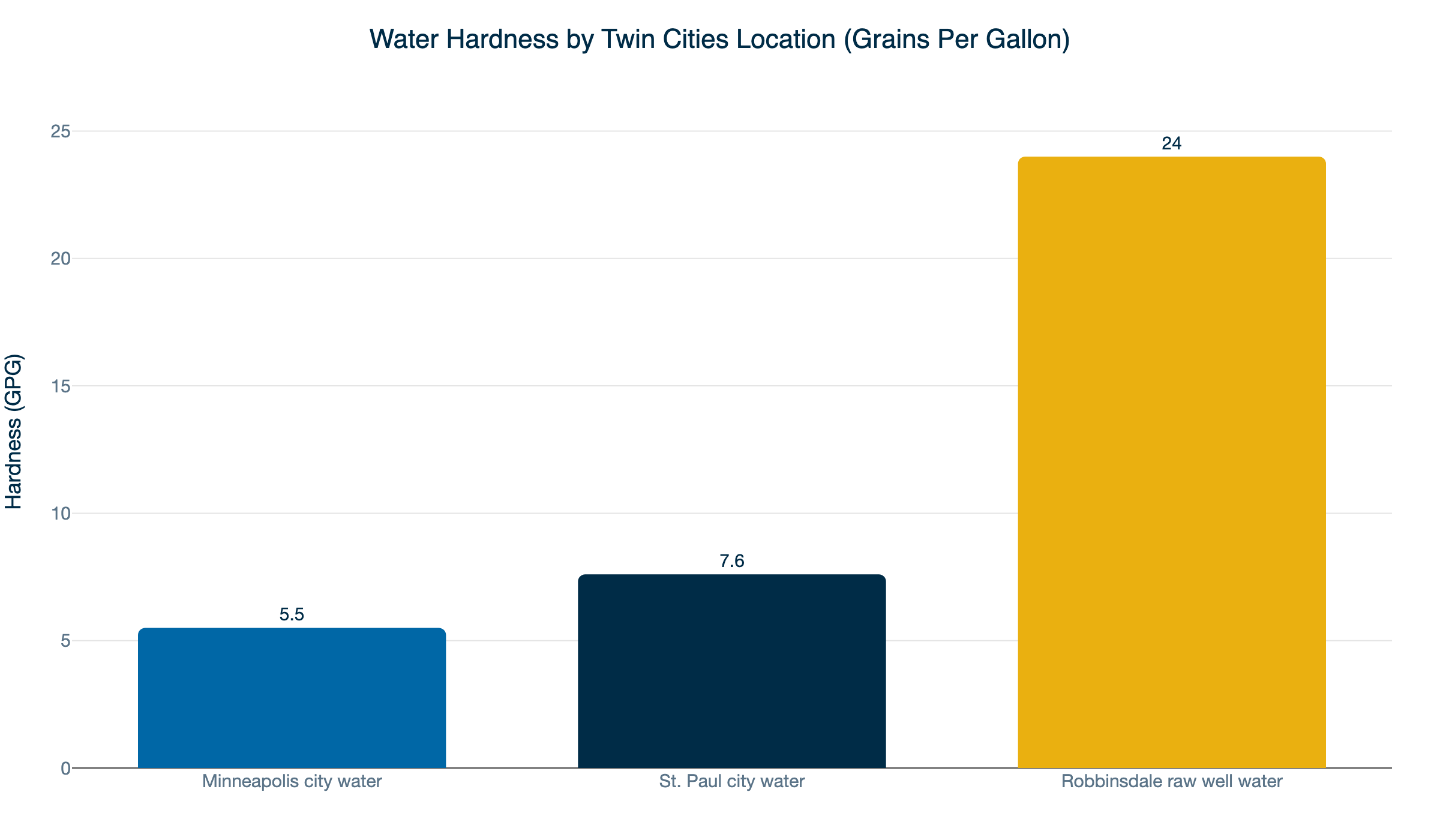
Minneapolis finished water averages 94 mg/L total hardness - roughly 5.5 grains per gallon - with a pH of approximately 9.0. At 5.5 GPG, Minneapolis water sits below the EPA’s 120 mg/L threshold where softening typically shows a clear benefit. But a pH of 9.0 is alkaline. At elevated pH, calcium carbonate deposits form more readily on heated surfaces, including water heater tank interiors, heat exchanger coils, and boiler components. Minneapolis water may not scale cold-water pipes aggressively. Anything that heats the water is a different matter.
St. Paul finished water runs around 130 mg/L, or 7.6 grains per gallon, after lime softening. That is classified as moderately hard, and source water before treatment runs significantly higher. Some Twin Cities suburban well supplies have been measured at 24 grains per gallon before central softening was installed. If your home is outside the Minneapolis or St. Paul municipal service area, your hardness level may be well above what city averages suggest.
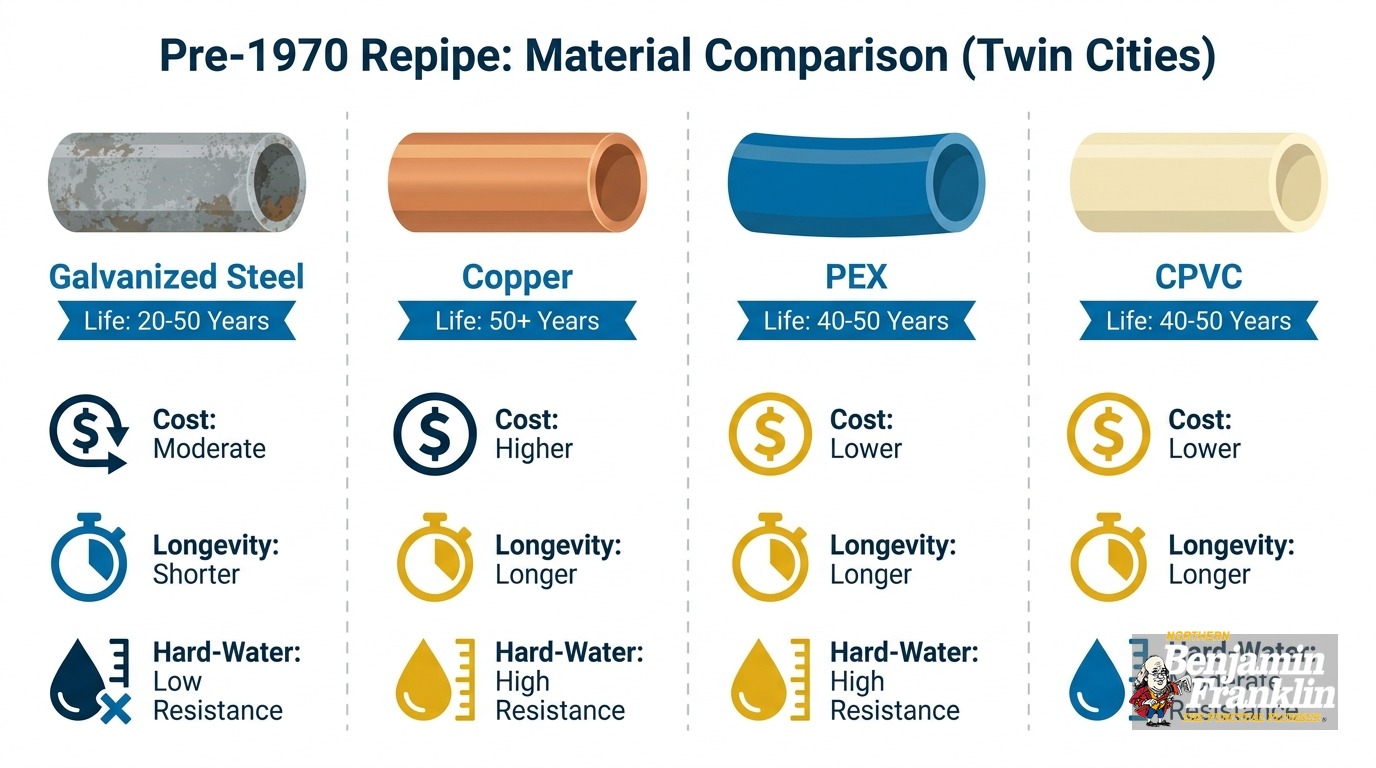
For copper pipe, high hardness combined with low pH or elevated chloramines can accelerate pinhole leak development over time. PEX-A’s smooth interior resists mineral scale adhesion better than a metal bore. In higher-hardness environments, PEX-A tends to hold up better over the long term without a softener in the system.
Water hardness above roughly 7 GPG is worth addressing regardless of pipe material. Our water hardness guide for Minneapolis and St. Paul covers what the numbers mean for your specific address and how a softener pairs with a repipe project.
Will PEX Hold Up in an Uninsulated Exterior Wall During a Minnesota Winter?
The short answer: PEX is more freeze-resistant than rigid copper because it can expand under ice pressure rather than split. But it is not freeze-proof. Pre-1970 balloon-frame homes are among the worst-case scenarios for pipe freeze risk. A repipe is the right moment to fix the insulation problem at the same time.
PEX flexibility is a genuine advantage when pipes approach freezing temperatures. The material can expand under ice pressure before rupturing. That characteristic provides more tolerance than rigid copper or CPVC and makes a meaningful difference in a marginal freeze event. It does not, however, protect against a sustained hard freeze at Minnesota winter temperatures. A pipe frozen solid long enough to block flow can sustain damage as it thaws. A pipe that freezes repeatedly will eventually fail regardless of material.
Pre-1970 homes in Minneapolis and St. Paul were built with balloon-frame or early platform-frame construction. Plaster was applied directly over lath. Exterior-wall cavities in many of these homes have little or no insulation behind the pipe runs. That creates a direct thermal path between the pipe and outdoor temperatures.
On nights when the mercury drops to -20 degrees Fahrenheit or below, that gap is significant.
Minnesota’s supplemental freeze protection requirements for extreme cold climates specify that supply pipes in exterior walls must be documented as compliant at rough-in inspection. That checkpoint is the natural moment to confirm insulation is in place before the wall closes back up.
A full repipe opens the walls. That is the opportunity to add batt insulation behind every exterior-wall pipe run in the house. Adding it during the repipe is far less disruptive than doing it as a separate project later. The insulation step reduces freeze risk for either material. Our post on why December is the critical month for Minnesota pipe freeze risk explains which pipe runs are most vulnerable and how outdoor temperature, run length, and insulation interact.
Does Minnesota Require a Permit for a Full Repipe?
The short answer: Yes. MN Statute 326B requires a licensed plumber to pull a dedicated plumbing permit for any repipe, separate from a general building permit. A rough-in inspection is required before walls are closed.
This matters when you are comparing quotes, and it is missing from every competing article in the current search results.
A contractor who skips the permit is not saving you money or hassle. They are creating legal and financial exposure. Work performed without the required permit can trigger stop-work orders and civil penalties from the municipality. A home repiped without a permit may have that flagged during a future sale inspection. That can open renegotiations and create title complications at the worst possible moment.
The permit process is a protection, not a formality. The rough-in inspection verifies that pipe sizing, support brackets, and exterior-wall insulation all meet code before the wall closes. If there is a problem, it is caught and corrected while the wall is still open. Leaks found years later are far more disruptive and expensive to address.
PEX-A is approved under MN Plumbing Code Chapter 4714, conditioned on correct pressure ratings and installation context. Both copper and PEX-A are legal under Minnesota code. The question is not which material the state allows. The question is which material fits your home.
When Northern Benjamin Franklin Plumbing performs a repipe, permit handling is part of the job. Our licensed plumbers pull the application, coordinate the rough-in inspection, and document compliance before the walls close.
PEX-A vs. Copper: A Direct Comparison for Pre-1970 Twin Cities Homes
With the three decision factors in hand - heating system, water chemistry, and wall construction - here is how the materials compare across the dimensions that matter most.
Lifespan. PEX-A is generally rated at 40-50 years when properly installed. Copper can exceed 50 years under favorable water conditions but tends to develop pinhole leaks in its third and fourth decade when water is acidic or high in chloramines. Minneapolis’s pH 9.0 is alkaline, so it does not aggressively attack copper on that front. Homes on lower-pH well water are in a different position.
Freeze resistance. PEX-A expands under freezing pressure and is less prone to rupture. Rigid copper does not flex and is more vulnerable to splits when water freezes inside the pipe. Where freeze risk is a primary concern, PEX-A has the advantage. Insulating the exterior-wall cavity is the more durable protection for either material.
Boiler compatibility. Copper is the right choice for any line serving a closed hydronic loop. PEX’s oxygen permeability is a documented long-term risk in steam or hot-water boiler systems. This distinction disappears for homes with forced-air heat, where the domestic supply lines carry no hydronic function.
Hard water resistance. PEX-A’s smooth interior resists mineral scale adhesion better than a copper bore. In homes supplied by harder suburban well water or St. Paul’s 7.6 GPG municipal supply, PEX-A holds up better over time without a softener in the system.
Lead solder. If your existing copper lines were joined with pre-1986 lead-tin solder, replacing them eliminates a health hazard regardless of which new material you choose. New joints are lead-free either way.
Installation and cost. PEX-A is installed using a manifold system and an expansion tool. Copper requires soldering at each joint and precise fitting work. Both are standard skills for a licensed plumber. Actual cost varies with home size, number of stories, fixture count, and wall access. Permit fees and wall restoration after the work are additional variables. That range is wide enough that a specific number here would mislead more than it would help. A meaningful estimate requires a licensed plumber to walk your home and price the actual job.
Financing is available for larger repipe projects. Ask about it when you call.
Ready to Schedule a Repipe Assessment?
Northern Benjamin Franklin Plumbing is locally owned and operated, serving Minneapolis, St. Paul, Blaine, Bloomington, Brooklyn Park, Coon Rapids, Maple Grove, and the surrounding Twin Cities metro.
Our licensed plumbers assess the pipe material, heating system, and wall construction together. For a pre-1970 home, those factors are connected. The right material choice follows from looking at all of them.
We back every appointment with the On-Time Guarantee(R). We arrive in the window you choose, or we pay you $5 for every minute we are late, up to $300. As the promise reads: “If there is any delay, it’s you we pay!”
Call us at (763) 296-1844 or book online to schedule your repipe assessment.
Frequently Asked Questions
Is PEX or copper better for repiping an older Minneapolis home? +
Does Minnesota require a permit to repipe a house? +
Can standard PEX pipe damage my boiler over time? +
Need a technician now?