
Do PEX Pipes Freeze? What Minnesota Homeowners Should Know
Key Takeaways
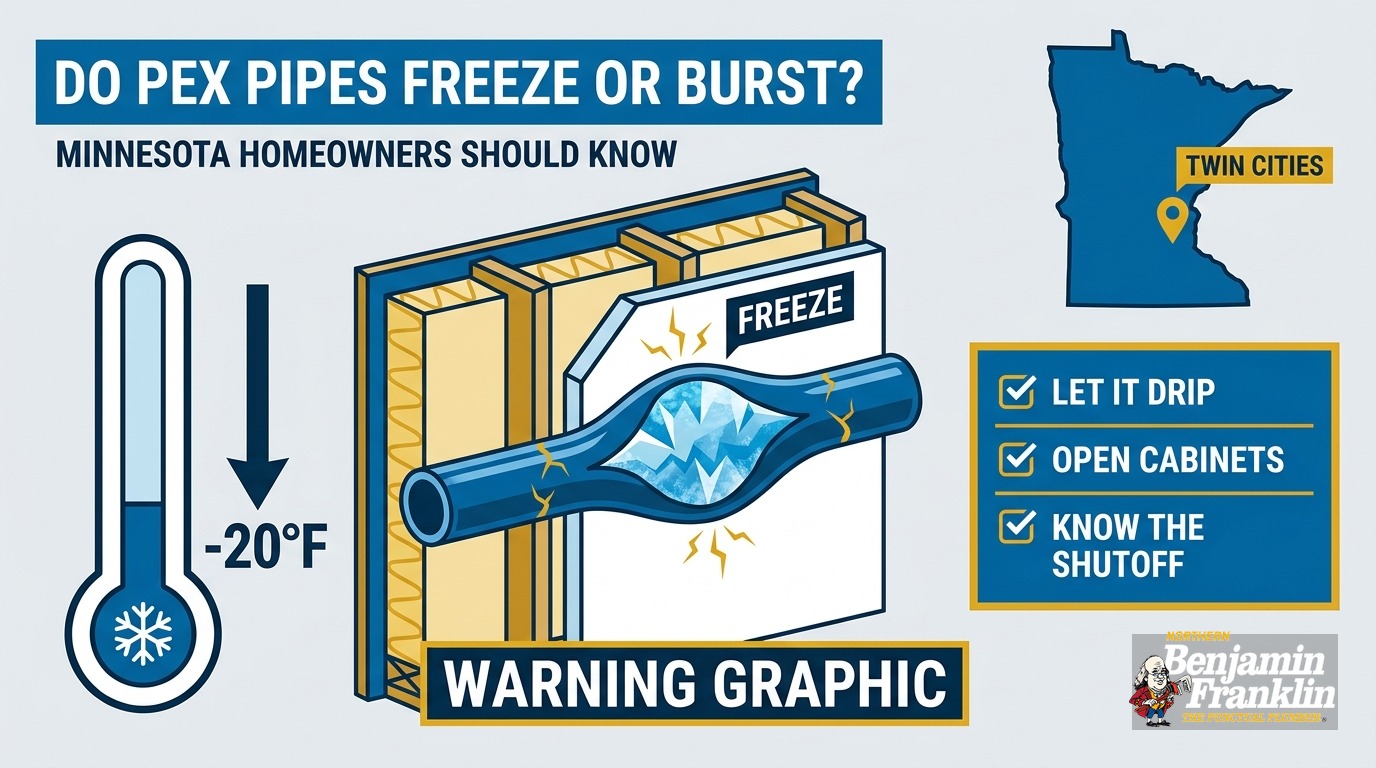
- PEX pipes do freeze when uninsulated or exposed runs drop below roughly 20°F for long enough.
- PEX is more resistant to an immediate burst than copper or CPVC, but pipe type matters. PEX-A handles freeze-thaw cycles far better than PEX-B.
- The real failure point is the fitting. Brass crimp rings and fitting shoulders do not flex with the pipe, so cracks form there first.
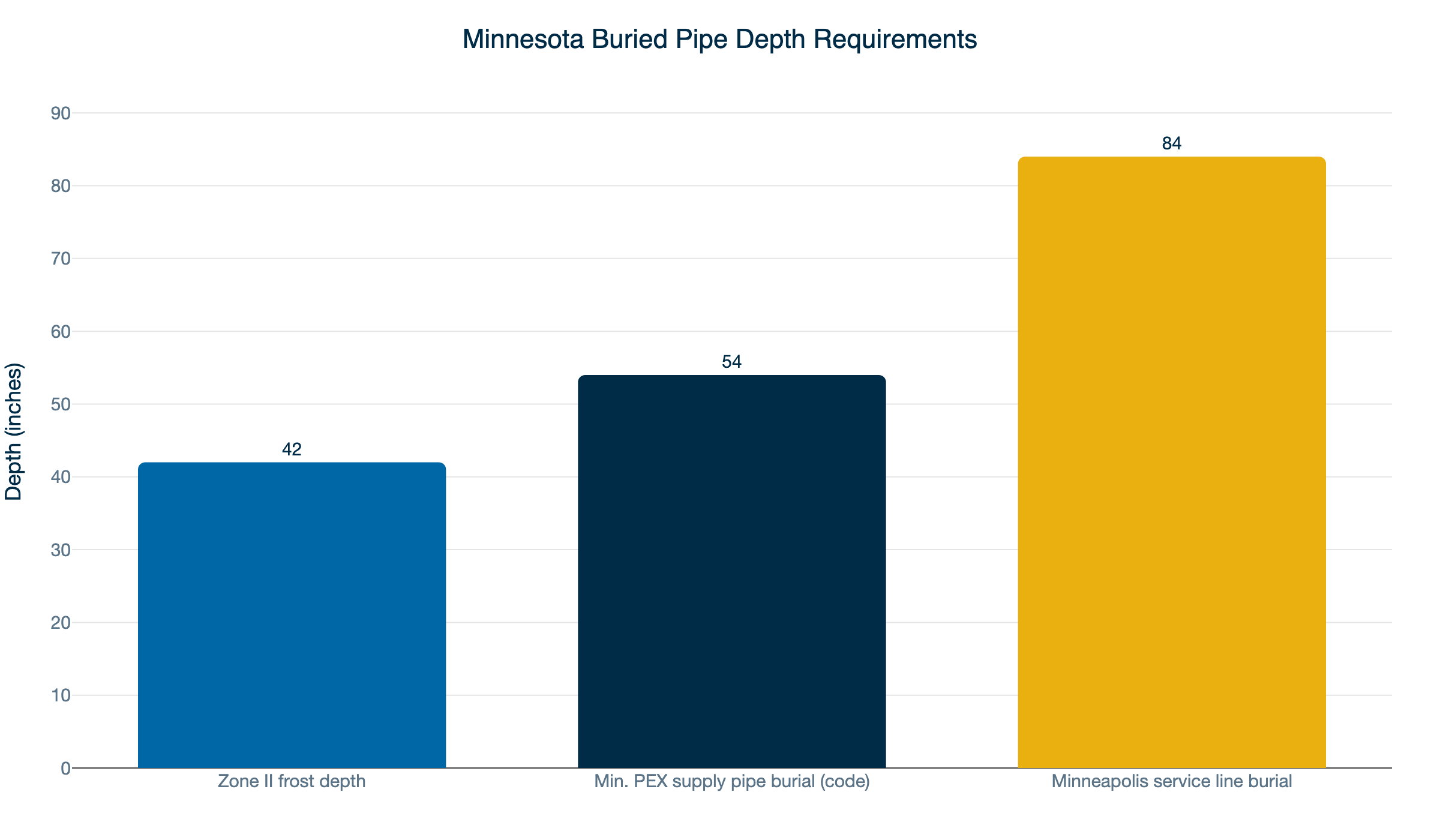
- Minnesota’s Zone II frost depth is 42 inches. State code requires buried supply lines at least 12 inches below that, putting the minimum at 54 inches.
- Minneapolis requires water service lines buried at 84 inches (7 feet). Homeowners own that line from the city main to the meter.
- If your service line freezes, run a pencil-width cold trickle continuously. Do not shut it off even briefly.
- A pipe that froze and thawed without a visible flood may still be leaking slowly at a fitting. Get it inspected.
Do PEX Pipes Freeze? The Short Answer
Yes, PEX pipes freeze. Any water-filled pipe can freeze when temperatures fall low enough and insulation is not there to stop heat loss. PEX is flexible and more burst-resistant than copper, but flexibility is not the same as freeze-proof.
In Minnesota, that distinction matters every winter. The pipe type in your home - PEX-A or PEX-B - determines how much damage a freeze event leaves behind.
PEX replaced copper and CPVC as the dominant pipe material for residential new construction and repipes over the past two decades. Homes built or re-plumbed in the Twin Cities after 2000 are likely to have it. Knowing the difference between PEX-A and PEX-B before the first hard freeze can save you a significant repair bill in January.
How Cold Does It Have to Get to Freeze PEX?
Ice begins forming inside any water-filled pipe at 32°F. Real freeze risk for an uninsulated PEX run starts around 20°F (-7°C). Below that threshold, a pipe in an exterior wall cavity, unheated crawl space, or attic can freeze solid within hours, depending on airflow and surrounding insulation.
According to Angi, PEX and copper reach the freezing point at the same water temperature. The difference is how quickly they get there. Copper conducts heat (and cold) efficiently, so the water inside a copper line reaches 32°F faster than PEX under identical air temperature conditions. PEX is a poor conductor, which slows that transfer. That gives you a small buffer - but once the water inside any pipe hits freezing, both materials are equally at risk.
In the Twin Cities, that risk is real and recurring. Minnesota winters regularly push overnight lows below 0°F from December through February. A home set to 55°F during a weekend trip, a crawl space with a foundation vent that was never blocked for winter, or a plumbing run added during a renovation without an insulation upgrade - any of those conditions can produce a freeze event in the right cold snap.
One frequently underestimated risk is travel. A house set to 55°F loses its ambient heat buffer, and pipes that have never frozen before can surprise you on your return. If you plan to be away more than two days during winter, keep the thermostat at 55°F minimum and consider running a slow drip from the faucet at the end of the longest run.
Snow is also an insulator. A dry autumn with little snow cover going into January means the ground loses heat faster than usual. A yard with six inches of snow holds ground heat far better than bare soil in a hard freeze.
PEX-A vs. PEX-B: Which Type Handles Freezing Better?
PEX-A is the stronger choice for cold climates. It can expand up to three times its diameter and spring back without micro-cracks. PEX-B expands during a freeze but develops micro-cracks at the expansion point. Those cracks cause slow leaks that appear days after the event - sometimes after you have already decided the pipe made it through fine.
Both types meet ASTM F876, the standard that governs PEX pipe performance. They look similar and cost close to the same at retail. The difference is in how each is manufactured.
PEX-A uses the Engel method, a peroxide cross-linking process that produces a polymer with roughly 88% cross-link density. That density gives the pipe a shape memory: it deforms under stress and returns to its original shape. PEX-A is rated for more than 400 freeze-thaw cycles and stays flexible down to -40°F. Under ASTM F2023 long-term hydrostatic pressure testing, PEX-A earns a 50-year rating at 180°F and 80 psi.
PEX-B uses a silane cross-linking process and reaches 65-75% cross-link density. It is the most common PEX type installed in the United States, including across the Twin Cities. In a mild winter, you will likely never notice any difference between them. But in a deep freeze - the kind Minneapolis and St. Paul get in February - the lower cross-link density means the pipe does not recover as cleanly from extreme expansion. PEX-B develops micro-cracks at the expansion site. A long-term pressure rating of 30-40 years (compared to PEX-A’s 50-year rating) reflects that lower margin. The leak may not appear at the moment of the freeze. It can show up hours or days later, as a slow drip, once the pipe returns to normal pressure cycles.
How do you know which type you have? PEX-A tends to feel softer and more pliable at room temperature. Look for the specification standard printed on the pipe wall - PEX-A references ASTM F876 and may also note the Engel or peroxide process. Color coding is common (red for hot, blue for cold, white for either), but color alone does not identify type.
If you are planning a repipe, ask your plumber specifically about PEX-A. It costs slightly more, but in a climate where pipes face freeze-thaw cycles every winter, the higher cross-link density and shape memory are worth the difference.
Why Are Fittings the Real Failure Point in Frozen PEX?
When PEX freezes, the pipe body expands. The brass crimp ring and fitting shoulder do not. That rigid connection is where frozen PEX systems most commonly fail - not along the pipe run itself. A fitting crack can appear hours or days after the freeze event, not during it.
This is the detail that almost every generic article on frozen PEX skips.
When the pipe swells around a crimp ring during a freeze, the ring is under intense stress. That joint is where frozen PEX systems typically crack, and the failure may not be visible during the freeze. It shows up when the pipe thaws and pressure returns to the fitting shoulder.
The practical consequence for a homeowner: after any freeze event, check every accessible fitting, not just the straight pipe runs. Look behind the washing machine, under sinks, at the water heater connections, in the utility room, and at every coupling between two sections of pipe. A fitting that looks intact right after a freeze can crack days later under normal pressure cycling.
A PEX pipe that froze and thawed without a visible flood is not necessarily in the clear. A hairline crack at a crimp ring may weep slowly - too slowly to form a puddle quickly, but fast enough to saturate a wall cavity over a week and produce mold. If you know a pipe froze, get a plumbing inspection even if you cannot see standing water. Catching it now costs far less than a mold remediation later.
What Does Minnesota Code Require for Buried PEX Lines?
Minnesota’s Zone II frost depth is 42 inches. State plumbing code requires buried supply lines at least 12 inches below that maximum, placing the code floor at 54 inches. Minneapolis requires water service lines buried at 84 inches, or 60 inches with two layers of certified foam insulation.
Minnesota Rule 1303.1600 places the Twin Cities metro in Zone II with a frost depth of 42 inches. That is the maximum depth to which the ground freezes during a design winter. Minnesota Plumbing Code Rule 4714.0609 then requires building supply lines and yard piping buried at least 12 inches below that maximum local frost depth. For the Twin Cities, the code minimum for a buried PEX supply line is 54 inches.
The City of Minneapolis sets a higher standard for water service lines: 84 inches to the top of the pipe. A minimum of 60 inches is allowed only with two layers of 2-inch certifoam insulation. The extra depth reflects the reality that service lines run long distances under streets and yards, and frost can push below the design depth in a dry year with little snow cover on the ground.
Minnesota requires a permit for any installation, alteration, or replacement of a plumbing system, and only a licensed plumbing contractor may pull that permit. That is not administrative paperwork. Code-compliant, permitted work matters for insurance claims after a freeze event, home sale inspections, and the standing of any future repair. Work done without a permit or by an unlicensed contractor carries real risk when problems surface later.
One additional code note: Minnesota residential code prohibits PEX within 18 inches of a water heater connection. This is a heat tolerance requirement, not a freeze issue, but it is a common violation in DIY work and worth knowing if any planned work runs near the water heater.
Does Your Minneapolis Service Line Freeze? Who Is Responsible?
If your water service line - the pipe from the city main to your meter - freezes, the repair falls to you. Minneapolis homeowners own that line from the main to the meter. If it freezes or fails, you hire the plumber and pay for the repair.
This surprises many Twin Cities homeowners. The city owns the main. Everything from the main to your meter is your line and your expense.
The City of Minneapolis guidance on frozen service lines is direct: run a cold trickle about the width of a pencil from the lowest faucet in your home continuously until the ground thaws. Do not shut it off even briefly. A partially frozen line can re-freeze within minutes when the trickle stops, even on a warmer afternoon.
Do not run hot water. The city specifies cold, because the goal is continuous water movement through the pipe - not heat that dissipates quickly. Moving water requires significantly more energy to freeze than standing water.
Minneapolis buries service lines at 84 inches precisely because frost still finds pipes in extreme winters. Homes on corner lots, homes with a long yard run from the street, and homes on the outer edges of city blocks are at elevated risk because the service line runs further before reaching the building. A bare yard going into a harsh January loses ground heat faster than one with six inches of snow cover.
If your service line has frozen in a prior winter, or if you know your line runs at a shallow depth from an older installation, talk to a plumber before December. Frozen pipe repair in the Twin Cities is far less disruptive when addressed before a cold snap than during an emergency at 6 a.m. in January.
How to Prevent PEX Pipes from Freezing This Winter
Prevention comes down to two goals: keep heat near the pipe, and keep cold away from it.
For interior runs:
- Insulate exterior wall cavities where plumbing runs. Pipe insulation sleeves install quickly on accessible runs and cost very little.
- During cold snaps below 10°F, open cabinet doors under kitchen and bathroom sinks. This lets warm interior air reach the cabinet and the pipe behind it.
- Set the thermostat to at least 55°F if you leave for more than a day. A burst pipe repair costs far more than a few extra days of heating.
- Know where your main water shutoff is and confirm it turns easily. If a pipe cracks on the thaw, you want to shut off water in seconds, not minutes. Our guide on finding and testing your main water shutoff valve walks you through it.
- Walk your basement and crawl space before the first hard freeze. Look for exposed pipe runs near exterior foundation walls and verify any insulation is intact and not displaced by prior renovation work.
For service lines and outdoor exposure:
- Block crawl space foundation vents before the first freeze. An open vent can drop crawl space temperatures to near-outdoor levels overnight.
- Run a pencil-width cold trickle from the lowest faucet during extended cold snaps below 0°F. Minneapolis recommends this for at-risk homes and it is the single most effective short-term prevention step you have.
- Disconnect and drain garden hoses before October. A hose left connected traps water at the bib, which can freeze back into the supply line even if the bib is frost-free when temperatures drop rapidly.
- If your service line has frozen before, ask a plumber to assess the burial depth and insulation. Correcting a shallow run is far less expensive than an emergency thaw.
What to Do If Your PEX Pipes Have Frozen
Do not apply direct flame or a heat gun to PEX pipe. A torch generates temperatures well above PEX’s rated service limit and creates a fire hazard in any wall cavity with wood framing nearby. Even a heat gun aimed at PEX for an extended period can damage the pipe material.
Work indirectly instead:
- Shut off the main water valve. This limits flooding if the pipe has already cracked and is waiting to release pressure when it thaws.
- Open the faucet nearest the frozen section to relieve pressure in the line.
- Apply indirect, gentle heat to the surrounding space. Open a duct register in the room, bring a small electric space heater into the area (not aimed directly at the pipe), or wrap accessible pipe with warm wet towels and replace them as they cool.
- Once water flows again, keep the faucet open and watch pressure and flow rate. Uneven flow or sputtering can indicate a crack at a fitting.
- Inspect every fitting within reach of the frozen section. Check again at 24 hours and again at 48 hours.
If you cannot locate the frozen section, if the pipe is inside a wall or under a slab, or if water does not return after a safe thaw attempt, call a plumber. Lines inside wall cavities require professional thaw equipment. If a fitting has already cracked, the wall needs to open regardless of how you thawed it.
Our guide on how to thaw frozen pipes in Minnesota covers the step-by-step process in more detail.
When Do You Need a Licensed Plumber for Frozen PEX?
Call a plumber when you cannot locate or access the frozen section, when water does not return after a safe thaw attempt, when you find standing water or wet drywall, or when the freeze involved a buried service line or supply pipe.
Any work that replaces a section of pipe, re-routes a line, moves a fitting, or touches buried plumbing requires a permit and a licensed contractor under Minnesota law. That rule does not have exceptions.
At Northern Benjamin Franklin Plumbing, we are locally owned and operated in the Twin Cities. We back every appointment with the On-Time Guarantee(R): we arrive in the window you pick, or we pay you $5 for every minute we are late, up to $300. “If there is any delay, it’s you we pay!” A frozen pipe is already a bad morning. Waiting past your appointment window makes it worse.
For frozen pipe repair in the Twin Cities, call (763) 296-1844 or book online. We handle thaw, inspection, and repair of PEX systems, service lines, and buried supply pipes across Minneapolis, St. Paul, Blaine, Bloomington, Brooklyn Park, Coon Rapids, Maple Grove, and the rest of the metro.
Frequently Asked Questions
Do PEX pipes freeze and burst? +
At what temperature do PEX pipes freeze? +
Is PEX-A better than PEX-B for Minnesota winters? +
Who pays if my Minneapolis water service line freezes? +
Need a technician now?