
Whole House Repipe: What to Expect in Minnesota
Key Takeaways
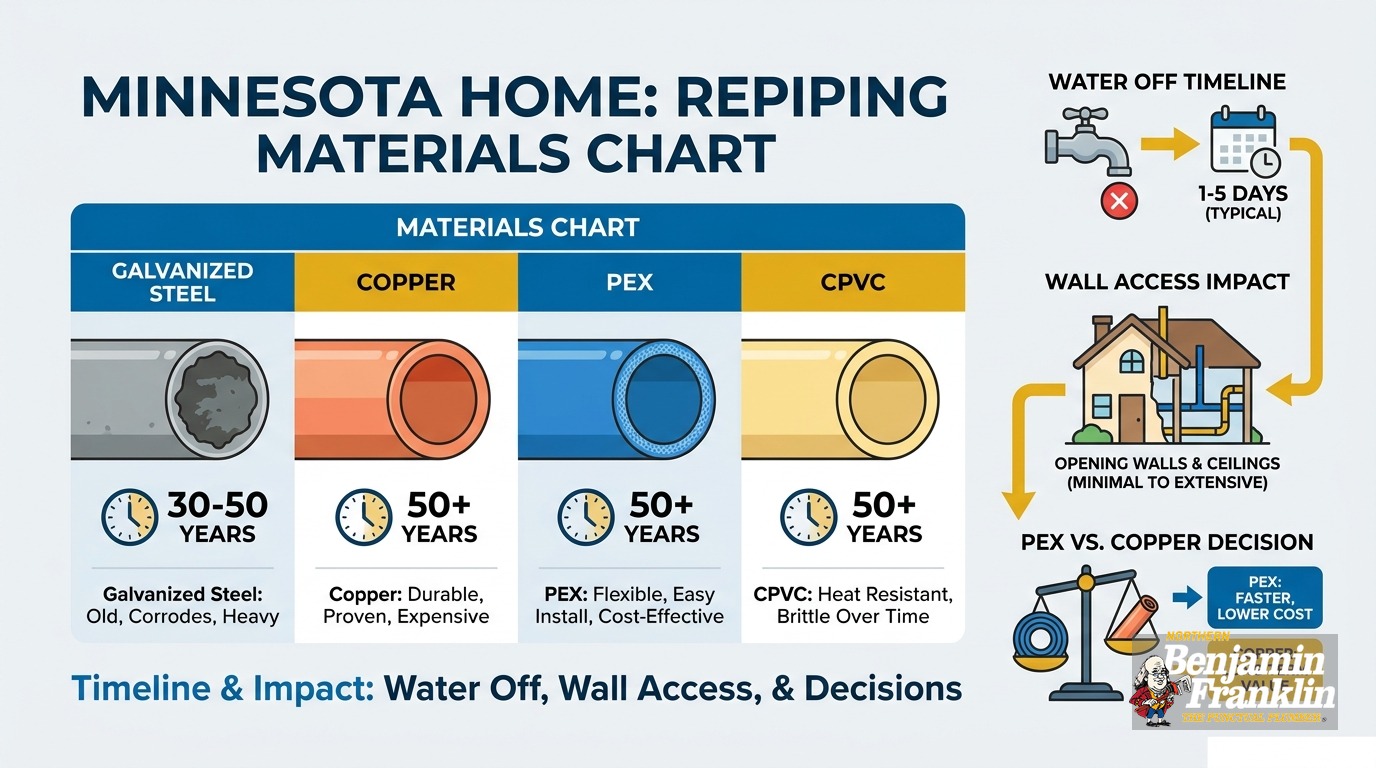
- A whole house repipe on a single-family home takes 2 to 5 days. Water is restored each evening.
- Crews open targeted access holes, roughly 12 by 12 inches, near each fixture. Full wall demolition is not standard.
- Minnesota law requires a permit and a licensed contractor for all repiping work. An inspector must see all rough-in piping before any wall closes.
- PEX handles Minnesota freeze-thaw cycles better than copper. Homes with hydronic boilers or cast iron radiators need copper or oxygen-barrier PEX for the heating loop.
- Kitec PEX, identifiable by orange hot and blue cold lines with yellow brass fittings, was installed from roughly 1995 to 2007. It is a known failure material.
- Minneapolis water hardness runs 5.4 to 6.1 GPG after treatment. St. Paul runs about 5.85 GPG. Both cities use chloramine disinfection, not free chlorine.
What Is a Whole House Repipe?
A whole house repipe replaces nearly all of the water supply lines inside your home. The drain lines stay in place unless there is a separate reason to address them. The scope typically covers the main supply line from where it enters the foundation, all branch lines running to kitchens, bathrooms, laundry, and mechanical equipment, and the stub-outs at each fixture.
Most homeowners reach the point of considering a repipe after repeated pinhole leaks in copper, visible rust or discoloration from aging galvanized steel, or the identification of a problem material like polybutylene or Kitec PEX. Sometimes a pre-purchase inspection or an insurance renewal triggers the conversation.
Understanding the process before you start removes most of the anxiety. Here is what to expect from a repipe in a Twin Cities home, including details that national guides skip entirely.
How Long Does a Whole House Repipe Take?
Most single-family homes take 2 to 5 days from start to final inspection. Water is off during work hours and restored each evening.
The exact timeline depends on the square footage, the number of fixtures, how the pipes are routed, and what the crew finds behind the walls. A compact two-bedroom rambler moves faster than a two-story home with three bathrooms and a finished basement. The 2 to 5 day window is the standard range for residential repiping, according to published guides on the repiping process.
Add a day for the inspection hold. Minnesota code requires a building inspector to sign off on all new rough-in piping before walls close. How quickly that inspection gets scheduled depends on your municipality. Your plumber should request the inspection as soon as the rough-in is complete. Do not assume same-day turnaround.
If your home has unusual access challenges - a spray-foam insulated rim joist, a slab-on-grade section, or a tight crawl space - ask the crew upfront how those affect the schedule.
Will the Water Be Off the Whole Time?
No. Water is typically shut off in the morning and restored each evening, so your household can function normally overnight throughout the project.
Active work on a repipe typically runs from about 8 AM to 5 PM on installation days. The main water is restored at the end of each workday. Your family can use sinks, toilets, and showers overnight without interruption.
If you have young children, elderly family members, or anyone with specific medical needs, tell the crew on day one. A well-run team sequences the work with those priorities in mind.
The final day is an exception. Water stays off longer while the crew completes all connections and pressure-tests the system before restoring service. Budget extra time that afternoon.
Which Walls and Ceilings Get Opened Up?
Targeted access holes, roughly 12 by 12 inches, near each fixture and at key pipe routing points. Full wall demolition is not the standard approach.
This is the question that causes homeowners to delay the call longer than they should. The mental image is rooms stripped down to the studs. That is not how a modern repipe is done.
Skilled crews cut small, targeted access holes near fixtures and at key run points. PEX tubing is flexible enough to fish through a wall cavity from one access point to the next, which reduces the total number of cuts substantially. Rigid copper cannot flex around corners the same way, so it typically requires more linear access. That difference in wall disruption is one practical factor in the PEX-versus-copper decision for an occupied home.
The wall patching happens after the inspection, not before. That is a code requirement under MN Rules Chapter 4714: all new piping must be visible and accessible when the inspector arrives. Closing walls early is not an option.
Patching drywall, retexturing, and repainting is typically handled by a separate contractor, not the plumbing crew. Clarify who coordinates that step before work starts. You do not want to discover the answer after the plumber has left.
Do You Need a Permit for a Whole House Repipe in Minnesota?
Yes. All plumbing work in Minnesota requires a permit and must be performed by a licensed contractor. There are no shortcuts.
Under Minnesota state plumbing statutes, a licensed plumbing contractor is required for all plumbing work in Minnesota. Homestead owners may self-permit in some jurisdictions, but the permit requirement still applies. The permit exists to protect you: it triggers the inspection process that confirms new piping meets code before it disappears inside your walls.
Any contractor who suggests skipping the permit is telling you something important about how they operate. A licensed plumber pulls the permit as part of the job, not as an optional add-on.
The governing code is MN Rules Chapter 4714, Minnesota’s adoption of the Uniform Plumbing Code with state amendments, administered by the Department of Labor and Industry. Whether you are in Minneapolis, Brooklyn Park, Maple Grove, or Blaine, the local building department issues the permit but the statewide code applies everywhere.
PEX or Copper: Which Is Right for a Minnesota Home?
PEX is the better freeze-tolerance choice for most Twin Cities homes. Copper may be the right call for portions of the system connected to a hydronic boiler. The material decision carries more weight here than in warmer climates.
This is where a generic national repipe guide falls short. A plumber in Jacksonville or Phoenix does not think about freeze-thaw cycles the way a Twin Cities plumber does. Pipe material choice in Minnesota has real consequences in the winter months.
Why PEX handles freeze-thaw cycles better
PEX and copper fail very differently when a pipe freezes. PEX can expand to roughly three times its diameter before rupturing. Copper splits at a far lower expansion point. When ice pressure builds inside a supply line during a deep cold stretch, PEX has a safety margin that copper does not. A copper supply line sitting in a cold rim joist or an unconditioned attached garage carries real burst risk during a severe Minnesota winter. PEX in the same location handles that stress far better.
Our guide to whether PEX pipes freeze in Minnesota covers the freeze mechanics in full. The short version: no pipe material is invulnerable, but what you choose changes the outcome significantly when temperatures drop hard.
PEX also resists the pinhole leak failure mode that affects copper over time. We cover that problem in detail in our copper pipe pinhole leaks post. PEX has a long lifespan when properly installed. Copper can also last for decades but may develop pinholes over time in water with higher chlorine concentrations or lower pH.
PEX is also faster to install in an existing home. Its flexibility means the crew can fish runs through wall cavities from fewer access points. That often means fewer holes and a shorter project timeline, both of which matter when you are living in the house during the work.
When copper makes sense: homes with hydronic systems
There is one situation where PEX is ruled out for part of the repipe: homes with hydronic boilers and cast iron or steel radiators. This is not a rare situation in the Twin Cities. Pre-1960 Minneapolis and St. Paul housing stock regularly has hot water radiator systems still in active use.
PEX allows trace oxygen permeation over decades. In homes with hydronic boilers or cast iron radiators, that oxygen can corrode heat exchanger components over time. For those closed-loop heating lines, the correct material is copper or PEX with an oxygen barrier. The domestic supply lines throughout the rest of the house can still be standard PEX. The heating loop is a separate decision, not a reason to avoid PEX across the whole home.
Tell the plumber upfront if you have a boiler and radiators. A repipe plan that accounts for both systems looks different from one that only considers the domestic supply.
Kitec PEX: what it is and whether your home has it
Kitec PEX was installed in homes from roughly 1995 to 2007. It has orange hot lines, blue cold lines, and distinctive yellow brass fittings. It is a known failure material with a documented history of fitting failures and pipe degradation over time.
Kitec is not the same product as modern PEX-A, PEX-B, or PEX-C, which are reliable materials with solid track records. If your home was built or substantially repiped during that window, ask the plumber to identify the pipe material before finalizing any scope. Finding Kitec changes the conversation about urgency and replacement priority.
What Does Twin Cities Water Chemistry Mean for Your Pipes?
Water hardness in both cities is moderate after municipal treatment. Minneapolis finished water hardness falls in the moderately hard range, based on recent monthly utility reports. St. Paul Regional Water Services reports total hardness of about 100 ppm after softening at the McCarrons plant.
Both cities use chloramine disinfection rather than free chlorine. Minneapolis total chloramine averaged approximately 3.9 ppm in recent monthly reports. Chloramine at these concentrations falls within safe limits for PEX. Copper is more vulnerable to pinhole failures in water with higher chlorine concentrations or lower pH.
Twin Cities water chemistry is not aggressive enough on its own to push the material decision strongly in either direction. The bigger factors for most homes are freeze exposure and whether a hydronic heating system is in the picture.
What About the Water Service Line?
A whole house repipe covers the supply lines inside your home. If the project scope also includes the water service line from the street to the foundation, there is a Minnesota-specific depth requirement to understand before the first shovel goes in the ground.
Water service piping must be buried at least 12 inches below the local maximum frost depth, under MN Rules 4714.0609. The Twin Cities metro falls in Minnesota’s southern frost zone with a 42-inch frost depth under MSBC Rules 1303.1600. That translates to a minimum burial depth requirement for water service lines in the metro area.
That depth affects excavation scope and cost for any exterior service line work. Confirm whether service line replacement is part of the project scope before you receive a price. It is a significant addition that changes both the schedule and the budget.
How Much Does a Whole House Repipe Cost?
We do not publish a price sheet, because every home is different. A national average is not our number, and presenting one as a starting estimate would mislead you. The only accurate figure for your home is a quote from a licensed plumber who has seen the job.
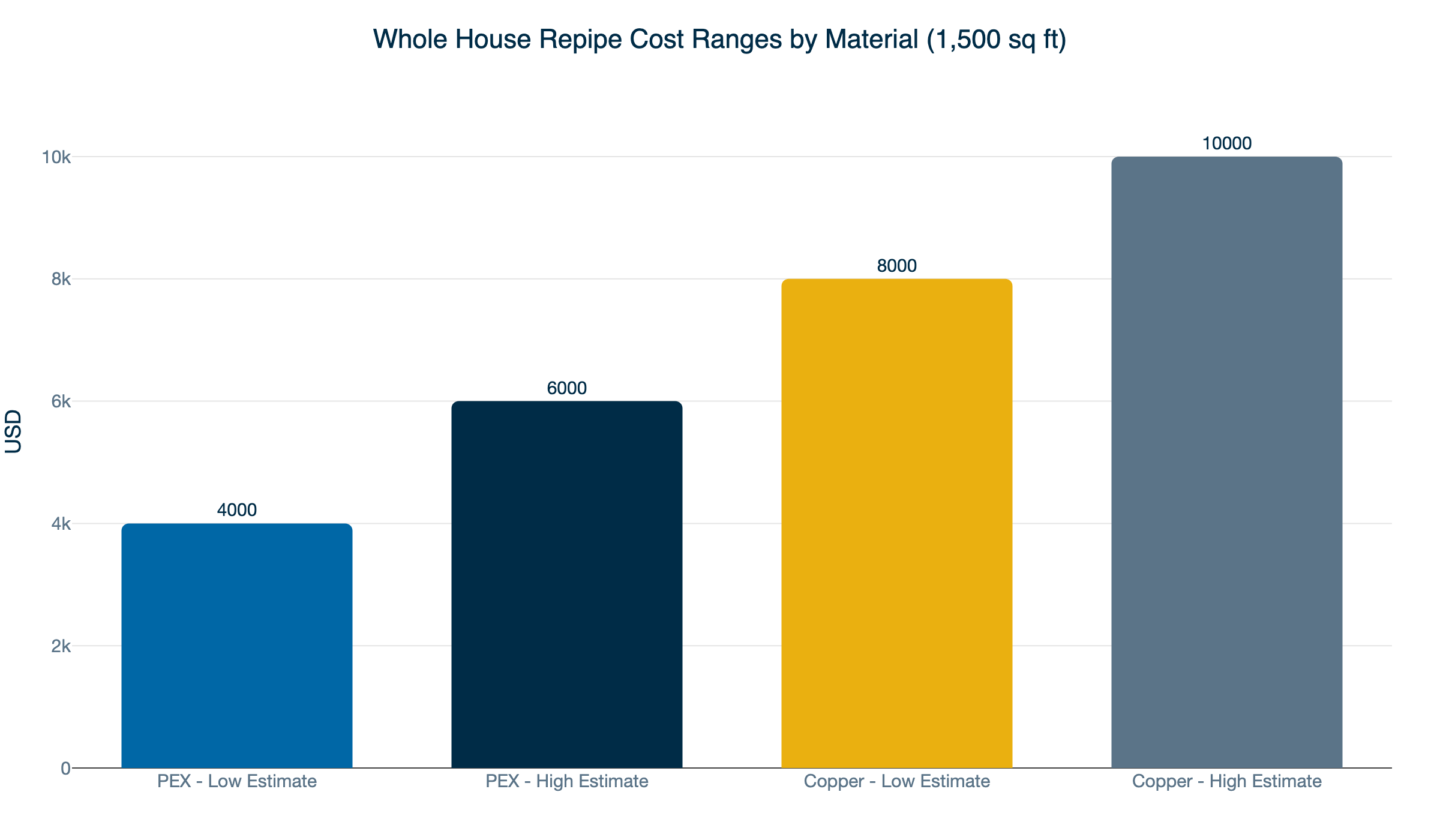
What published industry data shows as a reference point: for a typical home, PEX repipe estimates run significantly lower than copper repipe estimates. These figures reflect material and labor at a broad level. Your actual cost depends on the home’s size, pipe routing complexity, accessibility, local permit fees, whether drywall patching is included in the scope, and whether the water service line is part of the work.
For larger jobs like a full repipe, ask about financing options when you call.
Signs Your Home May Be Ready for a Repipe
Not every home with recurring plumbing problems needs a full repipe. But these signs together tend to point in that direction:
- Recurring pinhole leaks in copper supply lines, especially in a home built between 1970 and 2000
- Galvanized steel pipe with rust discoloration in the water or severely reduced pressure at fixtures
- Polybutylene pipe (gray plastic, often labeled “PB” or “Quest”) with a history of fitting leaks
- Kitec PEX anywhere in the system (orange hot, blue cold, yellow brass fittings)
- Multiple sections of supply pipe with poor insulation in rim joists, exterior walls, or an unconditioned garage
- A pre-purchase inspection or insurance renewal that flagged pipe material or condition as a concern
What to Expect on Day One
Day one sets the rhythm for the entire project. The typical sequence looks like this:
- The crew walks the home with you before work starts. They confirm scope, note access challenges, check for Kitec or other problem materials, and ask whether you have a hydronic heating system.
- The main water shuts off. The crew typically starts at the most remote fixtures and works back toward the main supply entry.
- Access holes are cut near each fixture and at key routing points. Work proceeds zone by zone.
- At the end of the workday, the main water is restored. The crew walks you through what was completed and what comes next.
This repeats until the rough-in is finished. Then comes the inspection hold. Patching starts only after the inspector signs off on all new piping.
If anything unexpected turns up behind the walls - a different pipe material than expected, a leaking joint that was not part of the original scope, or evidence of prior water damage - a good crew tells you immediately rather than working around it.
Ready to Talk Through a Repipe?
Northern Benjamin Franklin Plumbing is locally owned and operated in the Twin Cities. Our team pulls the permits, coordinates the inspection hold, and shows up in the window we commit to. The On-Time Guarantee(R) covers every appointment: if there is any delay, it’s you we pay.
See our repiping services page for more on how we approach this work. For a deeper look at the PEX-versus-copper decision, our PEX vs. copper whole house repipe guide covers the tradeoffs in detail.
Call (763) 296-1844 or book online to get an estimate from a licensed Twin Cities plumber.
Frequently Asked Questions
How long does a whole house repipe take? +
Do you need a permit for a whole house repipe in Minnesota? +
Is PEX or copper better for a Minnesota home? +
What is Kitec PEX and is it in my home? +
Need a technician now?