
Washing Machine Supply Hose Replacement: The Twin Cities Guide
Key Takeaways
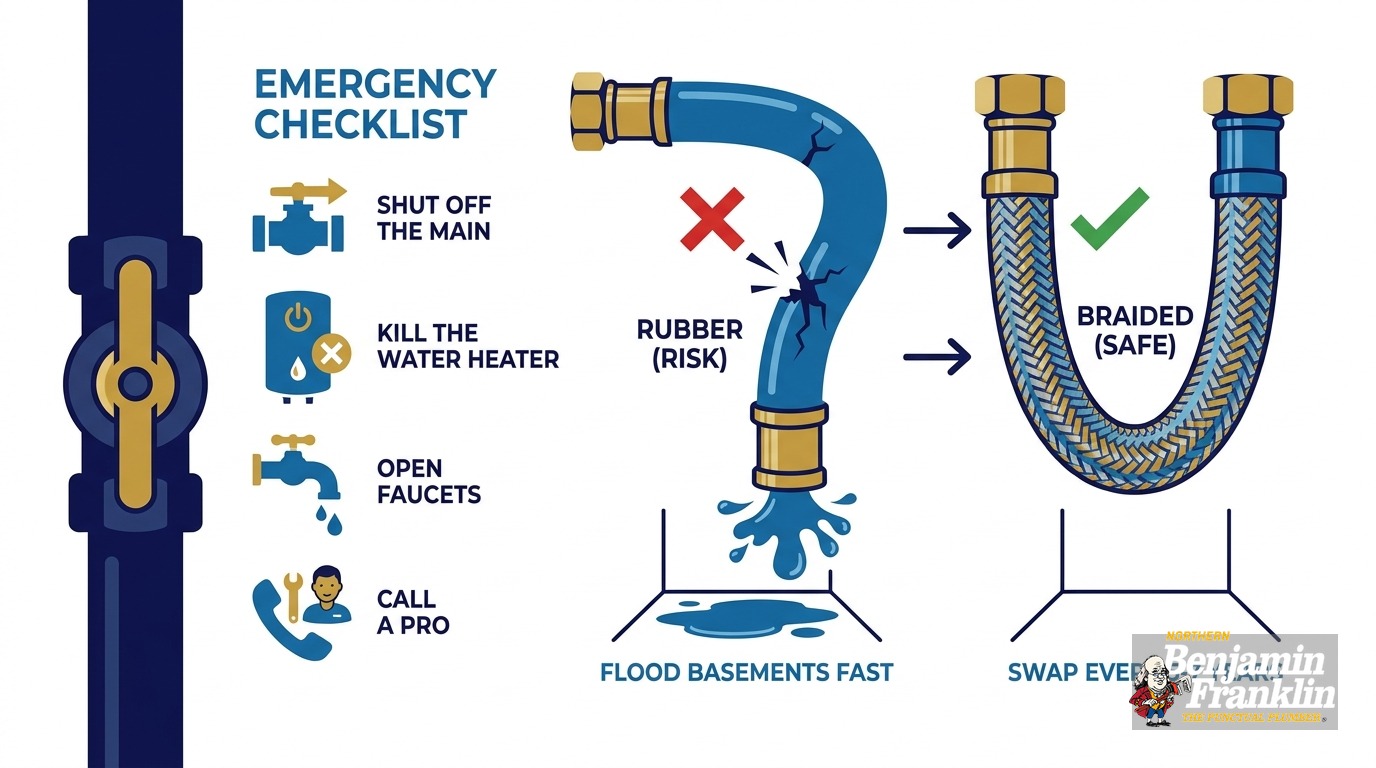
- Rubber supply hoses need replacement every 5 years. Braided stainless hoses need replacement every 5-7 years. Neither type is permanent.
- The failure point is almost always the brass crimp fitting at the hose end, not the hose body. Cracking and bulging in the middle are late-stage signs; the fitting end degrades first.
- Braided stainless steel changes the failure mode from a sudden burst to a slower seep. The inner rubber core still degrades on the same schedule.
- Minneapolis switched to chloramine disinfection in 2009. Chloramine degrades the rubber compounds in standard hoses faster than chlorine alone. Twin Cities homeowners are on a shorter replacement clock than national guides suggest.
- A burst hose releases more than 500 gallons per hour. Eight hours undetected dumps roughly 2,400 gallons into your home.
- Sudden bursts are typically covered by homeowners insurance. Gradual leaks from aged hoses usually are not.
- Close the supply valves behind your washer before any trip longer than a day.
What Is Washing Machine Supply Hose Replacement and Why Does It Matter?
Washing machine supply hoses connect your washer’s inlet valves to your home’s hot and cold water lines. Washing machine supply hose replacement is the scheduled swap of those hoses before they fail. Those hoses stay under constant pressure around the clock, whether the machine is running or not.
Most homeowners ignore the two hoses behind their washing machine until something goes wrong. They are hidden, the machine works fine, and there is nothing to prompt a check. That is exactly why supply hose failure is so costly when it happens.
Supply hose failure is a top-10 source of residential water loss claims, according to the Insurance Institute for Business and Home Safety. It accounts for more than half of all washing machine water damage claims. The average claim runs $5,308 after the deductible.
If the home is unoccupied when the failure happens, that number climbs further. Claims in unoccupied homes average 2.5 times more than in occupied ones. Two replacement hoses and a plumber’s visit cost a fraction of that.
Where Do Hoses Actually Fail?
The failure almost always starts at the brass crimp fitting where the hose meets the valve. Standard advice about looking for cracks and bulges misses the most common failure point entirely. The hose body can look perfect while the fitting end is already past safe service.
Every time your washing machine fills and shuts off, the solenoid valve that controls the water flow closes quickly. That fast closure sends a pressure wave through the supply line - water hammer. That repetitive micro-movement at the brass crimp fitting fatigues the hose from the inside out, long before any visible exterior sign appears.
You can run your hand along the full hose body and feel nothing wrong. The fitting end is where stress accumulates. The degradation there is invisible until the hose lets go.
Cracking, kinking, and bulging along the hose body are still real warning signs - they are just lagging indicators. If you are waiting for visible exterior damage before scheduling a replacement, the hose is already past the point where a proactive swap would have cost very little.
How Often Should You Replace Washing Machine Supply Hoses?
Replace rubber hoses every 5 years. Replace braided stainless hoses every 5-7 years. Do not run any rubber hose past 10 years, regardless of how it looks.
These intervals come from Hydroion’s replacement schedule guidance, based on how the materials degrade under constant pressure. The 5-year mark is the recommended interval for rubber. Ten years is the absolute outside limit.
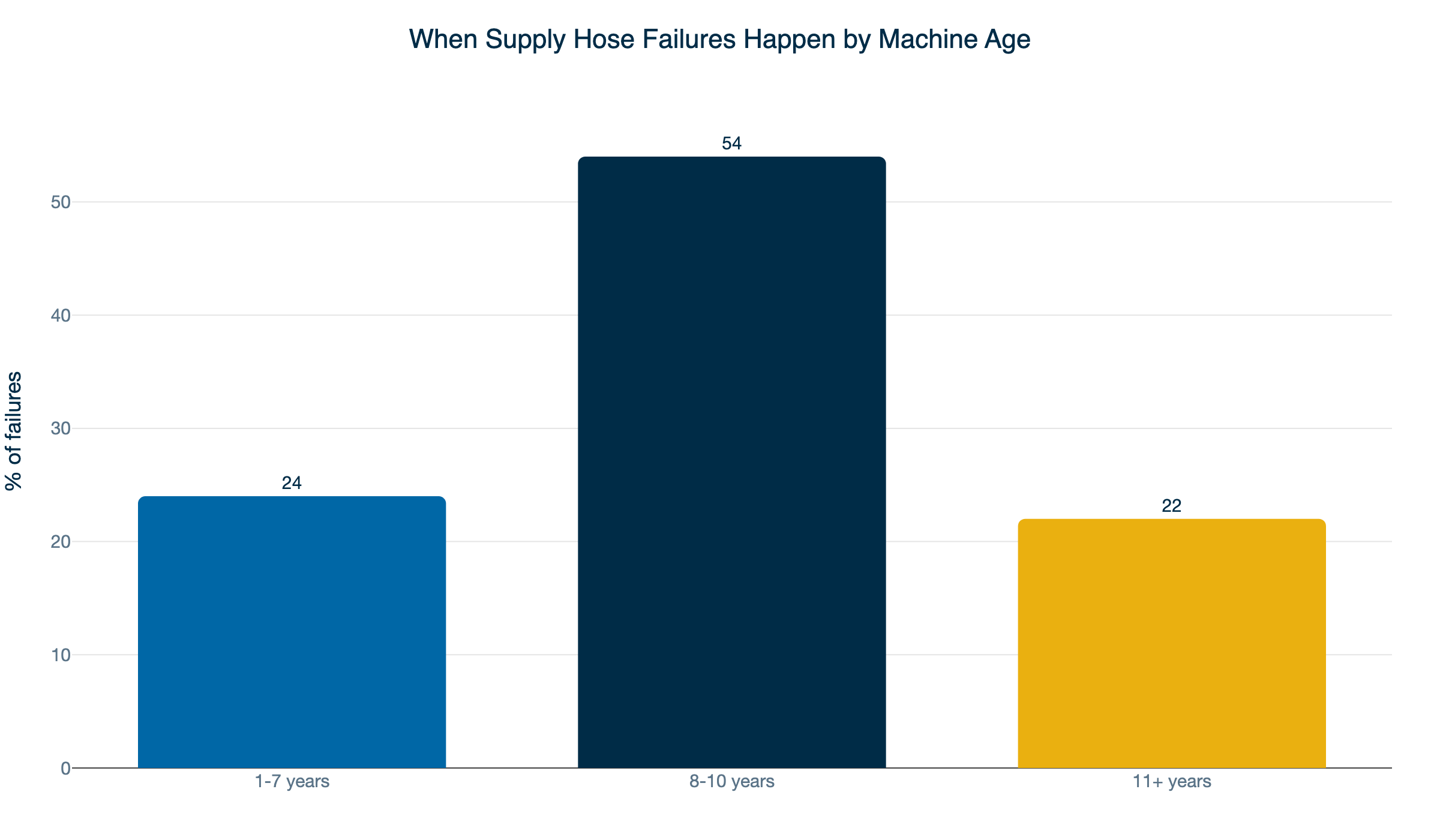
The failure data makes the risk window clear. Research shows 78% of supply hose failures involved machines less than 11 years old. Fifty-four percent occurred in machines aged 8-10 years. The hose reaches the edge of its service life long before the machine does.
Write the installation date on a piece of tape and stick it to the wall behind the machine. Many homeowners discover their hoses have been in place for 12-15 years when they finally check. If you do not know the age of your hoses, replace them. The cost of new hoses is a small fraction of the average $5,308 claim.
Does Braided Stainless Steel Mean You Never Have to Replace It?
No. Braided stainless steel changes how a hose fails, not whether it eventually fails. The inner rubber core still degrades over time. The braid converts a catastrophic burst into a slower seep - but an undetected seep inside a cabinet wall is still water damage.
This is the most common misconception about hose upgrades. Braided stainless hoses are genuinely better than plain rubber. The steel jacket adds burst resistance and reduces the likelihood of a sudden catastrophic failure. But the inner rubber core degrades just as it does in an unshielded hose, and the braid can hide that deterioration from view.
A slow seep behind a washing machine, running undetected for weeks, damages subfloor framing, encourages mold growth, and costs thousands to remediate. The braid does not change the replacement schedule. It only reduces the chance of catastrophic failure within that schedule.
Braided stainless hoses do earn a longer interval: 5-7 years per Hydroion’s guidance versus 5 years for rubber. That is a real advantage. It is not a permanent exemption from replacement.
What Twin Cities Homes Are Dealing With That Most Guides Miss
Standard replacement guides are written for a national audience. The 5-year and 5-7-year intervals reflect typical municipal water chemistry. Twin Cities homeowners are not working with typical chemistry.
The chloramine problem
Minneapolis switched from chlorine to chloramine disinfection in 2009. The city’s 2025 Consumer Confidence Report shows a chloramine average of 3.27 ppm. The range runs 2.70 to 3.50 ppm, against an EPA ceiling of 4.0 ppm.
Standard budget supply hoses use sulfur-cured nitrile, EPDM, and SBR (styrene-butadiene rubber). Chloramine chemically degrades these materials in ways that chlorine alone does not, accelerating the same internal breakdown the national 5-year interval was designed around.
A rubber hose installed in Minneapolis after 2009 has been running with chloramine for its entire service life. The interior of that hose is chemically older than its calendar age. Lean toward the 3-4 year end of the replacement window, not the 5-year end.
If your home uses a whole-house water filter or water softener, that equipment may modify what reaches the hoses - but it does not eliminate the replacement schedule. Our water softeners page covers what softening does and does not remove from your supply.
Water pressure
Typical residential water pressure in the Twin Cities runs 40-60 PSI. Homes without a pressure reducing valve can run well above that range. Higher pressure puts more stress on every supply connection, and the crimp fitting at the hose end is where that stress concentrates. If you have not tested your home’s water pressure, our post on high water pressure and pressure reducing valves explains what to look for and when a PRV pays for itself.
The vacancy risk in Minnesota winters
Minnesotans travel during the winter. Family visits, extended holiday trips, weeks at a cabin - any of these creates a window where a supply hose failure runs undetected. Claims in unoccupied homes average 2.5 times more than in occupied ones. A burst hose releases more than 500 gallons per hour. Eight hours of undetected flow puts roughly 2,400 gallons into the structure.
The fix is simple. Close the supply valves behind the washer before any trip longer than a day. They are the two handles mounted directly to the wall behind the machine. Turn them clockwise until they stop.
What Happens When a Hose Bursts?
A burst washing machine supply hose releases more than 500 gallons per hour. The water travels fast through subfloor seams and wall cavities. It reaches multiple levels of the home within minutes. The machine does not need to be running - the hoses are pressurized 24 hours a day.
The solenoid valve inside the washing machine controls when water flows into the drum. But the supply line between the wall shutoff and the machine is live the moment the wall valve is open. A failed hose floods whether the machine is mid-cycle or sitting untouched for a week.
McMahon Agency’s analysis of this failure scenario puts the flow at roughly 600 gallons per hour. Eight hours of undetected flow - the window that opens while a homeowner is at work - produces close to 2,400 gallons into the home.
In a first-floor laundry room, water flows to the lowest point, saturates the subfloor, and appears in the basement or first-floor ceiling within minutes. Structural drying, mold remediation, drywall replacement, and flooring repair pile on quickly. The $5,308 average claim figure does not fully capture multi-floor losses.
Signs Your Hoses Need Attention Now
Pull your washing machine away from the wall and check these things at least twice a year:
- Bulging or blistering: Any swollen or distorted section of the hose means the inner layers have separated. Replace immediately.
- Cracking or brittleness: Run your hand along the full hose length and flex it gently. A hose that cracks under light pressure is past safe service life.
- Corrosion at the fittings: Look at the brass crimp where the hose meets the wall valve. Green or white mineral deposits around that joint can indicate a seep that has already started.
- Kinking: A kinked hose concentrates stress at the bend. Straighten it if the material allows. If the kink has set into the hose body, replace it.
- Age past the interval: Hoses older than 5 years (rubber) or 7 years (braided stainless) should come out even if nothing looks wrong. Internal degradation runs ahead of visible signs, especially in homes on Minneapolis or Saint Paul water.
If you find any of the above, close the supply valves immediately. Do not run the machine until the hoses are replaced.
If the hoses are behind a stacked laundry unit or pushed tight against the wall, do not force the access. A plumber can work in tight clearances and inspect the fitting ends that are difficult to reach by hand.
Will Homeowners Insurance Cover a Burst Washing Machine Hose?
Sudden, accidental hose bursts are typically covered by a standard homeowners policy. Gradual leaks that developed over time are usually excluded. Cracked, aged, or visibly deteriorated hoses give an adjuster grounds to classify the failure as a maintenance issue and deny the claim.
McMahon Agency is direct about this: when an adjuster finds evidence that the hoses were in poor condition before the failure, coverage is likely denied. The line between a covered accident and an excluded maintenance failure often comes down to the condition of the hose at the time it let go.
Keeping a record of your last hose replacement matters here. Note the date, the hose type, and who did the work. That documentation shows the maintenance was current. It matters if you ever need to file a claim.
One more wrinkle: a braided stainless hose that fails as a slow seep rather than a sudden burst can be harder to classify as accidental. An insurer looking at gradual water damage behind a washing machine has reason to ask whether the hose had been deteriorating for weeks. The braid that prevented a catastrophic burst may also obscure when the failure actually began. Another argument for replacing on schedule rather than waiting for a visible sign.
When to Call a Plumber for Washing Machine Supply Hose Replacement
For most homeowners, this is a manageable job: close the supply valves, drain the lines, unscrew the old hoses, thread on the new ones with fresh rubber washers, check for drips. Many people handle it themselves without incident.
A few situations call for a plumber instead:
- You cannot reach the valves. A stacked laundry unit in a closet, or a machine pushed tight to the wall, can make the shutoff valves impossible to access safely. Do not improvise with extended tools in a tight space.
- The shutoff valves are stuck. Older Twin Cities homes with supply lines that haven’t been touched in years sometimes have valves that won’t turn. A stuck valve is its own repair job. Our post on shutoff valves that won’t turn covers what causes it and how to address it before the hose work can proceed.
- You want to add a flood-stop device. Auto-shutoff valves detect a pressure drop when a hose lets go and close the supply automatically. A plumber can install one as part of the same visit, and it works as a second line of defense between replacement intervals.
- You find water damage behind the machine. Staining, soft subfloor, or mold behind the washer when you pull it out means the scope extends beyond hose replacement. Stop, document what you see, and call for a full assessment before doing anything else.
Minnesota Plumbing Code (Chapter 4714) requires a permit for plumbing installation or alteration. Hose replacement at an existing connection typically qualifies as routine maintenance. But if the project involves relocating the connection, replacing the supply valves themselves, or adding new shutoffs, a permit may be required. A licensed plumber handles that paperwork as part of the job.
Our team at Northern Benjamin Franklin Plumbing is locally owned and operated, and we serve the Twin Cities and the greater Minnesota metro - Minneapolis, St. Paul, Blaine, Bloomington, Brooklyn Park, Coon Rapids, Maple Grove, and the surrounding communities. We operate under the On-Time Guarantee(R): we arrive in the window you pick, or we pay you $5 for every minute we are late, up to $300. If there is any delay, it’s you we pay!
If your hoses are overdue, or if you found something concerning when you pulled the machine from the wall, call us at (763) 296-1844 or book a repair appointment. If you have been hearing a banging or knocking sound when the washer shuts off, that is water hammer - worth addressing at the same time as the hose replacement. Our post on water hammer and banging pipes explains what is driving it and how we fix it.
Frequently Asked Questions
How often should I replace washing machine supply hoses? +
Where do washing machine supply hoses fail most often? +
Does braided stainless steel hose ever fail? +
Will homeowners insurance cover a burst washing machine hose? +
Need a technician now?