
Shut Off Valve Under Sink Stuck? Exercise or Replace
Key Takeaways
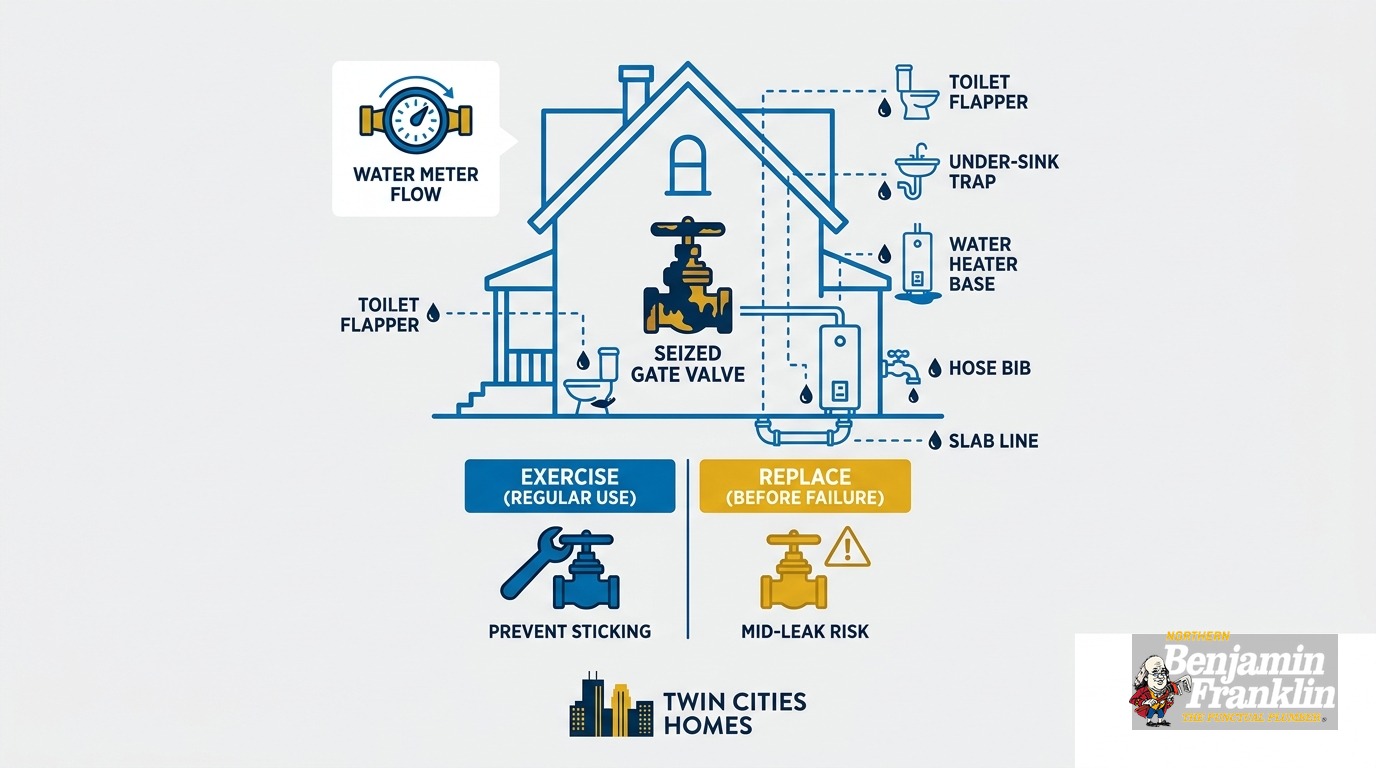
- A shut-off valve under the sink that will not turn is more than an inconvenience. It is a missing piece of your emergency plan.
- Gate valves seize from mineral scale, corrosion, and long inactivity. Twin Cities hard water accelerates all three.
- Homes built before 1960 with original plumbing likely have gate valves on galvanized supply lines. That combination carries the highest failure risk.
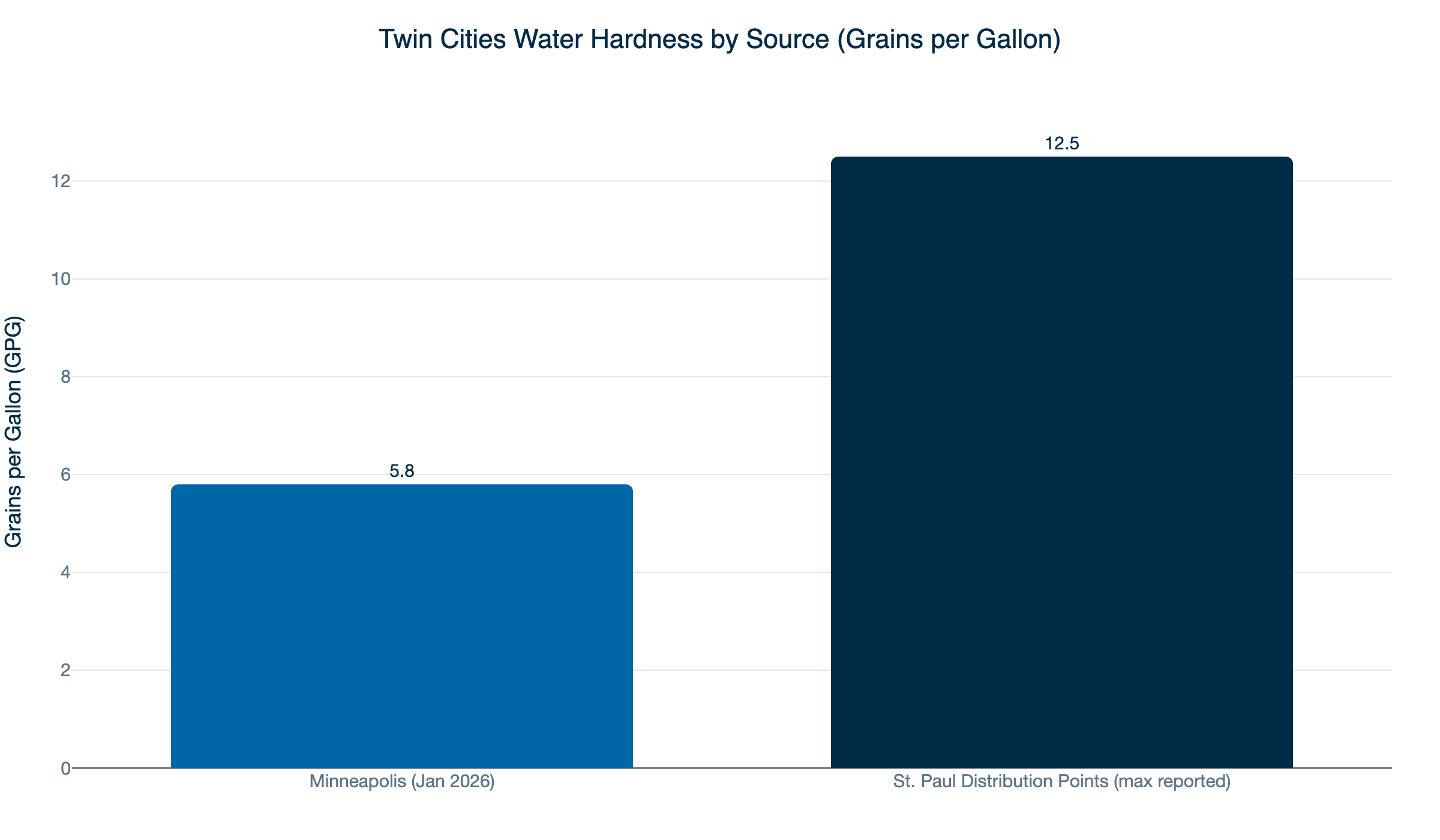
- Minneapolis finished water runs 5.8 grains per gallon (GPG). That hardness level is enough to cement a valve stem in 20 to 30 years of no use.
- Do not force a seized valve on a galvanized supply line. Forcing it can snap the stem or shake loose a corroded joint and start a new leak.
- If the home is pre-1960, the supply line is galvanized, or the stem shows corrosion, replace the valve. Do not exercise it.
- In Minneapolis, replacing only the internal parts of an existing valve is permit-exempt. Replacing the full valve body requires a licensed plumbing contractor.
- Fall is the right time to check. A stuck valve in January is a much worse problem than one in September.
The Scenario Nobody Plans For
There is a supply line leaking under your kitchen sink on a Tuesday night in January. You reach for the shut-off valve. It will not turn.
You try the other valve. Also stuck. You grab a wrench. Nothing gives. Now you are running through the house looking for the main water shutoff, water soaking the cabinet behind you.
That happens in Twin Cities homes every winter. The valve that would not close had not been turned in 20 years. It looked fine from the outside.
A shut-off valve under the sink that is stuck is not a plumbing inconvenience. It is a gap in your emergency plan. It shows up at the worst possible moment.
This post is not a DIY repair tutorial. It is a decision guide. Should you exercise the valve you have, or replace it before it fails during an active leak?
The answer depends on three things: the age of your home, the supply line material, and what the inspection shows.
What Is a Gate Valve, and Why Do Older Homes Still Have Them?
Gate valves were the residential standard before roughly 1980. They use a threaded stem and a wedge-shaped gate that rises and falls across the waterway. Multiple full turns open or close them. They seize easily when not exercised. Modern plumbing uses ball valves instead. A ball valve closes in a single quarter-turn and resists mineral buildup far better.
Ball valves replaced gate valves in modern residential plumbing for exactly this reason. A ball valve’s quarter-turn mechanism does not depend on threads that can pack with scale. It is more reliable for emergency shutoff and requires less maintenance over its life.
The problem is that older homes still have their original valves. A home built in 1958 in Edina, Golden Valley, or Coon Rapids almost certainly has gate valves throughout: under every sink, behind every toilet, at the main shutoff. Those valves may not have been turned since the original installation.
Gate valves are not passive components. The stem needs regular movement to stay lubricated and free. A valve that sits in one position for years builds mineral deposits between the stem and packing. Eventually it seizes.
When a homeowner discovers a stuck shut-off valve under the sink, the valve did not fail overnight. It seized slowly, one season at a time, while nobody noticed.
Why Does a Shut-Off Valve Under the Sink Get Stuck?
Scale from hard water deposits on the valve stem threads over years of inactivity. Corrosion from the pipe material adds to it. Together they lock the gate in place. A valve never exercised is far more likely to seize than one turned once a year.
Gate valves control flow by threading a stem in and out to raise or lower the gate. When a valve sits unused for years, hard-water minerals settle on the threads. They begin bonding with the metal. Each year, the scale layer grows thicker.
Corrosion runs parallel to the scale buildup. Older valves are typically brass or bronze. If the supply line is galvanized steel, the situation is worse. Galvanized pipe corrodes from the inside over decades, shedding rust and scale particles that settle into nearby valves and fittings.
When you combine hard-water scale with corrosion debris from galvanized pipe, a gate valve stem can lock completely. Forcing it then carries real risk. Attempting to open a seized valve can snap the internal stem. On galvanized pipe, the risk extends beyond the valve itself. A corroded joint that held for decades can start weeping the moment you torque something nearby.
Annual exercise prevents this. Turn each valve slowly through its full range and back, once a year. Most homeowners never do this. That is exactly how a valve goes from slightly stiff to completely frozen.
How Does Twin Cities Water Make This Worse?
Minneapolis finished water runs 5.8 grains per gallon, enough scale to cement a valve stem in 20 to 30 years. Some Saint Paul distribution points measure 12.5 GPG, in the very hard range. Higher hardness means faster, heavier scale deposits on every valve and fitting in the home.
Scale is the primary driver of gate valve failure in Minnesota. Minneapolis finished water measured 5.8 GPG (100 ppm as CaCO3) in January 2026. That is moderately hard. Over 20 to 30 years of no valve exercise, 5.8 GPG deposits enough scale to lock the stem. The valve becomes nearly impossible to turn.
Saint Paul is harder in spots. Some measurement points on the Saint Paul Regional Water Service system have reported hardness at 213 ppm, or 12.5 GPG. At that level, scale builds faster and bonds more aggressively to metal. Homes on harder water lines have a higher risk of seized valves. For a deeper look at how local water chemistry affects your plumbing, see our breakdown of Minneapolis and St. Paul water hardness levels.
The galvanized pipe factor makes this a compound problem. Galvanized steel was the Minnesota residential standard through the early 1950s. Copper became dominant by 1960. Inner-ring Minneapolis suburbs like Edina, St. Louis Park, and Golden Valley built out heavily through the 1950s and 1960s. Most of that housing falls squarely in the gate-valve era. Any pre-1955 home in those neighborhoods with original plumbing likely has galvanized supply lines feeding those gate valves.
Galvanized pipe corrodes inward over decades. The rust and scale it produces coat the inside of nearby valves and fittings. If you own a pre-1960 Twin Cities home, read more about what galvanized pipe looks like and when it needs to come out. The valve inspection you are doing now may open a broader conversation about the supply lines themselves.
How Can You Tell If Your Valve Is Still Safe to Use?
Turn it slowly by hand. If it moves without real force, run it through its full range and back. If it requires a wrench, will not move at all, or moves a turn and then stops hard, it is seized. Check the stem for green or white mineral buildup and identify the supply line material.
Here is the inspection process:
- Turn by hand, not with a tool. If the valve will not move without a wrench, stop. It is seized.
- Look at the stem packing. Green or white deposits around the base of the stem are mineral scale. Brown staining is corrosion. Both are warning signs.
- Identify the supply line material. Galvanized steel is dull gray metal, often with surface rust or pitting. Copper is reddish-orange. PEX is flexible plastic in white, red, or blue. Galvanized pipe raises the risk of a compound failure.
- Consider when this space was last renovated. A kitchen or bathroom unrenovated for 30-plus years has likely seen no valve exercise in that time.
- Identify the valve type. Gate valves have round handles and require multiple full turns. Ball valves have lever handles and a single quarter-turn. A lever handle means a ball valve, and the exercise concern is much lower.
If the valve turns smoothly by hand through its full range, exercise it once a year going forward. That is what keeps it functional when you actually need it.
When Should You Exercise, and When Should You Replace?
Replace the valve if the home is pre-1960, the supply line is galvanized, or the stem shows corrosion. Also replace if the valve will not turn by hand. Exercise is reasonable only on copper or PEX lines with a valve that turns by hand and shows no corrosion.
The decision comes down to three variables: home age, supply line material, and what the inspection showed.
Replace without attempting to exercise if any of these are true:
- The home was built before 1960 and the plumbing is original.
- The supply line feeding the valve is galvanized steel.
- The valve stem shows visible corrosion or heavy mineral scale.
- The valve will not move at all by hand.
- The valve moves one or two turns, then stops hard.
In any of these cases, forcing the valve risks a stem failure or a pipe joint disturbance on the galvanized run. Neither outcome is better than having a stuck valve. Replace it.
Consider exercising if all of these are true:
- The home was built after 1960.
- The supply line is copper or PEX.
- The valve turns by hand with moderate resistance. Not locked solid.
- The stem shows no visible corrosion or heavy scale.
If the valve passes that test, apply penetrating lubricant to the stem. Let it sit 20 to 30 minutes. Work the valve slowly through its full range several times. Do not use a wrench unless absolutely necessary. Stop the moment resistance increases rather than decreases.
Even a successfully exercised gate valve on an older home is a candidate for eventual replacement with a ball valve. Ball valves are more reliable in emergencies and require less ongoing maintenance.
Should You Try to Unstick It Yourself?
It depends on the supply line and how stuck the valve is. On copper or PEX with a mildly stiff valve, slow exercise with penetrating lubricant is reasonable. On galvanized pipe, or any valve that will not turn by hand, call a licensed plumber. Snapping the stem or cracking a pipe joint is a real risk.
If you decide to attempt a DIY exercise on a low-risk valve, here is the safe process:
- Turn off the water at the main shutoff first. Confirm where the main shutoff is before you start. If you have not tested it recently, read our guide on finding and testing your main water shutoff valve before going further.
- Apply penetrating lubricant to the stem. Spray at the stem packing nut and the visible threads. Wait 20 to 30 minutes.
- Try by hand only. Slow, steady clockwise pressure. No jerking, no wrenches.
- If it moves, work it back and forth. Run the valve through its full range several times to distribute the lubricant.
- If it does not move with steady hand pressure, stop. You are at the limit of what a DIY approach can safely do.
If the supply line is galvanized and the valve will not move, stop at step 2. Call a licensed plumber. The risk is not just the valve. It is every connection on that galvanized run downstream.
What Does Valve Replacement Require in Minnesota?
Replacing only the internal working parts of an existing valve is permit-exempt in Minneapolis. Replacing the full valve body or changing the supply line is not exempt. A licensed plumbing contractor must pull the permit. In Minnesota, homeowners cannot pull their own plumbing permits.
Minnesota has specific permit rules that matter here.
The City of Minneapolis lists permit exemptions for replacing internal working parts of existing faucets and valves. If you are only swapping the stem and packing inside an existing valve body, that work is permit-exempt in Minneapolis.
Installing a new valve body, or any change to the supply line, is different. Under the Minnesota Plumbing Code, all plumbing permits must be applied for by a licensed plumbing contractor. Homeowners cannot pull their own plumbing permits in this state.
In practice, a valve so seized that internal parts will not fix it needs a new body. On pre-1980 homes with original gate valves, that is the common outcome. The body itself is often corroded past the point of repair.
A plumber replacing a gate valve under your sink will also check the supply line condition while they are there. On a pre-1960 home, that check may open a conversation about the galvanized run. Catching that during a planned valve job is far better than catching it during a burst-pipe emergency.
Why Fall Is the Right Time to Check This
Minnesota’s frost depth in the Twin Cities metro runs 42 to 48 inches. That is among the deepest in the contiguous United States. The Minnesota Plumbing Code requires buried supply piping to sit at least 12 inches below maximum local frost depth. That rule protects the underground line. It does not protect the valves and pipes inside your walls and under your sink.
Minneapolis homeowners bear full repair costs if an interior service line freezes or fails. The city recommends managing interior lines proactively. A seized valve does not help with that. The valve you cannot close in January is a liability in exactly the season when burst pipes are most likely.
Fall is the right window. The work is dry. Plumbing schedules are more flexible than in January. You have time to make decisions without a crisis forcing the timeline. If valve replacement opens a conversation about galvanized supply lines, you have runway before the next freeze season to plan and budget.
Check every shut-off valve in the home now: under sinks, behind toilets, at the water heater, and at the main. Know which ones are gate valves, which move freely, and which do not move at all. A 30-minute inspection in September is a better use of time than an emergency call at 2 a.m. in December.
Call Northern Benjamin Franklin Plumbing
Northern Benjamin Franklin Plumbing is locally owned and operated, serving the Twin Cities and greater Minnesota. If you have a stuck shut-off valve, our team can inspect it, assess the supply line condition, and give you a clear picture before any work starts. Whether you need a single valve swapped out or a full assessment of the supply lines in an older home, we have seen what these homes need.
We serve Minneapolis, St. Paul, Blaine, Bloomington, Brooklyn Park, Coon Rapids, Maple Grove, and the rest of the metro.
We back every call with the On-Time Guarantee(R). You pick the arrival window. If there is any delay, it’s you we pay! We arrive when we promised, or we pay $5 per minute we are late, up to $300.
Do not wait until a burst pipe in January forces the question. Call us at (763) 296-1844 or schedule a valve inspection online today.
Frequently Asked Questions
How do I know if the shut-off valve under my sink is stuck? +
Is it safe to force a stuck gate valve? +
Do I need a permit to replace the valve under my sink in Minneapolis? +
What is the difference between a gate valve and a ball valve? +
How often should I exercise the shut-off valves in my home? +
Need a technician now?