
Refrigerator Ice Maker Water Line Leak: A Minnesota Risk
Key Takeaways
- A refrigerator ice maker water line leak is one of the most common sources of hidden household water damage, and one of the easiest to prevent.
- Clear plastic supply tubing, the kind in most big-box hookup kits, is rated the highest-risk material for refrigerator connections. Heat from the compressor depletes its plasticizers over time, leaving it brittle and prone to cracking.
- Minnesota’s cold basements accelerate that process. The plastic cycles between compressor heat and ambient cold thousands of times. Embrittlement happens faster here than in a warmer climate.
- Saddle valves, the piercing tap included in most hookup kits, are not approved under Minnesota Plumbing Code (MN Rules 4715.0420). They also calcify in Twin Cities hard water within 2-5 years.
- Standard homeowner’s insurance does NOT cover slow or gradual leaks. MN Commerce Department guidance is explicit: a pinhole dripping behind the fridge for weeks is excluded. Only sudden, accidental failures qualify.
- Mold begins within 24-48 hours of water exposure. Two weeks of undetected dripping almost certainly means mold in the subfloor and basement ceiling below.
- The fix is a braided stainless line with a tee fitting and a proper shutoff valve. A licensed plumber can typically complete the job in about an hour.
A Refrigerator Ice Maker Water Line Leak Can Cost More Than You Expect
A significant share of those claims start behind a refrigerator.
The refrigerator ice maker water line leak is not dramatic. There is no burst pipe sound. No sudden mess. In the most common scenario, a hairline crack forms in a clear plastic tube at the back of the appliance. Water seeps out slowly. It soaks into the subfloor, finds a gap, and drips into the basement ceiling below. You get ice. You have no idea anything is wrong.
By the time you notice a soft spot in the kitchen floor, the damage has been running for days, sometimes weeks. And in Minnesota, the problem is made measurably worse by climate, water chemistry, and a plumbing fitting that should not be in the hookup kit in the first place.
What Causes a Refrigerator Ice Maker Water Line to Leak?
Short answer: The most common causes are a brittle plastic supply line cracking from heat and age, a saddle valve failing at its connection point, a loose inlet valve fitting, or mineral scale clogging the saddle valve needle until water pressure forces a leak.
The longer answer starts with the line itself.
Most refrigerators are connected to the home’s water supply with a short run of clear polyethylene tubing. It comes in every big-box hookup kit, it is inexpensive, and it is described by appliance restoration experts as “the primary culprit in most kitchen floods.”
Here is the mechanism. Plastic tubing stays flexible because of chemical additives called plasticizers. The compressor and condenser coils at the back of your refrigerator generate sustained heat. Over months and years, that heat depletes the plasticizers. The line stiffens. It becomes brittle. A slight nudge when you pull the fridge out to clean, a compressor vibration, a small kink from the original installation - any of those can snap a brittle line or open a hairline crack.
A field analysis by a 20-year appliance restoration expert rates clear plastic tubing as high-risk for failure. Copper rates medium. Braided stainless steel rates low. That risk gap matters when you are deciding whether the cheap kit is worth it.
Why Does Minnesota Make Refrigerator Water Lines Fail Faster?
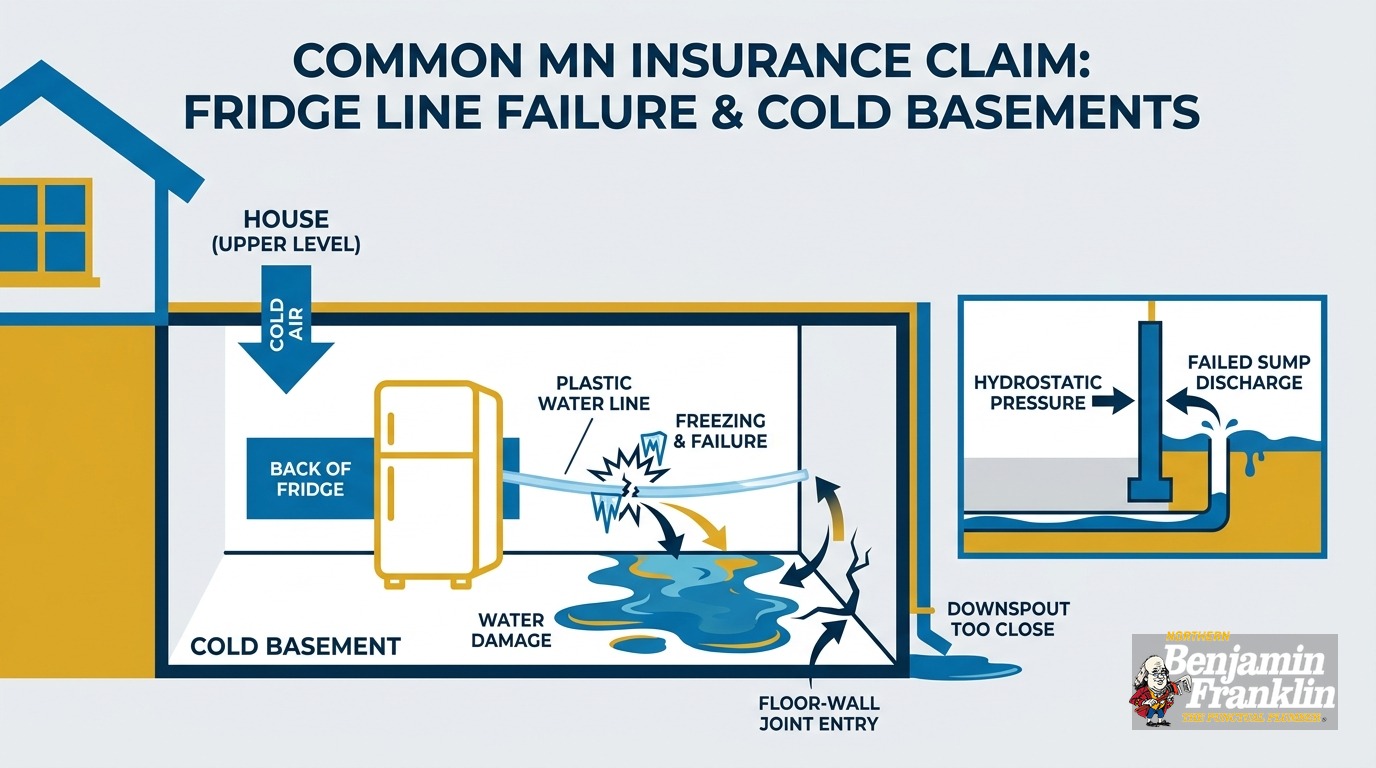
Short answer: The combination of compressor heat and a cold Minnesota basement creates a thermal cycling pattern that accelerates embrittlement. The plastic softens slightly under heat, then stiffens in the cold ambient air. That cycle repeats thousands of times and degrades the material faster than a temperate climate would.
This is the angle the national coverage misses entirely.
Many Twin Cities homes run their refrigerators over unconditioned basements or in kitchens where cold air from below pulls the ambient temperature down in winter. The basement itself can drop well below 50 degrees F even with the furnace running. The space behind the refrigerator, near the condenser coils, runs warm.
The line sits in the middle of that gradient. Warm near the coils, cooler toward the wall connection. The plastic softens where it is warm. It stiffens where it is cold. Compressor cycles run thousands of times a year. The degradation accelerates.
Minnesota context matters here. Frost depth in the Twin Cities metro reaches 42 inches, governed by MN Administrative Rules 1303.1600. MN Plumbing Code requires buried supply lines to sit at least 12 inches below local frost depth - meaning 54 inches minimum in the Twin Cities. The code exists because Minnesota’s thermal conditions put real stress on materials. The plastic tubing in your refrigerator kit is operating inside that same environment. It was not rated for it.
What Is a Saddle Valve, and Why Is It Not Allowed in Minnesota?
Short answer: A saddle valve is a piercing fitting that clamps onto a supply pipe and punches a small hole through the wall to tap a water connection. It requires no plumber and no pipe cutting. It also has no approval standard under Minnesota Plumbing Code, which makes it not permissible for new installations.
The valve clamps around a cold-water supply pipe. You tighten a needle until it punches through the pipe wall. You now have a water connection. The appeal is obvious. The problem is structural.
Minneapolis-based home inspection firm StructureTech calls saddle valves “cheap, easy, and wrong.” That assessment has run in the Star Tribune as well. StructureTech’s deeper analysis lists saddle valves among plumbing products that are not legal in Minnesota: MN Rules 4715.0420 requires listed approval standards for plumbing components, and saddle valves carry none.
Saddle valves fail in three distinct ways.
- Needle seal degradation. The rubber gasket around the needle dries out over time. The resulting drip is slow enough to go unnoticed for months.
- Corrosion at the pipe wall. The small puncture site corrodes, especially on older copper or galvanized supply lines common in Twin Cities housing stock.
- Calcification and rupture. The needle aperture is tiny. In hard water, mineral scale builds up inside that opening over years. Ice production slows as the opening narrows. Eventually the restriction causes enough pressure variation that the valve leaks or fails outright.
That third failure mode is specifically relevant to homes in Minneapolis, St. Paul, and the surrounding metro.
How Does Twin Cities Hard Water Speed Up the Problem?
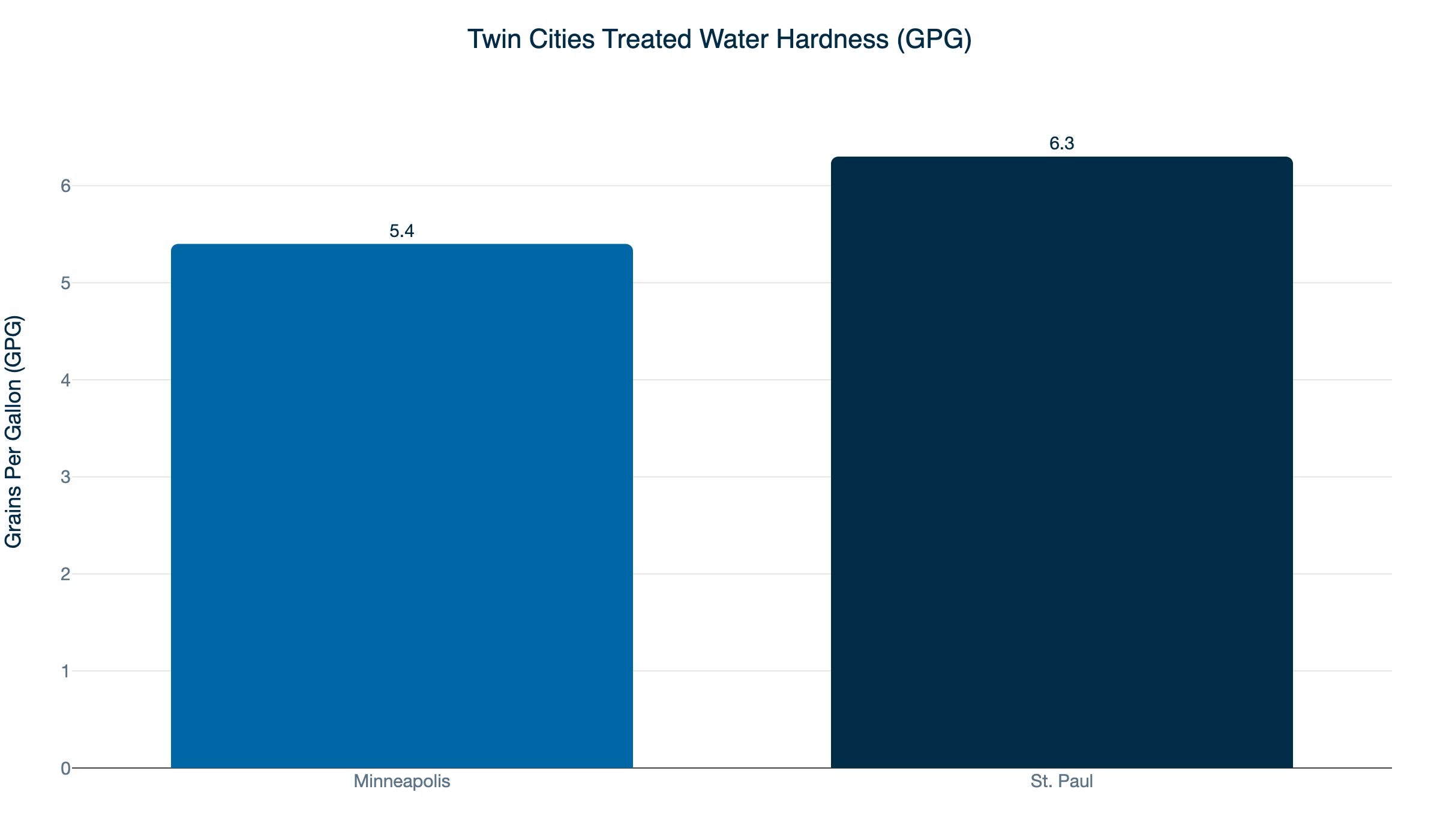
Short answer: Minneapolis and St. Paul water runs at 5-7.6 grains per gallon of hardness. At those levels, mineral scale accumulates on any small surface the water contacts. A saddle valve’s needle aperture is measured in millimeters. The math is not in the valve’s favor.
The chart above shows treated water hardness for both cities. Minneapolis Water Works reports treated water at approximately 5.4 grains per gallon (GPG) as of January 2026. Saint Paul Regional Water Services uses a lime softening process that brings raw source water down to roughly 5-7.6 GPG.
Water at those hardness levels leaves deposits on every surface it flows through. For a saddle valve, the needle aperture starts small and only gets smaller. Homeowners notice the problem first as reduced ice production. The ice maker cycles more frequently, trying to compensate. Then the valve fails and water releases behind the appliance.
This failure pattern runs 2-5 years from installation in hard water areas - long enough that most homeowners never connect the cause to the kit they installed when they bought the refrigerator.
If your ice maker is producing less than it used to and your plumbing has not been serviced, the connection hardware is worth inspecting before you call the appliance company. It may be a plumbing problem, not an appliance one.
What Does Your Homeowner’s Insurance Actually Cover?
Short answer: Standard HO-3 policies cover sudden and accidental water damage - a line that bursts and floods quickly. They do not cover slow or gradual leaks, which is exactly how most plastic line failures present.
This is the insurance gap that catches homeowners off guard.
The MN Commerce Department is specific on this point: standard homeowner’s insurance does not cover slow or gradual water damage. A pinhole forming over months in a plastic line, dripping slowly into the subfloor - that is a gradual leak. It does not qualify.
The MN Commerce Department also flags a language trap: do not call it flood damage. “Flood” has a specific policy meaning and HO-3 does not cover it. The correct framing for a sudden-burst event is “sudden and accidental water damage.”
Here is what that distinction means in practice:
- A line that develops a slow weep and soaks your subfloor over six weeks: not covered.
- A line that snaps and releases water rapidly, causing visible damage immediately: likely covered as sudden and accidental.
- Mold that grew because the slow leak went undetected for two weeks: probably not covered, because it stems from the excluded gradual event.
Mold begins growing within 24-48 hours of water exposure. A refrigerator water line dripping slowly for two weeks before discovery has almost certainly seeded mold in the subfloor and the basement ceiling below. Remediation costs sit on top of the repair - and your policy may not touch any of it.
What Are the Signs of a Refrigerator Ice Maker Water Line Leak?
Short answer: You may not see standing water. The more common early signals are a soft floor near the fridge, a musty smell in the kitchen or basement below it, water staining on the basement ceiling, and reduced ice production.
Look for these specifically:
- A soft, spongy, or discolored area on the kitchen floor near the refrigerator
- A musty or earthy smell in the kitchen or directly below it in the basement
- Water stains or bubbling on the basement ceiling
- Reduced ice production or slower fill times on the water dispenser
- A white mineral crust on or near the connection point at the wall
- The refrigerator has been moved recently - pulling the fridge out is one of the most common triggers for a brittle plastic line to crack
Any one of these warrants pulling the refrigerator out and inspecting the line and connection hardware. If you see evidence of moisture at the connection point or anywhere along the line, that is an active leak, even if the kitchen floor feels dry above it.
You can also check your main water shutoff valve location while the appliance is pulled out. Knowing exactly where it is before you have an emergency is one of the most useful things a homeowner can do.
What Does a Proper Refrigerator Ice Maker Line Installation Look Like?
Short answer: A code-compliant installation uses braided stainless steel tubing connected to a tee fitting with a dedicated shutoff valve installed on the supply pipe by a licensed plumber - not a saddle valve clamped to the outside of the pipe.
The correct installation has two components: the right material and the right connection fitting.
Material. Braided stainless steel tubing is the lowest-risk option for refrigerator ice maker connections. It does not embrittle under compressor heat. It does not carry the plasticizer-degradation failure mode. It resists kinking better than copper. It costs more than the clear plastic kit from the hardware store, and the difference is worth it on a job that is meant to run for years without inspection.
Copper is a reasonable alternative and is not prohibited. It does kink more easily than braided stainless, and pinhole corrosion is a real long-term concern - especially given the chloramines used in Twin Cities municipal treatment. For a deeper look at that risk, our post on copper pipe pinhole leaks in Minnesota homes covers the failure modes and what to watch for.
Connection fitting. The saddle valve comes out. A correct installation uses a tee fitting cut into the supply pipe with a dedicated shutoff valve. This is a code-compliant connection that will not weep from gasket failure or clog from mineral scale. It requires cutting the supply line - a job for a licensed plumber - but it produces a connection that holds.
The job is not large. A plumber can typically remove a saddle valve, install a tee fitting and proper shutoff, and run new braided stainless tubing in about an hour.
What Happens When a Slow Leak Runs Undetected for Weeks?
Short answer: Water migrates under the floor, soaks framing, and drips into the basement ceiling. By the time you notice discoloration or a soft spot, mold has almost certainly started in the subfloor cavity. Remediation adds significant cost before any repair work begins.
There is a version of this problem homeowners catch early. A puddle, a wet spot, an obvious drip. They pull the fridge, find the crack, call a plumber, and the job is done in a day.
There is another version that runs longer. The line develops a pinhole at the back of the fridge where no one looks. Water migrates under the floor, finds a gap in the subfloor, and drops into the basement ceiling. The kitchen floor feels solid. The basement ceiling looks fine - for a while. Then drywall begins to stain. By then, it has been weeks.
Water damage claims average $15,400. That is the claim payout. It does not include your deductible, increased premiums, or the portion of damage a gradual-leak exclusion leaves on your side of the ledger. An appliance restoration expert puts it plainly: “A $15 part can cause $15,000 in damage.”
A slow leak means mold. Mold in a subfloor or floor joist cavity means remediation - pulling flooring, treating framing, drying cavities with industrial equipment - before any repair work begins. It also means your insurance adjuster is reading a gradual-leak exclusion, not writing a check.
The case for replacing the plastic line before it fails is not complicated. It is one of the highest return-on-risk upgrades available to a Twin Cities homeowner.
When Should You Call a Plumber for a Refrigerator Water Line?
Short answer: If you have a saddle valve hookup, call now - it is not code-compliant in Minnesota and will eventually fail. If you have an existing plastic line, call before it is moved or if it is more than a few years old. If you see any sign of moisture at the connection, call today.
Some of this is DIY-friendly. Pulling the fridge out, inspecting the line, and checking for moisture at the connection point takes five minutes and costs nothing. That is worth doing on any refrigerator that has not been serviced.
Replacing a saddle valve with a tee fitting and a proper shutoff is a different matter. It requires cutting into a water supply line and installing a fitting that meets MN Plumbing Code. An incorrect fitting leaks. A saddle valve left in place eventually fails. The code requirement exists for a reason.
If you find a saddle valve, or if you see any sign of a leak behind the appliance, the right call is a licensed plumber. The job is small enough that it does not require a lengthy appointment. And the stakes - a five-figure average damage claim, a gradual-leak exclusion, and potential mold behind your walls - make professional installation the straightforward choice.
For homeowners watching for related issues, our post on water hardness in Minneapolis and St. Paul explains what your GPG number means for every appliance and fixture in the house, not just the ice maker.
Key Takeaways
- A refrigerator ice maker water line leak is one of the most common - and most preventable - sources of household water damage in the Twin Cities.
- Clear plastic supply tubing is the highest-risk material. Heat from the compressor depletes its plasticizers. Minnesota’s cold basements accelerate embrittlement through thermal cycling.
- Saddle valves are not code-compliant in Minnesota (MN Rules 4715.0420). They fail from gasket degradation and calcify in Twin Cities hard water within 2-5 years.
- Standard HO-3 insurance covers sudden, accidental failures - not gradual leaks. MN Commerce Department guidance is specific on this distinction.
- Mold starts within 24-48 hours. Two weeks of slow dripping behind the fridge likely means mold in the subfloor and basement ceiling.
- The fix is a braided stainless steel line with a tee fitting and a dedicated shutoff valve. A licensed plumber can complete it in about an hour.
If you have a saddle valve hookup on your refrigerator water line, or if you have noticed any of the warning signs above, call Northern Benjamin Franklin Plumbing at (763) 296-1844 or book a service appointment online. We are locally owned and operated in the Twin Cities. Our On-Time Guarantee(R) means we arrive in the window you choose - or we pay you $5 for every minute we are late, up to $300. If there is any delay, it’s you we pay!
Frequently Asked Questions
What causes a refrigerator ice maker water line to leak? +
Is a refrigerator water line leak covered by homeowner's insurance? +
Are saddle valves legal in Minnesota? +
What is the best water line material for a refrigerator ice maker? +
Need a technician now?