
Gas Line Installation Permit Minnesota: Safety and Process
Key Takeaways
- Natural gas is odorless until your utility adds mercaptan, a chemical that smells like rotten eggs. Even a small leak is detectable by smell.
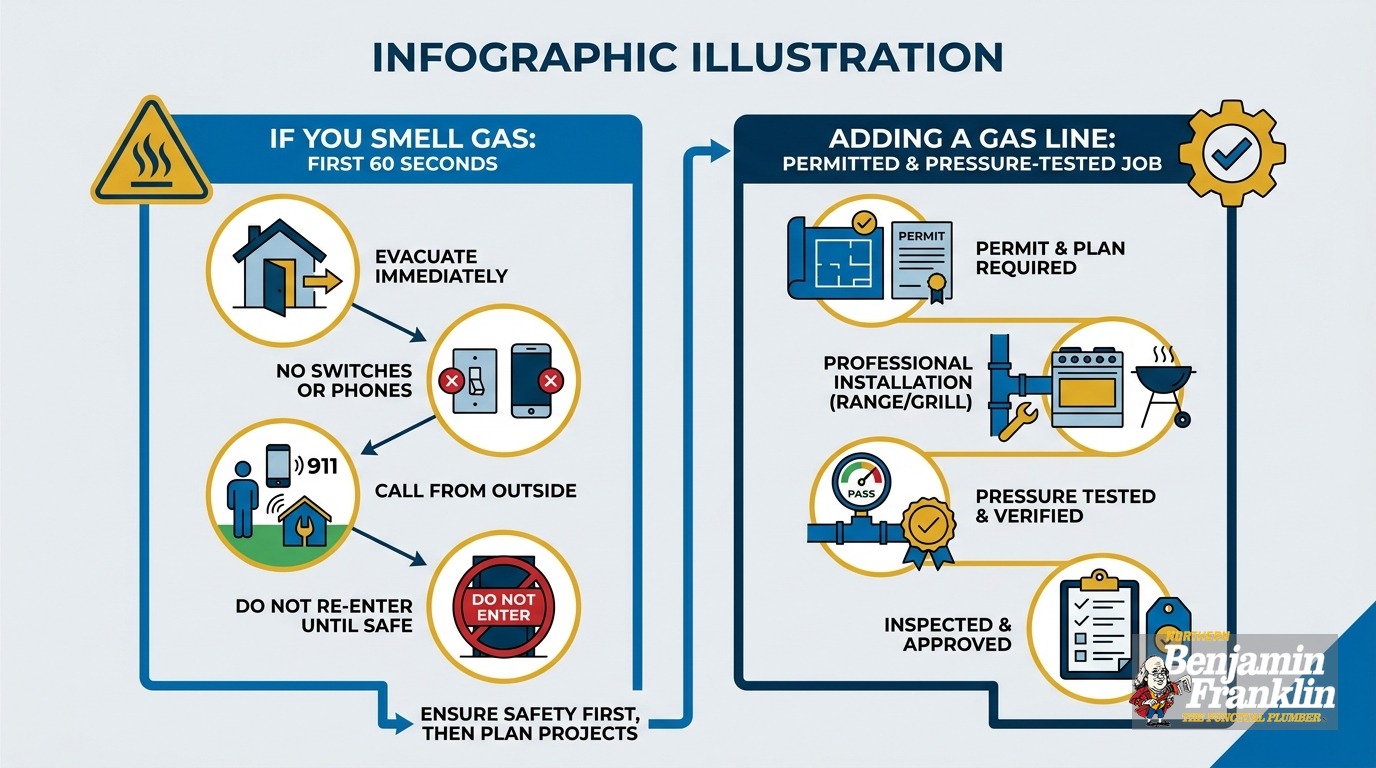
- If you smell gas: leave immediately, do not touch any switch or appliance, and call 911 plus your gas utility from outside the building.
- Your carbon monoxide detector will NOT detect natural gas. They are different gases requiring separate detectors.
- Any new gas line, extension, or alteration in Minnesota requires a permit under MN Rules Chapter 1346.
- The permit mandates a pressure test before the wall closes, verifying no leaks exist before gas flows through the new run.
- A contractor who skips the permit also skips that test. A hidden leak can sit behind finished drywall for years.
- Outdoor gas lines for grills require an 811 call before any digging, a minimum 8-inch burial depth, and a permit.
- Northern Benjamin Franklin Plumbing pulls every required permit and pressure-tests every gas line job in the Twin Cities metro.
What Does a Gas Leak Smell Like?
Natural gas has no odor of its own. Your gas utility adds mercaptan, a sulfur compound that smells like rotten eggs, so even a small leak is detectable. That smell is your most important warning system, and recognizing it quickly matters.
The smell is not the only signal. You might hear a hissing or whistling near the gas meter or near an appliance. Outside, dead or bare patches of grass over buried lines, or dirt blowing up from the ground, also indicate a leak. Any of these signs warrants the same response: get out of the building and call for help.
The Twin Cities area has cold winters and many homes with gas furnaces, water heaters, dryers, and ranges. Gas appliances in Minnesota homes are common. Knowing what a leak looks and sounds like, not just smells like, is worth taking a few minutes to understand.
What to Do in the First 60 Seconds If You Smell Gas
The short answer: Leave the building immediately. Do not touch any light switch, phone, or appliance. Call 911 and your gas utility from outside or from a neighbor’s home. Do not re-enter until the utility clears the building.
The first instinct is usually to find the source of the smell. Resist it. Your only priority in that first minute is getting out. Here is the full sequence:
- Stop what you are doing and move toward the nearest exit. Do not stop to grab your phone, turn off the stove, or flip a light switch. Any electrical arc, including a light switch toggling, can ignite a gas-air mix.
- Leave doors open as you exit. This allows the space to ventilate without creating sparks.
- Do not start a vehicle in an attached garage. The ignition creates a spark near the building.
- Once outside, move away from the structure. Get distance between yourself and the home before you make any calls.
- Call 911 first, then your gas utility. Both need to respond.
Twin Cities and Minnesota utility emergency contacts:
- CenterPoint Energy (Minneapolis, St. Paul metro): Call 911 first, then call CenterPoint. CenterPoint checks suspected leaks at no charge.
- Minnesota Energy Resources (greater MN): 800-889-4970
- Greater Minnesota Gas: 888-931-3411
Save these numbers somewhere accessible, not just on your phone inside the house.
Natural gas ignites only when the gas-to-oxygen ratio falls within a specific range. Getting out quickly prevents conditions from reaching that threshold. It is not about heroics. It is about reducing the time the gas-air mix has to build toward a dangerous concentration. Early action is what keeps a leak from escalating.
Once you are outside, do not re-enter for any reason, including pets, medications, or belongings. The utility technician will enter with equipment designed for that environment. You do not have that equipment.
Does Your Carbon Monoxide Detector Catch a Gas Leak?
The short answer: No. Carbon monoxide and natural gas are chemically different gases. A CO detector will not alert you to a methane leak. A dedicated natural gas detector is a separate device.
This is one of the most common misunderstandings in home safety. Many homeowners believe their CO detector covers both threats. It does not. Carbon monoxide forms as a byproduct of incomplete combustion, when fuel burns without enough oxygen. Natural gas, which is mostly methane, is the fuel itself before it ignites. The sensors that detect one cannot detect the other.
A natural gas detector is a separate, relatively inexpensive device. It mounts near appliances and monitors for methane concentration in the air. Unlike CO detectors, which are often placed near sleeping areas at ceiling height, natural gas detectors are placed lower: near the floor at appliance level, where a leak from a fitting or valve connection is most likely to register first.
If your home runs on natural gas and you do not have a dedicated gas detector, it is worth adding one. It gives you an early alert before your nose catches the smell, and it monitors continuously when you are asleep or away from the house.
CO detectors still matter. Carbon monoxide from a poorly venting furnace or water heater is a real and separate threat. Both devices belong in a home with gas appliances. They are not interchangeable.
Gas Line Installation Permit Minnesota: What the Law Requires
The short answer: MN Rules Chapter 1346 requires a permit for any installation, extension, or alteration of gas piping in Minnesota. This applies to every job, including small extensions and single-appliance additions.
MN Rules Part 1346.5101 is the Minnesota Mechanical and Fuel Gas Code, based on the International Fuel Gas Code. It covers all gas piping systems for natural gas operating at 125 psig or less. That scope runs from the point of utility delivery to the outlet of each appliance shutoff valve. Adding a line for a new gas range, a garage heater, a fireplace, or an outdoor grill is explicitly within that scope.
The code covers installation, alteration, and testing. It is not just about new construction. Any time a plumber extends an existing gas system, changes its routing, replaces a section, or adds a new branch, the code applies and a permit is required.
The permit process follows a clear sequence for any gas line installation permit in Minnesota:
- A bonded contractor applies for the permit with your municipality before work begins.
- The contractor installs the new gas piping.
- A rough-in inspection happens before any wall is closed or piping is concealed.
- The contractor performs a required pressure test at that inspection.
- The inspector approves or requires corrections before the wall closes.
- After inspection approval, the wall closes, the appliance connects, and the system is tested at operating conditions.
Skipping the permit skips every one of those checkpoints.
Why Does the Permit Actually Protect You?
The short answer: The permit requires a pressure test at rough-in, before the wall closes. That test proves no leaks exist before gas ever flows through the new run. Without the permit, there is no required test, and a leak can hide behind finished drywall for years.
The pressure test specification under Minnesota requirements is 1.5 times the maximum allowable operating pressure. The new piping must hold that pressure before the inspector signs off. If there is a leak, the contractor fixes it before the job is considered done. The wall does not close until the test passes.
This is the part that gets missed in most conversations about permits. The permit is not primarily a revenue mechanism for the city. It is the checkpoint that forces a verification step at the right moment, before the wall goes up and the problem becomes invisible.
A small fitting that was over-tightened or under-sealed can sit undetected behind finished drywall for years. At normal operating pressure, it may seep slowly. You may never smell it at typical indoor concentrations. You would have no indication it was there.
The permit also creates a permanent record. When you sell your home, a buyer’s inspector will look for permit history on gas work. Unpermitted gas line work is a disclosure requirement in a real estate transaction. It can affect your sale or your price. A permitted job has documentation that the work was inspected and approved.
What Does Adding a Gas Line for a Range or Outdoor Grill Actually Involve?
Adding a gas line for a new appliance is one of the most common calls we receive. A gas range replacing an electric cooktop, an outdoor grill, a generator, a garage heater, or a fireplace are the requests we see most often.
All of these are permit-required jobs. Adding a gas appliance to an existing residential system is explicitly within the scope of the permit requirement under MN code. There is no size threshold below which the permit is optional.
Here is what the job typically involves:
- Load assessment. The plumber checks whether your existing meter and regulator can support the additional load. An undersized supply causes pressure problems across all appliances on the system, not just the new one.
- Material selection. For new residential gas work, CSST (corrugated stainless steel tubing) is code-compliant in Minnesota and must be properly bonded for lightning protection per MN code. Black steel pipe is the traditional choice for interior runs. Material selection depends on the routing, the location, and the local inspector’s expectations.
- Routing and rough-in. The new line runs from an existing supply point to the new appliance location. Routing through walls, floors, and chases is planned to meet clearance and support requirements.
- Permit pull and inspection. We pull the permit before work starts, not after. The rough-in inspection happens before any wall or floor closes.
- Pressure test. We test the new run at the required 1.5x operating pressure and document the results for the inspector.
- Final connection and commissioning. After inspection approval, the appliance connects, the system is pressurized, and all connections are tested at operating conditions with a gas leak detector solution.
If you want to add a line for an outdoor fireplace or fire pit, that project carries the same permit requirement plus the outdoor burial rules described in the next section.
What Are the Rules for Outdoor Gas Lines in Minnesota?
The short answer: Outdoor gas lines must be buried at least 8 inches below finished grade. Piping running above grade must be elevated at least 3.5 inches. Aluminum-alloy tubing is not permitted for exterior or underground use. Call 811 before any digging.
An outdoor gas line for a grill or fire feature is a practical upgrade for a Twin Cities yard. It removes the need for propane tank management and gives you a permanent piped fuel supply. The outdoor rules are specific, and they protect the line from the conditions it will face in Minnesota’s climate.
Scott County (MN) gas line installation guidelines specify the 8-inch minimum burial depth and the 3.5-inch above-grade clearance for any piping that cannot be buried. Frost depth in the Twin Cities averages 42 to 60 inches, but gas lines do not need to match that depth. Gas flow through a properly sized line prevents freezing inside the pipe. The 8-inch minimum is about physical protection from lawn equipment, shallow roots, and general excavation, not freeze prevention.
Material rules for outdoor gas lines in Minnesota:
- Aluminum-alloy tubing is not permitted for exterior or underground use in Minnesota. This is a common error when a contractor familiar only with interior applications selects the wrong material for an outdoor run.
- CSST is permitted for outdoor use but requires proper bonding to the home’s electrical ground per MN code.
- Black steel and copper are the standard choices for underground and outdoor-exposed runs.
The 811 call:
Before any digging for an outdoor gas line, call 811. This is Gopher State One Call. Minnesota law requires the call before any excavation on your property, including shallow landscape digging. The service marks the locations of buried utility lines: gas, electric, water, and telecom. It is free. Call at least three business days before your planned start date.
Your contractor will typically place this call. Confirm that it is scheduled before any digging starts on your property. Hitting a buried gas or electric line mid-project is the kind of outcome that shuts a job down immediately.
Who Can Do This Work Legally in Minnesota?
The short answer: Any business contracting to perform gas work in Minnesota must file a $25,000 mechanical contractor bond with the Department of Labor and Industry. Individual municipalities may require additional local licenses. A handyman who skips the permit also skips these requirements, leaving you with limited protection if something goes wrong.
Minnesota does not issue a state-level mechanical contractor license in the traditional licensing sense. Instead, any business performing gas work must file a $25,000 mechanical contractor bond with the MN DLI. This bond is the state’s financial protection for homeowners: if a contractor performs defective work, the bond provides a route for a claim. The filing fee is $100 and the bond is valid for two years.
Beyond the state bond, municipalities can require additional local licenses or competency cards. Minneapolis and St. Paul each have their own inspection agreements with the DLI. A contractor who holds the state bond may still need a city-specific credential to pull a permit in your municipality. This layered structure is intentional: it ensures that anyone working on gas systems in your city has been vetted at both the state and local level.
When you call us for a gas line repair or new installation, we handle the permit, the bonding documentation, the pressure test, and the inspection scheduling. You do not need to track these requirements or chase down your municipality’s specific rules.
If you have questions about contractor requirements in your area, the MN DLI Construction Codes and Licensing division can be reached at 651-284-5034 or dli.license@state.mn.us.
Gas Lines in Older Twin Cities Homes
Much of the housing stock in Minneapolis, St. Paul, and the surrounding metro was built before current gas codes were in place. Homes from the 1950s and 1960s sometimes have aging gas piping that has never been assessed or updated. If you are adding a new gas line in an older home, having the existing system evaluated at the same time is the right move.
Our plumbers inspect the condition of the existing supply lines when they assess a new gas line job. An aging supply side may not support the added load safely. In some cases, the right answer is a partial replacement of the existing supply lines before the new branch is added. That is a better outcome than connecting a new range or grill to a supply system that was already undersized or degraded.
Older Twin Cities homes also tend to carry aging galvanized pipe in their plumbing systems. The same principle applies to gas: get the full picture of what is behind your walls before adding load to a system that has not been evaluated in decades.
Schedule a Gas Line Installation or Repair
Gas line work carries some of the highest stakes of any residential plumbing job. The permit and the pressure test exist because a mistake here does not reveal itself through a wet ceiling or a slow drain. It can go undetected until conditions become dangerous. That is why our gas line installation service starts with the permit, follows the full inspection sequence, and pressure-tests every new run.
Northern Benjamin Franklin Plumbing is locally owned and operated in the Twin Cities. We serve Minneapolis, St. Paul, Blaine, Bloomington, Brooklyn Park, Coon Rapids, Maple Grove, and the greater metro.
Our On-Time Guarantee(R) applies to every appointment. We show up in the window you pick. If we are late, we pay for the wait: “If there is any delay, it’s you we pay!” Every job is backed by a 100% satisfaction guarantee.
Call (763) 296-1844 or book online to schedule your gas line installation or inspection. If you are reading this because you smelled something right now, do not call us first: call 911 and your gas utility from outside the building, and let them clear the structure before any plumbing work begins.
Frequently Asked Questions
Do I need a permit to add a gas line in Minnesota? +
What should I do first if I smell gas in my home? +
Will my carbon monoxide detector alert me to a natural gas leak? +
Need a technician now?