
Add a Gas Line for a Dryer or Range: The MN Permit Process
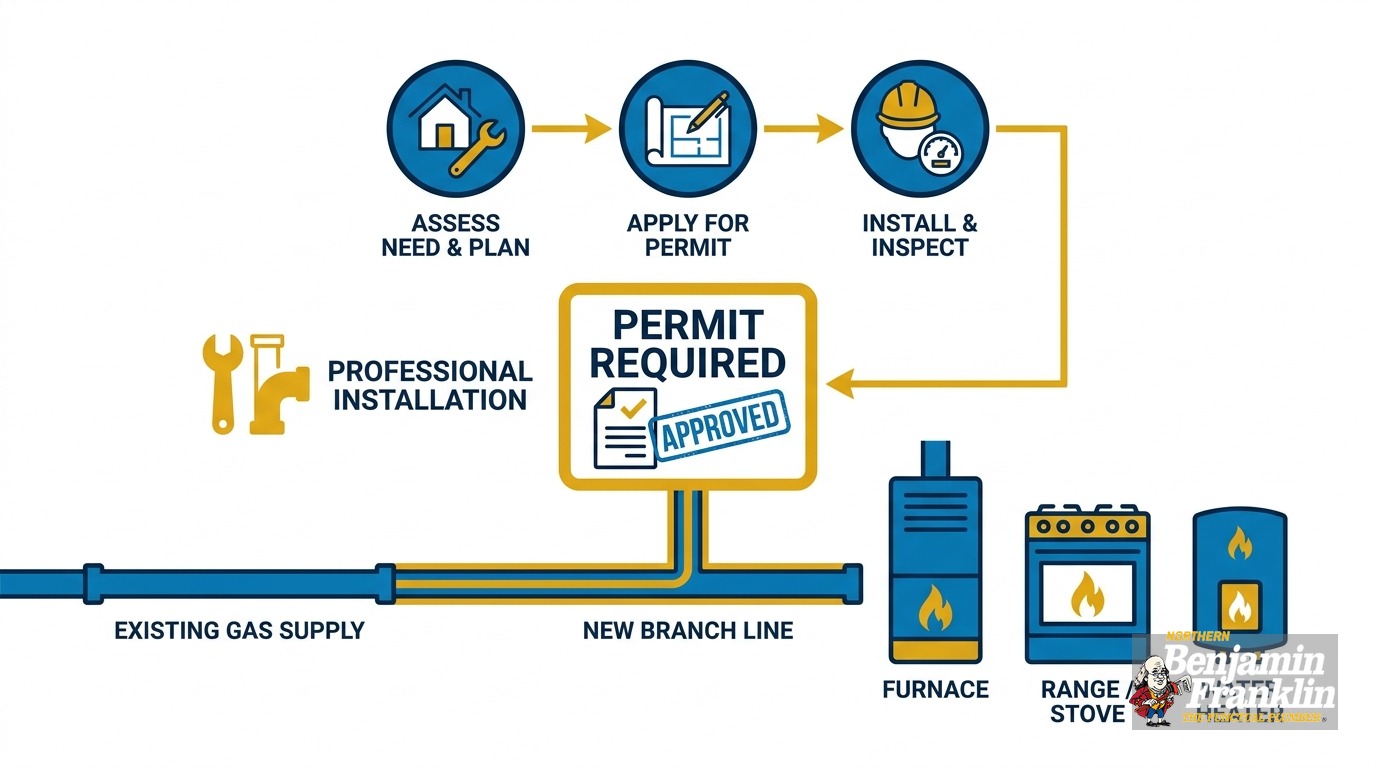
Key Takeaways
- Adding a gas line is permit-required work in Minnesota. No exceptions for dryers or ranges.
- Permits are issued by the Minnesota Department of Labor and Industry (DLI), not your local building department.
- Only a licensed plumbing contractor can pull a gas permit in Minnesota. Homeowners cannot do the work themselves or pull their own permits.
- Before running new pipe, a licensed plumber must check whether your existing gas service can carry the added BTU load.
- Modern gas branch lines typically use corrugated stainless steel tubing (CSST). CSST requires a listed bonding clamp at each fitting.
- A pressure test at 1.5 times operating pressure is required before DLI closes the permit.
- CenterPoint Energy owns the service line to your meter. The permit covers your side of the meter only.
What Does It Mean to Add a Gas Line for a Dryer or Range?
Quick answer: Adding a gas line means running a new branch line from your existing house gas piping to a new appliance location. It requires a DLI permit, licensed labor, a pressure test, and a state inspection. The project is not complete until the permit closes.
When you upgrade to a gas dryer or a gas range, the appliance is only part of the work. You also need a gas supply connection at the right location. Many homes do not have one near the laundry room or at the kitchen range position.
A branch line addition taps into your existing gas supply and runs new pipe to the appliance location. The work involves shutting off the gas, cutting into the existing supply line, running new pipe, and installing a shutoff valve at the connection point.
In Minnesota, that sequence also requires a licensed contractor, a DLI permit, and a scheduled inspection. The permit is not optional. It is how the state confirms that a licensed professional did the work correctly and that your home is safe.
Why Minnesota Homeowners Cannot Do This Work Themselves
Most national guides about adding a gas line include a DIY section. They walk through pipe selection, threading, and routing the line yourself to save money.
That information does not apply in Minnesota.
Minnesota Statute 326B.47 governs who may perform gas piping work in this state. Gas piping falls under the plumbing code here, not a separate gas code. The statute allows unlicensed individuals to assist with plumbing work only under the direct supervision of a licensed plumber. That licensed plumber must be a master, restricted master, journeyworker, or restricted journeyworker. And they must be employed by the same licensed contractor.
There is no homeowner-exemption path for gas line work. You cannot pull your own permit and supervise yourself. The permit belongs to the licensed contractor who performs the work.
This differs from how electrical work is handled in Minnesota, where homeowners can pull their own permits for their own homes. Gas is not structured the same way. If you run a branch line yourself and something goes wrong, your homeowner’s insurance coverage could be voided. The work may also fail inspection, or never get inspected at all.
Can I Pull My Own Gas Permit in Minnesota?
Quick answer: No. Minnesota Statute 326B.49 requires that the licensed plumbing contractor performing the work submit the permit application before work begins. The permit belongs to the licensed contractor, not the homeowner.
The statute is specific. Before any plumbing installation begins, the contractor must submit an application to the commissioner. That commissioner is the Minnesota Department of Labor and Industry.
You cannot hire an unlicensed person to run a gas line and then pull a permit after. The permit must be in place before work starts. Only the licensed contractor performing the work can apply for it.
How Does the Permit Process Work for Gas Line Work in Minnesota?
Quick answer: Your licensed plumbing contractor applies for a permit through DLI’s eLicense portal before work begins. For most residential gas line additions, no plan review is required. The contractor does the work, schedules a DLI inspection, and the inspection closes the permit.
Here is how the process runs from start to finish:
Step 1: The contractor pulls the permit. The licensed plumbing contractor submits an application through DLI’s eLicense system. The permit fee is based on construction valuation.
Step 2: Work begins. Once the permit is active, the contractor shuts off the gas. They tap into the existing supply line, run the branch to the appliance location, and install a shutoff valve at the connection point.
Step 3: Pressure test. Before turning the gas back on, the contractor runs a pressure test. Per MN Rule 1346, the Minnesota Mechanical and Fuel Gas Code, the test runs at 1.5 times operating pressure. For most low-pressure residential systems, the minimum is 3 PSI held for 10 minutes. Pressure must not drop.
Step 4: DLI inspection. The contractor schedules the inspection through DLI. In the Twin Cities metro, inspections typically occur within two to five business days. The DLI inspector verifies the work and closes the permit.
DLI’s permits page lists “Plumbing plan review and permits” as the permit type covering gas work statewide. This surprises many homeowners who expect to deal with their local city building department. In most states, gas permits go through local building departments. In Minnesota, they go through DLI.
What Does a Plumber Check Before Running New Pipe?
Quick answer: A licensed plumber checks whether your existing gas service and house piping can carry the additional BTU load of the new appliance. If existing pipe is undersized for the combined load, upstream piping may need to be upgraded before the branch line can be added.
This is called a capacity check. It is often skipped in national how-to articles. It matters more in Minnesota because older homes across Minneapolis, St. Paul, and the inner-ring suburbs were often built with just one or two gas appliances in mind.
The plumber uses pipe sizing tables from IFGC Chapter 4, adopted under MN Rule 1346. They total the connected BTU load of every appliance currently on the system. Then they add the new appliance load and verify whether existing piping can deliver that combined flow without pressure drop.
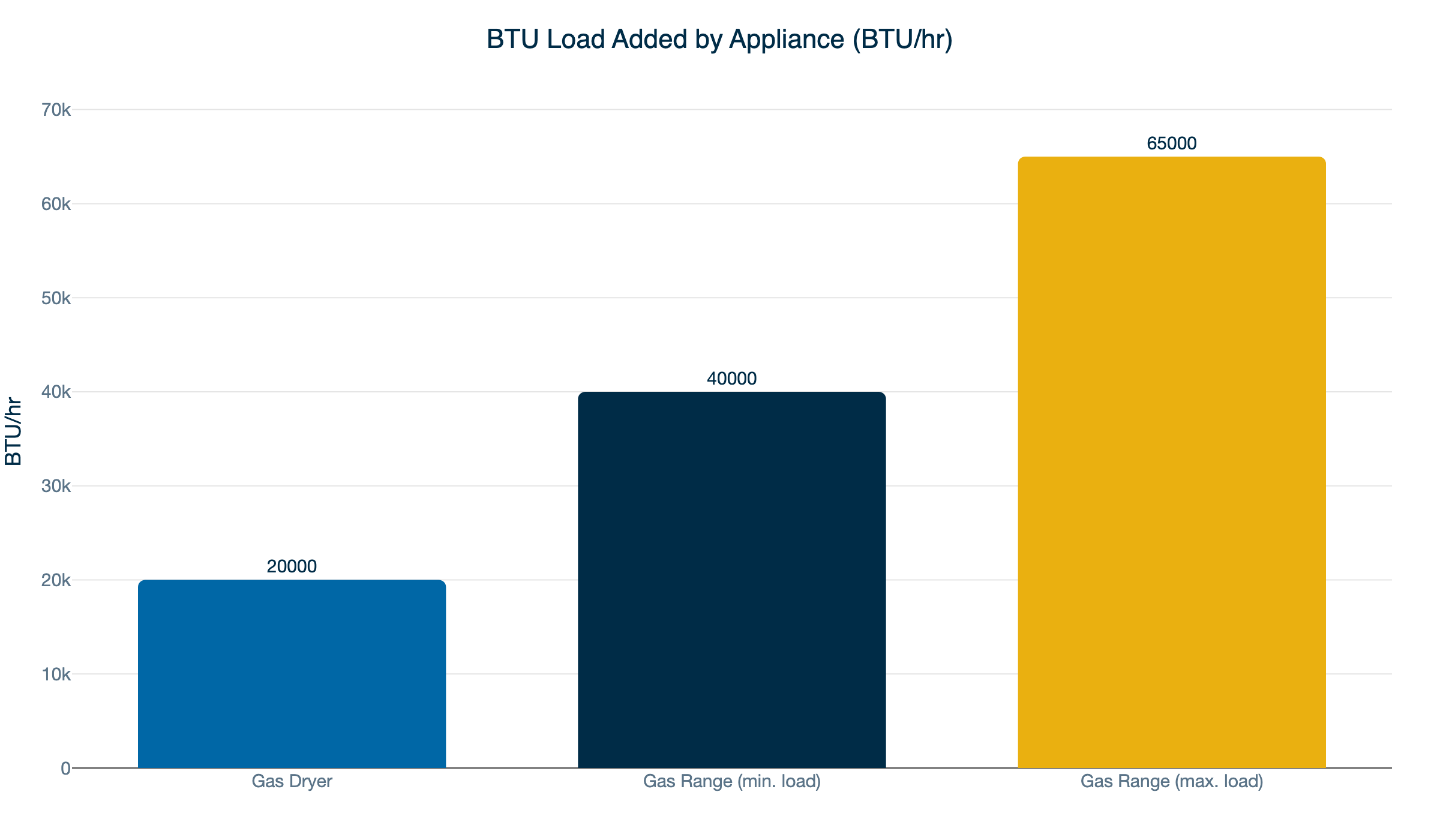
A standard gas dryer draws approximately 20,000 BTU/hr. A 30-inch gas range draws 40,000 to 65,000 BTU/hr. If your existing 1/2-inch branch near the furnace is already close to its limit, adding a high-BTU range on the same run creates problems.
If existing piping is undersized, the plumber must upsize it upstream before adding the branch. That adds scope to the project. It is better to know before work begins than to discover it mid-job.
What Pipe Material Will the Plumber Use?
Quick answer: Most residential branch lines today use corrugated stainless steel tubing, or CSST. It is flexible, faster to install than rigid black iron pipe, and code-compliant. CSST requires a listed bonding clamp at each fitting. Missing that clamp is the most common inspection failure on gas line additions.
CSST looks like a flexible yellow or black-jacketed corrugated tube. It bends around joists and fits through tight spaces without threaded joints at every direction change. That flexibility makes it the practical choice for running a branch line to a laundry room or behind a gas range.
The bonding requirement exists because CSST is susceptible to damage from nearby lightning strikes. A strike can arc through the corrugated walls and ignite gas. Every CSST segment must be bonded to the house electrical grounding system using a listed bonding clamp. Per IFGC Section 310 and NFPA 54, that clamp is required at each fitting. It is also the detail most often missing on non-licensed gas work.
Some plumbers use rigid black iron pipe for exposed runs or high-traffic areas. It is durable and does not carry the same bonding requirements as CSST. But it takes longer to install because threading equipment is required at each joint.
What Is a Pressure Test, and Why Is It Required?
Quick answer: A pressure test pressurizes the newly installed gas line to 1.5 times operating pressure for at least 10 minutes. Any pressure drop indicates a leak. The test must pass before gas is turned on or the DLI permit closes. It is required under MN Rule 1346.
For most residential gas systems at low pressure, the test runs at a minimum of 3 PSI for 10 minutes. If pressure drops at all during that window, the plumber locates and fixes the leak before the system is charged with gas.
The pressure test is not optional. A licensed plumber will not skip it. If someone offers to run a gas line and skip the test to save time, that is reason enough to find a different contractor.
DLI inspectors may review pressure test documentation during their visit. The permit does not close until the inspector confirms the work is correct.
What About CenterPoint Energy and the Gas Service Line?
Quick answer: CenterPoint Energy owns the service line from the street main to your meter. The contractor permit covers only the piping on your side of the meter. If the existing service line cannot handle the added BTU load, a CenterPoint service upgrade is required. That separate process can take two to six weeks.
CenterPoint Energy is the natural gas utility serving Minneapolis, St. Paul, and most of the Twin Cities metro. Xcel Energy serves some surrounding communities, including parts of the southwest metro.
The boundary between the utility and your home is the meter. CenterPoint owns everything from the main in the street up to and including the meter. The licensed plumbing contractor’s permit covers everything from the meter in.
For most branch line additions (one dryer or one range), the existing service is adequate. But if you are converting a previously all-electric home to gas, check total service capacity first. Your plumber handles this step before the branch line work begins. If capacity falls short, a CenterPoint service upgrade is a separate request. Plan for two to six weeks on the utility side if that step is needed.
A Note on Twin Cities Frost Depth
For interior branch line work (laundry room dryer, kitchen range), frost depth is not a factor. But if your project involves running a gas line to a detached garage or an outdoor appliance, it becomes a requirement.
The Twin Cities frost depth runs 42 to 48 inches. That is among the deepest in the continental United States. Any underground portion of a gas line routed to a detached structure must be buried below frost depth. It must also be sleeved where it penetrates the foundation.
No national guide mentions this detail. Most national articles are written for climates where frost depth is a minor constraint. A locally owned and operated Twin Cities plumbing team knows what the local inspection checklist includes. If your project involves running a line to a detached structure, confirm burial depth and foundation sleeve requirements with your contractor before any trenching begins.
How Long Does a Gas Line Addition Take in the Twin Cities?
Quick answer: On-site work for most residential branch line additions takes one to two days. DLI inspections in the Twin Cities metro typically occur within two to five business days. Budget one to two weeks from contract to closed permit.
The work itself is often faster than homeowners expect. A licensed plumber can run a CSST branch line from an existing supply to a laundry room or kitchen in a few hours. The shutoff valve installation, pressure test, and gas-up add time. If upstream piping needs resizing, that adds a day.
The permit and inspection timeline is the variable. DLI’s eLicense system processes applications online, so a permit can be active quickly. Inspection scheduling in the Twin Cities metro typically lands within two to five business days.
For a straightforward dryer or range branch line addition, plan on a one-week window from contract signing to closed permit.
What to Expect on Install Day
Your plumber will shut off the gas at the main valve before any work begins. Other gas appliances in your home (furnace, water heater, or existing gas range) will be off during the work.
The plumber will assess the existing supply line, confirm the branch point, and run the new line. If CSST is used, bonding clamps go at each fitting. A shutoff valve is installed at the appliance connection point. That allows the individual appliance to be isolated in the future without shutting off the whole house.
Once the line is run and all connections are made, the pressure test runs. If it holds, the gas is turned back on. All existing appliances are re-lit and confirmed working. The new connection is ready for the appliance hookup.
The appliance itself may be connected by the plumber during the same visit, or separately by the appliance delivery team. Confirm this with your contractor before install day so there are no gaps.
For more on what triggers a permit requirement for gas piping work in Minnesota, see our guide on gas line safety and permits in Minnesota.
Is Financing Available for a Gas Line Addition?
Quick answer: Financing is available for larger gas line projects. A single branch line to a dryer or range may not require it, but larger jobs (converting from electric to gas, running a line to a detached structure) can carry more scope and cost. Ask when you call or book online.
Ready to Add a Gas Line for Your Dryer or Range?
If you are upgrading to a gas dryer or gas range in the Twin Cities, the project starts with a licensed plumber. The permit comes from DLI. The inspection comes from DLI. The capacity check, pressure test, and CSST bonding are all required steps. All of them require a licensed professional.
Our gas line installation team is locally owned and operated in the Twin Cities. We pull the permit, do the work, schedule the DLI inspection, and make sure the job closes correctly. If anything with your existing gas piping needs attention before or after the install, our gas line repair team handles that too.
Our On-Time Guarantee(R) means we arrive in the window you pick, or we pay you $5 for every minute we are late, up to $300. “If there is any delay, it’s you we pay!”
Call us at (763) 296-1844 or book online to schedule a visit. We serve Minneapolis, St. Paul, Blaine, Bloomington, Brooklyn Park, Coon Rapids, Maple Grove, and the surrounding Twin Cities metro.
Frequently Asked Questions
Can I add a gas line myself in Minnesota? +
Who issues gas line permits in Minnesota? +
How long does it take to add a gas line in the Twin Cities? +
What BTU load does a gas dryer or range add? +
Need a technician now?