
How to Winterize Your Irrigation System in Minnesota
Key Takeaways
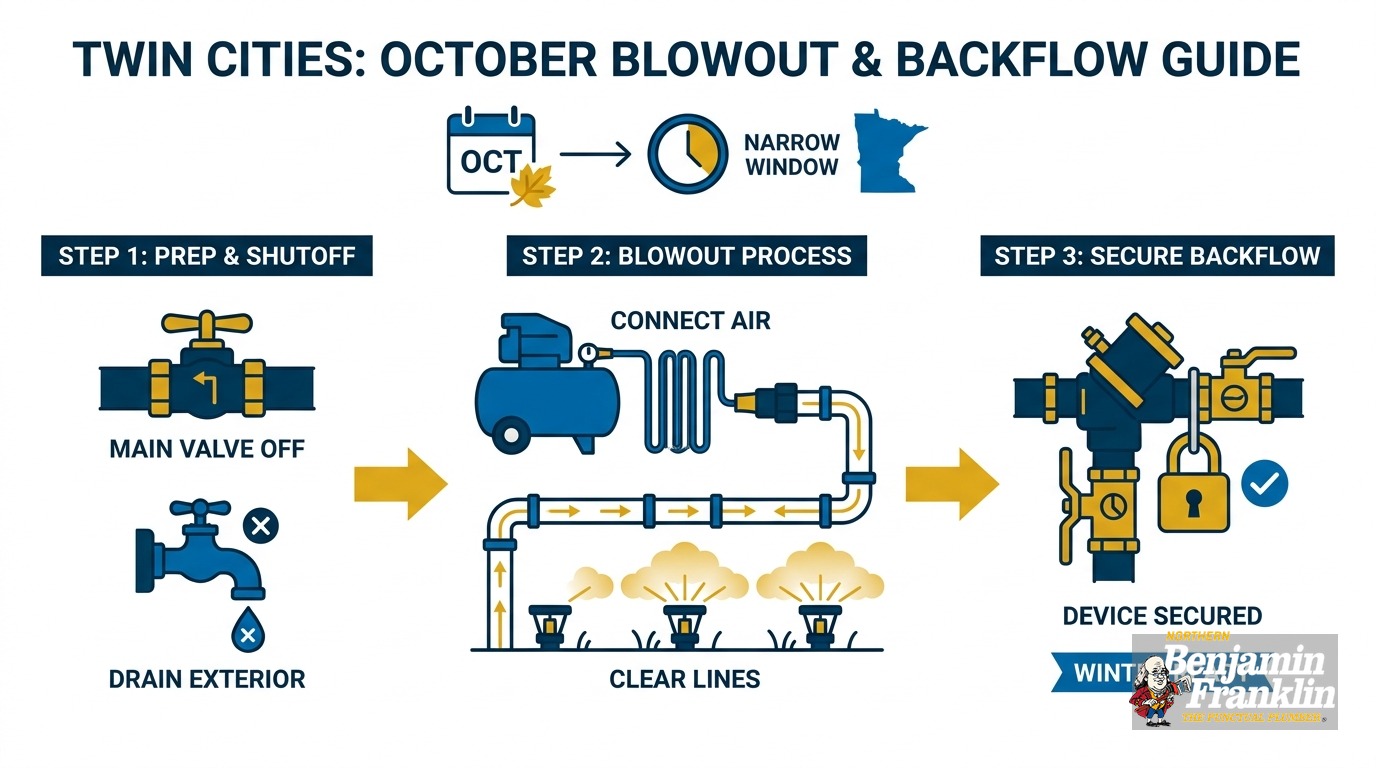
- The Twin Cities metro averages its first fall freeze October 1-10, per National Weather Service data. Blowout slots fill in late September.
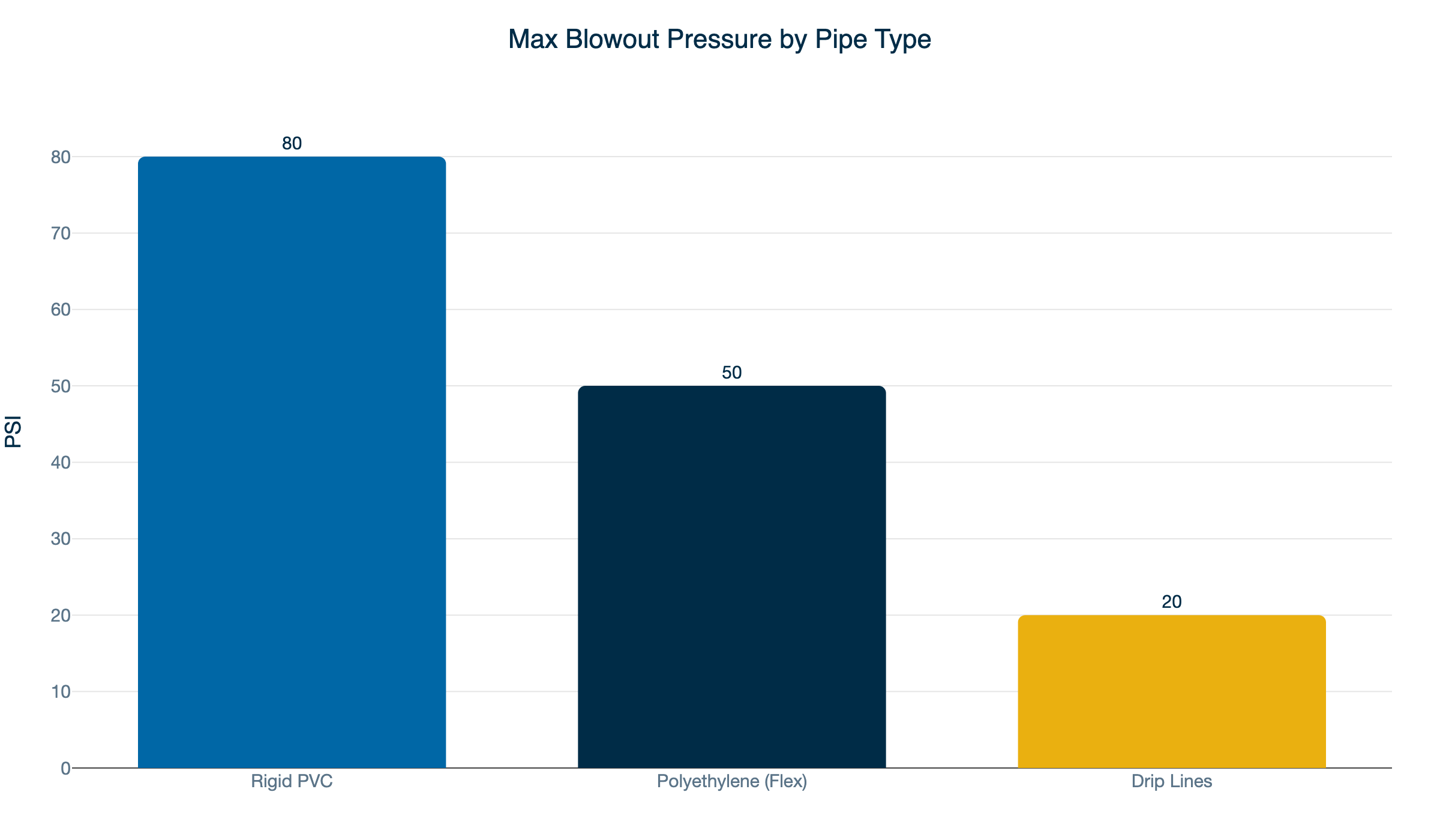
- Max blowout pressure depends on pipe material: 80 PSI for rigid PVC, 50 PSI for polyethylene flex pipe, and roughly 20 PSI for drip lines.
- Volume clears sprinkler lines, not just pressure. Professional crews use 100-185 CFM diesel compressors. A typical homeowner pancake compressor delivers about 2.5 CFM and cannot do the job safely.
- Annual backflow preventer testing is a Minnesota code requirement. Missing it is a violation, not a missed maintenance item.
- Backflow shutdown procedure differs by device type. PVBs leave ball valves at half-open. RPZ assemblies go to 45 degrees.
- Minneapolis runs a formal Regulated Backflow Assembly permit program. Certified testers must submit results to The Compliance Engine within 30 days.
If you want to winterize your irrigation system in Minnesota the right way, the window is September, not October. Here is what to do, in order, before the Twin Cities’ first freeze arrives.
Why Does the October Window Close So Fast in the Twin Cities?
The National Weather Service reports the Twin Cities metro averages its first fall freeze October 1-10. St. Cloud and communities north of the metro typically freeze by September 30. Irrigation technicians book their last September slots first. By the time nighttime temperatures start dipping, the schedule is already full.
The Old Farmer’s Almanac lists Minneapolis’s average first frost at October 13, using 1991-2020 climate normals. That date can mislead you. It is an average. Some years the freeze arrives a week earlier. A single hard night is enough to split a backflow preventer or crack rotor seals. Scheduling around the average means gambling on the unlucky years.
The smart booking window for most Twin Cities homeowners is the third or fourth week of September. That keeps a buffer before the median freeze date and aligns with what irrigation companies actually have open.
One more timing factor: if your backflow preventer has not been tested this year, that test needs to happen before you drain and shut the device down for winter. Book both tasks in one visit. It saves a second service call.
What Happens When You Miss the Deadline?
Water expands when it freezes and has nowhere to go inside a sealed irrigation line. PVC fittings crack. Polyethylene pipes split at couplings. Rotor heads can blow off their housings. A backflow preventer left full of water through a hard freeze can fracture its body, turning a routine annual test into an expensive replacement.
The damage typically stays hidden until spring startup. You pressurize the system and then find it: a wet patch in the lawn where a fitting let go underground, a zone that will not run, or a backflow preventer weeping through a seam you cannot see without disassembly.
Locally owned companies like Northern Benjamin Franklin Plumbing handle spring plumbing repairs across the Twin Cities every year. A disproportionate share of those calls trace back to irrigation systems left unblown when the temperature dropped. The repair is always more expensive than the winterization would have been.
How Do I Shut Off the Water Supply to My Irrigation System?
Find the dedicated irrigation ball valve on the supply line inside your home. Turn it fully closed. Do this before anything else. Without an isolated supply, the blowout is both ineffective and dangerous. This takes about 30 seconds and is the single most important step in the sequence.
Most Twin Cities homes place this shut-off near the water heater or in a utility room. Some older homes tapped the irrigation supply directly from an outdoor hose bib without a dedicated indoor valve. If that describes your system, you will need to close the main house water supply before blowing out the zones. A plumber can add a proper isolation valve if one is missing.
After closing the supply valve, open one zone manually through the controller. This bleeds residual pressure from the main supply line before you attach the blowout coupler. Attaching a compressor to a pressurized system is a safety hazard.
Not sure where your main shutoff is, or whether it actually closes fully? The post on finding and testing your main water shutoff valve walks through how to locate and verify it before you need it under pressure.
What Is a Backflow Preventer, and Why Is It Legally Required?
A backflow preventer stops irrigation water, which can carry fertilizer, pesticides, and soil bacteria, from flowing backward into your home’s drinking water supply. Minnesota requires one on every lawn irrigation system connected to a potable water line. The most common residential type is the pressure vacuum breaker, or PVB.
Most homeowners know the backflow preventer as the brass T-shaped fixture mounted above ground near where the irrigation supply exits the house. State code requires it installed at least 12 inches above the highest downstream sprinkler head to function correctly.
That above-grade position is also why it is the first component to freeze. Buried irrigation supply lines in the Twin Cities must be at least 12 inches below the maximum local frost depth per MN Rules 4714.0609. The Twin Cities design frost depth is approximately 48 inches, placing code-compliant buried mains around 60 inches below grade. The backflow preventer sits fully exposed above all of that.
If your system has a reduced pressure zone assembly, called an RPZ, instead of a PVB, the device looks different and shuts down differently. Both types are covered in the shutdown section below.
Is Annual Backflow Preventer Testing Required by Minnesota Law?
Yes. Minnesota Plumbing Code 4714.603.5.23, effective January 23, 2016, requires owners of testable backflow devices to have them tested annually by a certified tester. This is not a best practice or a recommendation. It is a code requirement, and skipping it is a violation.
The credential that matters is the BT (Backflow Prevention Tester) certification. The Minnesota Department of Labor and Industry requires BT holders to carry a current ASSE 5110 certification. A plumber without that credential cannot perform a legally compliant test. Experience alone does not satisfy the requirement.
Minneapolis adds another layer. The city runs a Regulated Backflow Assembly permit program. Certified testers must register with The Compliance Engine and submit results digitally within 30 days of testing. Questions about the program go to BackflowPrevention@minneapolismn.gov.
Structure Tech estimates backflow testing at $150-250 per device. That figure is theirs, not a quote from Northern Benjamin Franklin Plumbing. Rolling the test into the same fall visit as your blowout keeps it to one service call instead of two.
What PSI Should I Use When Blowing Out Sprinklers?
Stay at or below 80 PSI for rigid PVC, 50 PSI for polyethylene flex pipe, and roughly 20 PSI for drip lines. These are the maximum operating limits for each pipe material. Exceed them and you crack fittings, melt rotor seals, or blow nozzles off heads.
The PSI limits are not conservative estimates. They reflect the physical pressure ratings of each material. Most Twin Cities homes built before 1990 used Schedule 40 PVC for irrigation mains. Homes built or repiped after that often used polyethylene flex. If you are not sure which material your system uses, look at the lateral lines running from zone valves toward the heads. Black corrugated pipe is polyethylene. White or gray rigid pipe is PVC.
Blow each zone separately. Never run two zones at the same time during the blowout. Cycle through each zone in two or three passes of 30-60 seconds each. Stop when no water vapor comes from the heads. Running a dry zone too long risks overheating rotor seals from hot, dry compressed air. The goal is no trapped water, not a bone-dry pipe wall.
Why Won’t My Home Compressor Work for a Sprinkler Blowout?
The issue is CFM, not PSI. CFM stands for cubic feet per minute. It measures how much air a compressor delivers continuously. Your home compressor may reach the right pressure, but it cannot sustain the volume the job requires. Professional crews use diesel compressors rated at 100 to 185 CFM. A standard homeowner pancake compressor delivers about 2.5 CFM.
The CFM needed for a zone is calculated from the zone’s total flow in gallons per minute, divided by 7.5. Most irrigation mains on 3/4-inch or 1-inch supply lines flow well above that threshold. A 2.5 CFM compressor is built for inflating tires and running finish nailers. It is not built for this task.
What happens when a homeowner tries to compensate with a small tank? The tank empties in two seconds. The heads pop up and retract once. The lines stay wet. Repeating the cycle a dozen times does not solve the volume problem.
Safety applies here too. Wear ANSI-rated eye protection during any blowout. Never stand directly over sprinkler heads or backflow components while air is flowing. A fitting failure under pressure can send components across the yard.
Backflow Preventer Shutdown: PVB vs. RPZ
The correct winter position differs by device type. Using the wrong procedure can leave trapped water in a chamber that freezes and fractures the housing.
PVB (pressure vacuum breaker): Exercise both ball valves and all test cocks several times before settling them into the winter position. Move each valve back and forth to clear debris from the seats. For winter, leave both ball valves in the half-open position. This allows residual water to drain through the vent port and lets the internal float relieve any freeze expansion. Never apply compressed air directly to the rubber poppet or float inside the body. The PVB drains through its vent port by design. Let it do that.
RPZ (reduced pressure zone assembly): An RPZ has two independent check valve chambers. Drain each zone using the test cocks. Position the isolation ball valves at 45 degrees for winter. The partial-open position lets the assembly relieve pressure from freeze expansion without holding the spring-loaded check valves in a fully compressed state through months of cold.
Not sure which device you have? The PVB has a single vent port visible on top of the body and must be installed above the highest sprinkler head. An RPZ has two test cock ports and typically installs near grade. When in doubt, call a licensed plumber to identify the device before you attempt the shutdown. Getting it wrong costs more than the service visit.
What Should I Do With the Irrigation Controller?
Leave it powered on. Cutting power through winter can cause solenoid coils to lose tension and stick in the closed position. Zone valves may then fail to open when you run startup tests in spring. Set all watering programs to zero or use rain mode, but keep the unit plugged in.
If your controller has a “rain mode” or “seasonal off” setting, use it. This disables all watering schedules while keeping the clock, zone electronics, and solenoid coils live. If there is no rain mode, set all program start times to none and all run times to zero.
Take a few minutes before you close out the season. Walk each zone and note anything that did not run cleanly this summer: a head that stayed down, a zone that was slower than the others, or coverage that looked uneven. Add a note to the controller or take a phone photo. Spring startup is faster when the service list already exists.
The Complete Minnesota Irrigation Winterization Checklist
Work through these steps in order. Do not move to the blowout before the supply is closed and the backflow preventer is ready.
- Close the irrigation supply valve. Find the dedicated ball valve indoors. Turn it fully closed.
- Relieve system pressure. Manually trigger one zone at the controller to bleed residual pressure from the supply line.
- Schedule backflow preventer testing. If you have not had the device tested this calendar year, book a BT-certified tester. Minneapolis homeowners need a tester registered with The Compliance Engine.
- Attach the blowout coupler. Use the quick-connect fitting at the system’s blowout port. Confirm the compressor is a professional high-CFM unit, not a homeowner tank.
- Blow each zone individually. Hold to pressure limits: 80 PSI for PVC, 50 PSI for polyethylene. Run 30-60 second passes until no water vapor exits the heads.
- Shut down the backflow preventer. PVBs go to half-open ball valves. RPZ isolation valves go to 45 degrees. Do not apply air directly to rubber seals.
- Set the controller. Rain mode or zero run times. Leave the unit powered.
- Walk the yard. Confirm all heads have retracted. Mark any zones that need spring attention.
For a broader look at fall plumbing tasks beyond irrigation, the guide on 10 essential fall plumbing prep tips covers the full indoor and outdoor scope.
Book Before the October Rush
The September booking window is real. National Weather Service data shows average first freeze dates of October 1-10 for the Twin Cities metro. That means service slots are gone before the first cold snap arrives. Calling in October is often calling too late.
Northern Benjamin Franklin Plumbing is locally owned and operated right here in the Twin Cities. Our team sends licensed plumbers, not subcontractors, on every job. Our On-Time Guarantee(R) means we arrive in the window you pick, or we pay you $5 for every minute we are late, up to $300. “If there is any delay, it’s you we pay!”
A plumber on our team can handle backflow preventer testing and the mechanical shutdown in one visit. We can coordinate the blowout as part of a full winterization package so nothing gets missed before the cold sets in.
Ready to get on the calendar? Call (763) 296-1844 or book online today. Do not wait for the forecast to change.
For everything else your home’s plumbing needs this fall, the Twin Cities homeowner’s guide to preventing frozen pipes covers the full indoor picture. And when spring arrives, the frost-free hose bib spring leak check walks through what to inspect at outdoor water connections before you re-pressurize the system.
Frequently Asked Questions
When should I winterize my irrigation system in Minnesota? +
Can I blow out my own sprinkler system with a home air compressor? +
Is backflow preventer testing required by law in Minnesota? +
What PSI should I use to blow out sprinklers? +
Need a technician now?