
What Temperature Do Pipes Freeze in a Minnesota House?
Key Takeaways
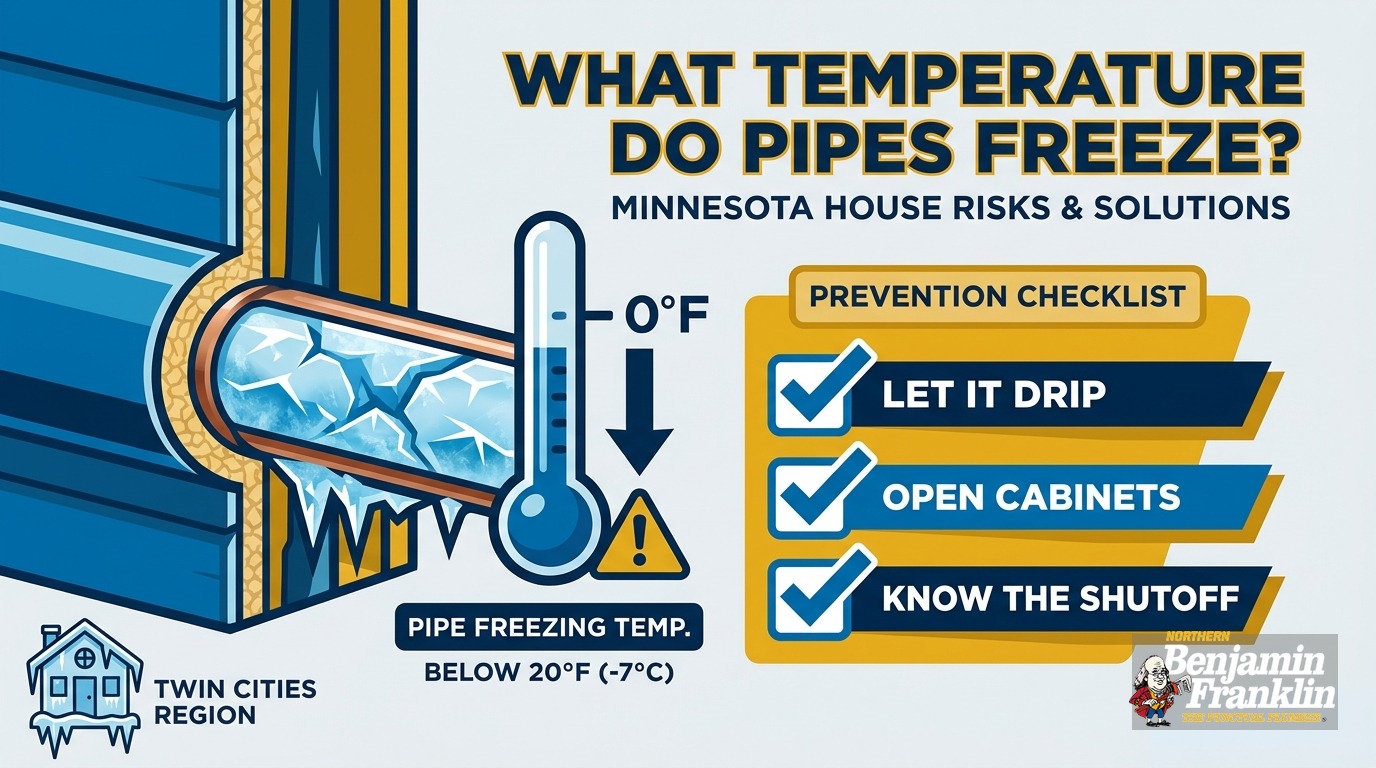
- The critical threshold is 20°F outdoors, not 32°F. Insulated wall cavities buffer interior pipes until outdoor air sustains that level for several hours.
- Duration matters. A single night at 20°F carries different risk than three days below zero.
- Wind chill accelerates freezing even above 20°F when cold air reaches a pipe through a crack or gap.
- Your buried water service line almost certainly will not freeze. Code-required burial depth in the Twin Cities keeps it well below the frost line under typical conditions.
- The three highest-risk spots in most Minnesota homes: exterior wall cavities, unheated attached garages, and homes left unoccupied with the thermostat set too low.
- Prevention is free. A dripping faucet, open cabinet doors, and a 55°F minimum thermostat will get most homes through a cold snap.
- If you lose water flow on a cold morning, shut your main water valve first. Then call a plumber. Skip the open flame.
What Temperature Do Pipes Freeze?
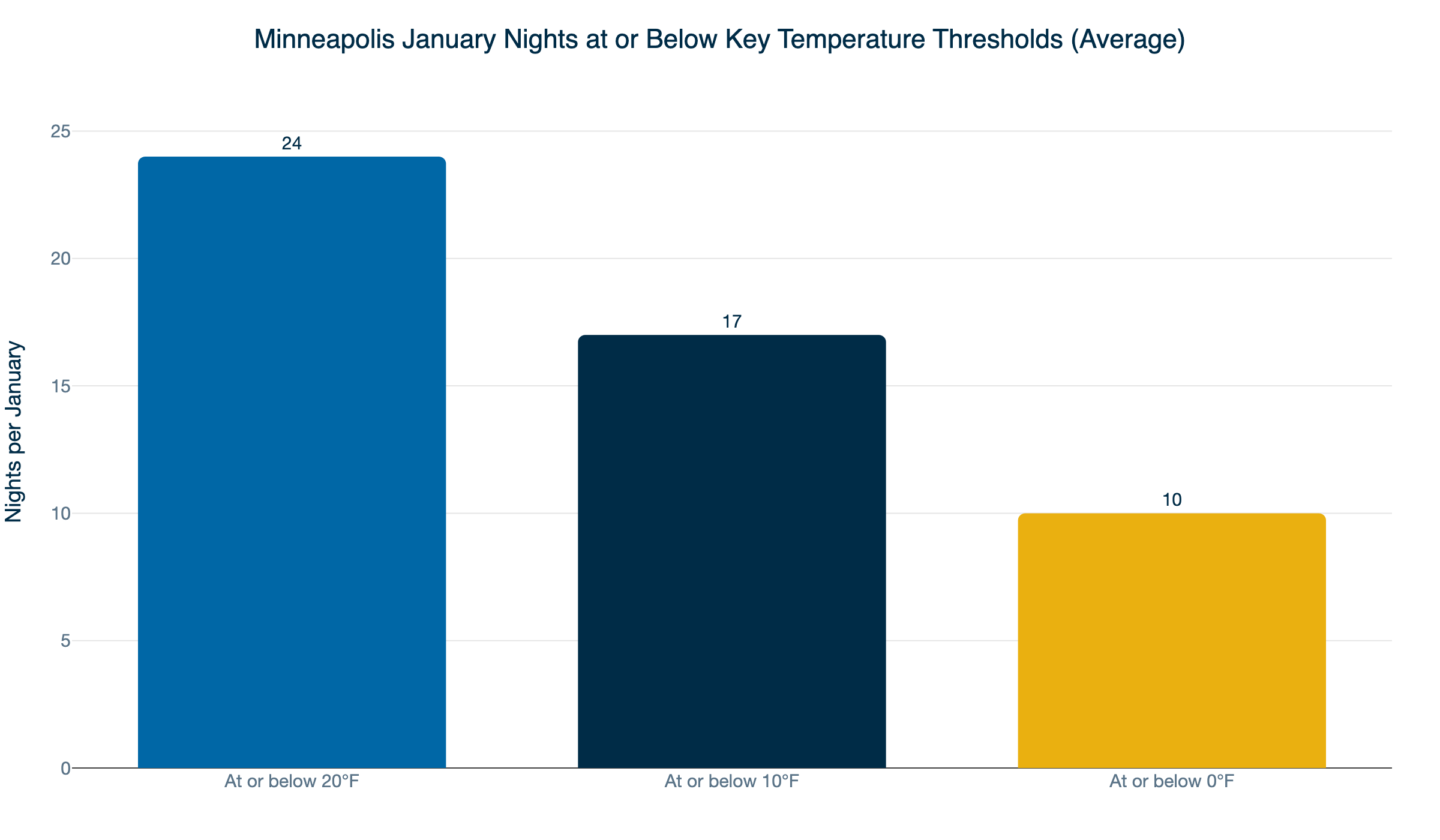
The number to know is 20°F, not 32°F. Research from the University of Illinois Building Research Council found that uninsulated pipes in unconditioned spaces begin to freeze when outdoor temperatures drop to 20°F. In Minneapolis, that threshold hits on roughly 24 nights every January. The gap between 20°F and 32°F is exactly where most frozen pipes happen.
Why Does the 20°F Threshold Matter More Than the Freezing Point?
Answer: Water freezes at 32°F, but your interior pipes are buffered from outdoor air by insulation, drywall, and building heat. The University of Illinois Building Research Council found that sustained outdoor temperatures at or below 20°F are what push an uninsulated interior pipe below freezing. Below that point, risk climbs fast.
The difference comes down to the layers between outdoor air and your pipe. A pipe running through an insulated interior wall cavity sits behind exterior sheathing, insulation, and drywall. That stack keeps it several degrees warmer than the outside air. A pipe in an uninsulated exterior wall cavity, a crawl space without vapor barrier, or an unheated attached garage has almost no buffer at all.
Wind chill compounds the problem. The University of Illinois research also found that cold air entering through foundation cracks, penetrations around conduit, or gaps at rim joists can cause freezing even when the thermometer reads above 20°F. The pipe does not know what the thermometer says. It knows how cold the air touching it is.
For Twin Cities homeowners, this translates to unavoidable winter exposure. Minneapolis averages 10 nights at or below 0°F, 17 nights at or below 10°F, and 24 nights at or below 20°F in a typical January. January 2026 pushed further than average. The metro recorded a low of -21°F on January 23, and logged 12 nights below zero, exceeding the 50-year average of 10. That is not an outlier anymore. It is the climate this area actually has.
The Three Scenarios Where Pipes Actually Freeze in Minnesota
Not every pipe in your home carries the same risk. Understanding where freeze events actually happen helps you focus your attention before a cold snap, not after one.
Scenario 1: The buried water service line
This is the pipe most homeowners worry about first, and it is typically the least likely to freeze.
Minnesota Plumbing Code, MN Rule 4714.0609, requires that building supply and yard piping be buried no less than 12 inches below the maximum local frost depth. In the Twin Cities metro, the design frost depth is 42 to 48 inches, which puts a code-compliant service line 54 to 60 inches below the surface at minimum. Extreme winters can push actual frost penetration toward 60 inches, but those depths rarely reach a properly buried line.
Minneapolis Public Works notes that if your service line has never frozen before, it is unlikely to freeze now. The exceptions are when the basement entry area around the line goes unheated, the pipe enters through a rim joist area open to cold air, or an unusually deep frost event pushes penetration to record levels.
If your service line does freeze, the ownership split matters. The city owns the main and the section from the main to the curb stop. You own everything from the curb stop to your meter, including the cost to thaw or replace it. The Minneapolis water emergency line is 612-673-5600.
Scenario 2: Interior pipes in exterior wall cavities and unheated spaces
This is where most freeze events actually occur.
Think about the pipe under your kitchen sink on the north wall of a 1960s split-level. That wall likely has less insulation than current code requires, and the pipe may sit closer to the exterior sheathing than the interior finish. When outdoor air sustains 20°F or below through the night, that pipe is vulnerable.
The same logic applies to:
- Pipes running through an unheated attached garage, especially where a water line crosses to a hose bib or utility sink
- Pipes in a crawl space with a missing or damaged vapor barrier
- Any pipe near a foundation sill plate where air infiltration is common
- Pipes serving an exterior hose bib if the frost-free valve is not functioning or was never installed
Research finds that 37% of all frozen pipe failures occur in basements, often near the point where a pipe approaches an exterior wall. And the burst rarely happens at the ice plug. It happens downstream of the plug, between the ice and a closed faucet, because pressure has nowhere to go. You can have ice in one place and a rupture in a completely different section of the line.
For guidance on identifying the specific configurations in older Twin Cities homes that create this exposure, see our post on pipe insulation and exterior wall freeze risk.
Scenario 3: Vacation and unoccupied homes
Leaving a Minnesota home unoccupied during winter introduces a separate category of risk. A house with the thermostat set back to 50°F to save on heating costs can seem like a reasonable compromise. In practice, it is not.
The American Red Cross recommends keeping your thermostat at the same temperature day and night, no lower than 55°F when the home will be unoccupied. At 55°F ambient temperature, wall cavity temperatures drop enough that exterior-wall pipes may fall below 32°F during a sustained cold night. The margin is smaller than most people expect.
There is also an insurance angle. A standard homeowners policy covers water damage from a burst pipe, but that coverage can be voided if the home was left unoccupied without heat. Read the fine print before you leave for three weeks in January.
What Temperature Do Pipes Freeze in an Unheated Garage or Crawl Space?
Answer: An unheated attached garage provides almost no frost protection once outdoor temperatures drop to 20°F. Interior garage air tracks outdoor air within a few degrees. Pipes crossing through that space can freeze in a matter of hours during a sustained cold snap, even though the garage is attached to a heated home.
An attached garage wall is one of the most dangerous spots in a Minnesota home for freeze risk, and one of the least discussed. Homeowners often assume that because the garage is physically attached, it shares some residual building heat. It does not, unless there is a dedicated heat source inside. The wall between the garage and the living space is insulated. The garage itself typically is not heated.
If your home has a water line running through the garage to a utility sink or a hose bib on the back wall, that line needs pipe insulation, a heat trace cable, or both. The better long-term fix is rerouting the line through conditioned space, but not every home’s layout allows for that.
A vented crawl space in Minnesota carries similar risk. Vents that stay open through winter allow cold air to circulate directly under the floor above. If your crawl space has pipes running through it, those vents need to be closed or insulated for the cold months, and the crawl space itself should be inspected for gaps at the rim joist.
How Long Does It Take for Pipes to Freeze Once Temperatures Drop?
Answer: Duration matters as much as temperature. An uninsulated pipe with direct exposure to 20°F air can begin to ice up within a few hours. A pipe inside an insulated wall cavity requires a sustained cold period, typically six or more hours at 20°F or colder, before freeze risk becomes significant.
The key variable is how much insulation stands between the pipe and outdoor air. A pipe fully exposed in an unheated garage moves toward freezing far faster than one buffered by wall insulation and building heat.
A few practical implications for Twin Cities winters:
- A single cold night, where temperatures drop to 15°F and rebound above 20°F before morning, carries moderate risk for the most exposed pipes.
- A multi-day cold snap with overnight lows in the single digits or below zero puts nearly all unprotected exterior-wall pipes at real risk. The metro sees conditions like this every year.
- Losing power during a sustained cold snap removes the one thing keeping wall cavity temperatures above the freeze threshold. If power goes out for 12 or more hours in a -10°F cold snap, let multiple faucets run, open all cabinet doors under exterior-wall sinks, and prioritize heat restoration.
What Should You Do If a Pipe Is Already Frozen?
Answer: Shut off the main water supply valve before you do anything else. If the pipe has already burst, this limits how much water enters your home. If it has not yet burst, this gives you time to locate and thaw the freeze safely. Do not skip this step.
Step by step:
- Shut off the main water shutoff valve. If you are not sure where it is, our guide on finding and testing your main water shutoff valve walks through locating it before you are in an emergency.
- Open a faucet downstream of the suspected freeze. This releases pressure and gives water a path out as the pipe begins to thaw.
- Locate the frozen section. Check the area closest to an exterior wall, unheated space, or visible air gap. Touch the pipes. The frozen section will be noticeably colder than the surrounding lines.
- Apply gentle, indirect heat. A hair dryer on low, an electric space heater aimed nearby, or warm towels wrapped around the pipe. Never use an open flame. Never use a propane torch.
- Call a licensed plumber if you cannot locate the frozen section, if water does not flow after thawing what you found, or if you suspect the pipe may have already split.
A pipe that freezes once is more likely to freeze again at the same spot. After the emergency resolves, identify why it froze and correct it before the next cold snap. For detailed guidance on the thaw process, see our post on how to thaw frozen pipes in Minnesota.
How to Protect Your Pipes Before Temperatures Drop
Prevention takes less time than you might expect, and it costs almost nothing.
Before the season starts:
- Disconnect and drain all outdoor hoses before the first hard freeze. A hose left attached traps water against the hose bib valve. That water can freeze and crack even a frost-free bib.
- Inspect crawl space vents and close or insulate them for winter.
- Check insulation in any exterior wall cavity where you know a pipe runs. Foam pipe insulation sleeves are a low-cost fix you can install in an afternoon.
- If your home has a known vulnerable spot, such as a north-wall sink or a garage water line, install heat trace cable before cold weather arrives.
During a cold snap:
- Let cold water drip from faucets on exterior walls. A pencil-width trickle is enough to prevent freeze in most cases.
- Open cabinet doors under sinks on exterior walls. Warm air from the room circulates around the pipes and slows the temperature drop.
- Keep the thermostat set to the same temperature day and night. The overnight dip in heating is when most freeze events happen.
- Do not dial the thermostat below 55°F if you are leaving the home unoccupied.
These steps come from American Red Cross prevention guidelines and Minneapolis Public Works recommendations for homeowners during cold weather events.
What Does a Frozen Pipe Cost If Prevention Fails?
The figures are worth understanding before you need them.
Burst and frozen pipes cost the insurance industry $1.4 billion per year. State Farm alone received more than 20,000 claims from 2024 through mid-2025, averaging over $30,000 per claim.
For Minneapolis specifically, water damage restoration averages $3,250, with a typical range of $1,400 to $6,250. Polar vortex burst pipe jobs tend to push toward the upper end of that range. The combination of drywall replacement, flooring removal, and mold remediation adds up fast.
Your homeowners policy covers the resulting water damage, not the pipe itself. And coverage can be voided if the home was unoccupied without heat. If you experience a burst, document everything before cleanup begins. Call your insurer before you call a restoration company.
The pipe repair is a job for a licensed plumber. The scope depends on where the break is, what pipe material your home has, and whether access requires opening a wall or floor. For a real estimate on your specific situation, call us at (763) 296-1844.
When to Call a Plumber vs. Handle It Yourself
Most prevention steps are DIY. Most emergencies are not.
Call Northern Benjamin Franklin Plumbing when:
- You have lost water flow to part or all of your home on a cold morning.
- You can hear that a pipe has burst but cannot locate it.
- You suspect a pipe has burst inside a wall and water is not yet visible.
- You have thawed a visible frozen section but water still will not flow, meaning the freeze is somewhere else in the system.
- You want a plumber to identify your home’s vulnerable spots before the next cold snap rather than after one.
We are locally owned and operated in the Twin Cities, and our On-Time Guarantee(R) means we arrive in the window we commit to. If there is any delay, it’s you we pay. Call us at (763) 296-1844 or book online. We serve Minneapolis, St. Paul, and the surrounding metro including Blaine, Bloomington, Brooklyn Park, Coon Rapids, and Maple Grove.
If a freeze event has you thinking more broadly about your home’s plumbing health, a plumbing maintenance visit before the coldest months of the year is a good investment.
Key Takeaways
- 20°F is the threshold. Minneapolis hits that temperature or below on roughly 24 nights per January. That is the number to watch, not 32°F.
- Your buried service line is probably safe. Code-required burial depths keep it below the frost line. Focus your attention on interior pipes near exterior walls and unheated spaces.
- Three scenarios drive most freeze events: pipes in exterior wall cavities, pipes through unheated garages or crawl spaces, and unoccupied homes with the thermostat set too low.
- Duration matters. A few hours at 20°F is different from three days below zero.
- Prevention is cheap. Dripping faucets, open cabinet doors, and a 55°F minimum thermostat setting will get most homes through a cold snap without incident.
- If a pipe freezes, shut the main valve first. Then call a licensed plumber. Skip the open flame.
- Insurance covers the damage, not the pipe. And it can void coverage if the home was unoccupied without heat.
For burst or frozen pipe repair in the Twin Cities, call Northern Benjamin Franklin Plumbing at (763) 296-1844 or book online. We will be there when we say we will.
Frequently Asked Questions
At what temperature do pipes freeze? +
How long does it take for pipes to freeze? +
Which pipes in a Minnesota home are most likely to freeze? +
What should I do if I turn on a faucet and nothing comes out in winter? +
Need a technician now?