
Sump Pump Discharge Line Frozen: Why Your Pump Dies First
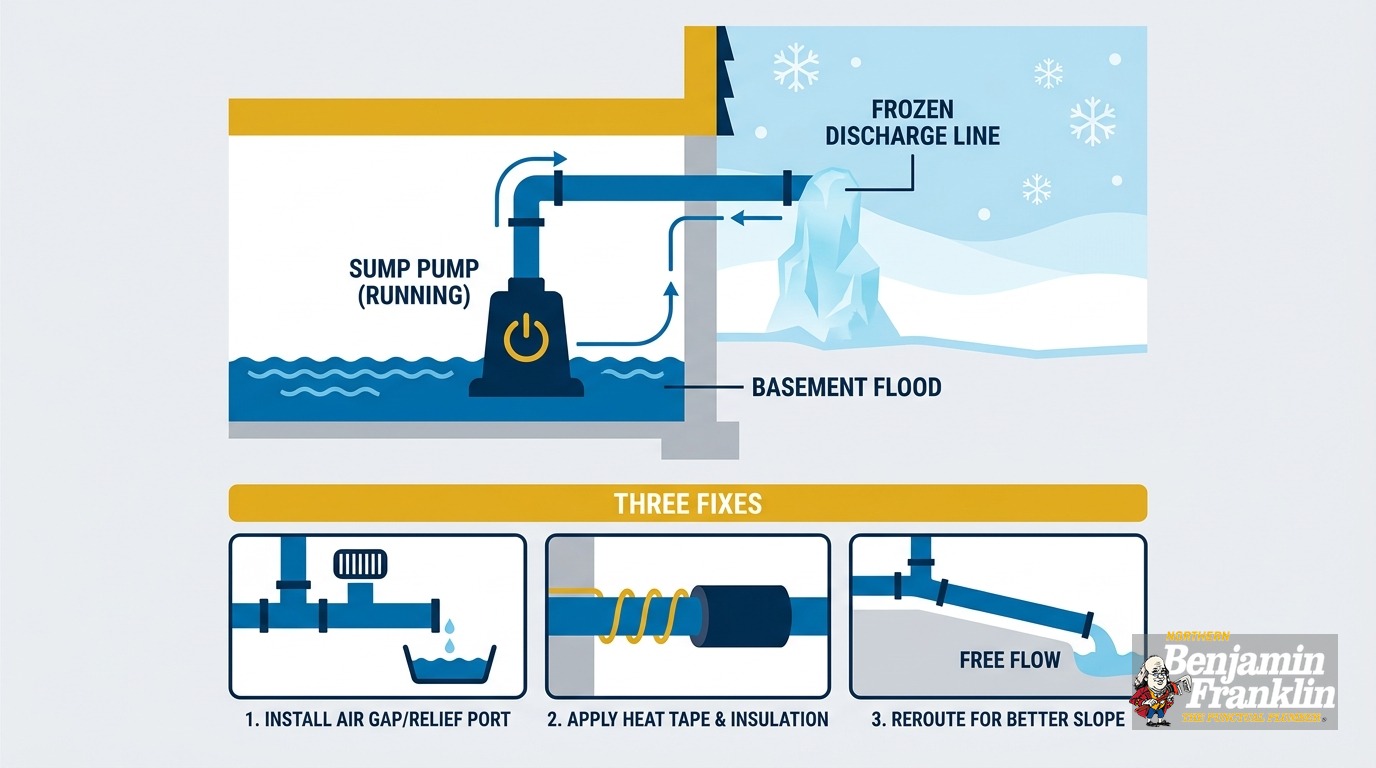
Key Takeaways
- A frozen sump pump discharge line rarely announces itself. The first sign is often a wet basement weeks after the pump burned out.
- Standing water trapped in the line after each pump cycle is the root cause. That water freezes, grows into a plug, and eventually blocks discharge entirely.
- Twin Cities frost depth is 42 inches. A standard residential discharge line buried 12 to 18 inches sits inside the frost zone all winter.
- Three fixes work: correct the slope, upsize to 2-inch rigid PVC, or add self-regulating heat cable. Each fits a different line configuration.
- Freeze guards (IceGuard-type fittings) release water next to the foundation - the opposite of what your pump is designed to do. Avoid them.
- Rerouting or extending a discharge line requires a plumbing permit in Minneapolis and St. Paul.
The Failure That Floods Basements in March
When a sump pump discharge line frozen solid is the problem, the basement doesn’t flood right away. The flood comes in March or April, during snowmelt, when groundwater pressure peaks. By then, the pump burned out weeks earlier - running continuously against a blocked line with nowhere to send the water.
Most homeowners never connect those two events. The dry basement in February feels like proof everything is fine. It isn’t. The pump was already failing.
This post explains the exact failure sequence, why February in the Twin Cities is when the damage compounds, and the three fixes that break the cycle. We are locally owned and operated, serving Minneapolis, St. Paul, Blaine, Bloomington, Brooklyn Park, Coon Rapids, Maple Grove, and the surrounding metro. We see this pattern on calls every spring. The cause almost always started forming in January.
Why does a sump pump discharge line freeze?
Standing water in the pipe is the cause. After the pump shuts off, a column of water stays in the discharge line, held there by the check valve. In a Twin Cities winter, that water sits against pipe walls that have dropped to or below the ambient air temperature. It freezes. Each pump cycle deposits more water behind the growing ice plug, and the blockage grows incrementally.
PJ’s Plumbing describes this mechanism directly: the line doesn’t freeze all at once. It closes off gradually. Over days or weeks, the plug extends from the coldest section of the pipe outward in both directions. By the time the pump can’t discharge at all, the blockage may span several feet.
The coldest sections are predictable. Wherever the pipe exits the house, wherever it runs above grade, and wherever it passes through the rim joist - these are the initiation points. Ice forms there first and grows toward both ends.
Minneapolis averages a February high of 24°F and a low of 11°F, with wind chills reaching well below zero during cold snaps. Any exposed or shallowly buried section of discharge line will drop to freezing temperatures overnight, repeatedly, for weeks. The conditions that cause this failure aren’t unusual. They’re the normal Twin Cities winter.
How does a frozen discharge line kill your sump pump?
When discharge is fully blocked, the pump runs continuously but can’t move water. The float switch fires every time groundwater enters the pit. The pump responds, but the blocked line sends pressure backward with no outlet for flow.
Acculevel explains the consequence: a pump running against zero discharge operates at dead head - maximum pressure, zero flow. The motor draws full amperage without moving any water. In some cases the motor fails within hours. In others it struggles for days before it burns out.
The timing is the cruel part. The pump fails in deep winter, when the water table is at a seasonal low. The basement stays dry. You might hear the pump cycling more than usual. You might not notice anything at all.
Then March arrives. The frost releases. Snowmelt saturates the soil. Groundwater pressure climbs to its annual peak. The pump switch triggers - and nothing responds. The one system built to protect your basement is already dead.
Catching a frozen line early requires checking the discharge point during cold snaps. If the pump is running indoors and no water is flowing outside, the line is likely blocked. That is the moment to call. Once the motor burns out, the job becomes sump pump repair plus urgent cleanup - not a prevention call.
Why is February the most dangerous month for Twin Cities sump pumps?
February is when all the conditions peak simultaneously. Ground frost has been accumulating since November and is at its maximum depth. Snowfall averages 10.8 snow days that month, more than any other month of the year in Minneapolis. And daytime temperatures are beginning to trend warmer, starting freeze-thaw cycling at the surface that adds moisture to the soil. The pump runs more. The line is at its most restricted. The intersection is lethal.
Minnesota’s frost depth for Hennepin and Ramsey counties is 42 inches, set under MN Rules 1303.1600. Northern Minnesota counties require 60 inches. A standard residential discharge line is buried 12 to 18 inches below grade. That pipe is inside the frost zone for the entire winter.
The Minnesota Plumbing Code requires buried pipes to sit 12 inches below the maximum local frost depth - which would mean 54 inches for Twin Cities installations. No standard residential discharge line is installed anywhere near that depth. The gap between code depth and typical installation depth is not a compliance failure specific to one home. It’s a design reality the industry acknowledges, and it’s why slope, pipe spec, and supplemental heat are the tools available.
Burying the line deeper is not a realistic fix for most homeowners. The three fixes below work within real installation constraints.
Fix 1: Correct the slope before anything else
The most effective and least invasive fix is ensuring the discharge line drains completely after every pump cycle. Water that drains out of the pipe doesn’t freeze inside it. Water that sits does.
PJ’s Plumbing identifies slope correction as the primary prevention fix for discharge lines in cold climates. A properly sloped line runs continuously downhill from the pump to the discharge point, with no sags, low spots, or long horizontal sections that hold water between cycles.
Flexible corrugated discharge hose is the most common culprit. It loses pitch over time, sags at supports, and creates low-point pockets. Replacing it with rigid PVC, secured to maintain continuous slope, addresses the root cause directly. Even a quarter-inch drop per foot is sufficient to drain the line fully.
The challenge is the route. If the line runs horizontally through a rim joist or crawl space before turning downward, that section traps water regardless of what comes after it. A plumber can assess whether the existing routing can hold slope or whether a new exit path is needed.
This fix is worth doing first because every other fix depends on it. Heat cable on a sagging line still leaves pooled water in the low spots. A larger pipe with a sag holds more pooled water than a smaller pipe with one. Slope is the foundation the other fixes build on.
One note from Family Handyman: dropping a 1.5-inch discharge line into a buried 4-inch pipe with an air gap lets water still exit the upper opening even if the buried section freezes. It’s a secondary layer worth knowing about, but it doesn’t substitute for slope. In a 42-inch frost-depth climate, it’s an additional safeguard, not the main fix.
Is rigid 2-inch PVC worth the upgrade?
For most Twin Cities homes that have had a frozen discharge line, yes. Standard lines use 1.5-inch pipe. A 2-inch pipe is stiffer, holds pitch better over long runs, and its larger interior means the same volume of standing water occupies a smaller fraction of the cross-section - making it slower to freeze solid.
Acculevel recommends upsizing to 2-inch rigid PVC as a standalone prevention measure for cold-climate homes. The geometry supports it: a 2-inch pipe has roughly 78% more interior area than a 1.5-inch pipe. Ice forms at the pipe wall and grows inward. A larger pipe requires more wall coverage before the restriction becomes critical.
The rigidity benefit matters separately. Rigid PVC holds the slope you set. Flexible hose doesn’t. Done together, slope correction and pipe upsizing address the two main causes of standing water with one repair.
The upgrade requires a compatible fitting at the pump outlet. Most residential pumps ship with a 1.5-inch port, though many include a 2-inch adapter. A plumber confirms the right connection before starting. This is also a good moment to have the pump inspected. A motor that has run against a frozen line, even briefly, may have wear that isn’t yet showing.
Should I add heat cable to my sump pump discharge line?
Self-regulating heat cable is the most reliable prevention layer for homes that freeze a discharge line repeatedly, or where the outdoor pipe run is long and exposed to the elements. The cable wraps around the pipe, connects to a standard outlet, and draws power only when ambient temperature drops near freezing. It doesn’t run continuously and doesn’t require monitoring.
Acculevel identifies heat cable as the most reliable fix for deep-cold climates. Pairing it with closed-cell foam pipe insulation reduces the rate of heat loss the cable has to compensate for, which means less frequent activation and lower operating cost over the winter.
The limiting factor is power access. The cable needs an outlet near where the pipe exits the house. An exterior outlet on the back or side of the home works. So does an indoor outlet near the rim joist if the cable can reach the outdoor section through the penetration. If neither is available, adding an outlet is an additional step before the cable work can start.
Heat cable does not fix a slope problem. Water pooled in a low-spot pocket will still freeze, even with cable installed. The correct sequence is: fix slope, upsize to rigid PVC if the run warrants it, then add cable as the final layer. Each fix reduces a different risk. None replaces the others entirely.
Are freeze guards safe to install?
No, for most Twin Cities homes. A freeze guard fitting - sometimes sold under the name IceGuard - is designed to open a side relief port when pressure builds from a blocked discharge line. The idea is to give the pump somewhere to send water before the motor burns out.
The problem is where that port releases water. Acculevel argues directly against freeze guards for this reason: the relief port sits at or near the foundation wall. On frozen ground, water released there has nowhere to absorb. It pools against the foundation, refreezes, and creates hydrostatic pressure against the very wall your sump system is designed to protect.
For a home with a steep grade away from the foundation, the risk is lower. But for a typical Twin Cities lot with flat or gently sloped grade and clay soil that drains slowly in winter, a freeze guard can turn a pump burnout into a foundation infiltration event. One failure trades for another.
The right fix is to keep the line from freezing in the first place. The three fixes above do that. A freeze guard is an emergency valve, and the emergency it creates can be worse than the one it prevents.
Does rerouting the discharge line need a permit?
Yes. In Minneapolis and St. Paul, any piping installation or replacement is plumbing work under Minnesota code and requires a permit. That includes extending the line, rerouting it, burying it deeper, or adding a new discharge exit point.
Calldeans Plumbing has documented this clearly: both cities require permits for new piping and replacements. Work done without a permit may not be covered by homeowner’s insurance if something goes wrong, and it won’t be inspected against code requirements for slope, setback, and discharge location.
Those requirements exist for good reasons. The discharge point must be at least 10 feet from the foundation. It cannot drain onto a sidewalk, street, or neighbor’s property. And it cannot connect to the sanitary sewer. Discharging groundwater into the sanitary system is prohibited under Minnesota rules because it overwhelms treatment capacity with water that doesn’t need treatment.
A licensed plumber pulls the permit as part of the job. There is no separate step for you. The inspection also catches problems that wouldn’t surface until the next hard freeze.
Get an assessment before the next cold snap
The prevention window is now. The emergency window is February, after the line is already frozen and the pump is already running against it.
If you had a wet basement after last winter, or if your pump ran longer than usual during cold stretches, a discharge line assessment is the right starting point. A plumber can evaluate slope, pipe spec, and the outdoor run, and recommend which combination of fixes fits your specific installation.
Our team serves Minneapolis, St. Paul, and the full Twin Cities metro. We’re locally owned and operated, and we back every appointment with the On-Time Guarantee(R): arrive in the window you pick, or we pay you $5 for every minute we are late, up to $300. “If there is any delay, it’s you we pay!”
Call (763) 296-1844 or book a sump pump service online. For more on protecting your home through the winter, see our Twin Cities winterizing guide and our overview of winter plumbing risks homeowners often overlook.
Frequently Asked Questions
What happens when a sump pump discharge line freezes solid? +
How do I thaw a frozen sump pump discharge line? +
What are the best fixes for a frozen sump pump discharge line? +
Does rerouting a sump pump discharge line require a permit in Minneapolis? +
Need a technician now?