
How Long Does a Sump Pump Last? Twin Cities Guide
Key Takeaways
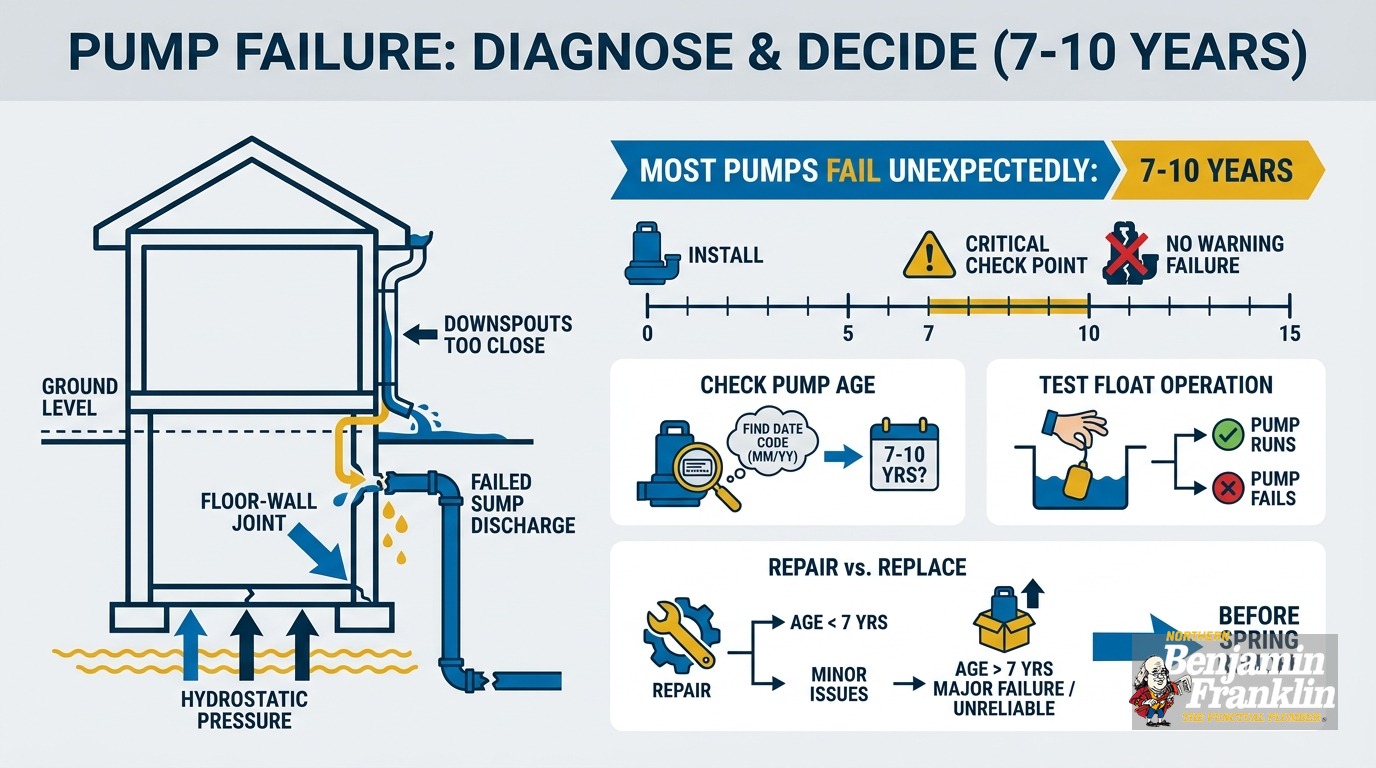
- How long does a sump pump last? Most units reach end of life between 7 and 10 years. Well-maintained pumps can reach 12.
- Pumps fail silently. Most homeowners learn about a dead pump when the basement floods.
- Test yours in January or February, before Twin Cities groundwater starts rising.
- A 15-minute check covers three things: find the manufacture date, test the float with water, and walk the exterior discharge line.
- Replace when the repair quote exceeds roughly 50% of a new pump’s installed cost, or when the pump is 7 or more years old.
- Standard Minnesota homeowners insurance excludes sump pump failure. A separate endorsement runs roughly $40-$75 per year.
- Northern Benjamin Franklin Plumbing is locally owned and operated in the Twin Cities. Call (763) 296-1844 or schedule a sump pump check.
How Long Does a Sump Pump Last?
Most sump pumps last between 7 and 10 years. A well-maintained unit can reach 12, according to Michigan Basements and ARS. But the range comes with a catch that most guides leave out.
Sump pumps run only when the water table rises high enough to fill the pit. In a dry year, a pump might cycle a handful of times. In a wet spring, it can run for days straight. The motor wears based on total run hours, not calendar years. A 6-year-old pump in a low-water area may have accumulated less wear than a 4-year-old pump in a clay-heavy neighborhood with a high water table.
That is also why pumps fail silently. A pump sitting in a dark corner of the basement can stop working entirely and nobody notices. The float switch seizes. The impeller corrodes. The motor winds down. And then April arrives and the ground thaws.
ARS notes that most owners don’t know the pump has died until the pit overflows. In the Twin Cities, that moment usually falls during snowmelt season. There is no time to schedule a replacement when water is already on the floor.
Minnesota conditions also push the lower end of the lifespan range. Pumps here run hard in spring and fall. They sit idle through dry summers. Then they face the worst conditions of the year all at once, during early snowmelt. That pattern of burst use and long dormancy is harder on components than steady year-round cycling. A calendar age alone does not tell the whole story.
The fix is not faster reaction. It is earlier inspection.
Why January or February Is the Right Window
Here is the timing insight that most online guides skip entirely.
USGS research on Minnesota groundwater shows that the largest single increase in groundwater storage in Minnesota happens in spring. Frozen soil cannot absorb snowmelt. The water saturates the ground instead. Twin Cities soil is clay-rich. It holds that water pressed against foundations for weeks.
MnDOT frost depth data puts Twin Cities frost at 18-28 inches in mid-February. That detail matters for the discharge line. A pump that cannot push water through a frozen or blocked outlet runs continuously and produces no flow. It burns out in hours. That is a distinct Minnesota failure mode. None of the major online guides address it.
First Call Restoration reports that sump pump failure is the most-reported cause of spring basement flooding in the Twin Cities. Clay soil keeps groundwater elevated for weeks after the initial melt, long past the first weekend a homeowner notices a damp floor.
Check in January or February for three concrete reasons:
- Discharge line freeze-ups are still visible and testable. Frost is in the ground. A blocked outlet is something you can see and address.
- You have 6-8 weeks before the March-April surge. That is enough lead time to schedule a non-emergency replacement.
- A planned replacement runs on your schedule. An emergency call during peak season does not.
For the full picture on what spring groundwater does to Twin Cities basements, see our post on spring runoff and sump pump preparedness.
How Do You Find Your Pump’s Age?
The manufacture date is usually stamped on the motor housing or on a label on the pump’s side. It may appear as a four-digit year, a full date, or a manufacturer’s date code. Pull the pit cover and look with a flashlight.
If nothing appears on the pump, check the original purchase receipt, a home inspection report, or a permit record with your city. Permits are public record in most Twin Cities municipalities and usually list the installation date.
If no date exists and no record exists, treat the pump as old. A pump of unknown age in a Twin Cities home has almost certainly crossed the 7-year mark. That alone is reason to test it.
Once you have the age, run the three-step test. It takes about 15 minutes.
Step 1: Record the date. Note the year. If the pump is 7 or older, proceed carefully through steps 2 and 3. If it is 10 or older, start a replacement conversation regardless of the test outcome.
Step 2: Test the float. Pour 2-3 gallons of water slowly into the pit. Watch the float arm or float ball rise as the level climbs. The pump should kick on before the water reaches the inlet screen. Once it starts, confirm:
- It sounds like a low, steady hum rather than grinding or rattling
- The water level drops within 30-60 seconds
- The pump shuts off cleanly when the float drops back down
If the pump does not start, the float switch may be stuck or the motor may be dead. If the pump runs but the water level does not drop, the impeller may be clogged or the check valve may have failed. A stuck float switch that keeps the pump running continuously can burn the motor out in months rather than years, according to Michigan Basements.
Step 3: Walk the discharge line. Follow the pipe from the pit to the exterior wall, then trace it to the outlet outside. Confirm:
- The outlet is not buried in packed snow or ice
- The pipe has not kinked or shifted where it exits the foundation
- The outlet points at least 6-10 feet away from the foundation
A plugged outlet means the pump runs and goes nowhere. That is the scenario that kills pumps in the first week of April. For the full picture on that failure mode, see our guide on frozen sump pump discharge lines in Minnesota.
What Are the Warning Signs a Sump Pump Is Failing?
Many pumps give no warning before they die. When signals do appear, they usually involve unusual noise, constant cycling, visible rust or iron-bacteria slime, heavy vibration, or no activation on the float test. Annual manual testing catches failures that no symptom ever announces.
Unusual noise. Grinding or rattling during a cycle usually means debris in the impeller or a bearing wearing out. A healthy pump runs with a low, even hum. Any mechanical clatter is a reason to investigate.
Constant running. A pump that never stops has either a stuck float switch or a failed check valve. Both conditions accelerate motor wear. What should last 10 years can wind down in months under continuous load.
Visible rust or slime. Iron bacteria thrive in groundwater, not in municipal tap water. They form a gel-like slime that clogs impellers and float switches. Saint Paul Regional Water Services reports that finished tap water runs at roughly 90 parts per million hardness after lime softening. That is moderate. But the water sitting in your sump pit comes from the ground, not the municipal supply. Iron bacteria growth is a routine maintenance concern in Minnesota groundwater specifically.
Heavy vibration. Strong shaking during a cycle usually points to a bent or debris-damaged impeller running off-balance. Left alone, it accelerates motor shaft wear well beyond normal.
No activation during the float test. Pour 3 gallons into the pit and watch. If nothing happens, the pump is dead or the switch is stuck down. Both need service before spring.
Age over 7 years with no recent testing. Silent failure is the norm, not the exception. A pump past its median lifespan that has never been manually tested is a standing risk.
How Long Does a Sump Pump Last if It Runs Continuously?
A pump running without stopping can fail in months rather than years. Continuous operation is not a quirk of the plumbing system. It is a failure mode in progress.
Normal pump operation cycles on and off. Water rises, the float trips the switch, the pump clears the pit, the float drops, the pump shuts off. Each cycle takes seconds to a minute or two. Between cycles there is silence.
If the pump runs and never stops, the likely causes are:
- A float switch stuck in the “on” position
- A failed check valve that lets discharged water flow back into the pit, forcing the pump to clear the same water repeatedly
- True high inflow, where groundwater is entering faster than the pump can remove it
The first two require a service call. The third may require a higher-capacity pump or a second unit. All three need attention before the motor gives out entirely.
If you walk past your utility area and the pump is always running, call for a diagnosis now. Do not wait until the next scheduled check.
Should You Repair or Replace Your Sump Pump?
Replace when the repair estimate exceeds roughly 50% of the installed cost of a new unit. Apply the same rule to any pump that is 7 or more years old, even if it currently appears functional. This guidance comes from Triple O and Foundation ResQ. A repair buys time. A replacement resets the clock.
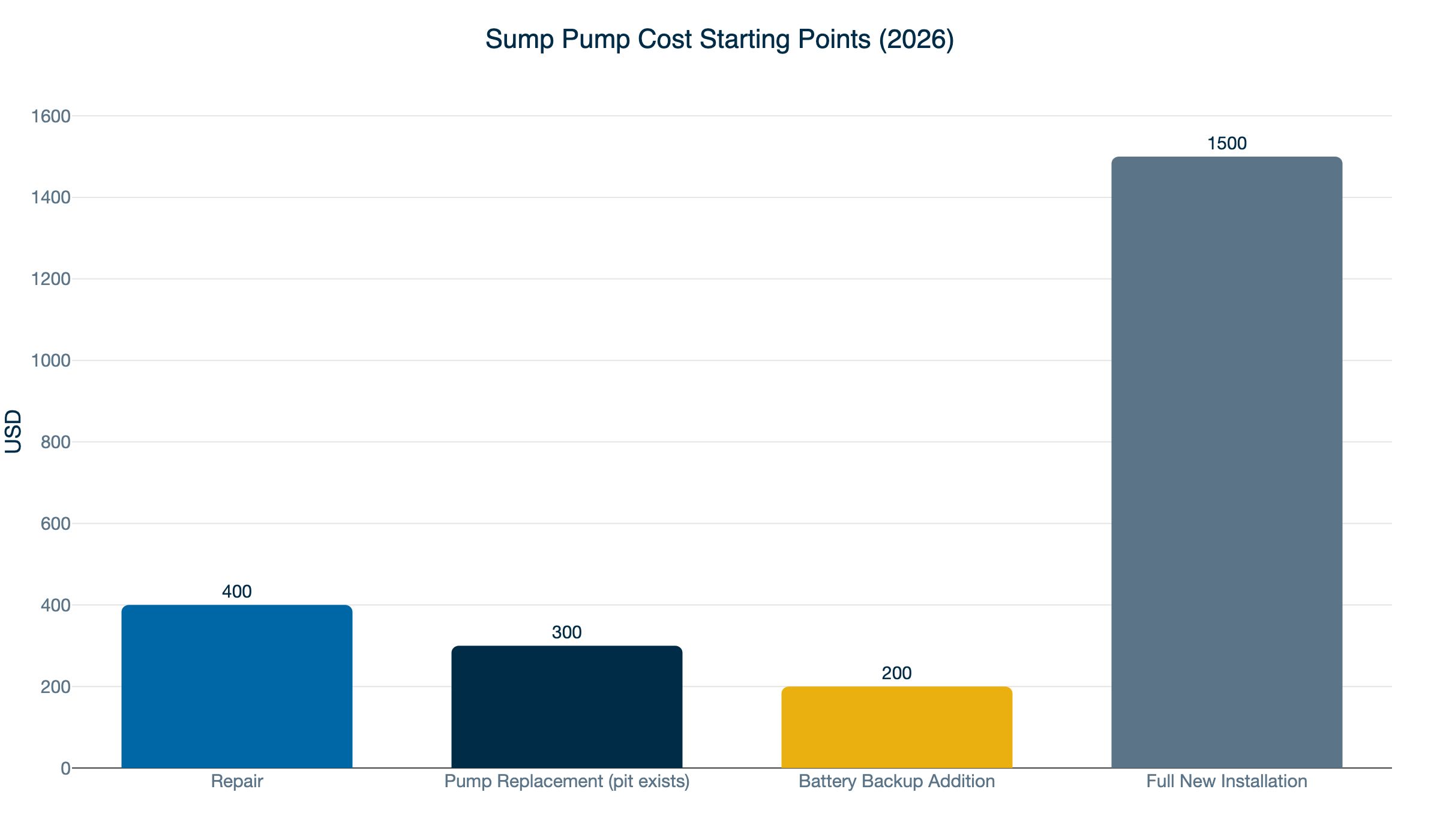
Here is how the 2026 cost data plays out using published third-party sources:
- Repair: $400-$550, per HomeAdvisor
- Replacement into an existing pit: $300-$700 installed, per Angi
- Battery backup unit addition: $200-$600, per Angi
- Full new installation with pit excavation: $1,500-$3,500, per This Old House
Notice where the repair and replacement ranges overlap. When a repair quote approaches $300 or higher, installing a brand-new pump into the same pit often costs the same or less. A new unit also comes with a fresh 7-10 year service window. For a pump protecting a finished basement, the argument for replacement over repair is even stronger. The cost of one flooded basement exceeds the cost of a new pump.
Adding a battery backup at the same time makes sense if your current pump lacks one. Spring storms in Minnesota routinely knock out power for hours. A backup unit keeps the pump running through a grid outage. Our battery backup guide for Minnesota homeowners covers what to look for and when the investment makes sense.
To get a direct answer on your specific unit, call (763) 296-1844 or book an evaluation online.
The Insurance Gap Most Twin Cities Homeowners Miss
Standard homeowners insurance in Minnesota excludes sump pump failure, sewer backup, and water seeping through basement walls. This is the default policy structure in the state. The Minnesota Department of Commerce confirms it.
A separate sump pump and sewer backup endorsement is available. It typically runs $40-$75 per year in the Twin Cities and covers $5,000-$50,000 in damage. Without that rider, a flooded basement from a pump failure is an out-of-pocket expense.
Federal flood insurance does not fill the gap. The MN DNR is direct about it: NFIP flood policies do not cover personal property in basements or finished basement spaces.
One more consideration: even if you add the endorsement today, losses that occurred before the endorsement took effect are not covered retroactively. Call your agent before spring, not after the basement floods. Verify the endorsement is active, check the deductible, and confirm the coverage limit.
Make two calls before spring. First: test or replace your pump. Second: call your insurance agent and confirm exactly what your policy covers.
What Does Minnesota Code Require for a Sump Pit?
At minimum, a code-compliant installation requires a bolted, gasketed cover over the pit and a vent pipe that runs through the roof. The discharge line must terminate at daylight on the exterior, not connect to the sanitary sewer system. These are the code minimums under MN Plumbing Code Chapter 4714, Section 710.10, and they are not optional.
The discharge rule surprises some homeowners. Routing the discharge into the sanitary sewer overloads municipal wastewater treatment infrastructure, per the MN Pollution Control Agency. The line must go to daylight at the exterior and must point away from the foundation. Directed toward a neighbor’s property or a downspout also creates problems. Aim for at least 6-10 feet from the house.
After a flood event, one additional point applies. Electrical wiring that was submerged by floodwater must be replaced before use, according to the MN Department of Labor and Industry. A submersible sump pump motor can survive inundation. The wiring feeding it may not pass inspection after a flood.
How Can You Extend Your Sump Pump’s Life?
Annual testing, a functioning check valve, a clear inlet screen, and a confirmed exterior discharge outlet are the four maintenance habits that matter most. A battery backup extends protection through power outages. None of these require more than a few minutes per year.
Run the annual float test. Once a year, pour 2-3 gallons into the pit and confirm normal cycling. Do it in January or February. That is the window when it matters.
Check the check valve. This fitting sits on the discharge pipe, about 12-18 inches above the pit. It prevents discharged water from running back in. A failed check valve causes short cycling that wears the motor fast. The part typically costs $20-$50 and is straightforward to swap.
Clear the inlet screen. Iron bacteria slime and small debris collect at the pump’s intake. A quick rinse with clean water clears it. Wear rubber gloves when working in the pit.
Inspect the exterior outlet each fall. Before the ground freezes, confirm the outlet is not obstructed. Verify it has a freeze-protection fitting or a standpipe that prevents an ice plug from forming inside. A sealed outlet in January is invisible until the first major snowmelt, at which point the pump burns out before most homeowners notice anything is wrong.
Consider a battery backup. Spring storms in the Twin Cities knock out power for hours at a time, often during the same events that send the most groundwater against foundations. A backup unit keeps the pump running through both.
Schedule Before the Spring Rush
Sump pump service call volume nationally increased 32% year-over-year into 2026, peaking between March and May. In the Twin Cities, that demand compresses into a narrow window around initial snowmelt. Every plumbing company in the metro fills up fast. Scheduling in January or February means your appointment is on your terms, not on a first-available calendar in April.
Northern Benjamin Franklin Plumbing is locally owned and operated. We serve Minneapolis, St. Paul, Blaine, Bloomington, Brooklyn Park, Coon Rapids, Maple Grove, and the surrounding metro. Every appointment is backed by the On-Time Guarantee(R): we arrive in the window you pick, or we pay you $5 for every minute we are late, up to $300. If there is any delay, it’s you we pay!
That is a written commitment. In a season when every crew is stretched and showing up on time is the exception, it is also a meaningful one.
Call (763) 296-1844 or schedule a sump pump inspection online before the spring rush fills the calendar.
Frequently Asked Questions
How long does a sump pump last on average? +
When is the best time to check a sump pump in Minnesota? +
What is the repair-vs.-replace rule for sump pumps? +
Does standard homeowners insurance cover sump pump failure in Minnesota? +
Need a technician now?