
Sump Pump Battery Backup: Why Your Primary Isn't Enough
Key Takeaways
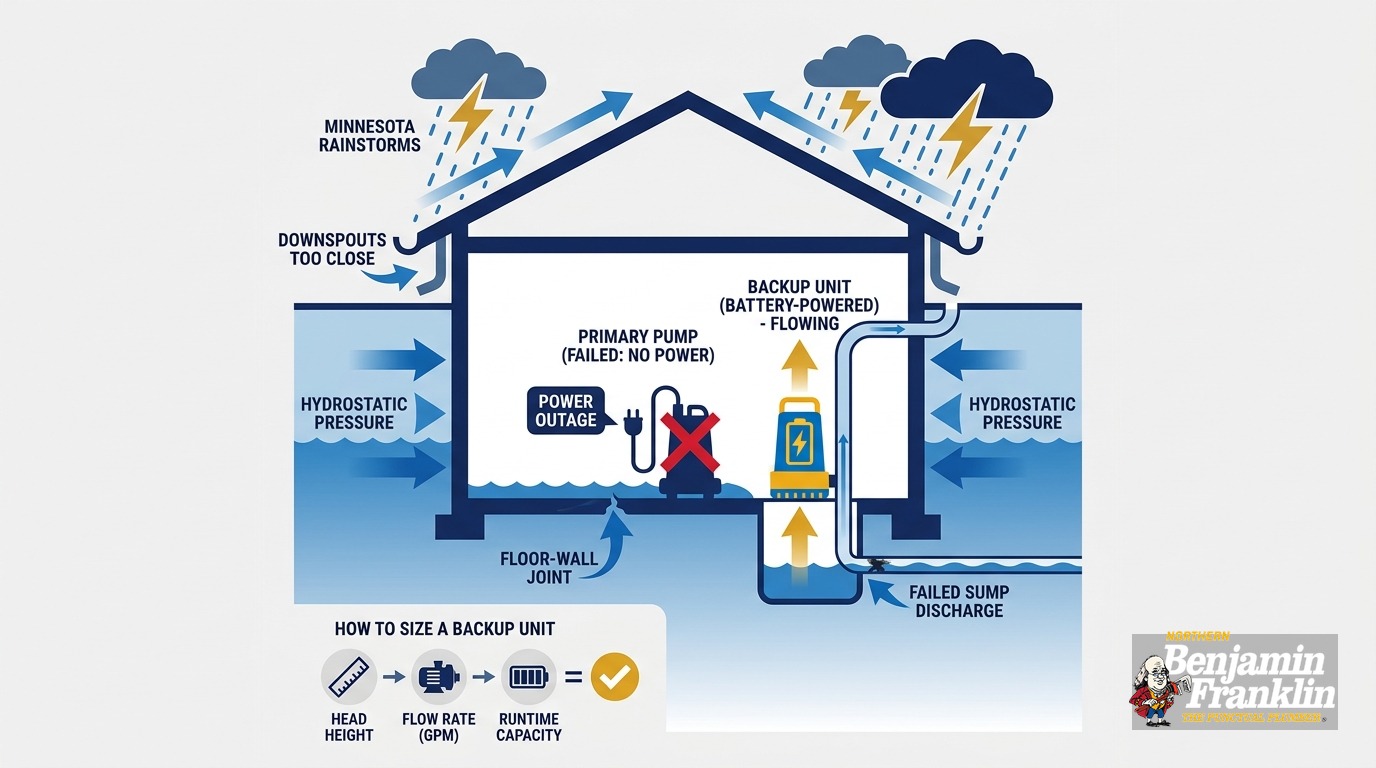
- A sump pump battery backup solves the one failure your primary pump cannot handle on its own: simultaneous flooding and power loss.
- The worst storms produce the highest inflow AND are the most likely to knock out your power. These two risks arrive together, not separately.
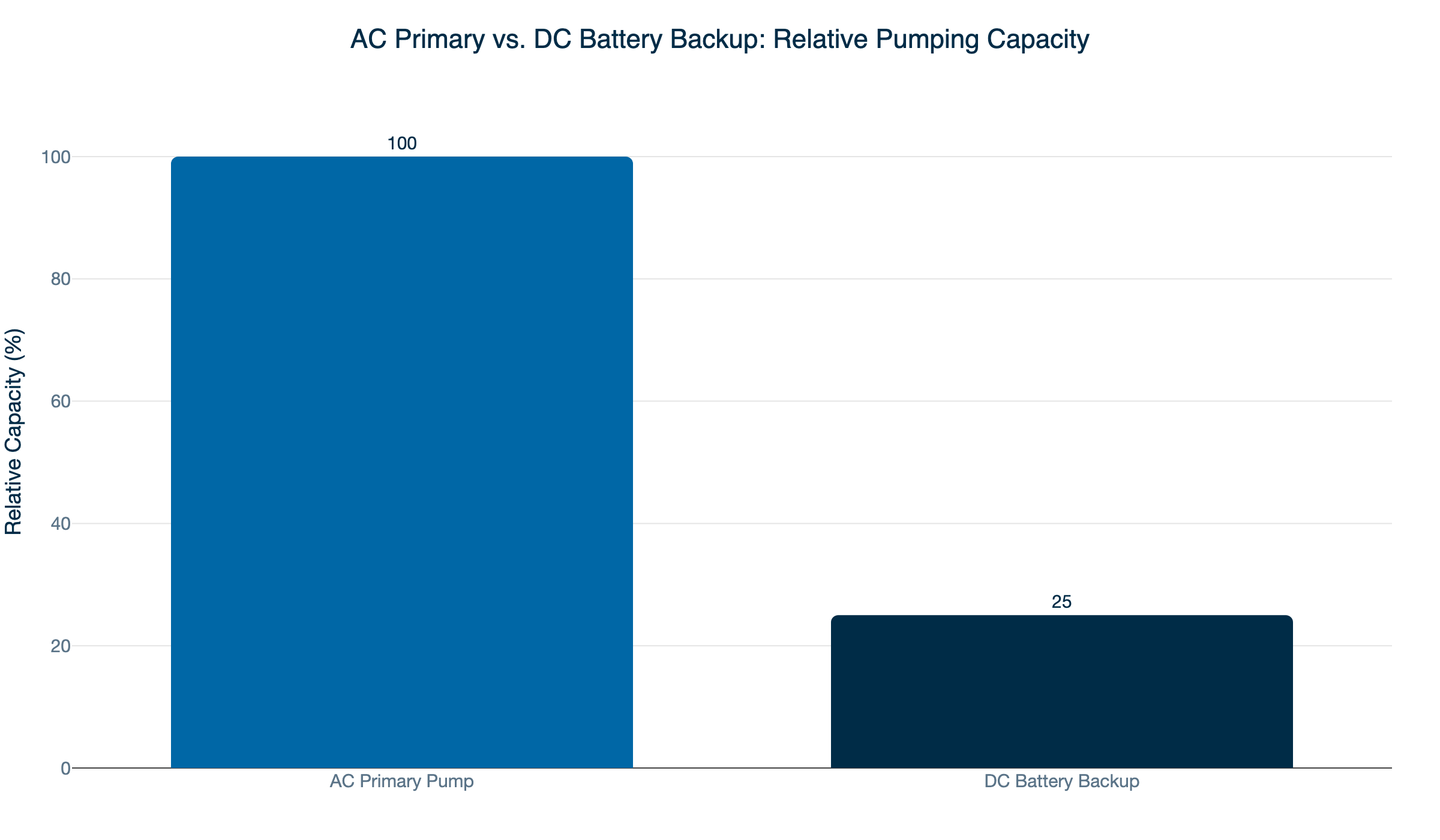
- A DC backup pump moves roughly one-quarter of the water your AC primary can. It buys critical hours; it does not replace the primary at maximum inflow.
- At a heavy-storm duty cycle - cycling every one to two minutes - a fully charged 75-100Ah AGM battery lasts only 6-24 hours.
- Twin Cities Xcel outages after major storm events have run 12-48+ hours. A minimum-spec battery may leave you without protection well before power returns.
- Replace your backup battery every three to five years, even if the pump has never been called on.
- In Minnesota, adding a battery backup with no piping changes is generally DIY-permissible. Basin or discharge pipe work requires a licensed plumber and a permit.
Why the Same Storm That Floods Your Basement Also Cuts Your Power
Your primary sump pump is powered by your home’s electrical panel. That works well until the storm generating the most basement inflow is also the one tripping transmission lines across the metro.
At that moment, the pump that should be running hardest cannot run at all.
This is the failure logic most battery backup guides never explain. A severe summer thunderstorm stalls over the Twin Cities, drops several inches of rain in a matter of hours, overwhelms municipal storm drains, and raises groundwater fast through the clay soils that surround most metro-area foundations. That same storm knocks out the grid. These are not separate events that happen to coincide. They are the same event, seen from two angles.
The documented record makes this concrete. On June 10, 2026, a single storm line knocked out power to about 54,000 Xcel Energy customers, most of them in the East Metro. Xcel deployed roughly 275 field crews. Additional storms were forecast before restoration was complete, meaning outages could stack on top of each other. On July 27-28, 2025, back-to-back overnight thunderstorms left roughly 300,000 customers without power across Minnesota and western Wisconsin. Crews were imported from Colorado and Texas to help with restoration. Ninety percent of customers were back online by Tuesday evening, after two full nights of events.
Two summers. Two major outage events. Both driven by the storms that send water into basements across the metro. A primary pump with no backup is exposed to both threats at once. It cannot protect you from either one when the grid is down.
What Is a Sump Pump Battery Backup?
The short answer: A sump pump battery backup is a DC-powered secondary pump that activates automatically when your primary pump loses power or falls behind on inflow. It runs from a sealed AGM battery, requires no action from you during the outage, and keeps water moving when the grid is down.
Most systems ship as four components: the DC pump, a sealed AGM (absorbed glass mat) battery, a battery charger that keeps the battery topped off from your home’s AC power under normal conditions, and a monitoring panel that alerts you when the battery health drops or the backup activates.
The backup pump sits in the same basin as your primary, typically mounted higher on the discharge pipe. When the float rises, the backup turns on. That happens whether the primary is out because of a power failure, a mechanical failure, or a storm pushing more water in than the primary can move alone.
No action required from you during the event. It runs on its own.
How Long Does a Sump Pump Battery Backup Last During a Minnesota Thunderstorm?
The short answer: On a 75-100Ah AGM battery cycling every one to two minutes during a severe storm, expect 6-24 hours. The same battery can stretch to weeks during light rain. The worst storm produces the shortest runtime.
How long the battery lasts depends entirely on how often the pump cycles, and that depends on inflow rate. In light rain, the pump may cycle once every 10-15 minutes and draw relatively few amp-hours. In a severe storm with sustained high inflow, cycling can happen every 60-90 seconds. The battery drains proportionally faster.
Stack that against restoration timelines. Xcel outages after major Twin Cities storm events have run 12-48+ hours for hard-hit neighborhoods, particularly when follow-on storms arrive while crews are still working. A backup that lasts 6 hours at peak duty cycle offers no protection across a 30-hour outage.
The useful question is not “how long does it last?” The more useful question is: how long do I need it to last, at the worst duty cycle documented for my home and neighborhood?
Does a Battery Backup Pump Move as Much Water as My Primary Pump?
The short answer: No. A standard DC backup pump has roughly one-quarter the pumping capacity of a 1/3 HP AC primary pump. In moderate rain, that gap is manageable. In a severe storm at maximum inflow, the backup may run continuously and still allow the water level to creep upward.
This capacity gap is the critical sizing constraint in high-inflow conditions, not battery runtime alone. When a major storm delivers heavy rain over several hours, a backup running at 25% of the primary’s capacity may not fully keep pace. It will slow the rate of rise. It will protect your basement far better than no pump at all. But it will not perform the way your primary does at full power.
Plan around the gap rather than assume parity. If your home has documented flooding history, or a basin that fills fast during any serious rain, size up to the largest-capacity DC pump your backup system supports. Then size the battery to match that pump.
What Size Battery Do You Need for a Sump Pump Backup?
The short answer: 75Ah for a standard home with moderate flood risk; 100Ah for a larger pump, a longer expected outage window, or a home with documented flooding history. The right number comes from your pump’s amp draw and your neighborhood’s typical restoration timeline, not a single generic rule.
Effective sizing starts from the pump’s actual amp draw and expected duty cycle. Here is a practical framework:
- Find your pump’s amp draw. Most DC backup pumps draw 8-15 amps at full load. Check the nameplate or the spec sheet.
- Estimate worst-case duty cycle. In a major storm, plan for 80-100% duty cycle if your basin fills quickly.
- Multiply amp draw by needed runtime. A 10-amp pump at 80% duty cycle draws an effective average of 8 amps. A 100Ah battery at about 50% safe discharge depth gives you roughly 50 usable amp-hours. That translates to about 6 hours before you’re drawing below safe discharge depth.
- Check your neighborhood’s outage history. If your area ran 24+ hours without power after recent storm events, size for that duration at the worst-case duty cycle.
For most Twin Cities homes in moderate-risk areas, 75Ah is a solid starting point. For a home with water history, a fast-filling basin, or a neighborhood with documented long outages: start at 100Ah and ask a plumber about a higher-capacity DC pump before settling on a final configuration.
Minnesota’s Storm History: Why This Is a Local Risk, Not a Generic One
From 1980 through 2024, Minnesota recorded 62 billion-dollar weather and climate disaster events. Thirty-eight of those were severe storms. More than half of all billion-dollar disaster events in the state fell into the category most likely to produce simultaneous flooding and power loss.
A 100-year rainstorm for most Minnesota communities delivers 6-7 inches in 24 hours, according to NOAA Atlas 14. The MN DNR notes those events may now recur every 50-75 years rather than every 100, as precipitation intensity trends upward. For a homeowner planning to stay in a home for 20-30 years, that is a meaningful planning probability, not a once-in-a-lifetime outlier.
Buildings in Minneapolis carry an estimated 29% chance of a flood about 11 inches deep over a 30-year period. Eleven of Minneapolis’s 257 census tracts have more than half of their buildings at significant surface or riverine flood risk. The risk is not evenly distributed, but it is widespread.
Clay soils throughout the Twin Cities metro make the flooding equation harder. Clay does not absorb rainfall; it sheds it toward storm drains and foundations. When storm drains reach capacity, surface and subsurface water moves toward basements. The MN Department of Public Safety identifies storm and sanitary sewer backup during flooding as a major cause of building damage, alongside mold growth, material swelling, and ruptured utility lines.
Your sump pump is the last mechanical line of defense between rising groundwater and your finished basement. If it is out of power, that line is down.
What About a Water-Powered Backup Sump Pump?
The short answer: Water-powered backups can work, but they require sustained 40 PSI municipal water pressure - which can sag during large flooding events when area demand spikes. They also fail entirely for homes on private wells.
Water-powered backup pumps use incoming municipal water pressure to drive a venturi that lifts basin water out through the discharge line. No battery, no motor. That sounds appealing, and in low-demand conditions it works as described.
The problem is structural. When a major flooding event hits the Twin Cities, regional water demand rises sharply as residents across multiple neighborhoods respond to flooding. Municipal pressure can drop below the 40 PSI operational minimum. If that happens during the event you installed the backup to handle, the pump stops.
For homes on a private well: a well pump runs on AC power. When the grid is down, the well pump is down. A water-powered backup has no supply to operate. Battery backup systems avoid both failure modes. They remain the more reliable choice for most Twin Cities homeowners, whether on city water or a private well.
Do I Need a Permit to Install a Sump Pump Battery Backup in Minnesota?
The short answer: Adding a battery backup with no piping changes generally does not require a permit under Minnesota’s homeowner exemption. Basin installation or discharge pipe modification does require a permit and a licensed plumber. Requirements vary by municipality.
Under Minnesota rules, adding a battery backup pump with no changes to the sump basin or discharge piping typically falls outside permit requirements. Minnesota Statutes § 326B.435 provides a homeowner exemption for owner-occupied single-family homes. The exemption does not waive permit requirements where they do apply. For a straight battery backup installation with no plumbing modification, most homeowners can proceed without pulling a permit.
If you are adding a new sump basin, extending or rerouting the discharge line, or modifying the pit in any structural way, those changes require a permit and a licensed plumber. Verify with your local authority having jurisdiction before starting any work that goes beyond the pump and battery themselves.
If you want the installation done correctly without navigating the local permit rules yourself, our team handles sump pump installation and service across the Twin Cities metro. We know the local landscape, and we show up when we say we will. That is the On-Time Guarantee(R): “If there is any delay, it’s you we pay!”
How Often Should You Replace the Battery?
The short answer: Every three to five years, regardless of how often the backup has run. AGM batteries degrade through chemical aging whether they’re cycled or not. A battery that has “never been used” for four years may be delivering 60% or less of its rated capacity when you need it most.
Backup batteries age on the charger whether or not they are ever called on. An AGM cell sitting at float charge for four years loses capacity through plate sulfation and internal resistance increase, regardless of cycle count. The monitoring panel may still show “charged.” That reading reflects voltage. It does not reflect capacity.
Most homeowners discover the degradation at the worst possible time: the first serious storm after several quiet years. The backup activates, runs for a few hours, and goes silent before the storm ends. The battery hit the bottom of its actual remaining capacity well before the outage cleared.
Set a calendar reminder. Replace every three to five years. Check the monitoring panel health indicator every spring, and replace immediately if it shows a degraded battery status before the scheduled date arrives.
Signs Your Primary Pump Also Needs Attention
A battery backup protects you when the primary fails. But a weakening primary reduces your margin of protection even when power is on. Watch for these signs:
- Water level rising in the basin while the pump is running
- The pump cycling more frequently than it used to during the same rain events
- Grinding, rattling, or labored motor sounds during operation
- The pump running continuously even during dry weather
- Visible corrosion on the pump body or discharge fitting connections
A primary pump that is already working harder than it should leaves the backup with less margin to cover during a power outage. Catching a failing primary early means the backup only has to handle the outage scenario, not compensate for an undersized or worn-out primary at the same time.
Our sump pump repair service covers the full range: motor replacement, float switch adjustment, discharge line inspection, and basin evaluation. Pairing a primary pump check with your battery replacement schedule keeps both systems current at the same time without an extra service call.
For more on how spring conditions specifically challenge sump systems in the Twin Cities, see our guide to spring runoff and basement drainage. For the full annual inspection checklist, the sump pump checkup guide walks through each step worth completing before the wet season peaks.
What to Do Before the Next Storm Season
An installed and tested battery backup is worth far more than one ordered after the storm watch is already posted. Here is a practical pre-season checklist.
Check your existing system:
- Pour water into the basin and confirm the primary pump float triggers cleanly
- Check the backup monitoring panel for charge status and any health alerts
- Unplug the primary, pour water in again, and confirm the backup activates on its own
- Inspect the discharge line for blockage, freeze damage, or improper pitch toward the exit point
If you haven’t installed a backup yet:
- Schedule a sump pump evaluation before the wet season peaks in late spring or early summer
- Bring your home’s flooding history and your neighborhood’s documented outage duration to that conversation
- Size for your worst documented event, not your typical one
Battery replacement timing:
- Four-plus years old: replace before this storm season, not after it
- Three years old with a panel warning: replace now
- “Never been used” is not a reason to wait - replace on the three-to-five-year schedule regardless
Call (763) 296-1844 or book your sump pump evaluation online before storm season gets underway. Northern Benjamin Franklin Plumbing is locally owned and operated. We serve Minneapolis, St. Paul, Blaine, Bloomington, Brooklyn Park, Coon Rapids, Maple Grove, and the rest of the Twin Cities metro. Every appointment is backed by the On-Time Guarantee(R).
Frequently Asked Questions
How long does a sump pump battery backup last during a Minnesota thunderstorm? +
Do I need a permit to install a sump pump battery backup in Minnesota? +
When should I replace my sump pump battery? +
Can a water-powered backup sump pump replace a battery backup? +
Need a technician now?