
Minnesota Well Pressure Tank Replacement: Test, Cost, Permit
Key Takeaways
- About 20% of Minnesota homes rely on private wells. In Anoka County, roughly 30% of residents are on well water. If that is your home, the pressure tank is a critical piece of infrastructure.
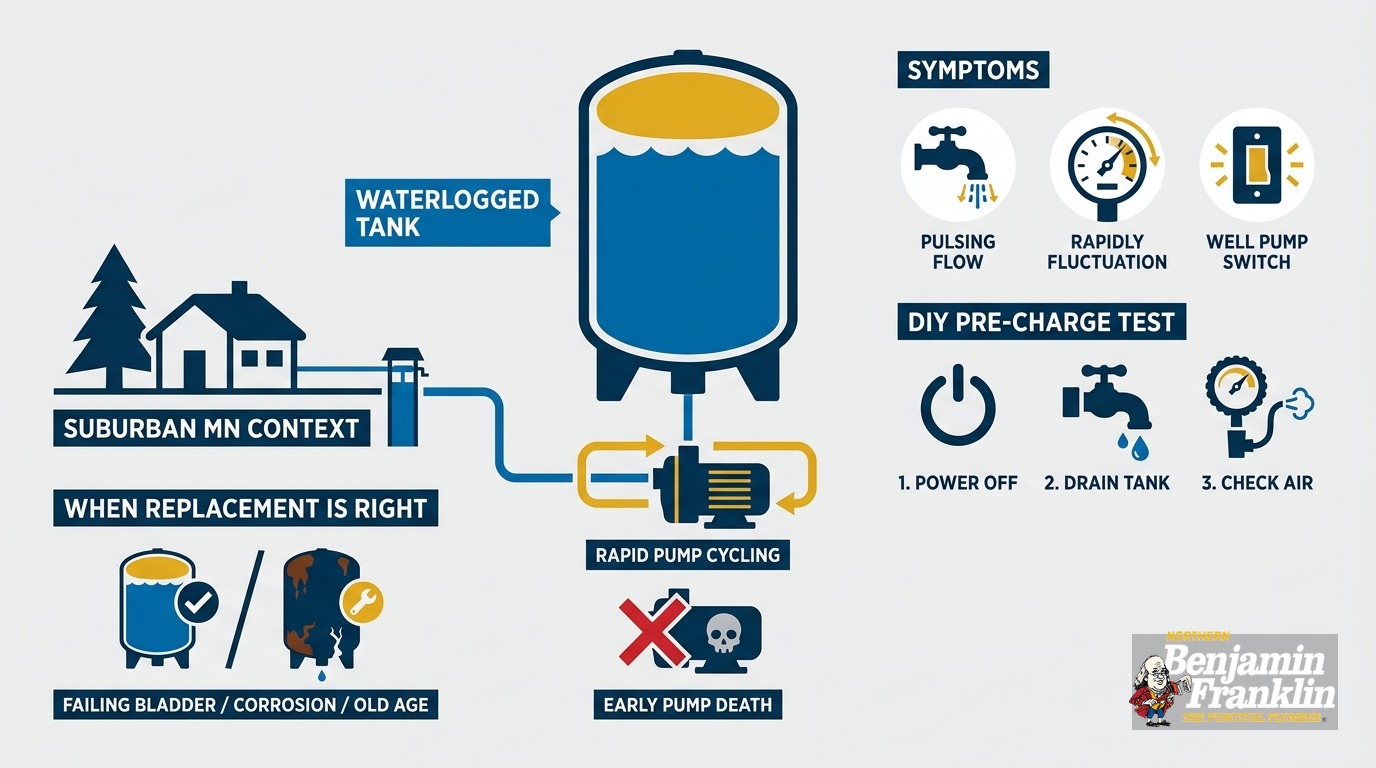
- A waterlogged pressure tank causes short cycling. The pump starts and stops every few seconds instead of every few minutes. That kills the motor.
- The Schrader valve test takes two minutes. Air at the valve means the bladder may be intact and a recharge could fix it. Water at the valve means the bladder is gone and the tank needs replacement.
- Correct precharge is cut-in pressure minus 2 PSI. On a standard 30/50 switch, that is 28 PSI. Always check it with the pump off and the tank fully drained.
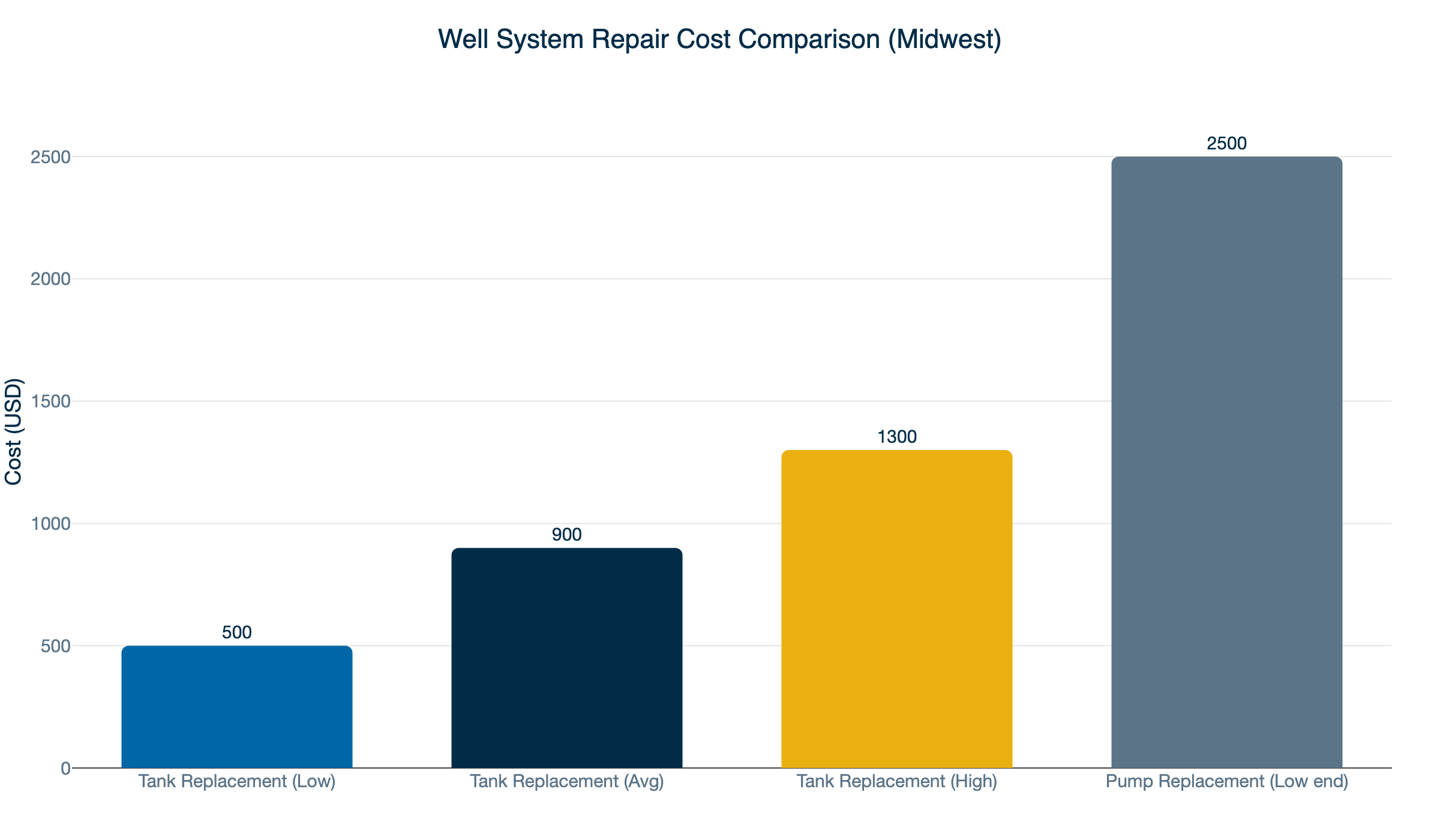
- Midwest well pressure tank replacement averages around $900, according to HomeGuide 2026. A pump burned out by short cycling runs $2,500 to $5,000 or more to replace.
- Minnesota requires a permit for pressure tank replacement. Use a licensed plumber.
What Does a Well Pressure Tank Do?
A pressure tank stores pressurized water between pump cycles. It keeps your water pressure steady and protects the pump motor by limiting how often it needs to start. Without a healthy tank, the pump short-cycles constantly until the motor overheats and fails.
Your submersible pump sits at the bottom of the well. Every time someone opens a faucet, the system needs to hold pressure without the pump running full-time. The pressure tank handles that job. It maintains a reserve of pressurized water ready for immediate delivery so the pump only runs when the reserve drops below the cut-in threshold.
Inside the tank is a rubber bladder. One side holds water. The other side holds a precharge of compressed air. That air cushion is what keeps pressure steady across the full draw cycle. When the system pressure drops to the cut-in point, the pump turns on and refills the tank. When it reaches the cut-off, the pump stops. Between those two points, the air cushion does the work and the pump rests.
A healthy system cycles the pump 6 to 8 times per hour under normal household use. When the bladder fails, the air charge escapes into the water. The cushion disappears. There is nothing left to buffer demand, so the pump turns on, hits cut-off almost immediately, stops, and the pressure drops right back down. That cycle repeats every few seconds. The pump was not designed for that load.
What Are the Signs of a Waterlogged Pressure Tank?
Rapid pump cycling, wildly swinging pressure gauge readings, and a tank that feels unusually heavy are the clearest signs. A tank past 10 to 15 years old is a risk factor even before symptoms appear.
Here is what to watch for:
- The pump cycles constantly. You can hear it start and stop every few seconds while a faucet runs. Under normal operation, you should barely notice the pump turning on during routine water use.
- Pressure drops immediately after spiking. The gauge hits the cut-off threshold, the pump stops, and the pressure falls off almost at once rather than holding between cycles.
- The gauge swings through a wide range quickly. A healthy system keeps the needle in a stable band between cut-in and cut-off. Rapid swings suggest there is no air cushion holding pressure in reserve.
- Low or no pressure at the tap. A completely waterlogged tank has no useful water reserve. Pressure can fall to near zero the moment demand starts.
- The tank is heavier than expected. A correctly charged tank is mostly air. Tilt or tap it lightly. A tank that sounds hollow toward the top is healthy. One that sounds and feels dense with water is not.
- The tank is past 10 to 15 years old. Bladder tanks last 10 to 15 years on average, and chlorine in the water along with high cycling frequency both shorten that range.
If two or more of these apply to your system, run the test in the next section before calling anyone.
How Do You Test a Well Pressure Tank at Home?
Turn off the pump breaker, open a tap to bleed off system pressure, then press the Schrader valve stem on top of the tank. Air means the bladder may be intact and the problem could be a low precharge. Water means the bladder has ruptured and the tank needs replacement.
You need a tire pressure gauge and access to the tank. The whole process takes about ten minutes.
Step 1: Cut the power. Locate the breaker for the well pump and flip it off. Do not attempt the test with the pump live.
Step 2: Bleed the pressure. Open a faucet and let it run until the flow slows noticeably. You want the system pressure as low as possible before touching the valve.
Step 3: Find the Schrader valve. It looks exactly like a bicycle tire valve stem. On most modern bladder tanks it is on the top or on the air fitting at the side. Older galvanized tanks may not have one.
Step 4: Press the center pin. Use a small tool or the back of the tire gauge to depress the pin in the center of the valve stem.
- Air comes out: The bladder is likely intact. Your problem may be a low or incorrect precharge, not a failed bladder. Check the air pressure and adjust before replacing the tank.
- Water comes out: The bladder has ruptured. Air and water have mixed on the wrong sides of the membrane. The tank needs replacement. No recharge fixes that.
What Is the Right Precharge Pressure for a Well Pressure Tank?
Set precharge to your cut-in pressure minus 2 PSI. On a standard 30/50 pressure switch, that is 28 PSI. Always check with the pump off and the tank fully drained. Reading the pressure while water is still in the tank gives a false number.
This is the step most homeowners get wrong. They add air, check the gauge, and get a reading that reflects water pressure rather than air pressure. The tank looks fine on the gauge. The short cycling continues.
Per National Water Service, the procedure requires draining the tank before any pressure check. Here is the math for common switch configurations:
- 30/50 switch: Cut-in is 30 PSI. Set precharge to 28 PSI.
- 40/60 switch: Cut-in is 40 PSI. Set precharge to 38 PSI.
- 20/40 switch: Cut-in is 20 PSI. Set precharge to 18 PSI.
To add air, use a bicycle pump or a compressor set low. To reduce pressure, press the valve stem briefly and recheck. Make small adjustments each time and verify after each one.
If the Schrader valve produced only air and the precharge was off, correcting it may stop the short cycling without replacing anything. If water came out of that valve, no amount of recharging resolves the problem. The bladder is the issue, and it cannot be repaired in place.
Recharge vs. Replace: How to Decide
The Schrader test makes this a clear fork rather than a judgment call.
Recharge: Air came out of the valve. The bladder appears intact. The precharge pressure was off the correct number. Adjust to cut-in minus 2 PSI, restore power, and watch the cycling frequency over the next day. If the pump cycles normally and pressure holds, you may be done.
Replace: Water came out of the valve. The bladder has failed. Air and water have mixed inside the tank. There is no repair path for a ruptured bladder. The tank goes.
A few other situations that point toward replacement even when the test result is borderline:
- The tank is 15 or more years old, regardless of how the test came out. The service life is spent.
- You have recharged this same tank more than once in the past year. Repeated air loss means the bladder is slowly failing, not a one-time pressure event.
- The exterior is visibly corroded, rusted through, or bulging anywhere.
- Short cycling continued or returned quickly after a recent recharge.
Do not let “maybe it just needs air” stretch into a two-month delay. The pump is the expensive part, and a failing tank will get to it eventually.
Why a Waterlogged Pressure Tank Burns Out Your Well Pump
Most homeowners learn this connection after the pump is already gone.
A submersible pump is built for start cycles, not continuous running. Each startup draws a surge of current and generates heat. The design assumes the pump starts, runs long enough to bring the system back to cut-off pressure, and then rests. That rest period is what keeps the motor temperature in a safe range. Short cycling eliminates it.
Per SC Well Service, a healthy system cycles the pump 6 to 8 times per hour. A severely waterlogged tank can push that to once every few seconds. At that rate, the pump might start and stop hundreds of times per hour. Bearings wear faster than designed. The motor overheats. Eventually something fails.
The cost difference is the clearest argument for acting early. Pressure tank replacement in the Midwest averages around $900 all-in. Submersible pump replacement runs $2,500 to $5,000 or more. That cost includes pulling the pump from the well, replacing it, lowering it back down, and reconnecting everything.
For Twin Cities homeowners, winter adds another layer of risk. A pump that fails in January at -10°F is not a job you schedule for next week. Getting a submersible pulled from a frozen well requires a licensed well contractor working in brutal conditions. Emergency timing and cold-weather access both push that cost higher than the same job in October. The $900 tank replacement is not a close call.
What Does Well Pressure Tank Replacement Cost in Minnesota?
Midwest all-in replacement runs $500 on the low end to $1,300 on the high end, with an average around $900, according to HomeGuide 2026. Several factors move that number in either direction.
What drives the range:
- Tank size. A modest home on a low-output pump may need a 20- to 30-gallon tank. A larger home or a high-output pump may call for an 80-gallon or larger unit. Bigger tanks cost more in parts and often require more labor to install.
- Access. A tank in an open, unfinished utility room is a straightforward swap. A tank tucked behind finished walls or in a tight mechanical room takes longer.
- Permit and inspection fees. Minnesota requires a permit for this work. That shows up as a real line item in the quote.
- Condition of the surrounding system. If the pressure switch is corroded, the shut-off valve is frozen open, or the connecting pipes need work, the scope grows.
- Season and timing. An emergency call in January carries a premium over a scheduled appointment in fall.
For a real number specific to your system, call (763) 296-1844 or book a service appointment. We are locally owned and operated. We give you a price before the work starts, not after.
If the job involves a larger scope, ask about financing when you call.
Do You Need a Permit for Pressure Tank Replacement in Minnesota?
Yes. Pressure tank replacement is a plumbing alteration governed by Minnesota Plumbing Code Chapter 4714. It requires a permit and a licensed plumber under Minnesota Statute §326B.46. Licensed well contractors have a limited exemption for the water service pipe, but tank-side connections fall under the plumbing code.
This surprises a lot of homeowners. A pressure tank looks like a standalone appliance. In Minnesota, the well system and its plumbing connections are regulated infrastructure. Changes to that system require documentation.
The well contractor exemption covers the water service pipe between the well casing and the tank. Once you are on the tank side of that connection, you are in plumbing code territory. A licensed plumber, a permit, and an inspection are required.
Two county-specific notes worth knowing:
- Dakota County has assumed its own well construction regulation rather than delegating to the Minnesota Department of Health. If you are in Dakota County, confirm the permit requirements directly with the county.
- Anoka and Washington Counties follow MDH rules, which include the Chapter 4714 permit requirement.
The permit is not bureaucratic overhead. It confirms the connections were made correctly, the system is properly sealed, and the record of your well system is complete. That record matters when you sell the home. Skipping the permit creates a gap that surfaces during a real estate transaction and can delay or complicate a closing.
Use a licensed plumber. The permit process is part of the job, not an optional add-on.
What Else to Check While the Plumber Is There
A pressure tank replacement opens up the full well system for inspection. A few things worth asking about while access is already open:
- Pressure switch condition. The switch controls cut-in and cut-off thresholds. A corroded or inaccurate switch can cause short cycling even after a new tank is installed.
- Shut-off valve operation. A valve that has not turned in years may not seat properly. A technician can check it while the system is open without any additional teardown.
- Well water quality. MDH recommends testing annually for coliform bacteria, every other year for nitrate, and at least once for arsenic. If you are not current on any of those, a service visit is a natural prompt. MDH also administers a Clean Water Fund grant program that provides free water test kits to at least 10% of private well households per county, covering coliform, nitrate, arsenic, lead, and manganese.
- Iron and manganese levels. High iron and manganese are common in Minnesota well water and can degrade pressure system components over time. If you have not tested for these recently, it is worth adding to the conversation. Learn more about iron and manganese in Minnesota well water.
- Water pressure elsewhere in the house. A new pressure tank is a good baseline point. If low water pressure has been a nagging issue throughout the home, ask the plumber to check the pressure reducing valve and the supply line condition while they are on-site.
Next Steps for Twin Cities Well Owners
A failing pressure tank does not always announce itself with drama. Sometimes the pump just starts cycling a little more than usual. By the time the sputtering becomes hard to ignore, the pump may have already taken damage from thousands of extra start cycles it was never designed to handle.
Run the Schrader valve test today if your tank is past 10 years old or your pump has been cycling more than normal. It costs nothing and takes ten minutes. If water comes out of that valve, call a plumber before the problem escalates.
Northern Benjamin Franklin Plumbing is locally owned and operated, serving Minneapolis, St. Paul, Blaine, Bloomington, Brooklyn Park, Coon Rapids, Maple Grove, and the broader Twin Cities metro. We back every service call with the On-Time Guarantee(R): we arrive in the window you choose, or we pay you $5 for every minute we are late, up to $300. As we say: “If there is any delay, it’s you we pay!”
Call (763) 296-1844 or book a service call online to get your well system inspected.
For more on your well water and home plumbing system:
Frequently Asked Questions
How do I know if my pressure tank needs replacement vs. just a recharge? +
What is the correct precharge pressure for a well pressure tank? +
Do I need a permit to replace a well pressure tank in Minnesota? +
How much does well pressure tank replacement cost in Minnesota? +
Need a technician now?