
Clean Faucet Aerator Low Flow: Twin Cities Hard Water Guide
Key Takeaways
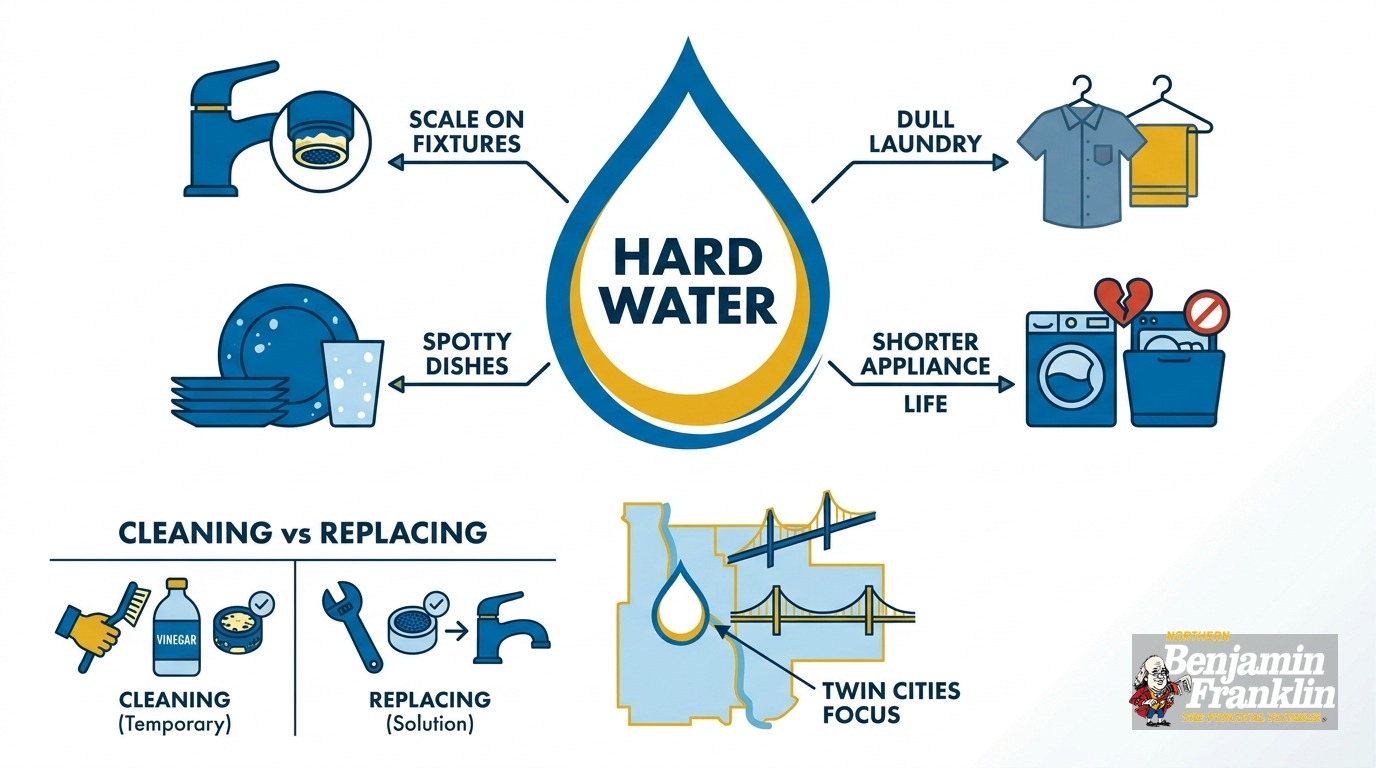
- To clean faucet aerator low flow, unscrew the screen from your faucet tip, soak it in white vinegar for 30 minutes, scrub with a toothbrush, and rinse. Most faucets need no tools.
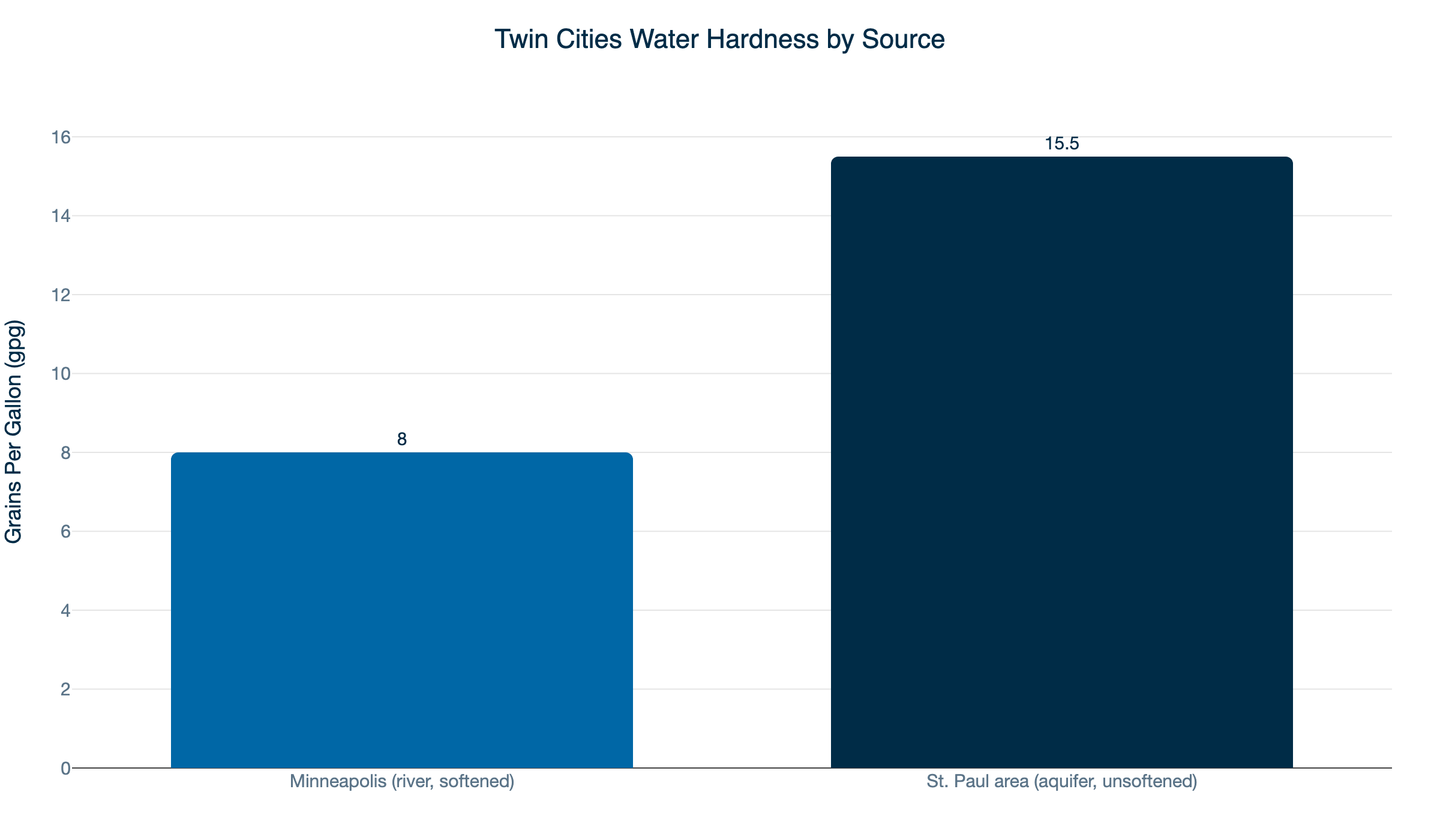
- Minneapolis water runs approximately 7-9 grains per gallon (gpg), classified “hard.” St. Paul and most surrounding suburbs draw from the Prairie du Chien-Jordan aquifer at 14-17 gpg, classified “very hard” - roughly double Minneapolis hardness.
- St. Paul-area aerators on high-use, hot-water faucets can clog in three to four months.
- Kitchen hot-water faucets and master bath lavatories clog fastest because heat speeds up mineral precipitation.
- Replace instead of cleaning when the screen is permanently discolored, the housing is corroded, or cleaning fails to restore full flow. Replacement parts run $3-8.
- A whole-home water softener treats the root cause, protecting every faucet, water heater, and appliance in the home.
Why Is My Faucet Flow Low?
A single faucet losing flow almost always means a clogged aerator. The small screen assembly at the tip of your faucet spout collects mineral scale from hard water. Once the mesh openings close down, pressure appears to drop even when the rest of your home’s plumbing is working fine.
The aerator is threaded onto the end of the spout. Inside the housing, it holds one or more fine mesh screens, a rubber washer, and a flow restrictor. The screens mix air into the water stream to reduce splashing and hold flow to a rated rate. As water passes through, calcium and magnesium minerals drop out of suspension and catch on the mesh. Over months, that buildup thickens until the flow you get feels like a slow pour.
The good news: a clogged aerator is not a sign of pipe damage or failing plumbing. It is routine maintenance that every faucet in a hard-water home eventually needs.
How Hard Is Twin Cities Water?
Minneapolis water (from the Mississippi River, lime-softened at the treatment plant) runs approximately 7-9 gpg, classified “hard” by the Water Quality Association scale. St. Paul draws from the Prairie du Chien-Jordan aquifer with no softening treatment, at 14-17 gpg, classified “very hard” - roughly double Minneapolis hardness.
The WQA hardness classification sets “very hard” at 10.5 gpg (180 mg/L). St. Paul-area water sits well above that line at its high end. The WQA notes that hard water “forms a scale of calcium and magnesium minerals that can contribute to the inefficient operation or failure of water-using appliances. Pipes can become clogged with scale that reduces water flow and ultimately requires pipe replacement.”
That is not a scare quote. It is the physics of what is happening to your aerator screen right now.
Calcium carbonate drops out of solution as water sits, cools, or heats. Fine mesh catches it. At 14-17 gpg, it catches a lot, quickly.
Minneapolis homeowners should plan to clean aerators twice a year. St. Paul homeowners - and those on the SPRWS groundwater system, which includes Roseville, Maplewood, Shoreview, and 11 other suburbs - should check kitchen and hot-water faucet aerators every three to four months.
Your suburb matters. Communities with their own river-fed systems, such as Bloomington and Eden Prairie, typically sit in the hard range, closer to Minneapolis. If you are unsure, your utility publishes an annual Consumer Confidence Report (CCR) listing hardness in mg/L. Divide by 17.1 to convert to grains per gallon.
Which Faucets Clog the Fastest?
Kitchen hot-water faucets clog fastest, followed by master bath lavatories. Heat accelerates calcium carbonate precipitation. A faucet running near-hot under daily use will accumulate scale faster than any cold-side faucet in the same home, regardless of water source.
Here is the ranking for a typical Twin Cities household:
- Kitchen sink, hot side. High flow, hot water, daily use. Check this aerator first when you notice any flow drop.
- Master bath lavatory, hot side. Heavy daily use, frequently near-hot for face washing. Second-worst on most homes.
- Guest bath lavatory. Less daily use, but water can stagnate between uses and deposit minerals even without heat.
- Cold-side faucets (any room). Cold water holds minerals in suspension without precipitating them as fast. Still clogs, just more slowly.
- Utility and laundry sink faucets. Intermittent use, but often factory-original aerators that have never been serviced.
Kitchen faucets also tend to use higher-flow aerators at 1.5-2.2 GPM. More throughput means more mineral contact time with the screen. A pressure drop on your kitchen hot side is often the first place aerator clogging becomes noticeable in the home.
How to Clean a Faucet Aerator for Low Flow
You do not need a plumber for this job. You need white vinegar and 30 minutes.
What you need:
- Adjustable pliers or channel-locks
- A rubber band or folded cloth to protect the finish
- White vinegar
- A small bowl or cup
- An old toothbrush
- A towel to catch small parts before they roll toward the drain
Steps:
- Turn off the faucet. You do not need to shut off the main supply for this job.
- Wrap your plier jaws with a rubber band or folded cloth to avoid scratching the aerator housing.
- Grip the aerator and turn it counterclockwise to unscrew it. Many hand-loosen. Others need light plier help.
- Pull the aerator off and lay the parts in order on the towel: washer, flow restrictor, screen or screens. Keeping them in sequence matters for reassembly.
- Fill a small bowl with undiluted white vinegar. Submerge all components. Soak for at least 30 minutes. For heavy scale, soak overnight.
- After soaking, scrub each screen with the toothbrush. The mineral deposits should break free. Rinse under running water.
- Hold each screen up to a light source. All mesh openings should be clear. Still blocked? Soak for another hour and scrub again.
- Reassemble in reverse order. Thread the aerator back onto the spout and hand-tighten. A snug fit is enough - over-tightening cracks older plastic housings.
- Run the faucet on hot for 30 seconds to flush any loosened debris through the line.
Total cost: nothing. Total time: 30 minutes, most of it waiting for vinegar.
One practical note: if your aerator is deeply recessed or on a pull-down kitchen faucet, the housing may be a different thread size. Bring the old aerator to the hardware store to match thread diameter and flow rating before buying a replacement.
Should You Clean It or Replace It?
Replace the aerator when the screen is permanently discolored, the housing threads are corroded, or cleaning fails to restore full flow. Replacement aerators cost $3-8 and take two minutes to install. Cleaning a screen that is too far gone wastes time you do not get back.
Clean it when:
- The screen is gray or white with mineral buildup, but the mesh is intact.
- Flow is reduced but not down to a trickle.
- The aerator is less than three to five years old.
- A vinegar soak returns the mesh to mostly open.
Replace it when:
- The screen is dark brown or black and stays discolored after soaking.
- Threads on the aerator or the faucet tip show corrosion or stripping.
- The housing is cracked or the rubber washer is deformed.
- Cleaning restores some flow but not full flow.
- You cannot remember the last time it was serviced.
- You are replacing the faucet anyway - always install a fresh aerator.
Standard bathroom faucet aerators are usually 15/16” male or 13/16” female thread. If the tip is recessed or an unusual size, match the old aerator at the hardware store before purchasing.
If replacing the aerator does not restore normal flow, the problem is upstream of the spout. Check that the shut-off valve under the sink is fully open and the supply line has no kinks. If low pressure spans multiple faucets in the home, that is a different diagnosis. Our post on low water pressure in Twin Cities homes covers the most common causes.
How Often Should You Clean Aerators in Minnesota?
In Minneapolis (approximately 7-9 gpg), clean aerators every six months. In St. Paul, Roseville, Maplewood, Shoreview, and other suburbs on the SPRWS aquifer system (14-17 gpg), check kitchen and hot-water aerators every three to four months. The national once-a-year guidance is written for average water, not for ours.
A simple schedule:
| Water source | Hardness (approx.) | Aerator check interval |
|---|---|---|
| Minneapolis Water Works (Mississippi River) | 7-9 gpg (hard) | Every 6 months |
| SPRWS / St. Paul aquifer suburbs | 14-17 gpg (very hard) | Every 3-4 months |
| Bloomington, Eden Prairie (own river-fed systems) | 7-10 gpg (hard) | Every 6 months |
| Private well | Varies - check your CCR | Verify annually |
A useful trigger: check aerators whenever you change your furnace filter. For St. Paul-area homeowners on a two-filter-per-year schedule, that may still be too infrequent on the kitchen hot side.
Early warning signs that do not require pulling the aerator: an uneven stream, water spraying sideways from the tip, or a pressure drop on one faucet while all others are fine. Any of those signals means the aerator is restricting flow and needs attention.
Is Hard Water the Real Problem?
Aerator cleaning is maintenance. A whole-home water softener is the fix. If you are cleaning aerators multiple times a year, the same mineral scale is building up inside your water heater, supply lines, and appliances - parts you cannot reach with a toothbrush and vinegar.
The University of Nebraska Extension describes the progression directly: “Pipes can become clogged with scale that reduces water flow and ultimately requires pipe replacement.” That is not the aerator talking anymore. That is the rest of the system.
Scale accumulation affects every water-using fixture and appliance in the home. Our post on how hard water affects anode rods and water heater life covers one of the less-visible effects: how scale inside a water heater tank shortens its life and reduces efficiency years before the tank itself fails.
Signs hard water is affecting more than just your aerators:
- White or yellow scale on showerheads, faucet bases, and the dishwasher interior.
- Soap that does not lather well, leaves a film, or requires more product than it used to.
- Spots on dishes and glassware after the dishwasher runs a full hot cycle.
- Itchy skin or dry hair after showering, caused by mineral residue left on skin.
- A water heater that takes longer to recover than it did when it was new.
A water softener replaces calcium and magnesium ions with sodium ions through an ion-exchange resin. The result is water that does not form scale. Aerators stay clear longer. Water heater sediment slows. Supply lines last.
Minnesota requires a plumbing permit when softener installation involves modifying the building’s plumbing. Our licensed plumbers handle the permit, the installation, and the inspection. For permit details, the Minnesota Department of Labor and Industry is the authority.
To explore whether a softener makes sense for your home, our water softeners page covers how the systems work and what installation involves. For a broader look at what hard water does to Twin Cities plumbing, our hard water problem page is a good starting point.
What About WaterSense Aerators?
When you replace an old aerator, consider upgrading to a WaterSense-labeled model. The EPA caps these at 1.5 GPM, down from the standard 2.2 GPM, saving the average family an estimated 700 gallons per year with no noticeable difference in everyday washing and rinsing.
Over the lifetime of the faucet, the savings can reach 11,000 gallons per aerator and an estimated $250 in combined water and electricity costs. The aerators themselves cost “as little as a few dollars”. At that price point, replacement almost always makes more sense than cleaning a tired screen for the third time.
Some Twin Cities utilities offer rebates on WaterSense products. The EPA rebate finder lets you search by zip code.
One practical note: WaterSense aerators come in the same thread sizes as standard models. Confirm the thread diameter on your existing aerator before purchasing. If you are upgrading multiple faucets at once, a thread gauge at the hardware store takes one minute and saves a return trip.
When to Call a Plumber
Aerator cleaning and replacement are DIY territory. Call Northern Benjamin Franklin Plumbing when:
- Replacing the aerator does not restore normal flow and the issue affects more than one faucet.
- You want a full plumbing checkup that covers aerators, supply valves, and shut-offs across the home.
- You see scale on multiple fixtures and want a water test to confirm hardness and identify the right treatment option.
- You are ready to explore a whole-home water softener and want a licensed plumber to assess your setup and pull the permit.
- The faucet tip is corroded enough that the aerator will not unscrew without damaging the spout.
Northern Benjamin Franklin Plumbing is locally owned and operated, serving Minneapolis, St. Paul, Blaine, Bloomington, Coon Rapids, Maple Grove, and the rest of the Twin Cities metro. Our licensed team knows our water - hard and very hard - and every appointment runs on our On-Time Guarantee(R). “If there is any delay, it’s you we pay!” That is $5 per late minute, up to $300, on every visit.
Call (763) 296-1844 or book online to schedule a service call or water treatment consultation.
Frequently Asked Questions
How do I clean a faucet aerator to restore low flow? +
How often should I clean faucet aerators in Minneapolis or St. Paul? +
When should I replace a faucet aerator instead of cleaning it? +
Can hard water damage more than just faucet aerators? +
Need a technician now?