
How to Clean a Water Softener Brine Tank (Before It Fails)
Key Takeaways
- A salt bridge or salt mush can silently disable your water softener while everything on the outside looks normal.
- The two-minute broom-handle test tells you right now whether you have a bridge.
- Minneapolis and St. Paul tap treated water at roughly 5-6 GPG, but suburban communities on groundwater face 25-32 GPG, where a failed softener causes real damage fast.
- Annual brine tank cleaning is the industry standard. Step up to every six months if you have iron in the water or a history of mushing.
- Use high-purity evaporated pellets in humid Minnesota basements. Rock salt and low-purity pellets mush faster.
- Keep the tank between one-third and two-thirds full. Overfilling is a top bridge trigger.
- Call (763) 296-1844 or book online for a professional water softener inspection or full brine tank service.
Why Your Water Softener Can Fail Without Warning
Your water softener brine tank looks full. Your control panel shows nothing unusual. The water feels fine. And yet your softener may not have produced a drop of soft water in three months. Knowing when and how to clean your water softener brine tank is the only way to catch this problem before it damages your home.
This is the most common water softener failure mode. Most homeowners never catch it until they notice scale building on fixtures or a spike in water heater energy use.
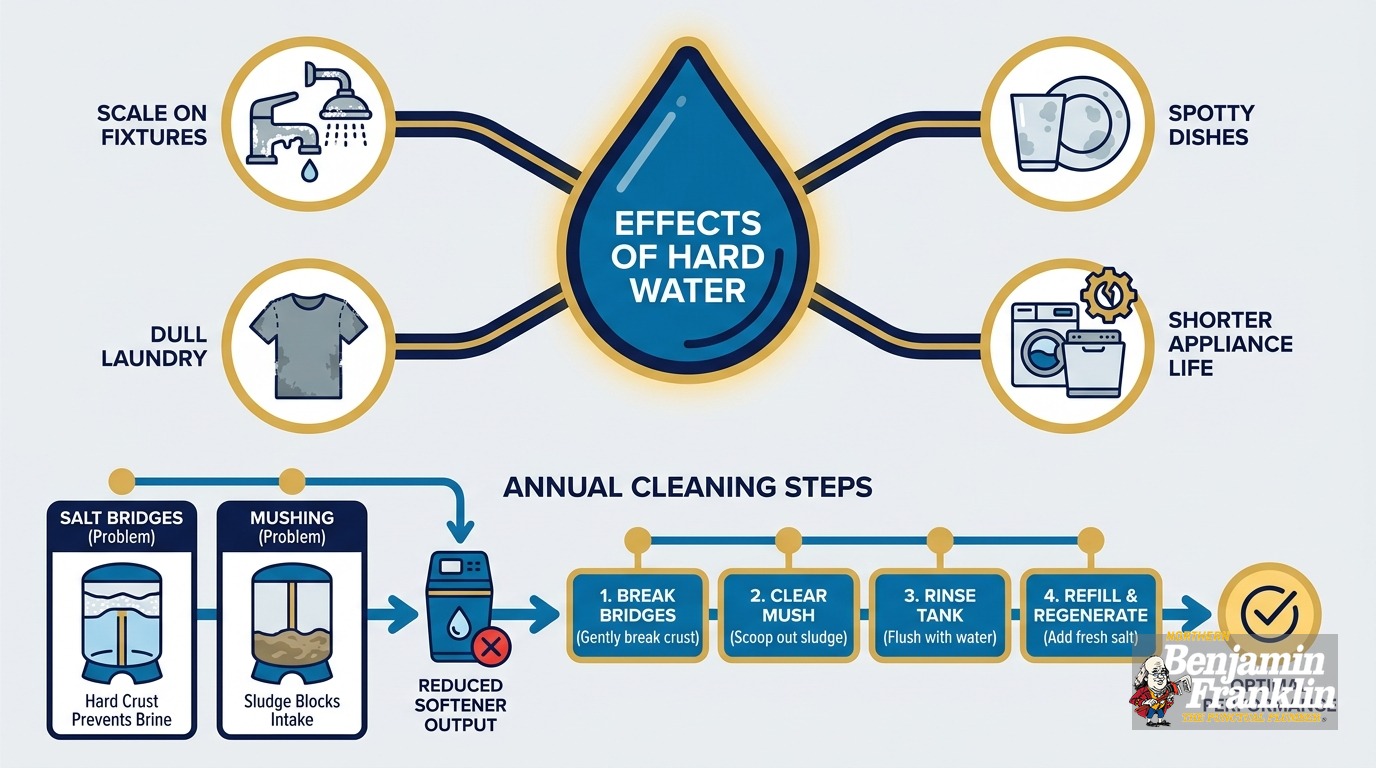
The culprit is almost always inside the brine tank. Salt can form a hard crust above the waterline with an air gap below. That is a salt bridge. Or undissolved granules can settle into sludge at the bottom and block the pickup tube. That is salt mushing. Either problem breaks the regeneration cycle completely. The unit runs through its scheduled cycle, draws plain water instead of brine, and leaves your resin bed loaded with hardness minerals. You get hard water on a soft water maintenance budget.
This post walks through how to diagnose the problem today, how to clean your water softener brine tank properly, and why the risk runs higher here in the Twin Cities and surrounding suburbs than most homeowners realize.
What Is a Salt Bridge?
A salt bridge is a hard crust that forms across the top of your salt supply, leaving an air gap below. The tank looks full, but no salt is reaching the water, so no brine forms. Your softener cycles with plain water and your resin never gets cleaned.
When the softener’s control valve calls for regeneration, it fills the brine tank with water, waits for brine to dissolve, and then draws that brine back through the resin bed. That flush strips the hardness minerals the resin has captured and recharges it for the next cycle. With a bridge in place, there is no brine. The valve draws plain water. Hardness stays locked in the resin. Salt bridges form when salt pellets partially dissolve and recrystallize into a crust, most often in humid environments or when the tank is overfilled.
Fixing a bridge is low-tech. Use the handle of a broom or a long wooden dowel. Push it straight down into the salt. A healthy tank lets you reach the water with no resistance. A bridged tank feels like a floor. Once you break through, hot water poured around the edges helps dissolve the remaining crust. Then run a manual regeneration cycle to flush the resin bed with fresh brine.
What Is Salt Mushing?
Salt mushing happens when undissolved salt granules settle and compact into sludge at the bottom of the brine tank. The sludge clogs the brine well pickup tube, blocking the control valve from drawing brine during regeneration. The softener cycles but delivers no softening.
Undissolved salt granules settle as sludge and can fully block the brine well, the narrow tube inside the tank where the control valve draws brine. A mushed tank looks normal from the top: salt is present, the timer fires, nothing seems wrong. But the pickup is blocked. The valve cannot draw a full brine charge, and the resin gets no cleaning.
Mushing is more common with rock salt, solar salt, and lower-purity pellets. It also develops faster in tanks that have not been cleaned in several years. A bridge you can often fix in place by breaking up the crust. Mushing requires a full clean: drain the tank, dissolve or scoop out the sludge, rinse the brine well and float valve, and refill with fresh high-purity pellets.
How Can You Tell If Your Brine Tank Has a Problem Right Now?
Push a broom handle or long dowel straight down through the salt surface. If it reaches the water below without resistance, your salt is loose and dissolving normally. If it stops mid-tank or you hear a hollow sound when you tap the crust, you have a bridge.
The broom-handle test is the standard field diagnostic. Straight down into the middle of the salt, no angling around the edges. If the handle meets resistance before the waterline, break through and keep pushing until you hit water. A hollow cavity confirms the bridge is real.
For mushing, look at the bottom of the tank when salt is low. Sludge looks like wet concrete, not loose pellets. Check your salt consumption too. If you used to add salt every six to eight weeks and now rarely need to, your resin may already be saturated. The softener is cycling without actually drawing salt.
One more signal: test your water. Run a cold tap for a minute and try to lather soap. Hard water makes soap feel filmy and difficult to rinse. Inexpensive hardness test strips from a hardware store give you a number in seconds. If you want a full picture, we can test your water as part of a service visit.
Why Do Twin Cities Homeowners Face Higher Risk?
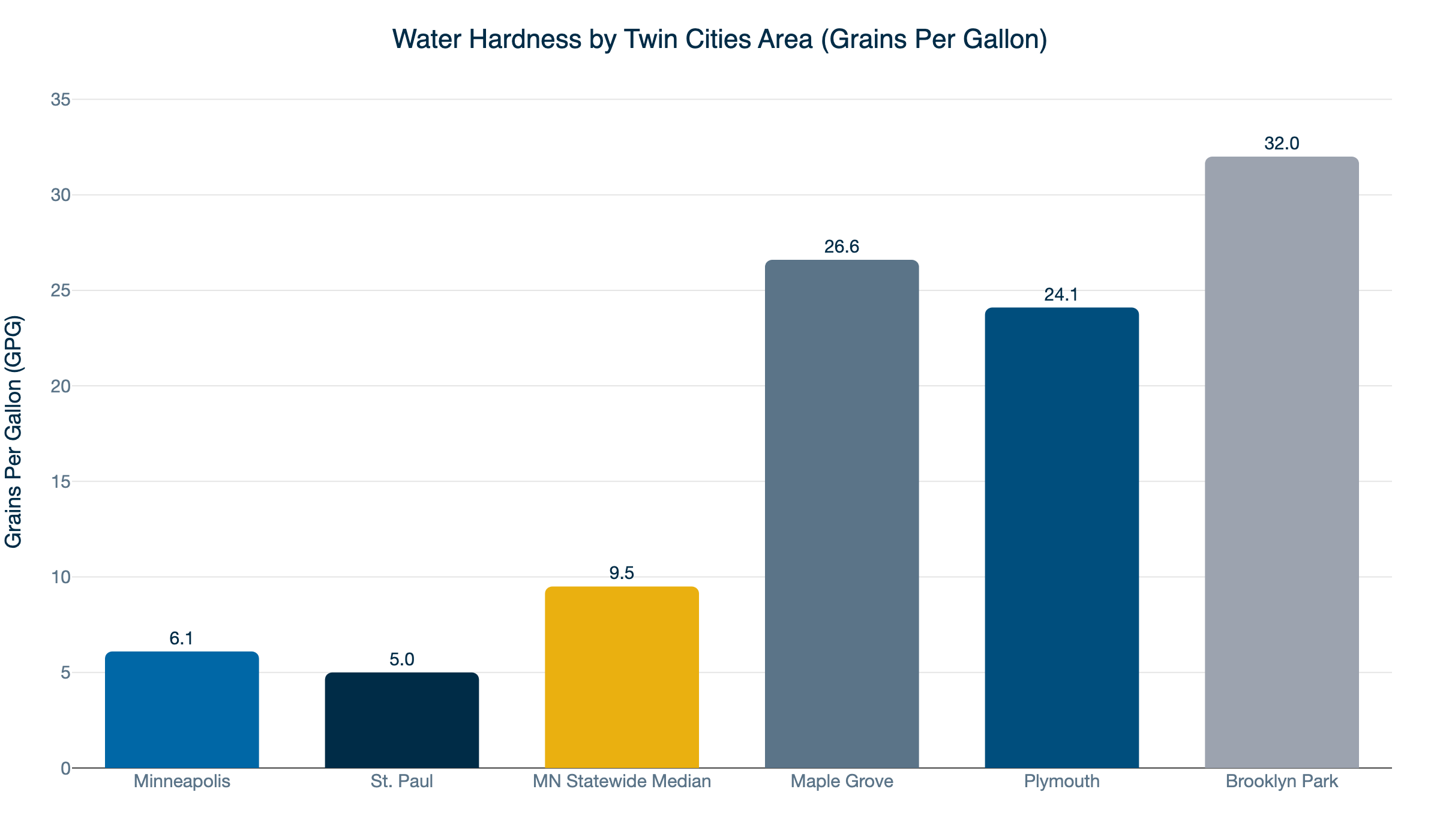
Water hardness varies sharply across the metro. Minneapolis and St. Paul tap relatively soft treated water at 5-6 GPG, but suburban communities on groundwater see 25-32 GPG. At those levels, a silent softener failure causes significant scale damage within weeks, not months.
Minneapolis finished water comes in at roughly 6.1 GPG, treated from Mississippi River source water before it reaches your tap. St. Paul is similar at around 5 GPG after lime softening at the McCarrons Treatment Plant. At those levels, a softener runs at a relaxed pace. Regeneration cycles are less frequent and salt consumption is lower.
Suburban households are a different story. The western and northern suburbs draw from the Prairie du Chien-Jordan aquifer. Hardness there runs dramatically higher: Brooklyn Park at 32 GPG, Maple Grove at 26.6 GPG, Plymouth at 24.1 GPG. At 30-plus GPG, your softener regenerates far more often and puts much more traffic through the brine tank. A bridge that a Minneapolis softener might tolerate for weeks becomes a serious problem in a Brooklyn Park home within days.
The statewide groundwater median is 9.5 GPG, rated “hard” on the USGS scale. Hardness commonly exceeds 200 mg/L across many parts of the state. Our full breakdown of water hardness by Twin Cities community maps the numbers city by city if you want to know where your household stands.
Minnesota’s climate adds another layer. High-humidity environments are a primary bridge trigger: humidity causes salt pellets to partially dissolve and then recrystallize into a crust. Twin Cities basements swing hard on humidity - wet and warm through the summer, bone dry when the furnace runs all winter. That thermal cycling is exactly the mechanism that builds bridges. If your brine tank sits in an unconditioned or partly conditioned basement, you are in bridge territory even with premium pellets.
How to Clean Your Water Softener Brine Tank
Annual cleaning is the consensus standard for most households. Here is the full process. You need a bucket, a wet-dry vac or utility pump, dish soap, a soft brush, clean water, and a bag of fresh high-purity evaporated pellets.
Step 1: Put the softener in bypass mode. Most units have a bypass valve behind or on the side of the control head. Slide or turn it to bypass. Water keeps flowing to your house from the supply line while you work on the brine tank.
Step 2: Run a manual regeneration (optional but helpful). If the resin bed is heavily loaded with hardness minerals, one regeneration cycle before cleaning helps flush the resin. It will be ready to work with fresh brine after the cleaning is done.
Step 3: Remove remaining salt. Scoop out as much loose salt as you can. A small bucket and a shop vac make this go faster. If you have a bridge, break it with your broom handle first, then scoop.
Step 4: Remove and inspect the brine well. The brine well is the narrow tube standing upright inside the tank. Pull it out and remove the float valve at the top. Rinse both with clean water. This is where mushing sludge clogs first. Scrub the brine well clear. Check the float valve assembly for cracks or corrosion.
Step 5: Drain the tank. A wet-dry vac or small submersible pump removes standing water and salt slurry. If the sludge is thick, add a few gallons of hot water to help dissolve it first, then vacuum it out.
Step 6: Scrub the tank interior. Use dish soap, warm water, and a soft brush. Scrub the walls, bottom, and any ports. Rinse thoroughly. You do not need harsh chemicals. Soap and water handle salt residue cleanly.
Step 7: Reassemble and refill. Reinstall the brine well and float valve. Add fresh salt and fill to no more than two-thirds of the tank’s capacity. Keeping the level between one-third and two-thirds full is the standard recommendation. Overfilling is a leading bridge trigger, and running too low risks the resin cycling without brine.
Step 8: Return to service. Move the bypass valve back to the service position. Run a manual regeneration to charge the resin bed with fresh brine from the clean tank.
If the float valve looks corroded, the brine well is cracked, or the control valve behaves oddly after cleaning, call a plumber before you return the unit to service.
How Often Should You Clean a Water Softener Brine Tank?
Once a year is the industry standard for most households. Step up to every six months if you have iron in your water, use lower-purity salt, or have had mushing before. Iron accelerates sludge formation and can foul both the brine tank and the resin bed.
If you have never cleaned your brine tank and the unit has been running for several years, treat the first cleaning as a diagnostic. Look at the sludge volume and the condition of the brine well. That will tell you whether the annual schedule is right for your household or whether a shorter interval makes more sense.
What Type of Salt Should You Use?
Use high-purity evaporated salt pellets. They dissolve cleanly and leave less insoluble residue than rock salt or solar salt. In Minnesota’s humid basements, where partial dissolving and recrystallization are already a bridge risk, cleaner salt pays for itself in avoided cleanings.
Rock salt and lower-purity pellets contain more insoluble material, which settles as sludge and accelerates mushing - especially during humid summer months in Twin Cities basements. Evaporated pellets cost more per bag. They cost less per year when you factor in avoided service calls and extended cleaning intervals.
If your water has elevated iron - common in many Minnesota well-water communities - ask about salt products with a built-in resin cleaner. Some are formulated for high-iron water. If your fixtures show orange staining or your water looks rust-tinged, a dedicated iron treatment system may be a better long-term solution than running iron through the softener alone.
What Happens When You Ignore the Brine Tank?
Hard water quietly accumulates scale inside your water heater, pipes, and appliances. Scale is an insulating layer - the harder your water and the longer the softener has been offline, the more aggressively it builds. The damage compounds with each passing week.
Resin bed degradation. A resin bed that never gets regenerated stays saturated with calcium and magnesium. Over months, the resin beads can foul permanently and lose capacity. Replacing a resin bed is a significant repair. Catching a bridge or mush early with a routine cleaning avoids it entirely.
Water heater scale. Scale on heat exchanger surfaces forces the unit to work harder to move heat through the buildup. One estimate puts annual efficiency degradation from scale at roughly 4-6% in hard-water homes. At the 25-32 GPG hardness levels common in the western and northern suburbs, that accumulates fast. Our post on hard water and water heater anode rod life covers how scale shortens the whole unit’s lifespan, not just its efficiency.
Fixtures and appliances. Dishwashers and washing machines run on whatever water reaches them. Hard water wears out seals, etches glass, and leaves mineral residue on surfaces. Faucet aerators and showerheads clog with white crust. Those are easy to clean. Inside a pipe or a valve, scale is not.
If you have been running hard water for months without knowing it, a professional inspection can assess whether the resin needs replacement and whether any downstream components took damage worth addressing now rather than later.
When to Call a Plumber
Most homeowners can handle brine tank cleaning themselves if the unit is accessible and otherwise in good shape. Call us when:
- The float valve or brine well assembly is corroded or visibly damaged.
- The control valve is not initiating regeneration correctly after cleaning.
- The mushing is severe and the softener has not regenerated in months.
- Your water hardness is in the 25-plus GPG range and you want the full system evaluated: softener, pre-filters, and water heater together.
- You are considering upgrading to a demand-initiated regeneration (DIR) system. The EPA’s WaterSense program recommends DIR systems over fixed time-clock units because they regenerate only when the resin is actually loaded, cutting both salt and water waste.
We are locally owned and operated, and we serve the full Twin Cities metro: Minneapolis, St. Paul, Blaine, Bloomington, Brooklyn Park, Coon Rapids, Maple Grove, and the surrounding suburbs. Northern Benjamin Franklin Plumbing carries the On-Time Guarantee(R). We arrive in the window you pick. If we are late, you receive $5 for every minute, up to $300. That is the commitment: “If there is any delay, it’s you we pay!”
To schedule a water softener inspection or brine tank service, call (763) 296-1844 or book online. If you are not sure whether your softener is working at all, our water softener service page is the right place to start.
Frequently Asked Questions
How do I know if my water softener is working? +
What causes salt bridges in water softeners? +
How often should I add salt to my water softener? +
Can salt mushing damage a water softener permanently? +
Is softened water safe to drink? +
Need a technician now?