
Toilet Slow to Fill After Flush: Diagnose and Fix It
Key Takeaways
- A toilet slow to fill after flush has four main causes: a partially closed shutoff valve, a kinked or damaged supply line, a worn fill valve, or low house water pressure.
- Check the shutoff valve first. It takes 10 seconds and costs nothing.
- Twin Cities water is moderately hard: 5.3-5.5 grains per gallon after treatment. Minneapolis finished water also runs at a pH of roughly 9.0. That combination accelerates calcium carbonate scale inside diaphragm fill valves faster than softer water would.
- Fill valve replacement in a single- or two-family home is permit-exempt under Minnesota Plumbing Code. Altering the supply piping configuration is not.
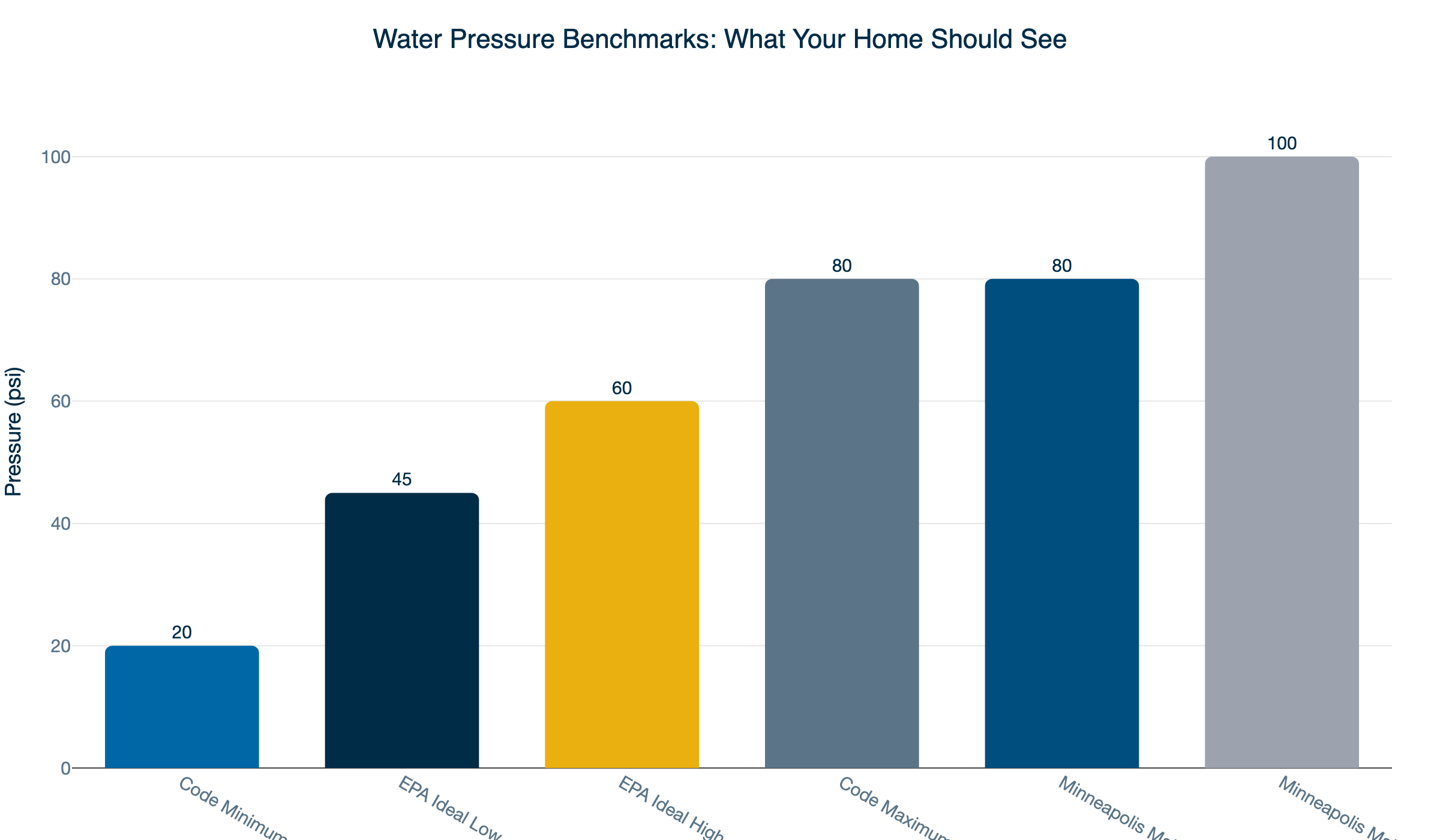
- EPA WaterSense targets 45-60 psi as the ideal residential pressure range. Minneapolis mains run 80-100 psi, making a failing pressure-reducing valve a real local cause.
- WaterSense-certified toilets flush at 1.28 gpf versus the older 1.6 gpf standard. They refill more slowly by design. If yours is newer and has always filled at this pace, it may not have a problem.
- Call (763) 296-1844 or book online when basic checks don’t solve it.
Why Is a Toilet Slow to Fill After Flushing?
A slow-filling toilet comes down to one of four causes: a partially closed shutoff valve, a kinked supply line, a worn fill valve, or low house water pressure. Most cases are inexpensive to fix. Start with the shutoff valve - it costs nothing and takes 10 seconds to check.
Most national repair guides list these causes without a framework for telling them apart. This post gives you that framework. Each diagnostic step ends with a clear outcome: you either fixed it, or you know exactly what to check next. At the end is a decision tree that maps your symptoms to specific actions.
How Long Should a Toilet Take to Fill After Flushing?
Most tank-type toilets refill in 1 to 2 minutes under normal household water pressure. If yours takes more than 3 minutes, something is restricting flow. One exception: newer WaterSense-certified toilets flush with less water, so they refill more slowly by design.
EPA WaterSense-certified toilets flush at a maximum of 1.28 gallons per flush, which is 20% less water than an older 1.6 gpf model. A newer, water-efficient toilet naturally takes a few more seconds to refill than an older one. A freshly installed toilet with a healthy fill valve and good water pressure should refill quickly enough that you barely notice it. If you can hear the fill valve running for more than a minute or two after every flush, that is worth investigating. If your toilet has always filled at this pace and the pace hasn’t changed, there may not be a problem.
Step 1: Check the Shutoff Valve
The shutoff valve is on the wall behind or below the toilet. It controls the water supply to the tank. A valve partially closed during a past repair, or one that has drifted over time, restricts flow without any other visible symptoms.
Turn the valve fully counterclockwise to open it. Flush and time the refill. If the tank fills significantly faster, you found the cause.
If the valve is stiff, corroded, or won’t open all the way, do not force it. A corroded angle stop can snap at the stem and turn a simple fix into a flooding event. Our guide on angle stop and shutoff valve replacement explains when to replace a valve rather than push it further. If it looks compromised, call a plumber before doing anything else.
Is a Kinked or Damaged Supply Line to Blame?
The supply line connects the shutoff valve to the bottom of the toilet tank. A kink, a pinched section, or mineral buildup inside the line restricts flow the same way a kinked garden hose does.
Close the shutoff valve. Disconnect the supply line at both ends. Hold it up to the light. Look for a visible kink, a flat section, or discoloration inside. If you find any of those, replace the line. Braided supply lines are inexpensive and the swap takes about 15 minutes.
One Minnesota-specific factor: supply lines on exterior walls, or inside vanities that face an unheated space, are a freeze risk in winter. A line that froze and partially thawed can have an internal restriction that is not visible from the outside. If your slow fill started after a cold snap, check the supply line before anything else.
On permits: Minnesota Plumbing Code Chapter 4714 exempts replacement of internal working components in single- and two-family homes from permit requirements. Replacing a supply line that alters the existing piping configuration is not exempt. If you are unsure, ask your plumber before starting.
A slow fill is typically a supply or fill valve issue. A toilet that keeps running after the tank is full is usually a flapper problem. Our guide to fixing a running toilet with a flapper replacement covers that side of the repair.
What Does the Fill Valve Do, and When Does It Fail?
The fill valve opens after every flush to let water into the tank, then closes when the float signals the tank is full. When the valve wears out, water flow drops to a trickle. The tank takes much longer to fill, or may stop filling partway through.
Fill valve failure is gradual, not sudden. A slow fill that has been getting worse over weeks or months is the signature symptom. A valve in its final stages may fill the tank only partway before closing, or stay open and run continuously.
Fluidmaster notes that diaphragm seals in fill valves in service for 7 or more years begin to show meaningful wear. Korky puts the practical replacement threshold at 5 years. Both assume typical residential use and normal water conditions. Hard water shortens that window. In-tank cleaning tablets containing bleach also accelerate seal degradation by breaking down the rubber faster than normal wear would.
In the Twin Cities, with moderately hard water cycling through every flush, a valve’s performance often starts to degrade before it fails outright. You notice the slow fill long before the valve stops working entirely.
If you notice white or grayish crust on the inside walls of the tank or around the valve seat, that is calcium carbonate scale. The same buildup is inside the valve itself. That is visual confirmation that hard water is shortening the valve’s effective life.
Replacing a fill valve is one of the more accessible toilet repairs a homeowner can take on. Our post on fill valve replacement and why a toilet keeps running after it fills walks through the full process.
How Does Twin Cities Hard Water Speed Up Fill Valve Wear?
Most national repair guides list “hard water buildup” as a cause and leave it at that. Here is what it actually means for a Minneapolis or Saint Paul home.
Both cities treat Mississippi River water before delivery. Minneapolis finished water hardness and pH are documented on the city’s water quality page. Saint Paul Regional Water Services treats the same river source down to 93 mg/L, roughly 5.3 grains per gallon. Both are in the moderately hard range.
The high pH figure matters specifically for fill valves. A higher pH increases the tendency for dissolved calcium carbonate to deposit on internal plumbing surfaces. Inside a diaphragm fill valve, that scale gradually narrows the opening in the valve seat. The result is a slow fill that worsens progressively. You may not notice it at first. Over a year or two, the fill time can quietly double.
If your toilet is more than five years old and you have never replaced the fill valve, the combination of age and moderately hard water is a likely cause. A new valve typically restores normal fill time in one visit.
Why Is My Toilet Tank Only Filling Halfway?
If the tank fills to a point well below the marked fill line and then stops, the float is the most likely cause, not the fill valve. The float signals the fill valve when to close. A float set too low shuts the valve before the tank reaches the correct level.
On older ballcock-style valves, the float is a ball on a long arm. Bend the arm gently upward to raise the shutoff point. On modern fill valves, the float is a cup on a vertical shaft with a twist-lock or clip adjustment on the side. Move it upward. Most tanks have a water level line marked on the inside wall, about a half-inch below the overflow tube. That is your target.
If adjusting the float does not fix the problem, replace the fill valve. A valve that can no longer hold a consistent water level has reached the end of its useful life.
Could Low House Pressure Be the Real Cause?
Low water pressure is less common than a worn fill valve. But it is the most important cause to identify, because it affects every fixture in your house, not just the one toilet.
The International Plumbing Code sets a minimum pressure requirement at tank-type toilet fixtures. The EPA WaterSense program recommends 45-60 psi as the ideal residential range and notes that very low pressure creates a contamination risk through back-siphonage.
Here is the local context: Minneapolis water mains deliver pressure to residential service lines. That is well above the residential target. Most Twin Cities homes have a pressure-reducing valve (PRV) at the main entry that steps the pressure down to the 50-60 psi range. A PRV that is failing or out of adjustment can let pressure swing unpredictably high and low. Either condition stresses fill valves and supply lines over time. This is a cause competitors skip entirely - and it is a real one in this metro.
To test your pressure, thread a simple gauge onto an outdoor hose bib. A reading below 40 psi warrants a plumber’s evaluation. A reading above 80 psi means the PRV may not be regulating effectively. Our post on high water pressure and the signs that a PRV is failing covers that diagnostic in full.
Signs that pressure is the root cause rather than the fill valve: multiple fixtures in the house run slowly, shower pressure has dropped, or the toilet fills faster in the early morning than during the day when household water demand is higher.
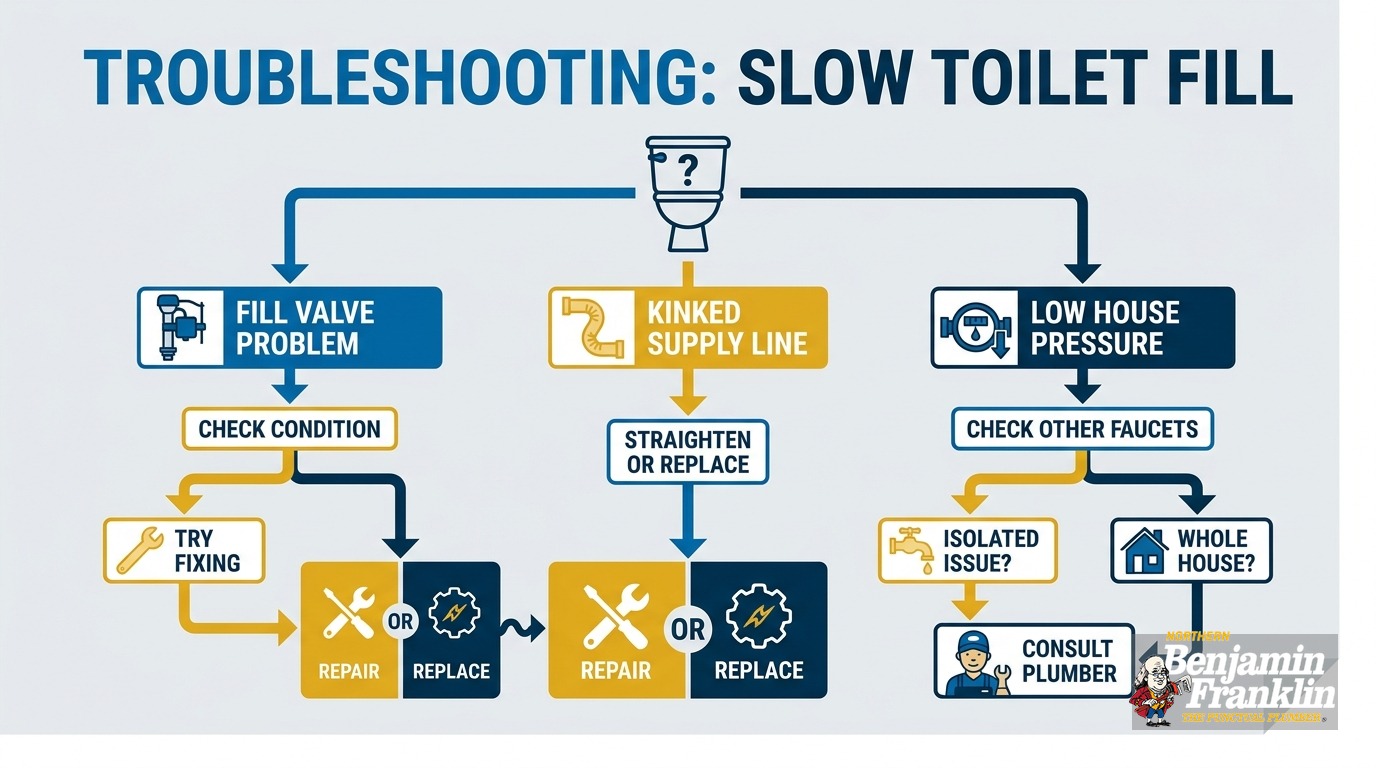
Your Diagnostic Decision Tree
The three top results on this topic list possible causes. None of them help you decide which cause applies to your specific toilet. Use this tree.
Did the slow fill start suddenly or gradually?
If suddenly, after a repair, a cold snap, or overnight:
- Is the shutoff valve fully open? Open it, test, and move on if the problem is solved.
- Is the supply line kinked, frost-damaged, or discolored inside? Replace it.
- Are other fixtures in the house also running slowly? That points to the PRV or main pressure. Call (763) 296-1844.
If gradually, over weeks or months:
- How old is the toilet? Five or more years makes the fill valve the primary suspect.
- Does the tank fill to a point and then stop short of the fill line? Adjust the float first. Replace the fill valve if the adjustment doesn’t hold.
- Is there visible white or gray scale inside the tank? That confirms hard water wear. Replace the fill valve.
Still slow after replacing the fill valve and supply line?
The restriction is upstream of the valve. The angle stop may be partially blocked, or house pressure is low. Book a toilet diagnostic online or call (763) 296-1844 and our team will work through the full supply-side diagnosis.
Can You Replace a Fill Valve Without Turning Off the Water?
No. You must close the shutoff valve behind the toilet before disconnecting any hardware inside the tank. If the shutoff valve won’t close fully, shut the water off at the main before starting.
Under Minnesota Plumbing Code Chapter 4714, replacing internal working components such as a fill valve or flapper in a single- or two-family home is permit-exempt. You do not need a permit for this repair. If you are replacing the supply line in a way that alters the existing piping configuration, the permit picture changes. Your plumber can clarify at the time of service.
When to Call Northern Benjamin Franklin Plumbing
A slow-filling toilet is usually fixable without a service call if the shutoff valve or supply line is the cause. Fill valve replacement is also an accessible DIY task for a homeowner comfortable with basic plumbing work.
Call us when:
- The shutoff valve is corroded, stripped, or won’t turn. Forcing a damaged valve can snap the stem and flood the area around the toilet.
- You replaced the fill valve and the tank still fills slowly. The cause is likely a supply restriction or a pressure problem that needs a proper diagnostic.
- Multiple fixtures in the house are running slowly. That is a PRV or main pressure issue.
- The supply line connects to corroded copper or the fitting looks damaged at the connection. A plumber can replace the valve and supply line together and pressure-test the result before leaving.
- Multiple toilet components are failing at the same time. Successive repairs on a worn-out toilet can cost more than replacing it. Our guide on when to repair versus replace a toilet gives you a framework for making that call.
Northern Benjamin Franklin Plumbing is locally owned and operated, serving Minneapolis, St. Paul, Blaine, Bloomington, Brooklyn Park, Coon Rapids, Maple Grove, and the surrounding Twin Cities metro. When you book with us, our On-Time Guarantee(R) means we arrive in the window you pick. If we don’t, you receive $5 for every minute we are late, up to $300. “If there is any delay, it’s you we pay!” Call (763) 296-1844 or book online.
Frequently Asked Questions
How do I fix a slow-filling toilet? +
Why does my toilet take a long time to start filling after I flush? +
Need a technician now?