
Repair or Replace Toilet: The Twin Cities Decision Guide
Key Takeaways
- Find the manufacture date stamped inside the tank lid. That date determines which efficiency era your toilet is from.
- Toilets made before 1994 use 3.5 to 7 gallons per flush. A WaterSense-labeled model uses 1.28 gpf. Replacing one pre-1994 toilet can save roughly 13,000 gallons per year.
- A crack in the bowl means replace immediately. Porcelain is not structurally patchable.
- A hairline crack in the tank exterior, above the waterline, and staying dry is a monitor. Any wet or weeping crack means replace.
- If a repair costs more than half what a replacement would cost installed, replacement is usually the smarter investment.
- Minneapolis water runs at 10 to 13 grains per gallon. Saint Paul water runs harder. Hard water shortens the repair cycle on rubber seals and fill valves.
- Minnesota requires a plumbing permit for toilet replacement. When we do the work, we handle the permit.
What determines whether to repair or replace a toilet?
Three factors drive the decision: the age of the fixture, the condition of the porcelain, and where the repair cost lands relative to a replacement quote. A toilet from 1982 and a toilet from 2012 are not the same decision. Neither is a worn flapper and a cracked bowl.
The sections below walk through each factor in order. If you want to skip ahead, the full decision framework is near the bottom of this post.
How old is your toilet?
The year your toilet was installed is the most important number in this decision. Lift the tank lid and look at the inside surface near the top of the porcelain. Most manufacturers stamp the production date there. If the date is not on the lid, check inside the tank itself, on the wall above the waterline.
Federal plumbing standards changed sharply in 1994. The Energy Policy Act of 1992 (42 U.S.C. § 6295(j)) set a 1.6-gallon-per-flush ceiling for all new toilets sold in the United States, effective January 1994. Toilets already installed before that date were not required to be replaced. A Twin Cities home from the 1970s or early 1980s may still have plumbing hardware that uses three to four times the water of a modern fixture.
Here is what each era actually uses:
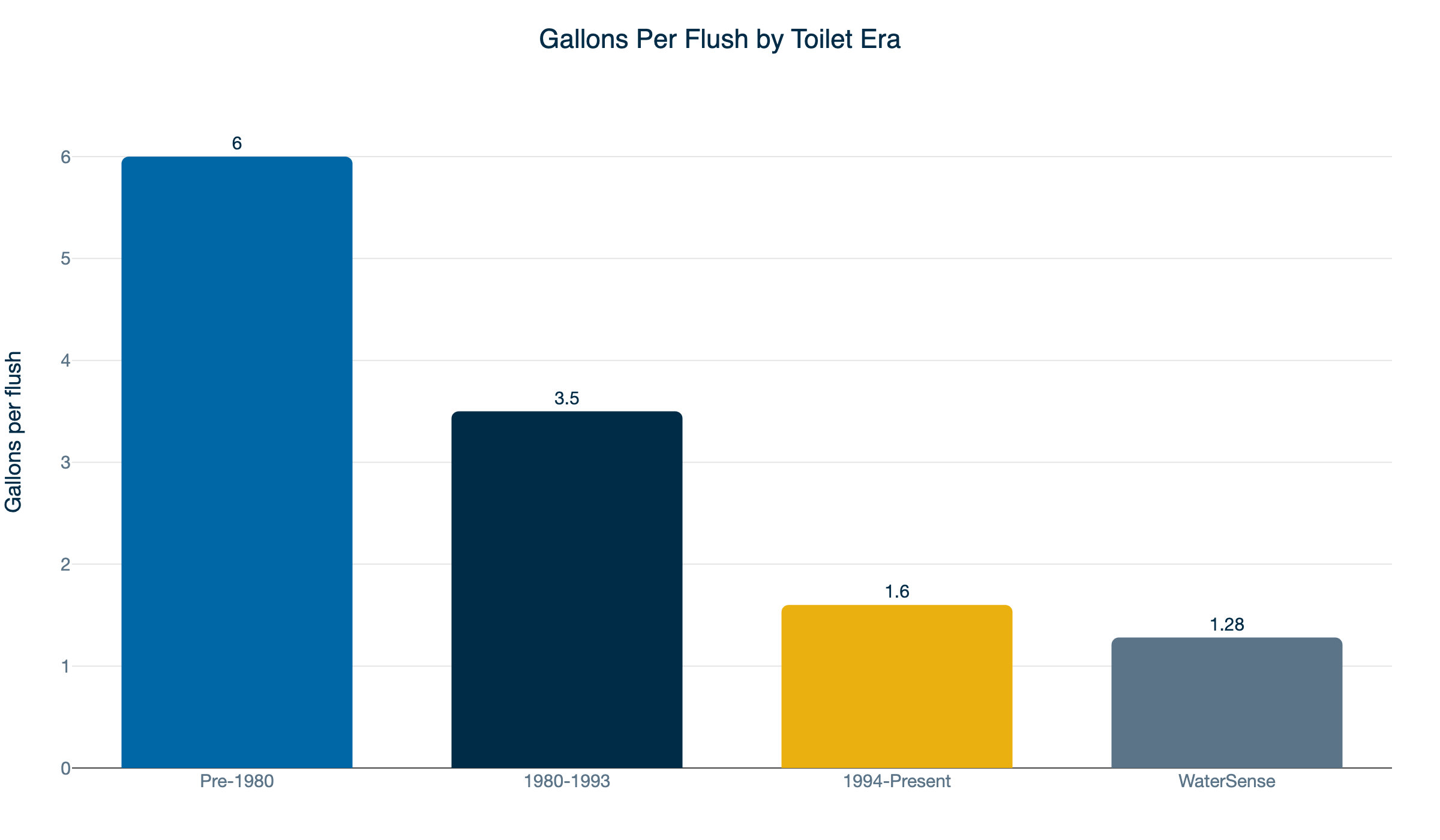
- Pre-1980: 5 to 7 gallons per flush
- 1980 to 1993: 3.5 gallons per flush (the first low-flow generation)
- 1994 to present: 1.6 gallons per flush (the federal mandate floor)
- EPA WaterSense labeled: 1.28 gallons per flush
According to the EPA WaterSense program, replacing one pre-1994 toilet with a WaterSense-certified model saves approximately 13,000 gallons of water per year. Toilets are the largest single indoor water user in most homes, accounting for nearly 30% of residential indoor water consumption.
For a pre-1980 toilet running at 5 to 7 gallons per flush, this is not a maintenance question. It is a financial one. The water savings on a modern fixture pay for the replacement within a few years in most cases. You do not need to wait for something to break.
Should you repair or replace a cracked toilet?
A crack anywhere in the bowl means replace now. Porcelain cannot be patched structurally, and a bowl that fails completely means water on the floor and subfloor damage. A dry hairline crack on the exterior of the tank, above the waterline, can be monitored monthly. Any crack that is wet, weeping, or sits at or below the waterline - in either the tank or the bowl - means replace without delay.
Here is how to read what you find:
Cracks in the bowl: A bowl crack is always a structural failure. It does not matter whether the crack is barely visible or obvious, dry or wet. The bowl supports the full weight of a person on every use. That repeated stress widens any existing crack over time. Do not wait for a complete failure. A bowl that fails suddenly puts water on the floor and can compromise the subfloor underneath, which turns a toilet replacement into a much larger flooring repair.
Cracks in the tank: The tank holds water under no pressure. That makes the calculus slightly different.
- Hairline crack, exterior only, above the waterline, no visible moisture: This is cosmetic for now. Check it monthly. If it stays dry and does not grow, you have time. If it begins to weep or spread, replace.
- Any crack that is wet or leaving a trace of moisture: Replace. A weeping tank crack will worsen with temperature cycling and daily use. A slow seep is still water on the floor, and water on the floor is subfloor rot waiting to happen.
- A crack at the waterline or below: Replace immediately. Hydrostatic pressure works against any porcelain weakness at that depth.
If you see staining or soft flooring around the toilet base with no visible crack, that can mean a failed wax ring or a hairline fracture where the base meets the floor. Either way, call us before the damage gets ahead of the repair cost.
What is the 50% rule for toilet repairs?
If the cost to repair your toilet exceeds half the cost of a new toilet installed, replacement is almost always the better financial decision. A toilet that has had one major failure is more likely to need another repair within the next 12 months than a toilet with no history of failures.
The 50% rule is a standard appliance-industry heuristic, and it applies cleanly to toilets. Parts-only repairs - a flapper, a fill valve, a flush valve seat - are typically well under the threshold. But when a repair involves the wax ring, a damaged flange, a corroded shut-off valve, or multiple components failing at the same visit on an aging fixture, the cost climbs toward replacement territory.
Think about it this way: a 1988 toilet that gets a new wax ring is still a 1988 toilet. The repair resets the clock on one part. The fixture as a whole is still 35 years old, and it still uses 3.5 gallons per flush. You paid to extend the life of hardware that is already running well below current efficiency standards.
The questions to ask when you are looking at a repair estimate:
- Is this the first repair in the last few years, or part of a pattern?
- How old is the toilet, and which era is it from?
- Where does this repair cost land relative to what a new installed toilet would cost?
When the math is close, lean toward replacement. New toilets are more efficient, have fewer parts near the end of their life cycle, and carry manufacturer warranties on components. For a look at how smaller plumbing problems compound over time, read our post on leaky faucets and running toilets in the Twin Cities.
How does Twin Cities hard water change the repair-or-replace math?
Hard water deposits calcium and magnesium on every internal surface it contacts. Inside a toilet tank, those minerals coat the flapper seat, stiffen rubber diaphragms in the fill valve, and accumulate on the float arm mechanism. Rubber components lose flexibility as mineral buildup increases. The repair cycle shortens. Minneapolis and Saint Paul homeowners see this play out faster than national repair estimates suggest.
Minneapolis draws from the Mississippi River. Annual Consumer Confidence Reports from Minneapolis Utility Services report hardness at approximately 10 to 13 grains per gallon, classified as hard. Saint Paul Regional Water Services draws primarily from the Prairie du Chien-Jordan aquifer (groundwater) and historically reports hardness at 15 to 20 or more grains per gallon - harder still.
That difference matters. A flapper in a soft-water market might last three to five years. In Minneapolis or Saint Paul, mineral deposits shorten that to 12 to 18 months in many cases. Fill valves scale up and fail sooner. The cumulative cost of repeated internal repairs on a hard-water toilet adds up faster than a simple repair-versus-replace comparison would show.
If your toilet is 10 or more years old and you have already replaced the flapper, fill valve, or flush valve seat more than once, you are on a shortening repair cycle. Hard water will keep taking parts. A replacement quote is worth getting before the next repair authorization.
For a deeper look at what Twin Cities water hardness does throughout your plumbing system, read our post on water hardness in Minneapolis and Saint Paul.
Do you need a permit to replace a toilet in Minnesota?
Yes. Minnesota Plumbing Code (Chapter 4714) requires a permit for plumbing fixture installation. That requirement covers toilet replacement. Homeowners may pull their own permit for work on their principal residence. When a licensed plumber does the work, the plumber is responsible for pulling the permit.
This surprises a lot of homeowners, especially those who have swapped a toilet before without one. A permit is not a formality. It ensures the rough-in is at the right dimension, the flange is at the correct height, and the work meets current code. In Minnesota, unpermitted plumbing work can create complications during a home sale and can establish liability if water damage follows.
Minnesota Department of Labor and Industry administers plumbing permit requirements for the state and can confirm what your municipality requires. When Northern Benjamin Franklin Plumbing does the work, permit management is included. You do not have to navigate the process yourself.
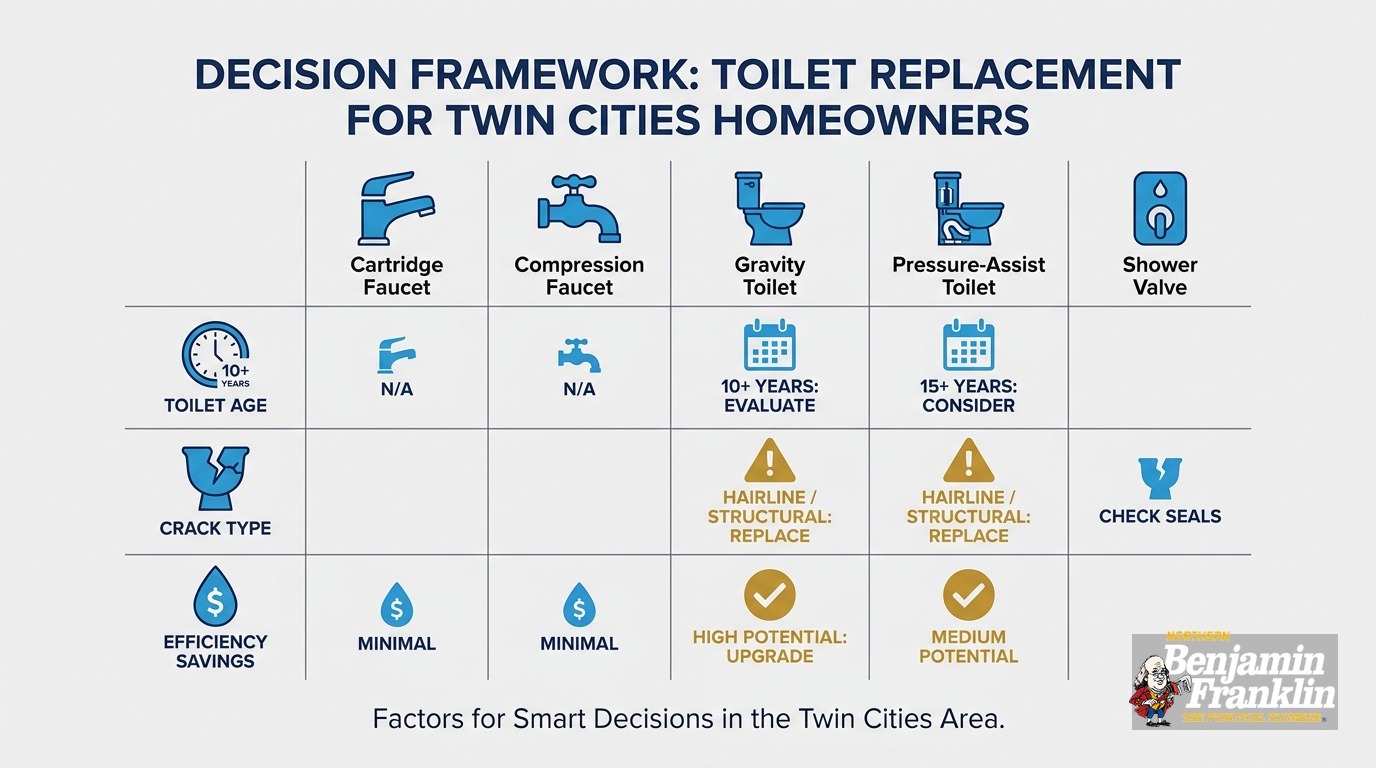
The repair-or-replace decision framework
Use this as your starting point. Then call us for a specific repair estimate and a side-by-side replacement quote so you can compare real numbers for your situation.
Pre-1980 toilet (5 to 7 gpf), any condition: Replace. The water savings alone justify a new fixture within a few years. This is not a close call; the math is settled by the efficiency gap alone.
1980 to 1993 toilet (3.5 gpf), working but aging: Replace if the repair cost crosses a meaningful threshold, or if you have had more than one repair in the past 12 months. A 3.5 gpf toilet is substantially below current efficiency standards, and the financial case for replacement is real.
1994 to present toilet (1.6 gpf), isolated part failure: Repair. Parts are inexpensive. You are already at the federal efficiency floor. A flapper replacement on a 15-year-old toilet in otherwise good condition is a straightforward, low-cost repair.
Any crack in the bowl: Replace immediately. Do not wait for it to worsen.
Hairline crack in the tank exterior, above the waterline, dry: Monitor monthly. Not an emergency. But the moment it weeps, replace.
Any wet or weeping crack in the tank: Replace.
Repair cost exceeds 50% of the installed replacement cost: Replace.
Twin Cities home, hard water, 10-plus years of internal repairs: Replace. You are on a shortening repair cycle. Hard water will continue degrading components faster than the repairs can offset.
Running toilet repaired more than once in two years: This is a symptom of broader internal wear. Get a replacement quote before authorizing another repair.
What does a toilet replacement actually involve?
A licensed plumber removes the old fixture, inspects the flange, sets a new wax ring, installs the new toilet, connects the supply line, and performs a full leak check before leaving. Permit management is part of the job when we do the work.
The flange inspection is the step most homeowners do not anticipate. The flange is the fitting that connects the base of the toilet to the drain pipe below the floor. A rocking toilet or a slow undetected leak often means flange damage underneath. If the flange needs repair or replacement, that work happens before the new toilet goes down. Installing a new toilet over a damaged flange recreates the same problem and could mean pulling the toilet again within a year.
For older homes - the pre-1970 housing stock common in Minneapolis, Saint Paul, and the inner-ring suburbs - there is sometimes a mismatch between the existing rough-in dimension and standard modern toilet sizing. The standard rough-in is 12 inches, measured from the finished wall to the center of the drain. Some older homes are 10 or 14 inches. This is worth confirming before you purchase a new fixture, because it determines which models will fit your bathroom without modification.
The job finishes with a flush test, a leak check at every connection point, and cleanup. Visit our toilet service page for more on what our plumbing repairs and replacements cover.
Are there rebates for replacing an old toilet?
Some Twin Cities homeowners may qualify for a rebate when replacing an older toilet with a WaterSense-certified model. Rebate availability and amounts change year to year and vary by utility district. Check the EPA WaterSense Rebate Finder by ZIP code before you purchase a new fixture. A qualifying rebate can meaningfully reduce your out-of-pocket cost.
Rebate programs are managed by utility providers. We cannot quote a rebate amount, because those figures change on their own schedule. Use the Rebate Finder to see what is currently available in your area, then factor that into your repair-versus-replace comparison.
Schedule service with Northern Benjamin Franklin Plumbing
We are locally owned and operated in the Twin Cities. Every appointment we book is backed by the On-Time Guarantee(R): we arrive in the window you choose, or we pay you $5 for every minute we are late, up to $300. “If there is any delay, it’s you we pay!”
Our licensed plumbers will assess your toilet, walk you through the repair-versus-replace math for your specific fixture and water conditions, handle the permit, and complete the work correctly. There is no reason to keep repairing a toilet that has already crossed the line into replacement territory.
Call (763) 296-1844 or book online to schedule service.
Frequently Asked Questions
How do I know how old my toilet is? +
Can a cracked toilet bowl be repaired? +
Does replacing a toilet in Minnesota require a permit? +
How does Twin Cities hard water affect toilet components? +
Need a technician now?