
Toilet Rough-In Size: Measure First, Buy Second
Key Takeaways
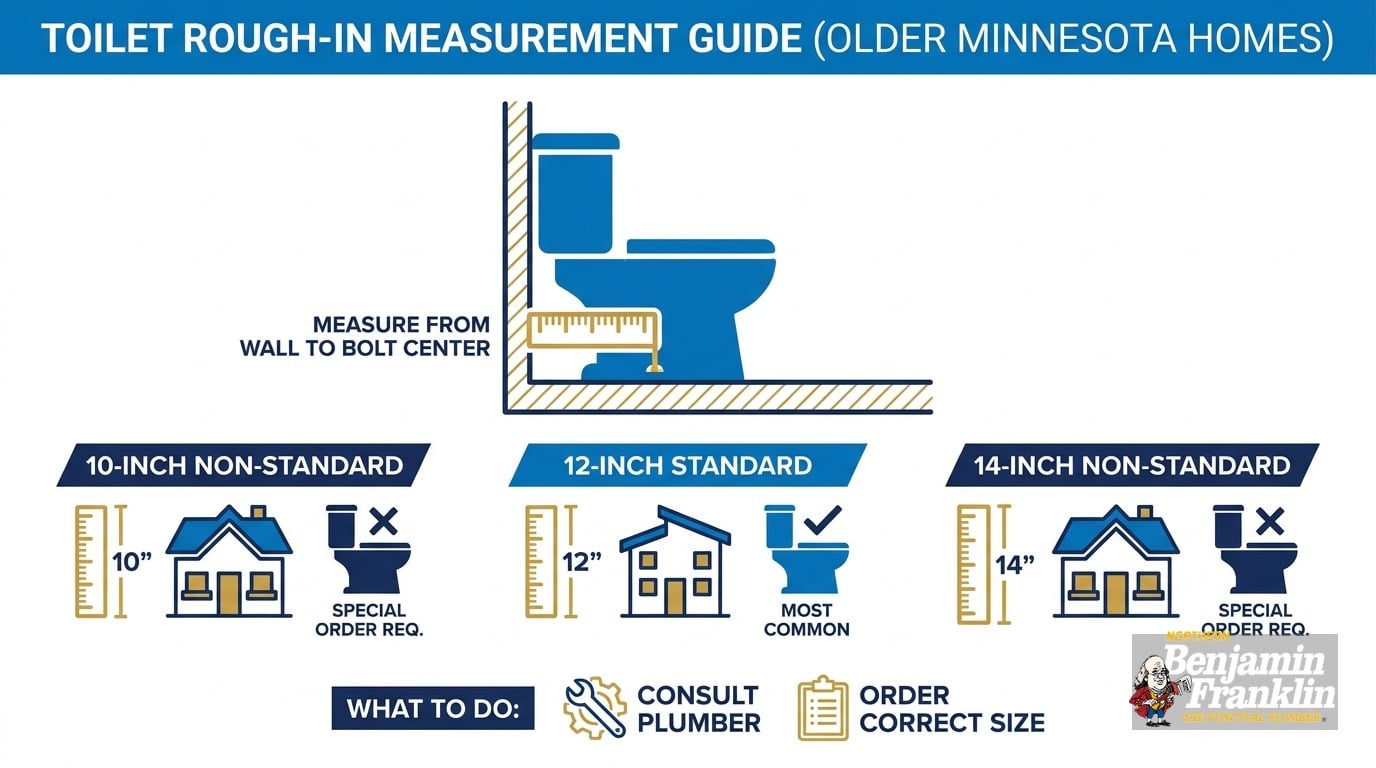
- Measure before you shop. The rough-in is the distance from the finished wall to the center of the toilet drain. Standard is 12 inches for homes built after 1950.
- Many pre-1950 Twin Cities homes have 14-inch rough-ins. This is common in south Minneapolis, northeast Minneapolis, and older St. Paul neighborhoods - not an oddity.
- Three options when the size doesn’t match: use a 12-inch toilet and accept the gap, source a true-size model, or have a licensed plumber move the drain.
- Moving the drain requires a permit in Minnesota under MN Rules Chapter 4715. It is not a DIY project.
- 10-inch rough-ins are the hardest to solve. Very few toilet models come in that size, and lead times stretch for weeks.
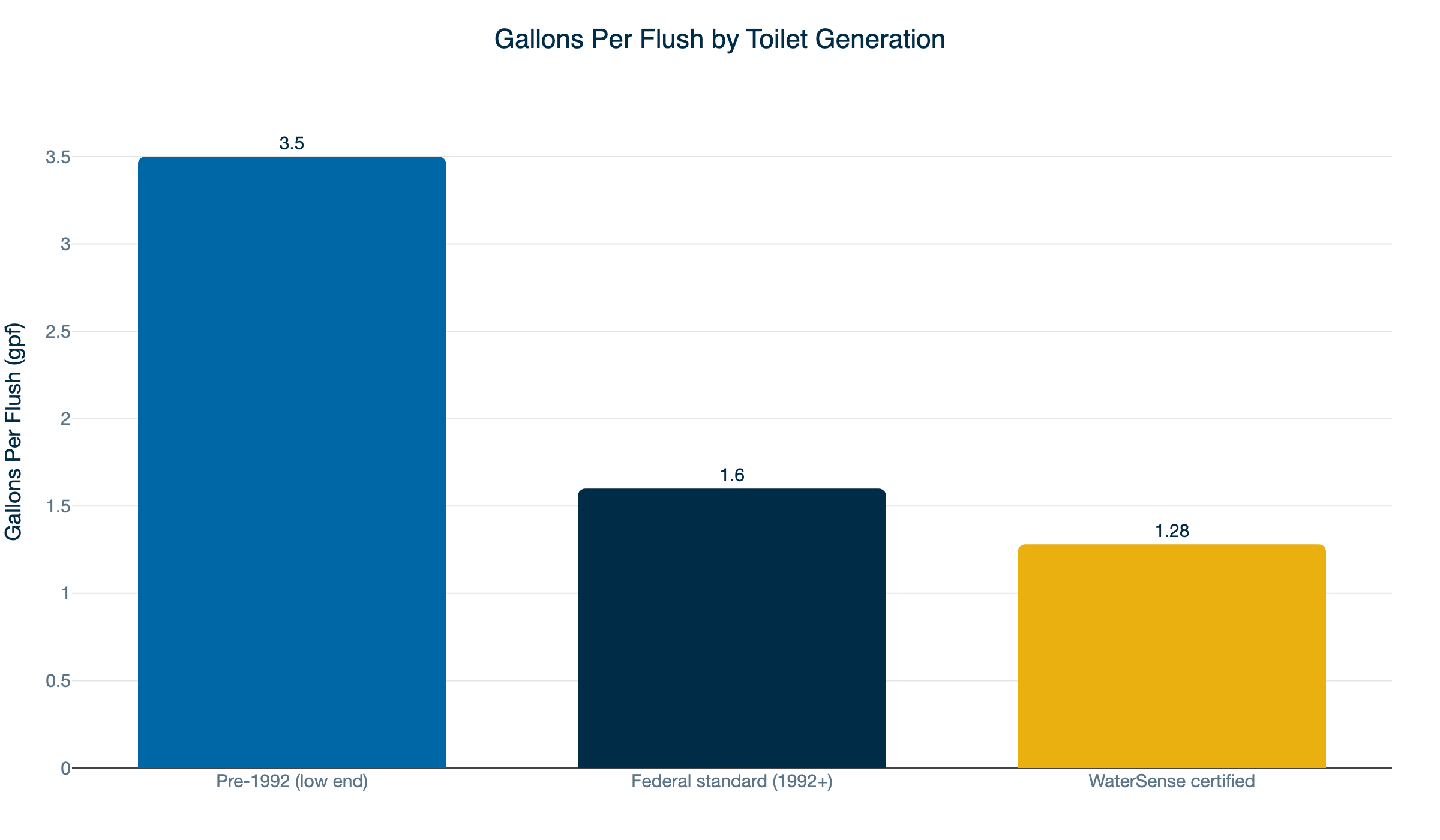
- A replacement is a good time to upgrade. WaterSense-certified toilets use a maximum of 1.28 gallons per flush. Pre-1992 fixtures used 3.5 to 7 gallons per flush.
Picture this: you buy a toilet at the hardware store without checking your toilet rough-in size first. You shut off the water, pull out the old toilet, and measure. The distance from the wall to the center of the drain is 14 inches. The toilet you bought fits a 12-inch rough-in. The store has no 14-inch models in stock. Your bathroom is now out of commission while you track down a special order.
This is not a rare scenario in the Twin Cities. A large share of Minneapolis and St. Paul homes were built before 1950, when 14-inch rough-ins were standard practice. Measuring first costs five minutes. Getting it wrong costs a day - or more.
What Is Toilet Rough-In Size?
The rough-in is the distance from the finished wall behind the toilet to the center of the floor drain. For most homes built after 1950, that measurement is 12 inches. Non-standard residential sizes are 10 inches and 14 inches.
The term comes from the rough-in phase of construction. That is when drain and supply lines are positioned before walls and floors are finished. Once the drain is set, that location is fixed. Every toilet is manufactured to fit a specific rough-in dimension. A mismatch means the toilet either cannot reach the drain or sits away from the wall.
This single measurement controls which toilet models you can buy. Check it before you shop.
How Do You Measure Toilet Rough-In Size?
Measure from the finished wall to the center of the floor drain. With the toilet still in place, you can measure to the center of the bolt caps on either side of the base. You do not need to remove the toilet to get a reliable reading.
Method 1: Toilet in place
Look at the base of your toilet. On each side you will see a small plastic cap sitting flat against the floor. Those caps cover the floor bolts that anchor the toilet to the drain flange. The bolts pass through the flange, which is centered over the drain.
Measure from the finished wall to the center of one of those caps. Repeat on the other side and average if the numbers differ slightly. The baseboard adds material thickness. Measure from the drywall surface behind the trim, not from the face of the baseboard itself.
Read your result:
- 11.5 to 12.5 inches: standard 12-inch rough-in
- 13.5 to 14.5 inches: 14-inch rough-in
- 9.5 to 10.5 inches: 10-inch rough-in
Method 2: Toilet already removed
If the old toilet is already out, measure directly from the finished wall to the center of the flange opening in the floor. This is the most precise method. It takes about ten seconds.
The Three Standard Toilet Rough-In Sizes
Toilets are manufactured in three dimensions. Here is what each means in practice.
12 inches is the current standard. Nearly every toilet on display at a hardware store is built for a 12-inch rough-in. Homes built after 1960 almost always have this dimension.
14 inches was common in homes built from the 1910s through the late 1940s. The 12-inch standard consolidated around 1950 as cast-iron closet flanges became uniform. Before that, American plumbing specifications allowed 12 to 15 inches. Fourteen inches was the prevalent choice in Midwest residential construction of that era.
10 inches is the most difficult scenario. Very few manufacturers produce toilets in this size. In any given model year, a buyer may find fewer than a dozen options nationally. Lead times for special orders stretch two weeks or longer. In some cases, moving the drain to a standard dimension is the more practical solution.
Why Does Toilet Rough-In Size Matter More in Older Twin Cities Homes?
Older Minneapolis and St. Paul homes were built before the 12-inch rough-in became the standard. A homeowner buying a toilet without measuring has a real chance of a mismatch - and it is a more common chance here than in most cities.
The Twin Cities has an unusually dense concentration of pre-1950 housing. Neighborhoods like Longfellow, Nokomis, and Powderhorn date primarily to the 1910s through the 1940s. So do northeast Minneapolis and older St. Paul neighborhoods like Highland Park, Summit Hill, Macalester-Groveland, and Hamline-Midway. Many of these homes still have their original drain rough-ins.
Hard water adds a layer of complexity. Minneapolis draws its water primarily from the Mississippi River, treated at the Minneapolis Water Treatment Plant. According to the city’s annual Consumer Confidence Report, hardness typically runs 120 to 180 mg/L - roughly 7 to 10 grains per gallon, classified as moderately hard to hard. Saint Paul Regional Water Services mixes river water with deeper groundwater, pushing hardness higher, often 150 to 225 mg/L (9 to 13 grains per gallon). Hard water accelerates mineral buildup in the toilet tank and around the base flange. An older home with a corroded flange and a 14-inch rough-in may need both addressed at the same time.
What Are Your Options When the Toilet Rough-In Size Doesn’t Match?
You have three choices: install a 12-inch toilet and accept the gap, source a true-size model, or have a licensed plumber relocate the drain. The right option depends on the specific size, your timeline, and how the gap will look in the space.
Option 1: Use a 12-inch toilet in a 14-inch rough-in
A 12-inch toilet installed in a 14-inch rough-in functions normally. It flushes and drains the same as any other toilet. The visible result is a 2-inch gap between the back of the tank and the wall. Some homeowners accept this. Others find it collects grime or looks wrong. Both are fair assessments. The toilet works, and the gap is there.
If you want the widest fixture selection with no construction work, and the gap is acceptable, this is the simplest path forward.
Option 2: Source a true 14-inch or 10-inch toilet
Major manufacturers - American Standard, Toto, Kohler - produce models in 14-inch rough-in. The selection is smaller than the 12-inch lineup, and local stores may not stock them. A plumbing supply house typically has more options than a big-box retailer and can order specific models.
For 10-inch rough-ins, options are limited and almost always require a special order. A licensed plumber can help identify what is available and realistic for your timeline.
Option 3: Move the drain
This is the right call when you want a standard-selection toilet with no gap, or when sourcing a 10-inch model is not practical. This is a construction job with specific legal requirements in Minnesota.
Do I Need a Permit to Move a Toilet Drain in Minnesota?
Yes. Moving a toilet flange is a drainage alteration that requires a permit under Minnesota Rules Chapter 4715, the state plumbing code administered by the Department of Labor and Industry.
Minn. Stat. § 326B.43 requires that plumbing work be performed by a licensed journeyman or master plumber. There is a homeowner exception that allows an owner-occupant to do plumbing work at their own primary residence. Even under that exception, a permit is still required any time the drainage system is altered.
Moving the drain means cutting into the floor structure. In a first-floor bathroom, that is the subfloor. In a finished basement with a concrete slab, it means saw-cutting the concrete, repositioning the drain, and patching with new concrete. In Minnesota, basement slab work may also intersect insulation or vapor barriers installed to meet frost-depth requirements. The scope expands accordingly.
Do not start this work without permits in hand. Unpermitted drainage work surfaces as a flag during home inspections at the time of sale. A home inspector who finds an altered drain with no permit history will note it.
For a like-for-like toilet replacement at the same location with no drain work, most Minnesota municipalities treat it as maintenance and do not require a permit. Check with your local building department first. Minneapolis and St. Paul both operate under the state plumbing code. When there is any doubt, call and ask before you start.
If a bathroom remodel is happening alongside the toilet work, the post on bathroom remodel plumbing covers what else requires permits and what falls under maintenance.
Is a Toilet Replacement a Good Time to Upgrade Water Efficiency?
Yes. A replacement is the practical moment to move from an older high-consumption fixture to a WaterSense-certified 1.28 gallon-per-flush model. For pre-1992 homes, the difference in consumption is significant.
The EPA WaterSense program certifies toilets at a maximum of 1.28 gallons per flush. The federal Energy Policy Act of 1992 set a ceiling of 1.6 gpf. Toilets manufactured before 1992 used 3.5 to 7 gallons per flush - a range that reflects an era before conservation was built into the regulatory baseline.
WaterSense-labeled toilets use at least 20% less water than the 1.6 gpf federal minimum. The older the fixture, the larger the gap.
The homes most likely to have a non-standard rough-in - pre-1950 Twin Cities housing stock - are also the homes most likely to still be running original or near-original plumbing. That includes high-consumption toilets. If you are pulling the toilet to deal with a rough-in issue, the replacement decision is already on the table. A WaterSense-certified fixture is the sensible choice while the old one is already out.
What Does a Professional Toilet Replacement Involve?
A standard toilet swap covers shutting off the supply, removing the old toilet, inspecting the flange, installing a new wax ring, setting and securing the new toilet, and confirming no leaks at the supply line or base. Add a drain relocation and the job requires permits and a licensed plumber.
For a like-for-like swap in good condition, this is straightforward work. The scope changes if the flange is damaged.
Flanges in older homes - particularly original cast-iron flanges under heavy porcelain toilets that have been in place for 50 to 70 years - can corrode, crack, or pull loose from the floor. A damaged flange lets the toilet rock. A rocking toilet breaks the wax seal. A broken seal allows sewer gas into the bathroom and eventually leads to a leak at the base.
If you notice the toilet shifting when you sit on it, or if there is an odor near the base, check the wax ring and flange before anything else. The post on toilet leaking at the base and wax ring repair explains what causes that failure and what the repair involves.
If you are on the fence about whether to repair or replace, the toilet repair versus replace guide covers the decision. When multiple components are aging - fill valve, flapper, flange - replacement often makes more practical sense than servicing them one at a time.
What to Know About Older Pipes While You’re at It
If your home is old enough to have a 14-inch rough-in, it may also have galvanized steel supply pipes, original cast-iron drain lines, or polybutylene supply tubing from a later renovation. A toilet replacement is a reasonable moment to get eyes on what is behind the wall and under the floor.
Galvanized pipes corrode from the inside out. As the interior diameter narrows from rust buildup, water pressure drops and water may come through discolored. These pipes are common in Twin Cities homes built before the early 1960s.
If a licensed plumber is already at your home to address a rough-in issue, it costs nothing to ask them to look at the visible supply lines while they are there. Catching an aging pipe before it fails is better than addressing a leak after the fact.
Ready to Schedule?
Northern Benjamin Franklin Plumbing is locally owned and operated, serving Minneapolis, St. Paul, and the broader Twin Cities metro - Blaine, Bloomington, Brooklyn Park, Coon Rapids, Maple Grove, and the surrounding communities.
Toilet replacements, flange repairs, and drain relocations are all standard work for our team. We know the older housing stock in this area. We know the rough-in surprises it produces.
When you book, you schedule under our On-Time Guarantee(R). We arrive in the window you choose. “If there is any delay, it’s you we pay!” - that means $5 for every minute late, up to $300.
Call (763) 296-1844 or book online through our toilet service page.
Frequently Asked Questions
What is toilet rough-in size? +
Can I install a 12-inch toilet in a 14-inch rough-in? +
Do I need a permit to move a toilet drain in Minnesota? +
Need a technician now?