
Plumbing Inspection When Buying a Home in the Twin Cities
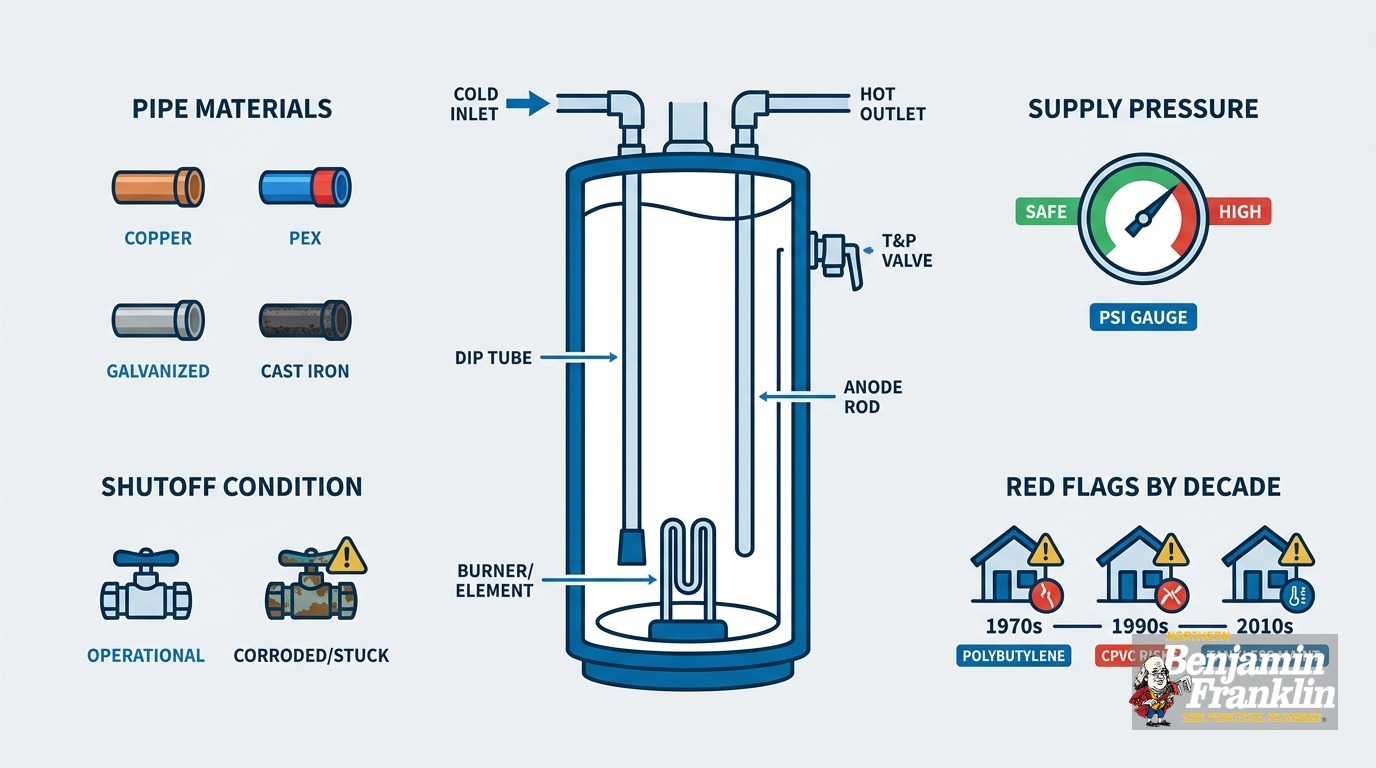
Key Takeaways
- A sewer camera inspects the drain lateral. It does not show supply pipes, shutoff valve condition, water heater age, or supply pressure. Both scopes belong in a pre-purchase inspection.
- Pipe material is largely a function of build decade. Galvanized steel, lead, and polybutylene each carry known failure modes. Knowing the era tells you where to look.
- Minneapolis water runs about 5.8 grains per gallon (moderately hard). St. Paul water runs 5-13 GPG. Hard water cuts a tank water heater’s lifespan nearly in half without annual maintenance.
- In Minneapolis, you own the sewer lateral all the way to the public main, including the stretch running under the street.
- Twin Cities frost depth runs 42-60 inches. Older supply lines buried shallower than code are a known failure point after severe winters.
- Lead service lines are still in the ground in parts of both cities. St. Paul has an active free replacement program. Confirm the status of the property’s line before closing.
What Does a Plumbing Inspection Cover When Buying a Home?
Short answer: It covers supply-side piping (material, condition, and age), every accessible shutoff valve, the water heater (manufacture date, fuel type, and signs of failure), static supply pressure at a hose bib or laundry valve, visible drain and supply connections at every fixture, and any evidence of unpermitted prior work. The sewer camera is a separate tool that covers the drain lateral only.
A full walkthrough moves through the home systematically. The inspector identifies what the pipes are made of: copper, galvanized steel, PVC, CPVC, PEX, or something older. They test each shutoff valve. Gate valves common in pre-1980 homes seize when they sit in the open position for years. They confirm the water heater’s manufacture date and note any corrosion around connections. They test pressure at a hose bib.
Any one of those checkpoints can surface a condition that changes the true cost of owning the home.
Decade-by-Decade: Red Flags Tied to When Your Home Was Built
The pipe materials in a Twin Cities home are largely a function of when it was built. Knowing the construction decade points you toward the right questions before the inspector ever arrives.
Pre-1940 homes. Lead supply pipes and lead bends were standard through much of this era. The Minnesota Plumbing Code (Ch. 4714) now restricts lead content in water-supply fittings to no more than 0.25% weighted average wetted surface. But older pre-code lead components can still be in place in homes built before those standards took effect. Look for dull gray pipe at the main entry point, soft metal that dents with thumb pressure, and clay sewer tile on the drain side.
1940-1960. Galvanized steel supply pipe was common. Galvanized steel corrodes from the inside out. It gradually narrows the bore and sheds rust into the water. The first sign is usually discolored water or reduced pressure at the far end of the house. The fix is a full repipe.
1960-1978. Copper supply became standard. Copper is durable, but these homes are now 50-plus years old. Shutoff valves from this era are usually gate valves, and gate valves seize when they sit open for decades. Test every one before closing. A seized shutoff valve is not cosmetic. It is a liability in any pipe emergency.
1978-1995. This is the polybutylene window. See the next section.
1995-2010. Most of these homes were built with PEX or CPVC, both generally reliable. The primary risk in this bracket is a water heater that is 15-25 years old and well past its expected service life.
2010 to present. Modern materials and code compliance. The main item to verify is the presence of a pressure reducing valve (PRV) and a static pressure reading in the 40-80 PSI range. New construction without a properly set PRV can damage fixtures and appliances over time.
Does Your Home Have Polybutylene Pipe?
Short answer: Polybutylene (PB) is a gray flexible plastic installed in homes built roughly 1978 to 1995. Chlorine and chloramine in municipal water oxidize it from the inside, creating micro-fissures that lead to sudden catastrophic failures. Roughly 60% of insurers refuse to write policies on homes that still contain it. A visual check at the water heater and under sinks takes two minutes.
Look for gray plastic pipe at the water heater connections, under bathroom and kitchen sinks, and at the main supply entry. Polybutylene is usually gray and has a dull, slightly chalky finish. Copper is orange-gold and rigid. PEX is flexible in red, blue, or white.
The scale of the polybutylene problem was large enough to produce one of the largest consumer class actions in American history. The Cox v. Shell Oil Co. settlement in 1995 resolved at $1.14 billion and covered 2.7 million homes. The claims window is long closed. A buyer who discovers polybutylene today has no fund to draw on and faces the full cost of replacement.
According to InspectApedia, roughly 6 million U.S. homes still contain polybutylene. Many are in the Twin Cities metro, built during exactly the years PB was in wide use. This is one condition where a visual check and a conversation with a licensed plumber before closing is not optional.
For a full identification and replacement guide, see Polybutylene Pipe Identification and Replacement.
What Should You Know About Water Heater Age?
Short answer: Standard tank water heaters last 8-12 years. In the Twin Cities, where municipal water is moderately hard, that lifespan is shorter without annual flushing and anode rod maintenance. Decode the serial number on the unit to find its manufacture date. Any unit over 10 years old is a near-term replacement cost that belongs in the negotiation.
Most manufacturers embed a letter-year code in the serial number. The first letter corresponds to the month (A equals January, B equals February, and so on) and the following two digits are the year. A unit with a serial starting “D17…” was manufactured in April 2017. That is a 9-year-old unit in 2026, sitting at the edge of its expected service life.
ENERGY STAR’s technical data shows certified tankless units reaching up to 20 years. Standard tank units run 8-12 years for both gas and electric configurations.
The hard water penalty makes this more urgent in the Twin Cities than in softer-water markets. Water Quality Association data, cited by Today’s Homeowner, shows hard water cuts a gas tank’s lifespan from 11 years to 5.5 years and an electric tank’s from 13 years to 6.5 years without maintenance. A 9-year-old water heater in a hard-water home that has never been flushed may be functionally at end of life, even if it falls within the standard age range.
Factor that into your offer, or ask for a replacement as a condition of sale.
To decode the serial number yourself, see How Old Is My Water Heater?
How Does Twin Cities Hard Water Affect the Plumbing You’re Buying?
Short answer: Minneapolis processed water ran at 5.8 grains per gallon (100 ppm) in January 2026. St. Paul water runs 5-13 GPG depending on season and source blend. Hard water deposits mineral scale inside every water-using appliance. Without maintenance, it cuts water heater lifespan nearly in half and affects shutoff valves, faucet aerators, and supply connections over time.
Minneapolis Water Works publishes monthly water analysis reports. The January 2026 figure puts Minneapolis at moderately hard. St. Paul Regional Water Services pulls from multiple sources, and hardness fluctuates seasonally. Third-party monitors have recorded St. Paul peaks above 12.5 GPG (213 ppm), which is solidly in the hard-water range.
When you tour a home, ask: Has the water heater ever been flushed? Has the anode rod been replaced? If the seller cannot answer those questions, assume the answer is no and price the maintenance liability accordingly.
A whole-home water softener eliminates the hard water penalty and extends the life of every water-using appliance in the house. The presence or absence of one is worth noting during the inspection walk.
Is the Sewer Camera Enough?
Short answer: No. A sewer camera is the right tool for inspecting the drain lateral from the clean-out to the main. It does not touch supply-side piping, shutoff valves, water pressure, water heater condition, or pipe materials inside the home. A complete pre-purchase plumbing review covers both sides.
In Minneapolis, the homeowner owns the sewer lateral from the house all the way to the wye connection at the public main, including the section running under the street. The average lateral replacement runs $13,000, with a range from $2,150 to $62,000 depending on depth, pipe material, and access conditions.
A permit is required for any lateral repair in Minneapolis. Unpermitted prior repairs are a red flag. Work that was not inspected may not meet code, and that liability transfers to the buyer at closing.
The camera shows you roots, cracks, offset joints, bellies, and grease accumulation. A section of cracked cast iron under the street that the seller did not disclose is material to the value of the property. Get the camera in before closing. Then get the supply-side inspection done too.
What About Lead Service Lines in Minneapolis and St. Paul?
Short answer: Lead service lines bring lead from the water main at the street into the home. Both cities have active replacement programs, but thousands of lines remain in the ground. Before closing, confirm whether the property’s service line has been replaced, is currently scheduled, or still sits in the queue. The answer affects water quality risk and whether a near-term street excavation is coming.
St. Paul’s Lead Free SPRWS program has replaced approximately 4,500 lead service lines since 2022. According to Community Reporter and SPRWS annual reporting, 2,200 more replacements are planned for 2026, funded by roughly $35 million in state Public Finance Authority dollars. Participating property owners pay nothing.
Minnesota’s statewide Lead Service Line Replacement Program operates under Minn. Stat. §446A.077. Minneapolis, St. Paul, and Duluth combined submitted roughly $130 million in requests for the 2026 infrastructure funding cycle.
For homes in Minneapolis built before 1960, have the service line material confirmed as part of the inspection. Lead pipe is soft and grayish. Copper is rigid and orange-gold. If the material is not immediately clear, the city’s utility records or a licensed plumber can confirm it.
More detail: Lead Service Line Replacement in the Twin Cities.
Minnesota’s Frost Depth and Your Supply Line
The Twin Cities metro publishes a design frost depth of 42-48 inches, and Minneapolis structural references cite 60 inches for certain applications. Water service pipe must be buried at least 6 inches below the frost line. In practice, that means properly installed supply lines in this area run at 4-5 feet or deeper.
Older homes sometimes have supply lines buried at the depth standards of an earlier era, which were shallower. After the severe winters this region sees every few years, those lines are a documented failure risk. Frost depth data for the metro confirms Minnesota’s 42-60 inch range, with northern Minnesota reaching 60 inches. A national frost line reference puts Minnesota among the deepest frost-depth states in the continental U.S.
A pre-purchase inspection should include a question about any prior freeze events at the property and any repairs made to the supply line. If the seller discloses a prior freeze and repair, ask for the permit number. Any plumbing work in Minnesota requires a permit under MN Rules Ch. 4714. An unpermitted repair is work that was not inspected and may not have been done to current code. That liability transfers at closing.
What Should You Ask the Seller Before You Close?
Short answer: Ask about water heater age and service history, pipe materials and any prior replacement work, the permit history for any plumbing repairs, shutoff valve condition, any prior freeze events, and the lead service line status with the city. The answers tell you where to focus the inspector’s attention and which items belong in the purchase negotiation.
A checklist for the conversation:
- Pipe material: What are the supply pipes made of? Has any section been replaced, and was a permit pulled?
- Water heater: How old is the unit? Has it ever been flushed? Has the anode rod been replaced?
- Shutoff valves: When were they last tested? Do they turn freely?
- Freeze history: Has any supply line or hose bib ever frozen? What repairs were made?
- Lead service line: Is the property’s line confirmed replaced, on the city’s schedule, or unknown?
- Pressure: Has the home ever had high or low water pressure complaints?
- Sewer: When was the drain lateral last scoped? Are there any prior backup events on record?
- Permits: Is there a permit record for any plumbing work done during the seller’s ownership?
Sellers are not required to know all of this. Some will not. Their inability to answer is itself useful information. It tells you which items need a closer look during the inspection and which conditions carry unknown risk.
Schedule a Pre-Purchase Plumbing Inspection in the Twin Cities
Northern Benjamin Franklin Plumbing is locally owned and operated in the Twin Cities, backed by the national Benjamin Franklin Plumbing franchise. Our licensed plumbers serve Minneapolis, St. Paul, Blaine, Bloomington, Brooklyn Park, Coon Rapids, Maple Grove, and the greater metro.
Whether you are buying a pre-1960 Minneapolis bungalow and need a supply pipe assessment, dealing with gray plastic pipe in a 1985 Coon Rapids rambler, or just want a second opinion before you close, our team can walk through the home with you. We handle water heater service and replacement, shutoff valve testing and replacement, sewer camera inspections, full repiping for older homes, and water treatment. If a repipe or sewer lateral replacement is part of the picture, ask about financing options when you call.
We back every appointment with our On-Time Guarantee(R). We arrive in the window you pick, or we pay you $5 for every minute we are late, up to $300. “If there is any delay, it’s you we pay!” That is not a marketing line. It is a written guarantee from a locally owned company that shows up when it says it will.
Call us at (763) 296-1844 or book online. Get the plumbing picture before you sign.
Frequently Asked Questions
What should a plumbing inspection include when buying a home in the Twin Cities? +
What is polybutylene pipe and why is it a problem in Twin Cities homes? +
How does Twin Cities hard water shorten a water heater's lifespan? +
Who owns the sewer lateral in Minneapolis? +
What is the lead service line situation in St. Paul and Minneapolis? +
Need a technician now?