
Polybutylene Pipe Replacement in Twin Cities Homes
Key Takeaways
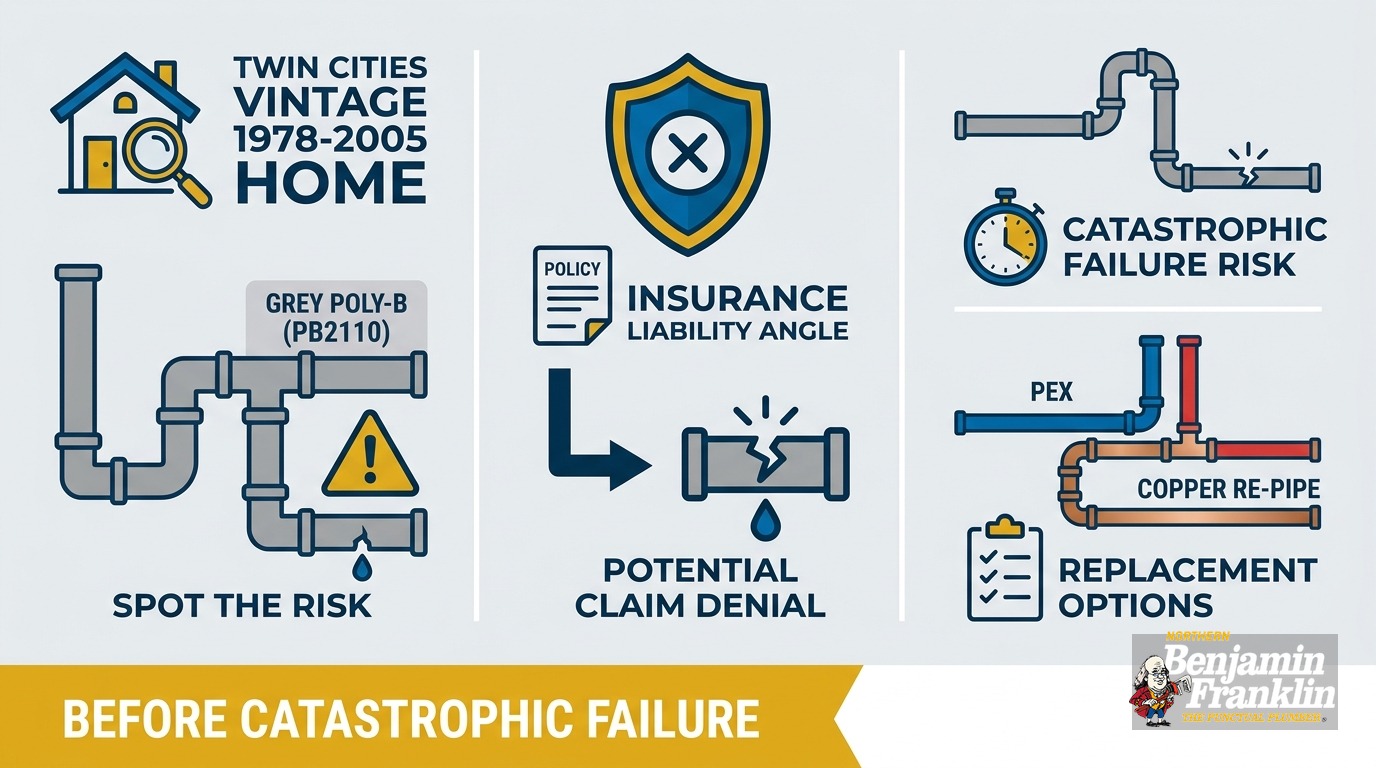
- Poly-B was installed in millions of U.S. homes from approximately 1978 to 1995. Twin Cities homes from that era are at risk.
- The pipes fail from the inside out. Exterior appearance tells you almost nothing about internal condition.
- Municipal oxidants, including chloramine used by Minneapolis Water Works, degrade poly-B over time.
- Minnesota’s freeze-thaw cycles add mechanical fatigue on top of the chemical stress already happening inside the pipe.
- Many homeowner insurance carriers now limit or surcharge coverage on homes with polybutylene piping.
- Minnesota law requires a permit for any pipe replacement. Unpermitted work creates title and insurance complications.
- PEX, CPVC, and copper are all approved replacements. PEX is the dominant choice for Twin Cities repipes.
- Northern Benjamin Franklin Plumbing is locally owned and operated. Call (763) 296-1844 or book online to schedule an assessment.
If your Twin Cities home was built between 1978 and 1995, there is a real chance your water supply lines are made of polybutylene. Many homes across Minneapolis, St. Paul, Blaine, Bloomington, and Brooklyn Park were plumbed with it during that era. The broader metro was too. Polybutylene pipe replacement is not a someday project. These pipes degrade from the inside out, and waiting until a fitting fails means water damage on the pipe’s schedule, not yours.
Does Your Twin Cities Home Have Polybutylene Pipes?
Quick answer: Poly-B supply lines are grey, flexible plastic, stamped “PB2110” on the pipe wall. Look for grey or white acetal plastic fittings with barbed inserts at connection points. Check the water heater cold-water inlet, sink stub-outs, and basement ceiling runs along the main water line path. If you see it, you have it.
Homes built in the Twin Cities metro between 1978 and 1995 are the primary risk window. That range covers a significant slice of the housing stock in Minneapolis, St. Paul, and the surrounding suburbs. Bloomington, Coon Rapids, Brooklyn Park, and Maple Grove all saw substantial residential construction during this period, and polybutylene was the standard supply pipe for much of it. Some installations extended into the early 2000s, so homes at the tail end of that era are worth checking too.
Visual identification is more specific than “grey pipe.” Here is what to look for:
Color and texture. Supply-line poly-B is usually grey and flexible. Underground or outdoor runs are sometimes black or blue. Do not confuse it with CPVC, which is rigid and cream or off-white, or with PEX, which is typically red, blue, or white with “PEX” printed directly on the pipe wall.
The stamp. The pipe wall is stamped “PB” followed by a four-digit ASTM material code. The most common marking is PB2110. That stamp is the definitive identifier. If you see it, the material is polybutylene.
The fittings. Poly-B connections use grey or white acetal plastic push-fit fittings with barbed inserts. Copper crimp rings may appear at some connection points.
Where to look first. Start at the water heater cold-water inlet. Check the supply stub-outs under kitchen and bathroom sinks. Look at the connection at the main shutoff valve. Scan utility room runs and the basement ceiling along the main water line path.
If you have any doubt about what you are looking at, a licensed plumber can confirm the material in a single visit. Our team at Northern Benjamin Franklin Plumbing knows the pipe inventory that shows up in Twin Cities homes from this era.
Why Does Polybutylene Pipe Fail?
Quick answer: Oxidants in municipal water attack the inner wall of poly-B, causing microscopic cracking from the inside out. The acetal plastic push-fit fittings are the most vulnerable point and typically fail first and most catastrophically. A fitting can let go while the outer surface of the pipe looks completely intact.
The failure mechanism of polybutylene is well documented. According to Wikipedia’s article on polybutylene, the 1995 Cox v. Shell Oil Co. settlement created a $950 million fund and ultimately led to the material being removed from U.S. building codes. The core issue was the same failure mode that continues today in unaddressed installations: free chlorine and chloramine in municipal water attack poly-B from the inside.
The degradation is invisible. The pipe wall develops microscopic scaling and cracking over time. The fittings, made of acetal plastic, are especially susceptible. They can fail suddenly at a connection point inside a wall, under a floor, or in a ceiling. By the time water appears at a visible surface, the leak may have been running for hours.
Poly-B does not discolor, swell, or drip before it fails. It looks the same the week before the fitting lets go as it did a decade earlier. That is the core problem. There is no visible countdown.
How Does Minnesota’s Climate Accelerate Poly-B Failure?
Quick answer: Twin Cities homes face both chemical degradation from municipal water treatment and mechanical fatigue from freeze-thaw cycling. Water service lines must be buried at minimum 42 inches below grade per the Minnesota Plumbing Code. Poly-B near that depth experiences compounding stress from both chemical and mechanical sources, a risk profile that is largely absent in southern states.
Most national content on polybutylene pipe replacement treats the failure mechanism as purely chemical. That is an incomplete picture for Minnesota homeowners.
The Twin Cities experiences design temperatures between -20 and -30 degrees Fahrenheit in a typical winter. The ground near the required 42-inch burial depth does not stay frozen and static. It cycles through the season. Each freeze-thaw cycle puts mechanical stress on the pipe material. For poly-B, that cycling adds fatigue on top of the chemical degradation already happening from the inside. The two failure drivers work simultaneously, not sequentially.
A pipe that might hold for several more years in a stable southern climate may reach failure faster in a Minnesota home. Freeze-thaw stress stacks directly on top of oxidant degradation.
Minneapolis Water Works uses chloramine as its primary disinfectant. Under EPA National Primary Drinking Water Regulations, disinfectant residuals must be maintained throughout the distribution system. Chloramine is generally considered somewhat less oxidatively aggressive on poly-B than free chlorine, but it still degrades the material over time. It is not a safe harbor. If you have poly-B, the specific disinfectant your municipality uses does not change the recommendation.
Twin Cities water from Mississippi River sources is also moderately hard. Hard water scale deposits on the inner wall of poly-B can affect the rate of chemical contact in the short term, but scale buildup also adds mechanical stress to the pipe wall. It is another variable compounding the problem, not offsetting it.
The Inside-Out Failure That Fools Homeowners
This point deserves its own section because it is the single most common reason Twin Cities homeowners delay polybutylene pipe replacement until it is too late.
A failing poly-B pipe looks fine from the outside. The degradation happens at the inner wall. Fittings fail before the pipe body shows any visible external damage. You cannot walk your basement, run a hand along the pipes, and conclude that everything is fine. If the pipe is grey, flexible, and stamped PB2110, the question is not whether it will fail. The question is when.
Water damage from a hidden poly-B fitting failure is fast and expensive. A fitting behind drywall that lets go overnight can saturate insulation, subfloor, and structural framing before anyone notices. Remediation from that kind of event typically costs far more than a planned, scheduled polybutylene pipe replacement done on your terms.
This follows the same pattern as galvanized pipe replacement in older Twin Cities homes: both materials were standard at the time of installation, both fail in ways that are not externally obvious until significant damage has already occurred, and both are far less expensive to address proactively than after the failure event.
If you want to understand the expected lifespan of the various pipe materials in your home, our post on how long home pipes last covers the full comparison across materials and conditions.
The bottom line: do not rely on a visual inspection to rule out poly-B failure risk. The pipe tells you nothing from the outside.
What Are the Insurance and Resale Risks of Polybutylene Pipe?
Quick answer: Many major insurance carriers in the U.S. now limit coverage or add a surcharge on homes with polybutylene piping, and some require signed disclosure at policy renewal. In Minnesota, known poly-B failure risk is a disclosable material defect under MN Statutes Chapter 513. A buyer’s inspection that flags poly-B can kill a sale or force a price reduction that exceeds the cost of replacement.
For homeowners not currently experiencing leaks, this section is often the most concrete argument for acting now.
The insurance exposure. Carriers across the industry have become more aggressive about poly-B risk over the past decade. If your insurer is unaware your home has poly-B, you may have a coverage gap you do not know about. If your insurer is aware and has priced accordingly, you are paying a surcharge indefinitely for a risk you can eliminate with a single job. Call your carrier directly and ask how they handle polybutylene pipe in a home policy. The answer will tell you what you need to know.
The resale exposure. Minnesota sellers must disclose known material defects under MN Statutes Chapter 513. If your pipes have been identified as poly-B, that fact belongs in your disclosure. A buyer’s inspection that flags poly-B frequently kills the transaction or triggers a price negotiation that exceeds the replacement cost. Replacing the pipes before you list the home removes the defect from the disclosure conversation entirely. You do not disclose what no longer exists.
The planning window. For homeowners planning to stay in place long-term, a planned and permitted polybutylene pipe replacement on your own schedule costs less, causes less disruption, and produces a better outcome than an emergency response after a fitting fails in a wall at two in the morning.
Does Minnesota Require a Permit for Polybutylene Pipe Replacement?
Quick answer: Yes. Under Minnesota Rules Chapter 4714, no regulated plumbing work may begin without a permit from the authority having jurisdiction. Licensed plumbers pull permits. Rough-in and final inspections are mandatory hold points. Unpermitted pipe replacement creates title and insurance complications that surface at the time of sale.
This is a detail that generic national content on polybutylene pipe replacement consistently misses. In Minnesota, the permitting requirement is not optional, and the consequences of skipping it are significant.
MN Statutes §326B.42 does allow homeowners to perform limited plumbing work on their own primary residence without a licensed plumber. But the permit requirement still applies. If you are considering a DIY approach to polybutylene pipe replacement, the permit paperwork is still your responsibility. Inspections are still mandatory hold points.
The practical risk of unpermitted work is this: when you sell your home, unpermitted work surfaces during a title search or buyer inspection. You may be required to open walls, demonstrate code compliance, and potentially redo the work without oversight certificates. That outcome costs more than doing the job permitted and inspected the first time.
Northern Benjamin Franklin Plumbing handles the permit process as part of every repiping job. Our team is licensed, and we know the inspection requirements across Minneapolis, St. Paul, Blaine, Bloomington, Brooklyn Park, Coon Rapids, Maple Grove, and the rest of the Twin Cities metro.
What Are Your Polybutylene Pipe Replacement Options?
Quick answer: The Minnesota Plumbing Code approves three replacement materials for polybutylene pipe replacement: PEX, CPVC, and copper. PEX is the dominant choice for Twin Cities whole-home repipes. Its flexibility reduces joint count, and its freeze tolerance reduces burst risk in cold-climate exposed runs.
Here is how the three options compare for a Minnesota home:
PEX (Cross-Linked Polyethylene)
- Flexible tubing that routes around existing framing with fewer joints than rigid pipe
- Freeze-tolerant in exposed and unheated runs, a meaningful advantage in this climate
- Less susceptible to hard water corrosion than copper
- Currently the go-to material for whole-home repipes in cold climates
- Widely available and familiar to licensed Twin Cities plumbers
CPVC (Chlorinated Polyvinyl Chloride)
- Rigid pipe with heat stability and a long track record in residential applications
- Requires more joints than PEX in complex or irregular layouts
- Approved under the Minnesota Plumbing Code
- A reliable option, particularly in straight or accessible runs
Copper
- The most durable option with the longest industry track record
- The highest material cost of the three
- Subject to pinhole leaks in homes with very aggressive water chemistry
- The premium choice when budget allows and longevity is the primary goal
For most Twin Cities whole-home repipes, PEX offers the best combination of performance and cost in this climate. Its freeze tolerance matters in Minnesota in a way that it simply does not matter in warmer states. If you want to go deeper on the trade-offs, our post on PEX vs. copper for a whole-house repipe covers the full comparison.
Our repiping service covers the complete process: confirming the pipe material, mapping the scope of work, pulling the permit, and completing the installation through final inspection.
Schedule Your Polybutylene Pipe Replacement Assessment
You do not need to be in the middle of a leak to get ahead of this problem. The right move is to address polybutylene pipe replacement before a fitting fails on its own timeline.
Here is the practical sequence:
Look. Check the water heater, sink stub-outs, and basement ceiling runs. Grey, flexible, stamped PB2110. If you see it, note where and how much.
Ask your insurer. Call your homeowner’s insurance carrier and ask directly how they handle poly-B in a home policy. Some homeowners discover surcharges or exclusions they were never told about.
Get an assessment. A licensed plumber can confirm the pipe material and map the scope of a replacement. This does not commit you to anything. It gives you real information to make a real decision.
Act before the failure event. A planned, scheduled replacement is less expensive and less disruptive than an emergency response to a fitting failure behind drywall. The result is permitted, inspected work that strengthens your home’s title and insurance position.
Northern Benjamin Franklin Plumbing is locally owned and operated in the Twin Cities. We back every appointment with our On-Time Guarantee(R). We arrive in the window you pick, or we pay you $5 for every minute we are late, up to $300. As we put it: “If there is any delay, it’s you we pay!”
Call (763) 296-1844 or book online to schedule your assessment. If your repipe is a larger job, ask about financing options when you call.
Frequently Asked Questions
What does polybutylene pipe look like? +
When should I replace polybutylene pipes? +
Does Minnesota require a permit for polybutylene pipe replacement? +
What is the best replacement material for poly-B in Minnesota? +
Need a technician now?