
Hard Water Buildup and Shower Head Replacement: Twin Cities
Key Takeaways
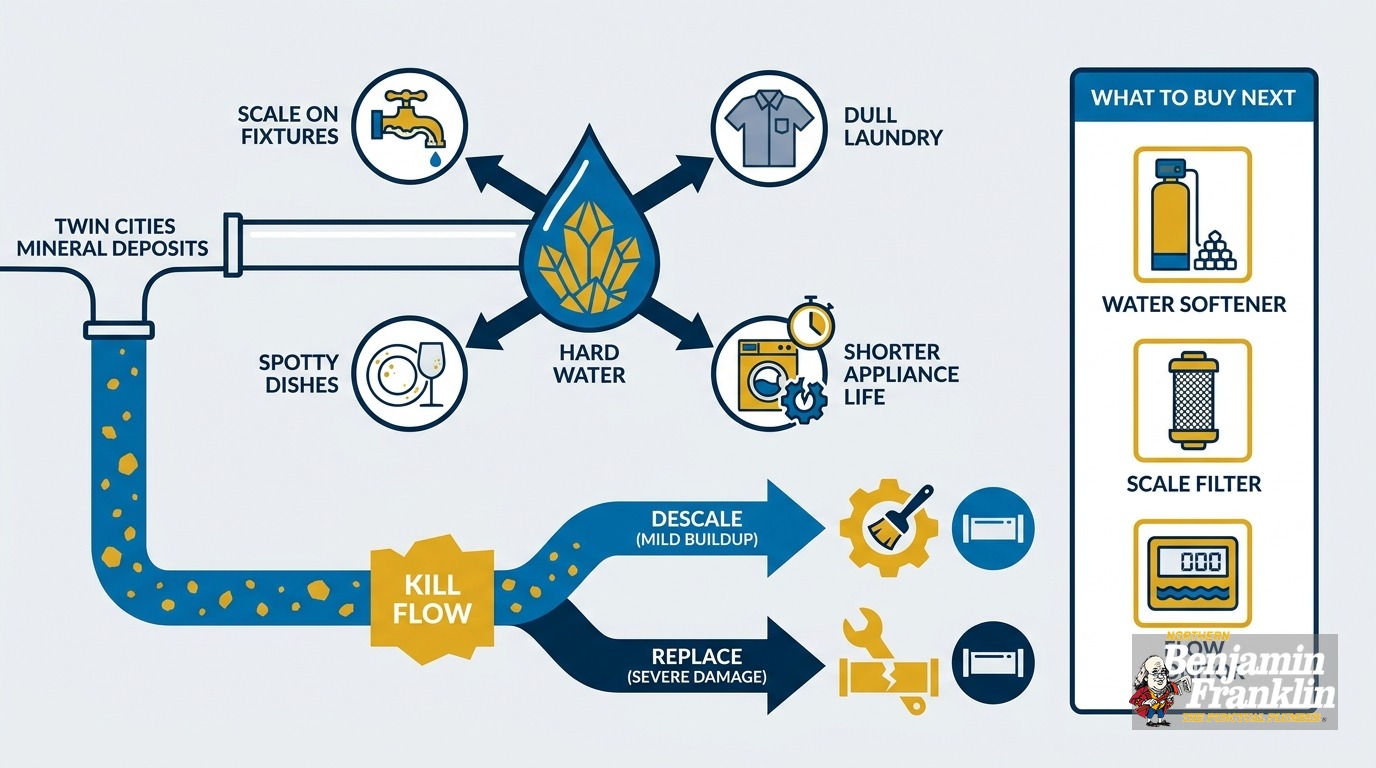
- Hard water buildup is the leading cause of shower head replacement before a fixture simply wears out. The minerals responsible are calcium and magnesium dissolved in your water supply.
- Minneapolis and Saint Paul city water finishes at 5-6 grains per gallon (GPG) after lime softening. Many suburban communities on well or blended groundwater run 15-30 GPG.
- Controlled testing by the Water Quality Research Foundation and Battelle found shower heads on hard water lose significant flow rate over time.
- Descale when the problem is new, the head is under 3 years old, and it has never been cleaned. Replace when you have cleaned twice and flow still has not recovered.
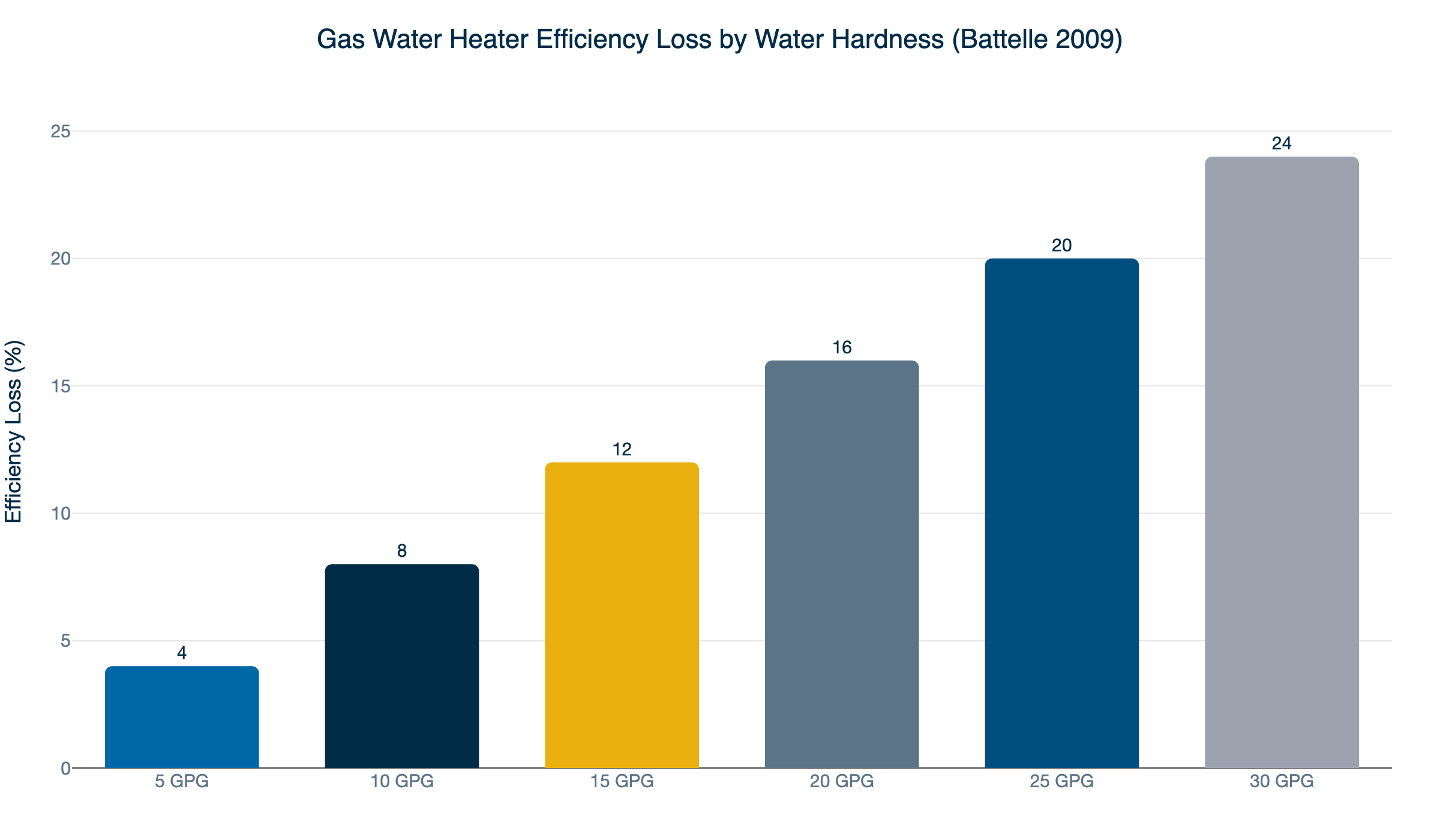
- Every 5 GPG of hardness causes a 4% efficiency loss in a gas storage water heater. At 30 GPG, that is a 24% penalty on every utility bill.
- EPA WaterSense-certified shower heads max at 2.0 gpm, which cuts the mineral load depositing per shower compared to a standard 2.5 gpm head.
- The shower head is a symptom. The same minerals are building up inside your water heater right now.
Why Is Shower Head Replacement from Hard Water Buildup So Common in the Twin Cities?
Calcium and magnesium deposit on every surface water touches. Shower heads take the hit first because water heats and evaporates on the nozzle face after every use, leaving a thin mineral film. Those films accumulate until the nozzle openings - typically 1-2 mm wide - start to clog.
The Twin Cities sits above groundwater sources that are naturally high in dissolved minerals. Treatment plants in Minneapolis and Saint Paul run lime-softening processes that pull most of that hardness out before water reaches your tap. Minneapolis removes roughly 65,000 pounds of hardness per day, according to the Minneapolis Water Treatment and Delivery page.
Saint Paul Regional Water Services finishes at approximately 5 GPG after lime softening, per the Saint Paul Annual Water Quality Report.
That is the city picture. Cross into communities on well water or blended groundwater - Maple Grove, Woodbury, Eagan, Eden Prairie, Cottage Grove, parts of Anoka County - and hardness commonly runs 15-30 GPG. That is three to five times what comes out of a Minneapolis tap. At those levels, the vinegar-bag soak you read about on most cleaning guides buys you six months, maybe less, before the head is back to restricted flow.
The solution you choose - descale, replace, or treat the water - depends almost entirely on which category you are in. The first step is knowing your number.
How Do You Find Out Your Water Hardness?
Check your city’s annual water quality report online. Hardness is listed in mg/L or GPG. Divide mg/L by 17.1 to convert to GPG. If you are on a private well, order a water test - the report alone will not tell you.
A rough guide to hardness by area across the Twin Cities metro:
- Minneapolis, Saint Paul, and communities served by their distribution systems: 5-6 GPG after treatment.
- Suburban communities on well water or blended groundwater - Maple Grove, Woodbury, Eagan, Eden Prairie, Cottage Grove, and parts of Anoka County: commonly 15-30 GPG.
- Transitional areas on a mix of surface and groundwater: often somewhere in between, and variable by street.
City reports are published annually and posted on municipal websites. The hardness number is usually in the “minerals” or “secondary parameters” table. If you cannot find it or you are on a well, we offer home water testing that gives you hardness, iron content, and other factors that affect scale formation rate. Knowing your GPG number before you buy your next shower head - or before you call us about a softener - is worth the time.
Should You Descale or Replace Your Shower Head?
Descale if the head is under 3 years old, flow just started dropping, and it has never been cleaned. Replace if you have cleaned twice without lasting improvement, the finish is damaged, or the head is 4 or more years old on water harder than 15 GPG.
Most guides skip the hardness variable. It is the most important one.
Descale when:
- White or yellow crust is visible on the nozzle face, but the head is otherwise intact.
- Flow has dropped but the spray pattern is still mostly even.
- The head is less than 3 years old and has never been cleaned.
- You are on Minneapolis or Saint Paul city water at 5-6 GPG.
Replace when:
- You have descaled twice in the past year and buildup returned within 6 months each time.
- Nozzle openings are cracked, torn, or the rubber is missing.
- The finish is pitting, flaking, or discolored from corrosion.
- The head is 4 or more years old on water harder than 15 GPG.
- Flow is still weak after a complete overnight vinegar soak.
- The head rattles when you shake it - loosened internal scale is blocking the body passages.
At 5-6 GPG, quarterly cleaning keeps a good head running for years. At 25 GPG, that same head plugs back up in months no matter how thoroughly you clean it. If you are on hard suburban well water and replacing shower heads every 2-3 years, you are managing a symptom. The water is the problem.
How Do You Descale a Shower Head Without Damaging the Finish?
Soak the nozzle face in white vinegar for 30 to 60 minutes if your water is 5-6 GPG, or overnight on harder water. Scrub nozzles with a soft toothbrush, then run hot water to flush. Oil-rubbed bronze and brushed nickel need a shorter soak - extended acid contact pits those finishes.
Step by step:
- Fill a plastic bag with enough white vinegar to submerge the nozzle face.
- Slip the bag over the head and secure it tightly with a rubber band or zip tie. If the head is removable, detach it and soak in a bowl instead - full submersion cleans the internal screen too.
- Soak 30-60 minutes for city water hardness; soak overnight for 15 GPG or harder.
- Remove the bag and scrub the nozzle face with a soft-bristle toothbrush.
- Run the shower on hot for 1-2 minutes to flush any loosened deposits through the lines.
Finish warning: Chrome holds up fine under extended vinegar exposure. Oil-rubbed bronze, brushed nickel, and many matte coatings - all popular in Twin Cities bathroom remodels - do not. Check the manufacturer’s care guide before soaking overnight. A 30-minute limit is safer for those finishes.
If the head still rattles after the soak, internal scale has broken loose but is lodged in the body passage. That is hard to clear by soaking. Replacement is the faster and cleaner fix at that stage.
What Should You Look for When Buying a Shower Head to Resist Hard Water Buildup?
Prioritize silicone nozzles, a WaterSense certification at 2.0 gpm, and a chrome or polished nickel finish. On hard Twin Cities well water, those three features can double the interval between replacements.
Silicone nozzles: The nozzle material matters more than the fixture body. Soft silicone nozzles flex when you rub them with a finger, breaking off early mineral deposits before they harden into scale. Hard plastic nozzles require a full vinegar soak every time.
WaterSense certification: The EPA WaterSense program caps certified heads at 2.0 gpm, compared to the federal maximum of 2.5 gpm. That is 20% less water through the nozzles per minute, which means 20% less mineral load depositing per shower. The EPA estimates a WaterSense head saves the average household 2,700 gallons per year and more than 330 kWh in water-heating energy. Minnesota’s plumbing code uses 2.0 gpm as the design flow rate per shower head for sizing purposes, so a certified head is already aligned with local code.
Finish: Chrome and polished nickel are the most forgiving finishes for both hard water contact and routine vinegar cleaning. Oil-rubbed bronze and matte black look sharp in remodeled bathrooms but need more careful maintenance. They are also vulnerable to finish damage from extended acid exposure during cleaning.
Spray pattern simplicity: Rain heads with hundreds of small holes look appealing and clog fast on hard water. Models with fewer, larger nozzle openings have less surface area for deposits to form. If you are on 20+ GPG well water, pick function over spray pattern variety.
Is Scale on the Shower Head a Warning Sign for the Water Heater?
Yes - and the water heater is the larger financial story. The same minerals blocking your shower head nozzles are coating the inside of the tank, the heating element, and the downstream piping. The efficiency loss from scale in a water heater compounds every month.
The Battelle study measured this directly. For gas storage water heaters at a 50-gallon daily draw, every 5 GPG of hardness causes a 4% efficiency loss and a corresponding 4% increase in operating cost. At 30 GPG - within the range of some Twin Cities suburban communities on well water - that is a 24% efficiency penalty on every utility bill. You are paying roughly a quarter more to heat the same water than you should be.
Tankless heaters face a sharper risk. The same study found tankless gas water heaters on 26 GPG water failed entirely after the equivalent of 1.6 years of use. Scale blocked downstream controls and piping. That is a premature failure on a $1,000 to $3,000-plus appliance, well before the end of its designed service life.
For electric storage heaters, scale accumulates as a physical deposit inside the tank: roughly 0.4 lbs per 5 GPG per year. Over a heater’s lifetime, that can reach 30 lbs of minerals sitting in the bottom of the tank, insulating the heating element.
If your shower head has visible scale, your water heater is carrying that same mineral load right now. Flushing the tank annually removes loose sediment before it hardens. See our guide to flushing water heater sediment for when and how to do it. For a deeper look at how hard water shortens anode rod life and accelerates tank corrosion, see our post on anode rods and hard water.
When Does a Water Softener Make More Sense Than Repeated Shower Head Replacement?
If your water is harder than 15 GPG and you are cleaning or replacing shower heads more than once a year, a whole-home water softener addresses the source and protects every fixture and appliance in the house at the same time.
Repeated shower head replacement is a maintenance cost. A water softener is an infrastructure decision. It protects the water heater, the faucet aerators, the dishwasher, and the supply pipes throughout the home. The Battelle study found gas storage water heaters on softened water maintained factory efficiency ratings over a full 15-year lifetime - a significant difference from the degradation and early failures documented in the hard-water groups.
A few things to factor in before installing:
- Sodium addition: Ion-exchange softeners replace calcium and magnesium with sodium. Saint Paul’s finished city water already measures 26.6 ppm sodium. Home softening raises that further. For most households this is not a concern. For households managing a medically sodium-restricted diet, it is worth discussing with a physician before installing.
- No rebates available right now: Xcel Energy’s Minnesota residential rebate program does not include water softeners, per the Xcel Energy Home Rebates page. Heat pump water heater rebates of $400-$500 are listed, but water treatment equipment is not on the current list.
- Sizing matters: An undersized softener regenerates too often and shortens resin life. The right unit is sized to your household’s daily water use and your actual GPG - not a one-size-fits-all number.
For a starting point on softener options, see our overview of water softeners for Twin Cities homes or our page on hard water treatment. If you are on a well and also seeing orange or black staining in the fixtures, you may have iron or manganese alongside hardness. A standard softener handles calcium and magnesium but not iron above roughly 1 ppm. Our team can run a full water test and recommend the right combination.
How Do You Prevent Hard Water Buildup on a New Shower Head?
Clean before you can see scale. Every 3-6 months for city water at 5-6 GPG. Every 4-8 weeks for suburban well water at 15 GPG or harder. Prevention takes 30 minutes. Remediation of a clogged head takes overnight.
Additional steps that slow buildup between soaks:
- Rub silicone nozzles with a finger during your weekly shower wipe-down. Early deposits have not hardened yet. A quick rub removes them in seconds.
- Keep a small spray bottle of white vinegar in the shower. A weekly spray on the nozzle face, left for a few minutes before rinsing, breaks down early film before it becomes scale.
- Squeegee the head face after each shower if buildup is a persistent problem. Less standing water means less evaporation and less deposit.
- Consider an inline shower filter if you are not ready for a whole-home softener. These cartridges reduce mineral load at the shower only. They slow buildup but will not hold up indefinitely on 20+ GPG water.
For households on water harder than 15 GPG, no cleaning schedule fully compensates for the mineral volume. If you are cleaning monthly and still seeing visible scale return within a few weeks, that is not a cleaning problem. That is a water quality problem, and the right fix is upstream.
When Should You Call a Plumber Instead of Replacing the Shower Head Yourself?
Call when the issue is not the head. Low pressure throughout the house, a head that drips after the valve closes, a connection corroded solid to the arm - those are plumbing problems, not a fixture swap.
Signs that go beyond the shower head:
- Low pressure at every fixture: A failing pressure reducing valve, a supply restriction, or whole-home scale buildup in the pipes can all cause this. See our guide on diagnosing low water pressure to narrow it down.
- Dripping after the valve closes fully: That is a cartridge or valve seat problem, not mineral buildup. Replacing the shower head will not stop the drip.
- Connection corroded solid to the arm: Forcing it risks snapping the arm at the wall stub-out. That is now a pipe repair job, not just a shower head swap.
- Scale or rust-colored discoloration inside the supply line: This points to pipe corrosion. The problem is in the pipe, not the fixture.
If pressure is low in the shower only, check the pressure balancing valve and the faucet aerator at the sink nearest the shower. Mineral buildup in the aerator restricts flow the same way it does in the shower head.
Northern Benjamin Franklin Plumbing is locally owned and operated in the Twin Cities. Our On-Time Guarantee(R) means we show up in the window we committed to - or you collect $5 for every minute we are late, up to $300. “If there is any delay, it’s you we pay!”
Whether you need a water hardness test, a shower head service, or a water softener consultation, call us at (763) 296-1844 or book your appointment online.
Frequently Asked Questions
How often should I replace my shower head if I have hard water? +
What is the best shower head for hard water? +
Will a water softener stop shower head scale buildup? +
Need a technician now?