
Basement Bathroom Ejector Pump: Costs, Permits, and MN Code
Key Takeaways
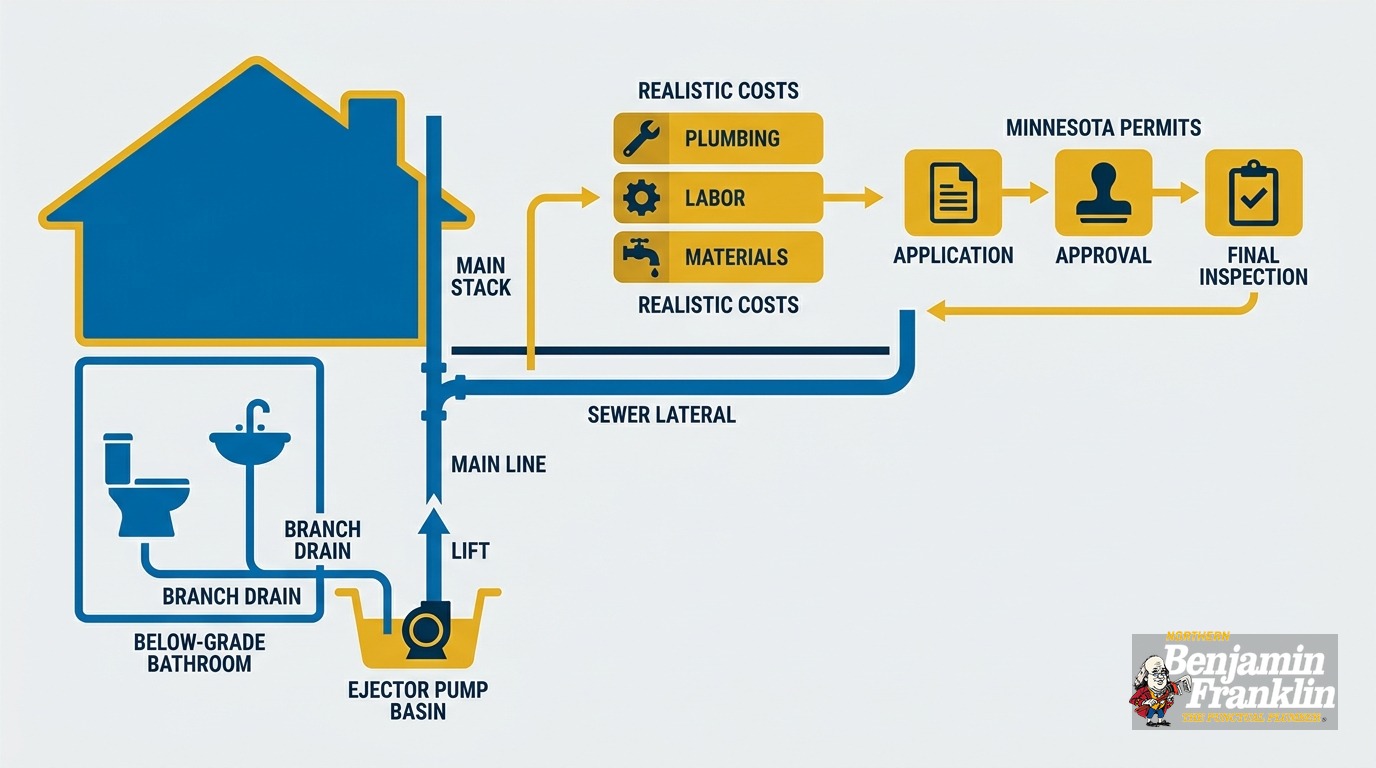
- A basement bathroom ejector pump collects waste from below-grade fixtures in a sealed basin and forces it up to the main drain line above grade.
- In Minnesota, below-grade plumbing requires a plumbing permit pulled before work starts. Cities including Blaine, Maple Grove, and Maplewood require rough-in inspection before concrete is re-poured.
- Minnesota Plumbing Code (MN Rules 4714) limits macerating toilet systems to one bathroom group in one- or two-family homes. They are not a legal workaround for a second basement bathroom.
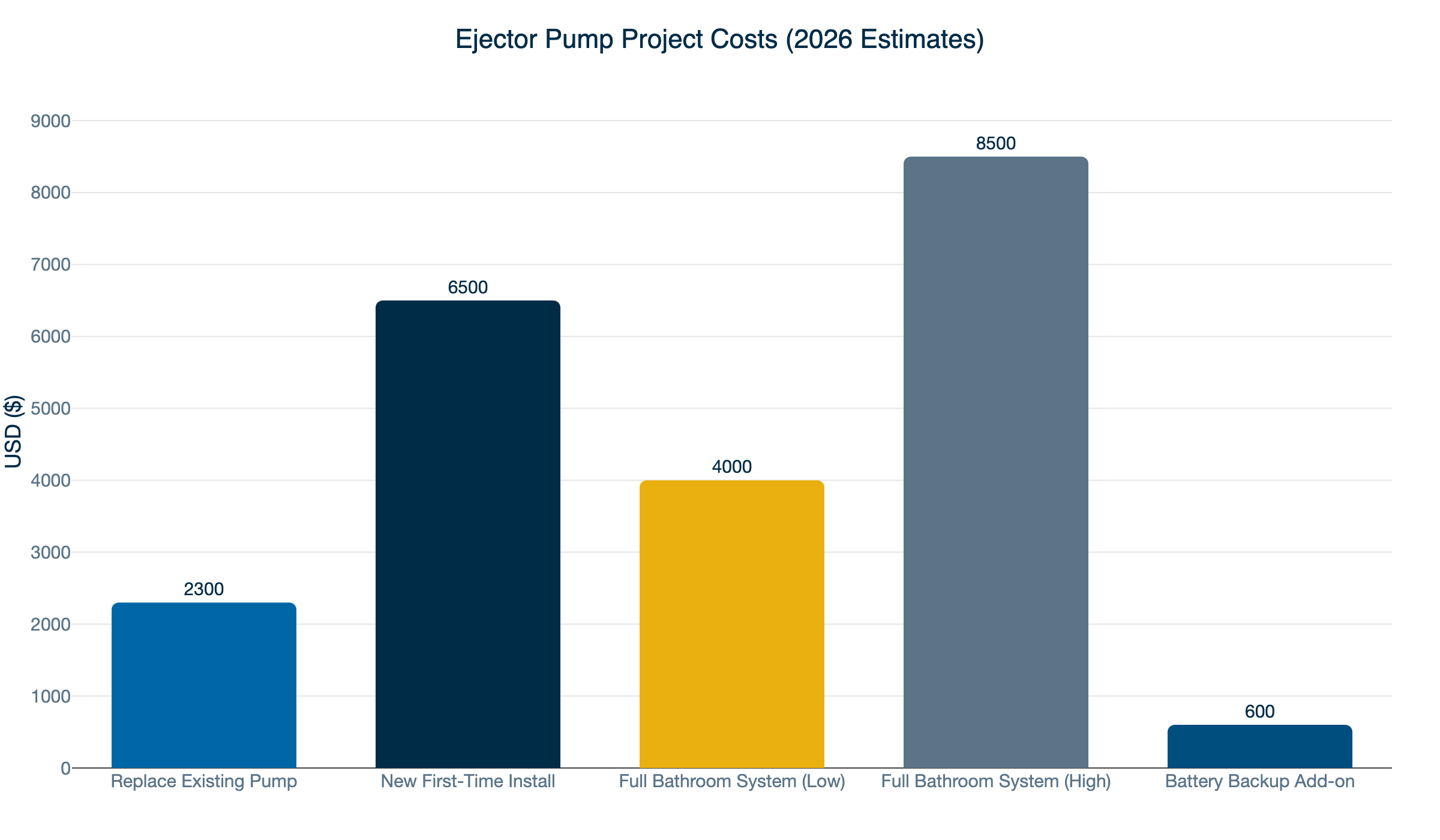
- Replacing an existing pump averages $2,300 nationally. A first-time install with concrete work runs closer to $6,500. A full below-grade bathroom system can reach $8,500.
- In the Twin Cities, frost depth reaches 42-48 inches. Any discharge line routed through an unheated garage, crawl space, or rim joist cavity must be insulated against freezing.
- Warning signs your pump is failing: continuous running, grinding noise, slow basement drain, sewage odor at the basin, or a tripped breaker.
- Northern Benjamin Franklin Plumbing is locally owned and operated in the Twin Cities. Our On-Time Guarantee(R) means we arrive in your window - or we pay you $5 per minute we are late, up to $300.
How Does a Basement Bathroom Ejector Pump Work?
The short answer: A sealed pit collects waste from your below-grade fixtures. A float switch triggers the pump when the pit fills to 12-15 inches. The pump forces waste up through a discharge pipe and check valve to your main drain line above grade.
Gravity does not work in your favor when your bathroom sits below the sewer connection. That is the core problem a basement bathroom ejector pump solves.
When you flush the toilet or run the sink in a below-grade bathroom, waste flows by gravity into a sealed basin - the ejector pit - set into your basement floor. The pit holds a gastight container, typically 18-30 gallons. A float switch monitors the level. When water reaches roughly 12-15 inches, the switch activates the pump.
The impeller inside forces waste up a 2-inch discharge pipe. A check valve and a shutoff valve sit on that line, keeping waste from flowing back when the pump stops. About 2-3 inches of water remains in the pit after each cycle to block sewer gas from entering the house.
The discharge line connects to your main drain stack or sewer line at a point above grade. From there, everything flows by gravity the way the rest of your plumbing does.
This system works quietly for years - until it does not. And when it fails, the basin overflows into your basement floor.
What Does Minnesota Code Require for a Basement Bathroom Ejector Pump?
The short answer: Minnesota Plumbing Code section 710.12 requires a check valve and a fullway-type shutoff valve on the discharge line, a basin sized for peak fixture flow, and a discharge pipe of at least 1.25 inches in diameter. These are enforceable minimums, not guidelines.
Minnesota Plumbing Code MN Rules 4714 governs all plumbing work in the state. For ejector systems, section 710.12 spells out what a compliant installation requires:
- The basin must be sized to handle peak flow from all connected fixtures.
- The pump must have enough capacity for that peak load.
- Discharge piping must be at least 1.25 inches in diameter.
- The discharge line requires both a check valve and a fullway-type shutoff valve.
- The basin must be watertight and gastight.
- All fixtures must be vented per code.
These requirements exist for good reason. A pump that cannot handle peak flow backs sewage into the basin. A missing check valve lets waste flow backward every time the pump stops. A basin that is not gastight puts sewer gas into your living space.
The Minnesota Department of Labor and Industry licenses all plumbing contractors in the state under Minnesota Statutes 326B. Plumbing work must be performed by or under a licensed contractor and is subject to inspection by the local authority having jurisdiction.
Can You Use a Macerating Toilet Instead of an Ejector Pump?
The short answer: Only if you are adding a single bathroom group in a one- or two-family home and gravity flow is impossible. Minnesota code does not allow a macerating system to handle more than one toilet, one lavatory, and one shower or tub.
Macerating toilets come up in this conversation because they look simpler. No jackhammering. Faster installation. But Minnesota Plumbing Code section 710.13 puts hard limits on them:
- They are permitted only in one- or two-family dwellings.
- Gravity flow must be impossible - they are a last resort when code allows, not a preference.
- Only one bathroom group may discharge into a single macerating system. One toilet, one lavatory, one shower or tub. That is the full legal limit.
If you want two basement bathrooms, or a bathroom plus a wet bar sink, a macerating toilet is not the answer. You need a standard ejector pump system sized for the full fixture load.
The sump for a macerating system must also be watertight and gastight, and fixtures must be vented per code. The trade-off is installation ease versus flexibility. A single basement bathroom in a single-family home may qualify. Anything beyond that requires an ejector pump.
What Do Permits Look Like in the Twin Cities?
The short answer: You need at least a plumbing permit and typically a building permit for finish work, both pulled before work starts. Rough-in inspection must happen before concrete is re-poured. Pull a permit after the fact and you are looking at demolition.
Adding a below-grade bathroom is not a project you can finish and then permit after the fact. Cities across the metro require permits in the right order - and they enforce it.
Blaine explicitly lists both a Bathroom Project permit and a separate Plumbing Permit for this scope. Maple Grove and Maplewood both publish basement finishing guides requiring plumbing permits for any new fixtures, and both require city inspection before concrete is poured back. Lakeville follows the same pattern.
That last point is the one that surprises homeowners most. The inspector needs to see the rough-in while the floor is open. If you pour concrete first, the inspector has no way to verify the basin seal, the drain sizing, or the venting. You can expect a demolition order.
A homeowner can technically pull their own permit for an owner-occupied single-family home in Minnesota. But ejector pump installation involves concrete cutting, drain-line sizing, venting, and a gastight basin seal. One error on any of those steps means a failed inspection - and tearing up a floor you already poured.
One more thing worth raising with your plumber before work starts: some cities trigger a backwater valve requirement when below-grade plumbing is added. If that applies to your project, it is easier and cheaper to install it during the same excavation than to come back later.
Basement Bathroom Ejector Pump Costs: First-Time Install vs. Replacement
The cost difference between replacing an existing pump and installing a new system for the first time is significant. National sources often average the two together, which understates what a new install actually costs.
According to Today’s Homeowner, the national average for ejector pump replacement - pump and labor, assuming the basin and piping are already in place - is around $2,300, with a range of $630-$4,300. A first-time installation that requires concrete jackhammering, new drain lines, and a re-pour runs closer to $6,500. HomeAdvisor puts a full new below-grade bathroom system - basin, pump, discharge line, venting, and rough-in plumbing - in the $4,000-$8,500 range by 2026 estimates.
The pump unit itself is only part of a new install. Excavation, concrete work, drain-line sizing, venting, and inspections all add to the total. On a replacement job, most of that work already exists.
What drives the cost on a new install:
- Concrete cutting and re-pour
- Basin size and material
- Length and routing of the discharge line
- Venting requirements and connections
- Whether the project triggers a backwater valve requirement
- Permit fees for both plumbing and finish work
- Pump material: cast iron runs $200-$2,000; plastic runs $150-$500. Cast iron is the better choice if your home uses a water softener with salt brine, because salt accelerates plastic degradation over time.
Battery backup: A battery backup pump runs about $600 installed. In Minnesota, where severe storms regularly knock out power, this is worth a serious look. Without power, the ejector pump cannot run. The basin fills up. Waste has nowhere to go. A battery backup keeps the system running through an outage.
The cost of failure: Sewage cleanup after an ejector pump failure runs $7,000-$15,000. Many homeowner policies have limited sewer-backup riders. A battery backup is cheap insurance by comparison.
For any project involving a new ejector system, call (763) 296-1844 or book online for a precise local quote. Financing is available for larger jobs.
Minnesota Cold Weather and Your Ejector Pump Discharge Line
The discharge line from your ejector pump travels up through the house and exits to the main sewer line. Depending on your home’s layout, that routing may take the pipe through an unheated garage, a crawl space, or a rim joist cavity.
In the Twin Cities, frost depth runs 42-48 inches. Any discharge piping routed through an unheated space must be insulated. A frozen discharge line is a dead end. The pump runs, pressure builds, and sewage backs up into the basin with nowhere to go.
This is a cold-climate detail that most national guides skip entirely - because they are written for the whole country, not for Minneapolis in January. When we size and route an ejector system in the Twin Cities, insulating the discharge line through any unheated section is part of doing the job right, not an optional add-on.
If you are replacing an existing pump, check where the discharge line runs before the next winter. An older install may have routed the line through an unheated space without insulation. That is a freeze waiting to happen - and it will happen at the worst possible time.
A battery backup belongs in this conversation too. Severe thunderstorms, ice storms, and derecho-type events knock out power across the metro every year. If the ejector pump cannot run during an extended outage, you have a sewage problem in your basement. The backup pump handles that. It pairs naturally with an insulated discharge line as a full cold-climate package.
For more on protecting basement drainage through the seasons, see spring runoff and your basement drainage system and our guide to sump pump battery backup for Minnesota storms.
What Are the Warning Signs Your Ejector Pump Is Failing?
The short answer: Watch for a pump that runs continuously or short-cycles, a grinding or rattling noise, a slow basement drain, a sewage odor near the basin, or a breaker that keeps tripping. Any of these signals a problem that gets worse, not better, if you wait.
An ejector pump works out of sight and out of mind for most homeowners. These warning signs tell you the system is struggling:
- Pump runs continuously or short-cycles: The float switch may be stuck, or the pump cannot keep up with the load.
- Grinding or rattling noise: Something is caught in the impeller, or the bearings are failing.
- Slow basement drain: The pump is not clearing the basin fast enough.
- Sewage odor near the basin: The gastight seal has failed, or the check valve is letting waste flow back.
- Tripped breaker: The motor is drawing too much current. This is a pump problem, not a breaker problem.
None of these fix themselves. A pump that short-cycles wears out its motor faster. A failed gastight seal means sewer gas in your basement. A grinding impeller is a clog that gets worse until the pump seizes completely.
Call (763) 296-1844 or book online when you notice any of these signs. Catching a failing pump before it quits is far less expensive than cleaning up after it fails.
How Long Does a Basement Bathroom Ejector Pump Last?
The short answer: The average lifespan is 7-10 years, but a well-maintained pump can reach 30 years. Annual professional inspection and basic quarterly checks significantly extend the life of the system.
According to Today’s Homeowner, ejector pumps average 7-10 years in service. With consistent maintenance, that number can stretch to 30 years.
What maintenance actually looks like in practice:
- Quarterly: Open the basin lid and do a visual check. Look at the float switch, the discharge line connection, and the basin walls. No special tools required.
- Annually: Clean the basin, test the float switch manually, and have a licensed plumber inspect the check valve and shutoff valve. A professional annual inspection runs $100-$200.
The annual inspection is the one that catches problems early - a float switch that is starting to stick, a check valve that is not seating cleanly, or a basin seal that is beginning to fail. Catching those things at the annual visit costs far less than a full pump replacement after a failure.
If your home uses a water softener, ask about cast iron over plastic when the pump needs to be replaced. The salt brine in a softener cycle is hard on plastic components over time. Our sump pump services page covers related below-grade equipment if you want to understand the full picture of what is working in your basement.
What Should You Never Flush in a Basement Bathroom?
The short answer: Wipes - including “flushable” ones - dental floss, and grease are the top causes of premature ejector pump failure. None of them dissolve in water. They wrap around the impeller, jam the float switch, and burn out the motor.
This matters more in a basement bathroom than in a main-floor bathroom because the ejector pump is a mechanical system with moving parts. A jam in the impeller does not just slow the drain - it can seize the motor and kill the pump entirely.
The word “flushable” on a wipes package is a marketing claim, not a plumbing claim. Those wipes do not break down in a basin. They clump with dental floss and grease into a mass that no impeller handles gracefully.
A simple list near the toilet goes a long way:
- No wipes of any kind, including brands labeled “flushable”
- No dental floss
- No grease or cooking oil poured down the sink
- No feminine hygiene products
- No paper towels
Everyone who uses the basement bathroom needs to know the rules - guests included. The downstream cost of a pump failure and the sewage cleanup that follows runs into the thousands. A posted list costs nothing.
Getting the Right Ejector Pump Install in the Twin Cities
A basement bathroom ejector pump is not a kit-from-the-hardware-store project. It involves concrete cutting, drain-line sizing, venting, a gastight basin seal, and a permit process with inspection before the floor goes back down. Done correctly, it runs quietly for a decade or more. Done wrong, it fails - and the cleanup runs $7,000-$15,000.
Northern Benjamin Franklin Plumbing is locally owned and operated in the Twin Cities. Our team knows MN Rules 4714, the specific permit requirements in Blaine, Maple Grove, Maplewood, Lakeville, and across the metro, and how to route a discharge line that survives a Minnesota winter.
Our On-Time Guarantee(R) means you get a firm arrival window. If there is any delay, it’s you we pay! - $5 per minute we are late, up to $300. That is the Northern Benjamin Franklin Plumbing standard, backed by a 100% satisfaction guarantee.
If you are planning a basement bathroom, replacing an aging pump, or dealing with warning signs right now, call (763) 296-1844 or book online. Our team handles every step from permit application to final inspection.
For related services, see our drain and sewer services page.
Frequently Asked Questions
What is a basement bathroom ejector pump? +
Do I need a permit to add a basement bathroom ejector pump in Minnesota? +
How much does a basement bathroom ejector pump cost to install? +
Can I use a macerating toilet instead of an ejector pump? +
Need a technician now?