
How to Find Your Main Sewer Cleanout Before an Emergency
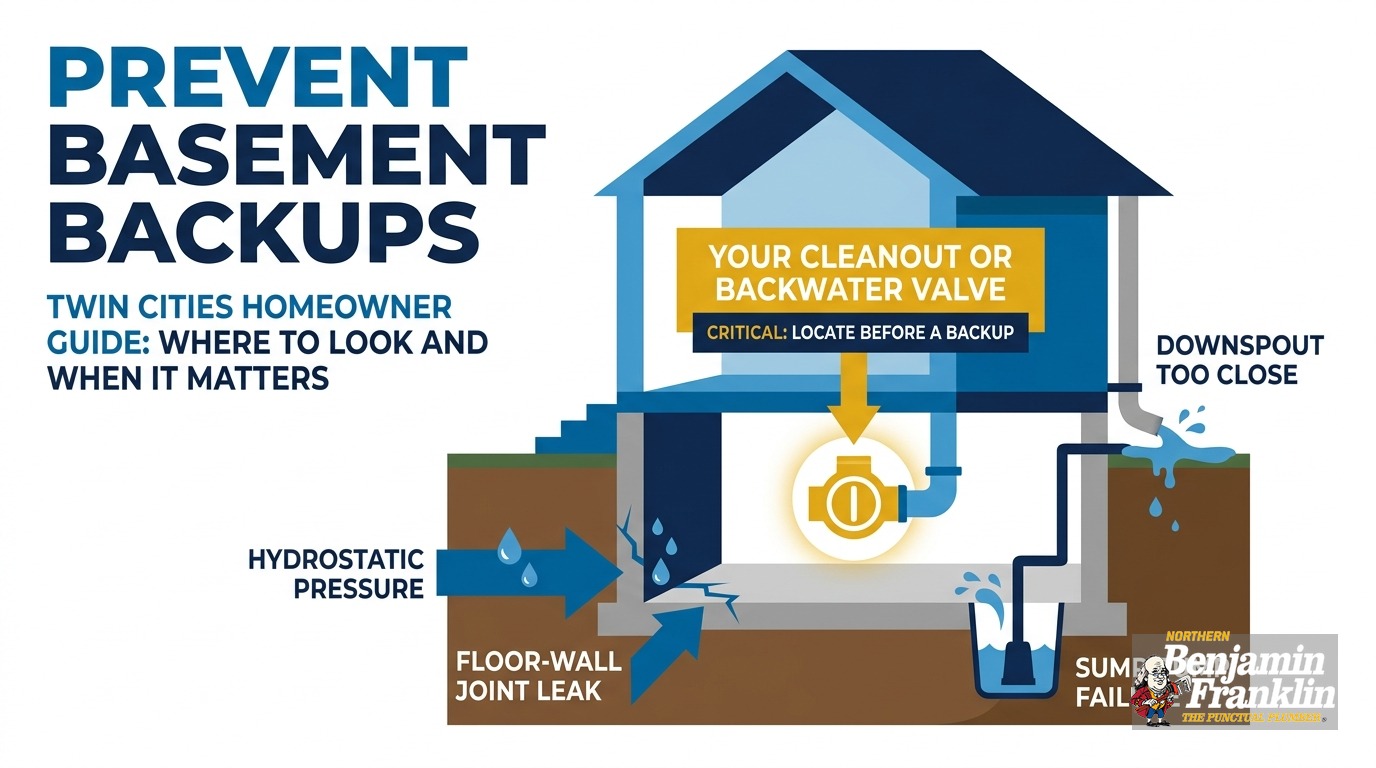
Key Takeaways
- The sewer cleanout is a capped access pipe on your main drain line. It lets a plumber snake or jet the line without digging up your yard.
- In basement homes, look on the lowest horizontal drain run near the exterior wall facing the street. Outside, check within a few feet of the foundation.
- Outdoor cleanout caps can frost-heave, sink below grade, or disappear under snowpack. Locate and mark yours before the ground freezes each fall.
- In Minneapolis and St. Paul, you own the entire lateral from your building wall to the city main connection, including pipe under the boulevard and the street.
- Homes built before the mid-20th century may have no cleanout. A camera inspection confirms what is there. A plumber can add one in the same visit.
- Cleanup costs from a sewer backup fall on the homeowner even when the blockage starts in the city main, unless the city’s negligence is proven.
- Verify your homeowner’s insurance covers sewer backup. Not all policies include it.
Most Twin Cities homeowners have never tried to find main sewer cleanout access on their own property. You won’t think about it until water rises through the basement floor drain. That is the wrong moment to start looking.
This post covers where to look, what Minnesota’s freeze-thaw cycle does to outdoor access points, and what to do when an older home doesn’t have a cleanout at all.
What Is a Main Sewer Cleanout?
The main sewer cleanout is a capped access point on your drain line. It gives a licensed plumber direct entry to snake or jet the line without digging up your yard. Without it, clearing a blocked lateral is slower, harder, and more expensive. Most homes have at least one. Older homes may have none.
Every drain in your home runs to one main pipe called the building drain. That pipe runs toward an exterior wall and exits the foundation as the lateral. The lateral connects to the city’s sanitary sewer main under the street.
The cleanout is a T- or Y-shaped fitting with a threaded cap, installed somewhere on that line. On modern plumbing, there is usually at least one inside the house and one near the foundation outside. The cap is typically 3 to 4 inches in diameter. On PVC lines it is white or gray plastic. On ABS it is black. On older cast-iron or clay-tile lines it may be a brass or cast-iron threaded plug with a square nut on top.
That square nut is how you open it. A wrench fits the nut, the cap threads off, and the plumber has direct entry to the pipe below.
Where to Find Your Main Sewer Cleanout
The right search approach depends on when your home was built and whether you have a basement.
Inside a basement home
Start in the basement. Walk toward the wall that faces the street. The building drain, the main horizontal run, typically travels 6 to 8 inches above the floor along the interior side of that wall.
Look for a short capped pipe, roughly 3 to 4 inches across, extending up from the horizontal run or tee’d directly into it. Common spots:
- Along the wall closest to the street, near the floor drain
- Behind the water heater or furnace, where drain lines converge
- Under the staircase on an exposed pipe run
- In the utility or laundry room near the floor drain
If the basement is finished, check the mechanical room first. If the cleanout is behind drywall, there should be a small access panel in the wall near the floor. That door is standard on finished basements with concealed plumbing.
Outside near the foundation
Walk the perimeter of your home along the side facing the street. The lateral exits the foundation and runs toward the street. An outdoor cleanout cap is often within a few feet of the exterior wall, at or slightly below grade.
Look for a round plastic or metal cap between 3 and 4 inches across. It may sit flush with the lawn or slightly above it. In some Twin Cities yards it sits under a round green or black cover that pops off by hand.
If landscaping has grown over it, check along the edge of mulch beds near the foundation. Small caps are easy to miss when a yard has had a few seasons to fill in around them.
Near the boulevard
On properties with longer lots, the cleanout may be in the boulevard, the strip between the sidewalk and the curb. That is still your pipe and your responsibility. A cleanout in the boulevard does not mean the city owns it. It means your lateral is longer.
If you cannot locate the cap after a full search, the Minneapolis Sewer Repairs Common Questions page notes that homeowners can contact Sewer Operations at (612) 673-5625 or Surface Water and Sewers at (612) 673-2405 for information about where the public sewer runs on their property. A sewer line camera inspection is the definitive tool for mapping what is actually underground.
How to Find a Main Sewer Cleanout in an Older Twin Cities Home
In pre-war and early postwar Minneapolis and St. Paul homes, a cleanout may not exist at all. Search the exposed main drain line in the basement and along older clay or cast-iron pipe near the foundation. If you find nothing after a thorough search, assume it is missing and schedule a camera inspection to confirm.
Twin Cities housing stock creates a real problem here. Minneapolis and St. Paul have large concentrations of homes built between the 1920s and the 1950s. South Minneapolis, Mac-Groveland, Powderhorn, Como, and dozens of other neighborhoods developed before cleanouts became a standard code requirement. These homes often have original clay tile laterals, unlined cast-iron building drains, and no cleanout installed anywhere on the system.
Minnesota’s state plumbing code is codified at Minnesota Rules Chapter 4714, but those current requirements did not govern construction 80 years ago. A home built in 1928 has no cleanout because nobody was required to install one.
The pipe materials in these older homes compound the problem. Clay tile joints are prime targets for tree root intrusion. Cast-iron corrodes over decades. A line that has never been accessed and never been inspected may have years of slow buildup, significant root intrusion, or structural damage that is completely invisible from inside the house.
If you are in an older Twin Cities neighborhood and cannot locate a cleanout after working through the search steps above, schedule a camera run before the next winter. The camera will map the condition of the line, confirm whether a cleanout exists somewhere you missed, and flag any root intrusion or pipe deterioration that needs attention. For more on what root damage looks like before it becomes a full blockage, see tree roots in sewer lines in Minnesota.
What If There Is No Cleanout?
A licensed plumber can add one by cutting the pipe at an accessible junction and installing a Y-fitting with a threaded cap. On an exposed basement line, this is straightforward work. It gives permanent access to the main drain for every future service call.
Without a cleanout, a plumber can sometimes run a snake through a toilet or a drain fixture. But that approach limits what a camera or hydro-jetter can do. If a camera run or full line clearing is the goal, adding the cleanout first gets the job done right. Our sewer line cleaning service covers both the access work and the clearing in one visit.
Adding a cleanout is almost always worth it on an older home with clay or cast-iron pipe. It is a one-time cost that reduces the labor involved in every future drain service call on that property.
Why Does Minnesota Winter Change the Math?
Outdoor cleanout caps can freeze in place, frost-heave out of alignment, or disappear entirely under snowpack. That happens at exactly the moment a winter backup forces you to find one. Locating and marking the cap before the ground freezes is the practical move. A cap you cannot find in January is no better than no cap at all.
Minnesota’s design frost depth runs roughly 42 to 60 inches or more depending on location. The soil around an outdoor cap moves with the freeze-thaw cycle every year. A cap that sits just above grade can heave an inch or two over a single season. In a heavy snow year, it disappears under 18 inches of pack. Finding a flush-grade cap with a flashlight at 10 p.m. during a January backup is not a realistic plan.
The prep step is simple: locate the outdoor cap this fall, before the ground freezes. Mark it with a stake, a painted rock, or a flag that survives snow cover. If the cap is cracked, won’t turn, or is corroded in place, have it replaced before freeze-up. Caps cost almost nothing. A backup that triggers remediation cleanup does not.
SERVPRO’s guidance on sewer cleanout location notes that indoor cleanouts are common in colder climates where outdoor access is impractical. If your Minnesota home was built with indoor-only cleanout access, that is intentional climate-appropriate design, not a defect.
The spring side of this matters equally. Snowmelt combined with spring rain drives what plumbers call inflow and infiltration: clear water entering the sanitary sewer through cracked pipe joints, improperly connected sump pumps, or deteriorated laterals. When that happens at volume, the system backs up even when individual laterals are clear. Anoka County’s sanitary sewer guidance notes that city ordinance prohibits clear-water connections to the sanitary sewer because of the system overload risk.
Fall is the right window to prepare for both seasons. Knowing where your cleanout is, having a working cap on it, and knowing the condition of your lateral puts you in the best position heading into spring. Those are decisions made in October, not March. A camera run and cap inspection this fall addresses both the winter freeze risk and the spring I&I exposure in one visit.
How Much of the Sewer Line Do You Own?
In Minneapolis and St. Paul, you own the entire lateral from your building wall to the connection point at the city main, including the section under the boulevard and the street. The city maintains only the public main itself. Most homeowners don’t learn this until they receive a repair bill for pipe that sits 80 feet from their house.
The city main runs down the middle of most Minneapolis streets. Your lateral connecting to that main can be 60 to 100 feet long, depending on lot depth and street setback. Every inch of that pipe is your responsibility to maintain and repair.
Minneapolis Public Works states it plainly: the city is not responsible for determining where a blockage is in a private lateral. If a camera run finds a root mass 80 feet from your house, under the boulevard, you pay to fix it.
Saint Paul’s Sewer Utility Division frames the requirement similarly: property owners are responsible for maintaining and repairing building sewers from the building wall to and including the connection to the public sewer. Saint Paul maintains approximately 804 miles of sanitary sewer connected to over 74,000 private service pipes. None of those private pipes are the city’s responsibility.
Saint Paul does offer help for homeowners facing large lateral repair costs. The city’s Sewer Assessment Program provides low-interest loans for qualifying work. Contact PW-SewerCounter@ci.stpaul.mn.us or call 651-266-6234.
Minneapolis requires a permit for lateral repair work to confirm it meets code. The permit is pulled by a licensed plumber. The city’s plumbing permit line is (612) 673-2451.
What Happens During a Sewer Backup - and Who Pays?
Cleanup costs fall on the property owner in almost every scenario, including when the blockage originates in the city main, unless city negligence is proven. Your homeowner’s insurance may or may not cover it. Check your policy before an emergency makes the question urgent.
A sewer backup is one of the most damaging events a home can experience. Sewage is a category-3 contaminant. Remediation involves removing contaminated materials, treating the affected space, and drying everything before repair work can begin. The bill is not modest.
Anoka County’s sanitary sewer guidance addresses this directly: in most cases, the property owner is responsible for cleanup costs regardless of where the blockage is found, whether in the private lateral or the city main, unless city negligence can be proven. That standard is high. Most homeowners who experience a backup from a city-main surcharge do not recover their cleanup costs from the city.
Homeowner’s insurance sometimes covers sewer backup, but it is not included in every standard policy. Anoka County’s guidance notes the gap explicitly. Call your agent and ask whether backup or overflow from a sewer or drain is a covered loss, and whether there is a sub-limit on that coverage. That is a five-minute call worth making now.
The connection between cleanout access and backup costs is direct. A plumber with a working cleanout will clear the blockage faster. A line with no accessible cleanout takes more time to diagnose and service. If a camera run is needed, the cleanout is also the cleanest way to get the camera into the line. For help distinguishing a true sewer backup from a localized fixture clog, see sewer backup vs. drain clog - how to tell the difference.
When Should You Schedule a Cleanout Inspection?
The best time is now, particularly if you have not located your cleanout, if the cap looks corroded or damaged, or if you live in a pre-1950s Minneapolis or St. Paul home and have never had a camera run on the lateral. Fall is the ideal window: before the ground freezes, before the spring inflow season.
Situations that call for a cleanout inspection:
- You cannot find the cleanout after searching the basement and the home’s perimeter
- The outdoor cap is cracked, frozen in place, or missing its plug
- Multiple fixtures in the home are draining slowly at the same time
- You smell sewer gas in the basement
- The home was built before 1960 and the lateral has never been inspected
- You are buying or selling the home and want to know what is in the ground before closing
If you have located the cap, test it. It should turn off by hand or with light wrench pressure. A cap corroded solid, cracked through, or missing entirely is worth replacing. Caps are inexpensive and they keep roots, debris, and pests out of the line year-round.
If you have not located the cleanout after working through the search steps above, call a licensed plumber and combine the camera inspection with the cleanout assessment in one visit. The camera will show what is underground. If a cleanout needs to be added, it can usually be done the same day.
Northern Benjamin Franklin Plumbing is locally owned and operated, serving Minneapolis, St. Paul, Blaine, Bloomington, Brooklyn Park, Coon Rapids, Maple Grove, and communities throughout the metro. When you call to locate a cleanout, schedule a camera run, or clear a blocked drain, we honor the On-Time Guarantee(R): we arrive in the window you choose, or we pay you $5 for every minute we are late, up to $300. “If there is any delay, it’s you we pay!”
Call (763) 296-1844 or book online to schedule a sewer cleanout inspection or drain service.
Frequently Asked Questions
Where is the main sewer cleanout typically located? +
What does a sewer cleanout look like? +
What if my home doesn't have a sewer cleanout? +
Who owns the sewer lateral on my property in Minnesota? +
Need a technician now?