
Why Do My Drains Gurgle? Air Pressure and Vent Problems
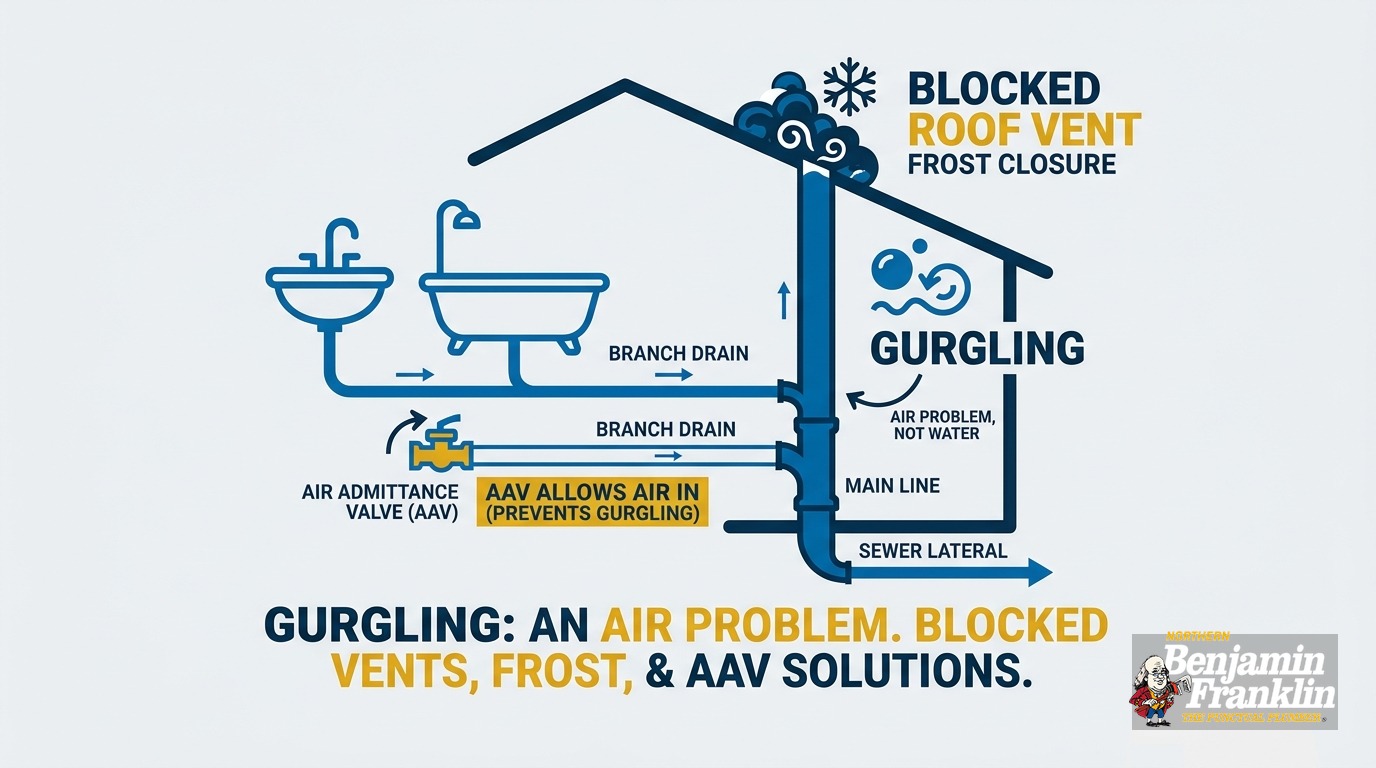
Key Takeaways
- Gurgling is an air-pressure problem. The sound happens when negative pressure pulls air backward through the water in your P-trap because the vent cannot equalize normally.
- Three causes cover most Twin Cities cases: a blocked roof vent terminal, frost closure of that terminal during deep winter, and a partial drain clog creating negative pressure downstream.
- The cross-fixture tell: toilet gurgles when the bathtub drains, or kitchen sink gurgles when the upstairs toilet flushes. That pattern points to a vent problem, not a local clog.
- Minnesota winters add a cause that most national guides miss. Frost closure seals the vent terminal from outside and forces pressure through your drain openings instead.
- Air admittance valves solve this problem in many states but are not currently legal in Minnesota.
- Sewer gas from a breached trap can be odorless. If you smell anything alongside the gurgling, call the same day.
- To schedule an inspection: call (763) 296-1844 or book online.
Why Do My Drains Gurgle?
The short answer: Your drain is gasping for air. Gurgling is an air-pressure problem, not a water problem. The sound is trapped air being pulled backward through the water in a P-trap because pressure cannot equalize through the vent.
Most homeowners assume a gurgling drain means a clog somewhere downstream. Sometimes a clog is part of the picture. But the sound itself is not water struggling to move. It is air bubbling up through a water trap because pressure behind that trap has dropped.
Every time water flows down a drain, it pushes air ahead of it and leaves a low-pressure zone behind. Your drain-waste-vent (DWV) system is designed to equalize that pressure by drawing fresh air down a pipe that exits through your roof. When that air path is blocked, restricted, or frozen shut, the plumbing pulls air from whatever opening it can find. That is the gurgle you hear.
Knowing this changes the diagnosis. The sound is coming from the vent, not the drain.
How the Vent System Works
Every drain in your home connects to a DWV stack: a vertical pipe that carries wastewater down to the sewer and extends up through the roof to open air. As water flows down, air must enter from above to replace it. Without incoming air, the drain creates negative pressure. That pressure siphons water out of the P-trap and pulls air back through your drain opening.
The P-trap is the curved section of pipe under your sink. It holds a small amount of water at all times. That water is the barrier between your home and the sewer gas below the drain. When vent failure creates enough negative pressure to siphon it away, two things happen: gurgling now, sewer gas later.
Minnesota homes face one additional variable. Your vent pipe rises through conditioned space, through the attic, and terminates above the roofline. That exposed section has no insulation and no heat. In January, the terminal is fully exposed to outdoor air temperature. The warm, moist air rising from the drain stack hits that cold opening and can freeze solid. This is a cause that does not appear in most national plumbing guides because it barely occurs south of Minnesota.
Three Reasons Your Drains Gurgle in Twin Cities Homes
1. A blocked roof vent terminal
The most common cause. Leaves, bird nests, animal debris, and ice from a single freeze-thaw cycle can partially or completely block the vent terminal. A partial blockage creates a pressure restriction that produces intermittent gurgling. A complete blockage creates constant problems on multiple fixtures.
The fix is straightforward. Clear the terminal, confirm the pipe is open, and the symptoms stop.
2. Frost closure in deep winter
This is the cause that separates a Minnesota diagnosis from a national one. During extended cold spells, water vapor in rising sewer gas condenses inside the top of the vent pipe and freezes. The frost layer builds inward, gradually narrowing and eventually sealing the terminal.
When sealed, all pressure must route through drain openings. You get gurgling, slow drains on multiple floors, and eventually sewer-gas odors inside the home.
Some of those gases are odorless. The absence of smell does not mean the air is safe. This is why frost closure warrants a prompt response, not a wait-for-spring approach.
Two factors make newer Twin Cities homes more susceptible than older ones. Plastic vent pipes conduct less heat from the interior than cast iron, leaving the terminal colder. Well-insulated attics cut off the warm-air column that once kept the pipe above freezing on its way up. Multi-bathroom homes are also more vulnerable because they push more water vapor into the system.
Pipe orientation matters too. A north-facing vent pipe is more prone to frost plugging than a south-facing one because it receives less solar gain throughout the day.
3. A partial drain clog creating negative pressure
A partial clog does not have to be near the vent to produce gurgling. Grease buildup, soap scum, or debris narrows the pipe’s cross-section. Fast-moving water through that restriction creates a venturi effect: lower pressure draws air backward through the nearest trap.
This cause tends to localize. The drain closest to the blockage gurgles. If multiple fixtures are affected, or the pattern crosses fixture types, the vent is the more likely cause.
How Do I Know If It’s a Vent Problem or a Drain Clog?
The short answer: Watch which fixtures gurgle and when. One drain that gurgles only when it runs, then clears quickly, points to a local clog. A toilet that gurgles when the bathtub drains, or a kitchen sink that gurgles when the upstairs toilet flushes, points to a shared vent problem.
The cross-fixture pattern is the clearest diagnostic a homeowner can run without tools. Each fixture connects to the same DWV stack. When that stack is restricted or sealed, draining one fixture changes pressure throughout the system. Every connected trap feels it. The trap with the least water in it gurgles first.
What to watch for:
- One fixture, local gurgling, clears quickly: A partial clog near that drain is the first suspect. For more on how slow drains escalate, see our guide to what slow drains are trying to tell you.
- Multiple fixtures affected at the same time: Vent restriction or a partial sewer blockage is more likely.
- Toilet bubbles when the tub drains, or vice versa: Strong indicator of a shared vent problem.
- Symptoms appear or worsen in late January or February: Frost closure moves to the top of the list.
- Sewer odor alongside the gurgling: The trap has been siphoned dry. Our post on dry floor drain traps and sewer smell in the basement covers that specific case.
What Is Frost Closure and Why Does It Happen Here?
The short answer: Frost closure happens when water vapor from the drain stack condenses and freezes inside the vent terminal during a cold snap. It is a Minnesota-specific risk that builds gradually from the outside in, eventually sealing the vent completely.
Minnesota requires sewer laterals to be buried at least 48 inches below grade because of our frost depth. The vent pipe above the roofline has none of that protection. It rises fully exposed to outdoor air from the roofline up. On a night well below zero, the terminal is at outdoor temperature. The warm, moist air rising from the drain stack hits that cold opening and freezes.
The first indication of trouble is often the toilet gurgling or not flushing properly as water is pulled from the traps. What follows is gradual worsening: slow drains on multiple floors, then the sewer-gas odor that signals trap water has been displaced.
Minnesota’s plumbing code addresses frost closure directly. Section 906.7 of Minnesota Plumbing Code Chapter 4714 requires vent terminals to be a minimum of 2 inches (50 mm) in diameter, specifically to resist frost and snow closure. Terminals must also extend at least 12 inches above the roofline. Both requirements reduce the rate at which a frost plug can form. They do not eliminate the risk during an extended below-zero stretch.
If you notice these symptoms during a deep cold spell, do not wait it out. A sealed vent that is pulling sewer gas into the living space needs a plumber, not warmer weather.
Can I Install an Air Admittance Valve in Minnesota?
The short answer: No. Air admittance valves are not currently legal in Minnesota. A licensed plumber cannot install one, even if you ask. Legislation to change that is working through the statehouse but has not passed.
An air admittance valve (AAV) is a mechanical one-way valve installed at the fixture level. It allows air in to equalize pressure without a roof penetration. AAVs work, cannot frost-close, and some manufacturers offer lifetime warranties on them. They cost less than running a traditional vent stack. In many states they are a standard option.
Minnesota is an exception. The old plumbing code prohibited AAVs explicitly. The 2016 and 2020 codes are silent on them, and the Minnesota Department of Labor and Industry interprets that silence as prohibited. The relevant statute is MN Stat. 326B.43 Subd. 6.
HF437, introduced February 13, 2025, would repeal that prohibition. As of this writing, the bill has received a first reading. It was referred to the House Commerce Finance and Policy committee. It has not passed and is not law.
If you encounter a contractor who offers to install one anyway, that work will not pass a permit inspection. It can also create problems when you sell the home.
The legal fix for a chronic frost problem is a traditional vent repair: clear the terminal, resize it to code if undersized, extend it further above the roofline, or add an insulated sleeve to the exposed section.
What Does a Plumber Check When Drains Gurgle?
The short answer: The inspection covers the vent terminal, the DWV stack, and the drain line. A camera can confirm whether the cause is at the roof vent, in the pipe, or at the sewer lateral.
When a plumber arrives for a gurgling complaint, the inspection typically runs in this order:
- Symptom pattern. Which fixtures are affected? Does the gurgling cross fixture types? Does it worsen in cold weather? These answers narrow the cause before any tools go into the drain.
- Roof vent inspection. Is the terminal clear, open, and sized to code? Is there visible debris, animal intrusion, or frost damage?
- Drain-line check. A cable or camera identifies partial blockages and root intrusion. A sewer line camera inspection also finds pipe deterioration and belly sections that hold standing water and create recurring pressure problems.
- Sewer lateral assessment. If the whole-house pattern suggests a deeper issue, a camera run on the lateral confirms root intrusion or pipe failure.
The goal is to confirm the cause before recommending a fix. Clearing a drain when the real problem is a frost-closed vent terminal does not solve anything. It delays the answer and extends the time sewer gas may be entering the home.
Northern Benjamin Franklin Plumbing is locally owned and operated in the Twin Cities. Our team serves Minneapolis, St. Paul, Blaine, Bloomington, Brooklyn Park, Coon Rapids, Maple Grove, and the surrounding metro. We back every visit with our On-Time Guarantee(R): arrive in the window you pick, or we pay you $5 for every minute we are late, up to $300.
How Do I Prevent Frost Closure on My Vent Pipe?
Prevention focuses on three approaches. The first two are DIY-friendly. The third involves a plumber.
Keep the terminal clear year-round. Check after heavy snowfall and ice storms. A warm-water flush from above can break up an early frost plug before it seals the pipe completely.
Insulate the exposed section. An insulated sleeve over the exterior terminal keeps the pipe warmer longer, allowing vapor to escape above the freeze point before condensing. These sleeves are available at hardware stores and are the standard prevention method for chronically frost-prone terminals.
Extend and upsize the terminal if needed. A vent terminal at the code minimum (2 inches in diameter, 12 inches above the roofline) is legal but marginal in a severe Minnesota winter. A plumber can extend it further above the roofline and increase the opening diameter. A thicker frost layer then still leaves enough clearance for air to move through.
If your home has had a frost closure before, a fall inspection costs less than a February emergency call. Our fall plumbing prep guide covers the broader seasonal checklist for Twin Cities homeowners.
When Should I Call a Plumber?
The short answer: For most gurgling symptoms, a scheduled visit is fine. Call the same day if you smell sewer gas inside the home, if multiple floors are affected at once, or if symptoms appeared during a deep-winter cold snap. Those situations carry a real risk of sewer-gas exposure.
Most gurgling complaints trace to a blocked or partially restricted vent. They are not emergencies. A scheduled visit gives the plumber time to run a full inspection without a premium charge.
Call the same day in these situations:
- Sewage odor is present inside the home alongside the gurgling.
- Multiple fixtures on different floors are affected at the same time.
- You have already snaked the drain closest to the sound and the gurgling persists.
- Symptoms appeared or worsened in January or February during a sustained cold stretch.
For anything outside those conditions, schedule a visit when it fits your week. The right move is to confirm the cause before clearing, snaking, or replacing anything.
Call Northern Benjamin Franklin Plumbing at (763) 296-1844 or book online. We are locally owned and serve the full Twin Cities metro. If there is any delay, it’s you we pay! That is the promise behind our On-Time Guarantee(R).
Frequently Asked Questions
What does it mean when my drain gurgles? +
Can frost close my vent pipe in Minnesota? +
Why does my toilet gurgle when the bathtub drains? +
Are air admittance valves legal in Minnesota? +
Need a technician now?