
Toilet Won't Flush: Clog or Vent Stack Problem?
Key Takeaways
- One slow or non-flushing toilet with no other symptoms almost always points to a localized drain clog.
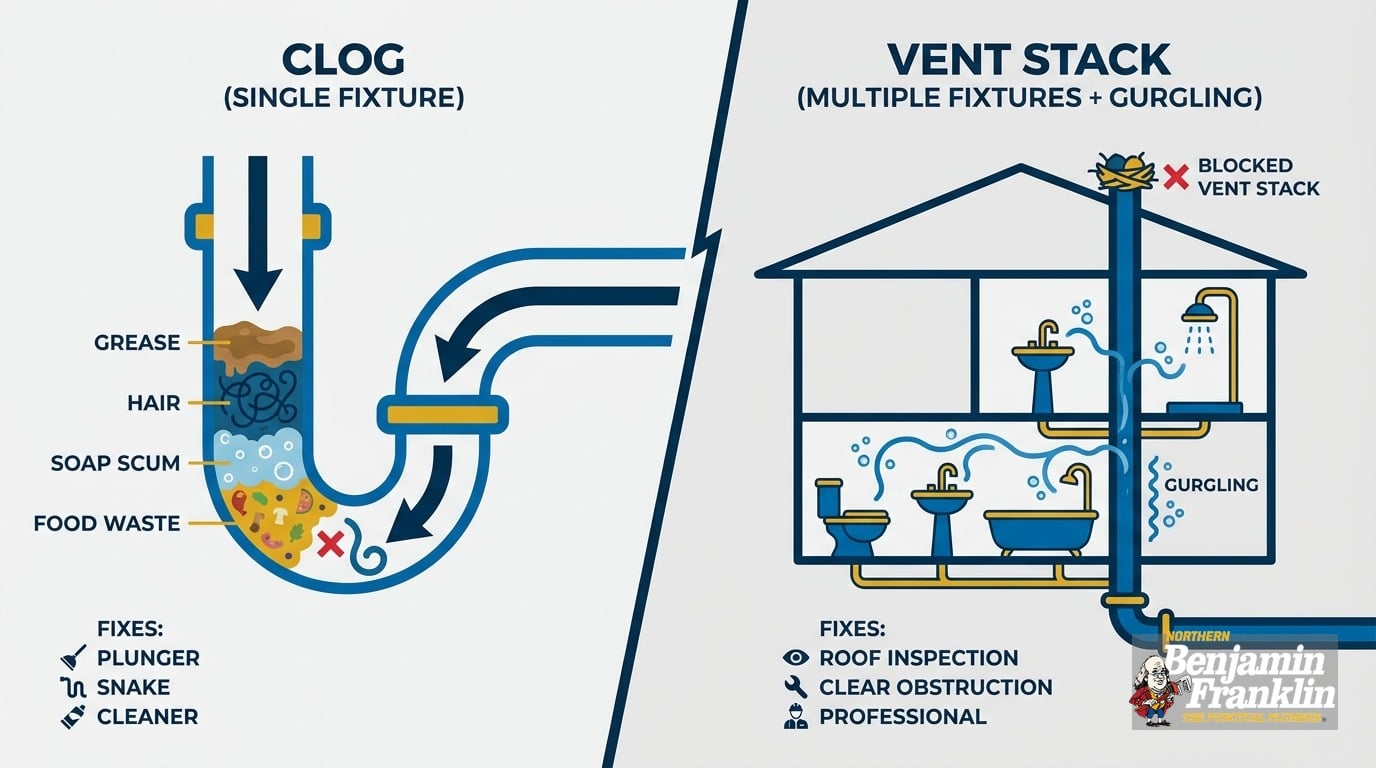
- When multiple fixtures gurgle or drain slowly at the same time, the problem is in a shared drain line or the vent stack.
- A fix that holds for only a day or two before sluggishness returns usually means the vent is the culprit, not the drain.
- Minnesota vent stacks can freeze completely shut during polar vortex conditions. A frozen vent produces identical symptoms to a blocked one.
- Vent stack repair is permitted work in Minnesota and must be done by a licensed plumber in almost all cases.
- A blocked vent stack eventually siphons P-trap seals dry, allowing sewer gas into your home.
- Call Northern Benjamin Franklin Plumbing at (763) 296-1844 or book an appointment online to get a diagnosis.
Toilet Won’t Flush: Is It a Clog or a Vent Problem?
When your toilet won’t flush, the cause is almost always one of two things: a clog or a vent stack problem. They share symptoms at first. Both produce a slow or gurgling toilet. But the fixes are completely different, and reaching for the plunger when the real problem is the vent accomplishes nothing.
This post gives you a clear two-branch diagnostic. One branch leads to a localized drain clog you may be able to clear yourself. The other leads to a vent or sewer line issue that requires a licensed plumber and, in Minnesota, a permit.
How Do I Know If My Toilet Won’t Flush Because of a Clog or a Vent Issue?
Short answer: Check your other drains. If only one toilet is slow and every other fixture drains normally, you almost certainly have a localized clog. If other fixtures are gurgling or slow at the same time, or if the toilet gurgles when you run a different fixture, the problem is in a shared drain line or vent stack.
This check takes about two minutes and requires no tools.
Go to the nearest sink or tub and run water for 30 seconds. If it drains quietly and normally, your toilet problem is isolated. Isolation means the blockage is in the toilet trap or in the short stretch of drain pipe directly behind the fixture.
Now flush the toilet and listen. Does a floor drain or the tub in the same room make any noise in response? If the flush causes a nearby drain to gurgle, that is cross-fixture gurgling. Plumbing specialists confirm that vent stack or shared-line pressure issues affect multiple connected fixtures simultaneously. A localized clog cannot do that.
The second part of the test is timing. If a plunger or snake clears the toilet and it stays clear for a week or more, you had a clog. If sluggishness returns within a day or two after clearing, that pattern points strongly to the vent stack, not the drain line.
Both checks together take under five minutes. Run them before reaching for any tools.
What Does a Vent Stack Actually Do?
Short answer: The vent stack is a vertical pipe that runs from the drain system through the roof. It carries no water. It supplies air to the drain lines, equalizing pressure so water flows freely and the water seals in your P-traps stay intact and keep sewer gas out of the house.
Here is the mechanics. When you flush, a slug of water rushes down the drain and pushes a column of air ahead of it. That movement creates a vacuum behind the water. Under normal conditions, the vent pipe supplies fresh air fast enough that no harmful negative pressure builds up. The drain runs quietly.
Block the vent, and the same vacuum forms with no air supply to fill it. The system finds the next easiest source: the water sitting in every nearby P-trap. A small amount of that water gets siphoned out, pulling air through the standing water with it. That is the gurgling sound.
Baker Brothers Plumbing describes the tell directly: a noisy but fast-draining fixture points to a vent problem, while a slow AND noisy drain points to a physical obstruction. Speed and noise together mean clog. Noise in one fixture while a separate fixture runs means vent.
That distinction matters because it tells you where to spend your time.
What Are the Symptoms of a Clog vs. a Vent Problem?
Clogs and vent problems look similar at first glance. The key is watching the pattern across the whole house, not just the single fixture giving you trouble.
Signs pointing to a localized clog:
- Only one toilet is affected. All other drains work normally and silently.
- The toilet gurgles only when you flush it, not in response to another fixture running.
- The bowl fills high on a flush, then drains slowly. Water is backing up against a blockage.
- A plunger or closet auger clears the problem, and it stays clear.
Signs pointing to a vent or shared-line problem:
- More than one fixture is slow or gurgling at the same time.
- The toilet gurgles when you run the kitchen sink, start the shower, or run the washing machine.
- The problem returns within a day or two after clearing.
- A faint rotten-egg odor appears near floor drains or in bathrooms where a fixture has not been used in a few days.
One pattern calls for immediate action: when multiple drains throughout the house are slow or gurgling simultaneously, the main sewer line is the likely culprit, not an individual vent. Stop using water and call right away. A failing sewer main can push wastewater backward into the house if use continues.
Why Does My Toilet Gurgle When I Run the Shower?
Short answer: The vent stack supplies air to multiple fixtures at once. When it is blocked, any fixture you run creates a pressure drop in the shared drain line. Nearby fixtures equalize that drop by pulling air through their own P-trap water. You hear that air movement as a gurgle in the toilet, a floor drain, or both.
This cross-fixture response is the clearest indicator separating a vent problem from a standard clog. A clogged toilet cannot make your shower drain gurgle. Only a shared air pressure problem causes that reaction.
Think of the vent stack as the air intake for the entire drain network. When it is open, everything flows and drains silently. Block it, and any water movement creates a pressure chain reaction. Every connected fixture with water in its trap becomes a secondary air source.
The mechanism: water rushing down a blocked-vent drain pulls air through trap water instead of through the vent pipe. The bubbling sound you hear is air traveling through standing water in a nearby trap. It is the drain equivalent of a straw reaching the bottom of a cup.
If your toilet gurgles from the next room while someone runs the kitchen faucet, a plunger will not fix the problem. The toilet is not the source. The vent is.
For a fuller look at what gurgling drains are signaling, see our post on gurgling drains and plumbing vent problems.
Can Minnesota Winters Freeze a Vent Stack Shut?
Short answer: Yes. During deep cold snaps in the Twin Cities, warm moist air rising through the vent pipe condenses and freezes against the cold pipe walls near the roofline. Ice builds up gradually and can seal the pipe completely. The symptoms are identical to a blocked vent: sluggish flushing, gurgling, and slow drains across multiple fixtures.
Here is why it happens. Every hot shower, load of laundry, and run of hot water sends warm, humid air through the vent stack. When outdoor temperatures drop well below zero, that moisture condenses on the cold interior pipe walls and freezes. Over the course of a prolonged cold event, the ice builds toward the center until the pipe closes.
Minnesota Plumbing Code (MN Rules 4715.2530, Subp. 2) sets 2 inches as the minimum vent pipe size through the roof. Upsizing to 3 inches is standard practice for cold climates because the narrower pipe fills with ice faster. If your home was built to the minimum standard, it is more exposed during sustained cold.
During polar vortex events, some Minnesota service crews respond with pressurized steam equipment to clear vent stack ice. That is the same equipment used to clear ice dams from gutters. It is not a homeowner-level fix.
NW Home Partners, a Minnesota contractor, notes that freeze-related closures worsen when temperatures stay low, snow accumulates over the vent opening, and hot-water use inside the home is high. Running hot water briefly from a nearby faucet can generate enough warm vapor to melt a partial ice plug. A complete blockage needs professional equipment.
If your toilet trouble started during a cold snap and disappeared when temperatures rose, you likely had a partial or full freeze. A pipe that freezes once is more likely to freeze again. The next step is having a licensed plumber assess the pipe diameter and the vent cap. A preventive fix now costs far less than an emergency call in January.
When Should You Plunge, and When Should You Call a Plumber?
Short answer: Plunge and snake when only one toilet is slow and every other fixture is fine. Call a licensed plumber when multiple fixtures are involved, when the problem returns quickly after you clear it, or when you smell sewer gas anywhere in the home.
Tools worth trying first:
Use a flange plunger, the kind with the rubber extension at the bottom, not a flat cup plunger. Seat it firmly over the drain hole and give it 10 to 15 firm, rhythmic strokes. If the toilet clears and stays clear, you had a localized clog.
A closet auger reaches 3 to 6 feet into the drain line. It can break up or pull out a blockage the plunger cannot reach. If the auger clears the toilet and it stays clear for a week or more, you had a drain clog. Done.
Stop and call if any of these are true:
- The problem returns within a day or two. Repeated quick return after clearing almost always points to the vent.
- More than one fixture is slow or gurgling.
- You smell anything resembling rotten eggs or sewage anywhere in the house.
- The toilet is overflowing rather than just draining slowly.
Minnesota permit note: Vent stack repair requires a permit under the Minnesota State Plumbing Code. In most cases, a licensed plumbing contractor must do the work. A homeowner may pull their own permit only for their own homesteaded primary residence. Before hiring anyone, verify the plumber’s license at dli.mn.gov.
For more on the DIY-versus-call decision for drain issues, see our post on when drain fixes make sense to try yourself and when to call.
Can a Blocked Vent Stack Let Sewer Gas Into My Home?
Short answer: Yes. A blocked vent creates negative pressure in the drain lines. Over time, that pressure siphons water out of nearby P-trap seals. Those seals are the only physical barrier between your drain system and the air in your home. Once they dry out, sewer gas enters freely through the open drain.
A P-trap is the curved pipe section under every drain fixture. It holds a small, constant pool of water. That standing water physically blocks sewer gases from traveling backward up the pipe into the room. It works as long as pressure on both sides of the trap stays balanced.
Block the vent, and every flush or drain event creates a small vacuum. Adjacent P-traps lose a little water each time. Over the course of days or weeks, the trap can run dry.
The primary gas of concern is hydrogen sulfide (H2S). According to the CDC, H2S is detectable at a concentration of 0.5 ppb, but the sense of smell fatigues rapidly as concentration rises. That means you can lose the ability to smell it while the concentration continues to build. OSHA sets a ceiling exposure limit of 20 ppm. NIOSH classifies 100 ppm as immediately dangerous to life or health. At low concentrations, H2S causes eye and throat irritation. At moderate concentrations, it causes dizziness, nausea, and fluid buildup in the lungs.
A faint rotten-egg smell near a floor drain or a bathroom that has not been used in a few weeks often means a dry trap rather than an active vent failure. Pour a cup of water into the drain. If the smell clears and stays gone, the trap was simply dry from evaporation. If the smell comes back within a day or two, the vent is siphoning the trap dry on a recurring basis.
If the smell is strong, spreading, or persistent, do not continue investigating. Get people out of the affected area and call a plumber.
Who Owns the Sewer Line Outside Your House in Minneapolis and St. Paul?
Short answer: In both Minneapolis and St. Paul, the homeowner owns the entire sewer lateral from inside the house to where it connects with the city main in the street, including that connection point. Repairing or replacing it requires a permit and, in most cases, a licensed plumber.
Some homeowners follow this diagnostic to its end and discover the problem is not in the vent stack at all. It is in the sewer lateral. Before assuming the city is responsible, know where your liability ends.
In Minneapolis, the sanitary service lateral from inside the property to the city main is entirely the homeowner’s responsibility, including the connection to the main itself. A repair permit is required before any work begins.
In St. Paul, the rule is the same. The lateral from your house to the city main is yours. St. Paul’s sewer assessment program offers a low-interest, 20-year loan to spread repair costs for eligible homeowners. If a repair estimate comes back as a full lateral replacement, ask about that program when you call.
The symptom pattern for a main-line sewer problem is similar to a blocked vent but more severe and faster-moving. Multiple drains are slow or gurgling at the same time, and the situation can escalate to sewage backing up inside the home if water use continues.
If you are not certain whether the problem is in the vent, the drain line, or the sewer lateral, a camera inspection locates it before any guesswork or digging. Our post on telling a sewer backup apart from a drain clog covers what each situation looks like in practice and what to expect when you call.
What to Do Next
A toilet that will not flush normally is a solvable problem. The diagnostic is straightforward once you know what to watch for.
If one toilet is the only affected fixture and it clears with a plunger or auger and stays clear, you had a drain clog. Watch it over the next week.
If multiple fixtures are involved, if the problem returns within a couple of days, or if you smell anything, the issue is beyond the toilet. It is in the vent stack, the main drain line, or the sewer lateral. In Minnesota, that is permitted work. It requires a licensed plumber in almost every case.
Northern Benjamin Franklin Plumbing is locally owned and operated right here in the Twin Cities. Our team shows up in the window we promise, backed by our On-Time Guarantee(R): if we are late, we pay you $5 for every minute, up to $300. “If there is any delay, it’s you we pay!”
Call us at (763) 296-1844 or book online. We will diagnose the problem from the fixture to the street and give you a clear answer on what it takes to fix it.
Frequently Asked Questions
How do I know if my toilet problem is a clog or a vent stack issue? +
Can Minnesota winters freeze a vent stack shut? +
Is vent stack repair a DIY job in Minnesota? +
Can a blocked vent stack let sewer gas into my home? +
Need a technician now?