
Sewer Line Belly Symptoms: What Your Camera Report Means
Key Takeaways
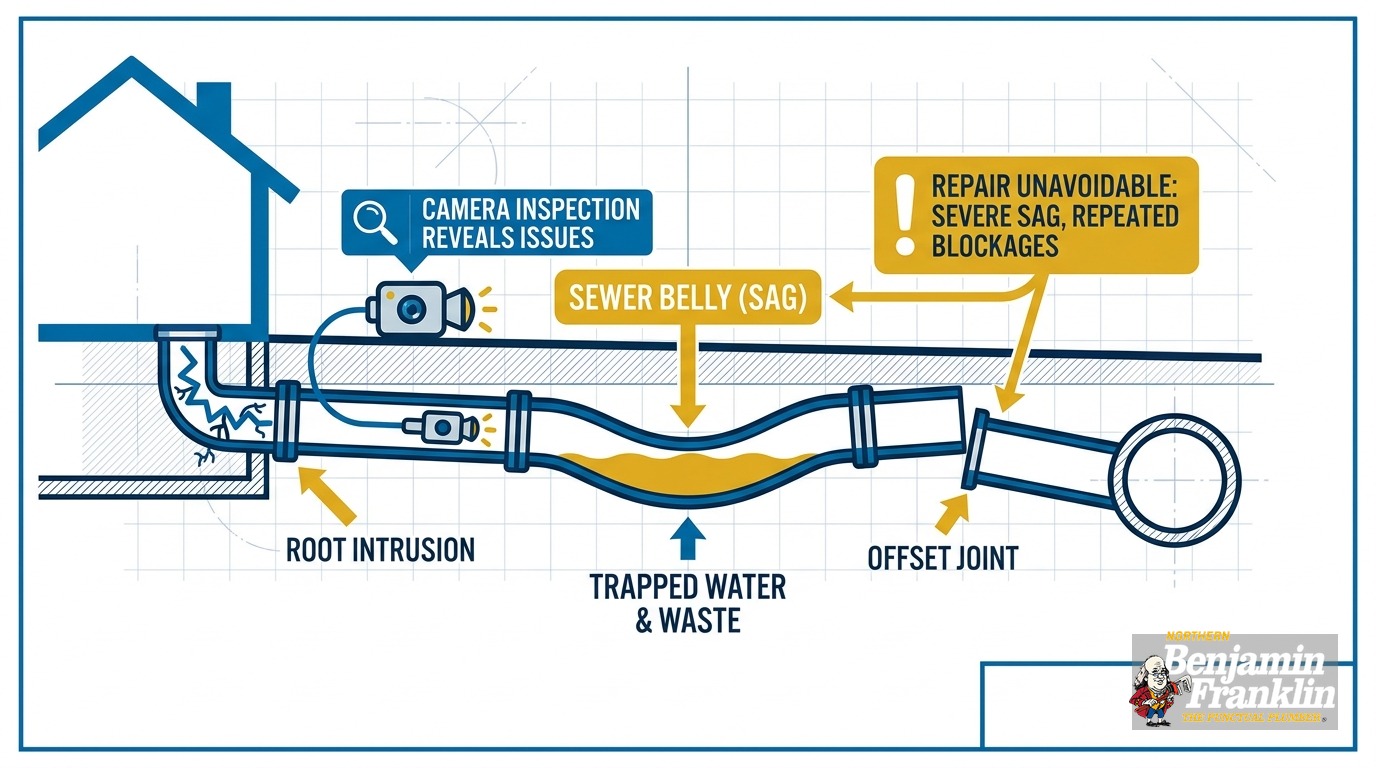
- A sewer line belly is a sag or low spot where the pipe has dropped below the required slope, causing wastewater and solids to pool instead of drain.
- Common sewer line belly symptoms include slow drains at multiple fixtures, recurring gurgling, sewage odors, wet ground over the pipe run, and clogs that keep coming back after snaking.
- A camera inspection reveals the belly and shows the water depth at the sag. That measurement drives the repair decision more than any other factor.
- Trenchless lining (cured-in-place pipe, or CIPP) does not fix a belly. It does not restore slope. Repair requires open-cut excavation or pipe bursting.
- Twin Cities frost heave in clay-heavy soils is a recurring cause. A belly that formed over one winter will likely deepen with each freeze-thaw cycle.
- Minneapolis and St. Paul homeowners own the lateral from their foundation to the city main. The repair bill is theirs.
- If you are buying or selling a Twin Cities home, a sewer scope is increasingly required before closing. A belly on camera can delay or derail the deal.
- Call (763) 296-1844 or book online to schedule a camera inspection.
What Is a Sewer Line Belly?
Quick answer: A sewer line belly is a section of pipe that has sagged below the proper slope. Code requires drain pipe to slope at least 1/4 inch per foot so gravity moves waste to the city main. When the pipe sinks, flow stalls and solids collect at the low point.
Your home’s sewer lateral runs underground from the foundation to the city main, usually under the street. For most Twin Cities homes, that entire run is your responsibility.
Minnesota’s plumbing code sets a minimum drain slope of 1/4 inch per foot for 3-inch and 4-inch horizontal drain pipe. A belly violates that requirement in the affected section. It did not fail overnight. Soil settles over decades, tree roots shift joints, and in Minnesota, frost heave moves pipe sections every single winter.
The belly itself is not the only problem. The problem is what happens inside it. Wastewater that slows down drops its solid load. Grease cools and sticks. Over time, that accumulated material narrows the pipe further. Each flush and each drain cycle adds to the deposit in the same low spot.
How Do You Know If You Have a Sewer Line Belly?
Quick answer: Sewer line belly symptoms appear gradually. You notice sluggish drains across the whole house, gurgling when water drains, recurring sewage odors, or soggy ground over the pipe run. These signs overlap with a simple blockage, so a camera inspection is the only way to confirm.
Here are the specific symptoms to watch for:
Slow drains at multiple fixtures. A single slow sink usually points to a local clog. When your toilet, bathtub, and basement floor drain are all slow at the same time, the problem is further down the line.
Gurgling sounds. When air gets trapped behind pooled water in a belly, it pushes back through the nearest open fixture. That sound is a pressure signal, not a minor nuisance.
Sewage odors inside the house. Standing water in a belly goes stagnant and releases gas. That gas can travel back through low-use floor drains or a basement toilet that rarely gets flushed.
Wet or sunken ground over the pipe run. A belly can hold enough water that the surrounding soil stays saturated even in dry weather. You may notice a soft strip or a slight depression in the yard.
Clogs that return quickly after snaking. A plumber clears the line and it backs up again in weeks. The snake removed the buildup, but the belly is still there collecting debris with every use.
Previous camera reports that noted a sag or grade issue. Those terms describe the same condition as belly. If a past scope flagged this and no repair was done, the pipe has not corrected itself.
Because these sewer line belly symptoms closely mirror signs of a tree root intrusion or a deep blockage, a sewer camera inspection is the only reliable diagnostic. You need to see where the pipe goes and how deep the water sits.
What Does “Belly” Mean on a Camera Report?
Quick answer: A camera report that says “belly” or “sag” means the operator saw the pipe drop to a low point where water pooled. The number that matters most is how deep that water sits as a fraction of the pipe’s interior diameter. Deeper water means more urgent repair.
Camera inspection crews use a grading standard developed by the National Association of Sewer Service Companies (NASSCO) called the Pipeline Assessment and Certification Program, or PACP. Under that system, a belly is classified as a structural anomaly. Severity is graded by water depth relative to the pipe’s interior diameter:
- Under 25% of pipe diameter: Low severity. The pipe is still mostly self-cleaning, though solids can accumulate over time at the low point.
- 25 to 50% of pipe diameter: Moderate severity. Flow is restricted. Solids build up faster, and backup risk increases.
- Over 50% of pipe diameter: High severity. The pipe is no longer self-cleaning. Sewage can back up into the house under normal daily use.
If your report includes video footage, look for the moment the camera tips slightly downward and you see standing water ahead of it. That is the belly. Ask your plumber for the estimated water depth at the sag as a percentage of pipe diameter. That number tells you more than the word “belly” by itself.
Your report may also use codes you do not recognize. A note like “structural defect - grade” or “negative grade” refers to the same condition. If the summary says the pipe has a low spot and water is visible, you have a belly regardless of how it is labeled.
Why Frost Heave Makes This a Minnesota-Specific Problem
A belly that forms in a warmer climate typically stays where it is. Soil settlement is slow and incremental. In Minnesota, there is an additional force at work every winter: frost heave.
The design frost depth for Minneapolis is approximately 60 inches, or five feet. Frost depths across Minnesota range from around 42 inches in the southern part of the state to well over 80 inches in the north. The Twin Cities sits squarely in the middle of that range.
What amplifies the problem here is soil type. Much of the Twin Cities metro sits on glacial clay and glacial till deposited by the last ice sheet. Clay soil holds moisture and expands when it freezes. Frozen, moisture-laden clay pushes upward against whatever is buried inside it, including your sewer pipe. That upward pressure can shift a pipe joint, open a gap at a connection, or deepen an existing belly.
Here is the key point: a belly formed by frost heave does not heal in spring. The pipe joint has shifted. The soil may resettle partially, but it will move again next winter. Each freeze-thaw cycle has the potential to deepen the sag further. What begins as a minor grade problem can become a full blockage over several seasons.
Most Twin Cities homes were built between the 1920s and the 1960s. The clay tile and cast iron laterals from that era are now 60 to 100 years old. They were laid by hand with less precise grading than modern installations use. They have been through a century of Minnesota winters. Age, frost history, and clay soil together create the conditions that make sewer line belly symptoms progress faster than homeowners expect.
Can Trenchless Lining Fix a Sewer Belly?
Quick answer: No. Cured-in-place pipe (CIPP) lining bonds to the existing pipe wall and hardens there. It does not alter the pipe’s slope. After lining, the belly is still a belly. The low spot still holds water and solids. Trenchless lining repairs cracks, root infiltration, and corrosion - not grade problems.
This distinction matters because it comes up often when homeowners compare repair options. Trenchless sewer line replacement has real advantages in the right situation. It is less disruptive than open-cut work, avoids tearing up a lawn or driveway, and is well-suited for laterals with cracking or root damage that still maintain adequate slope.
But a belly is a slope problem. The pipe has physically sagged. Applying a smooth new liner to the interior of a sagged pipe leaves you with a new surface on a pipe that still holds standing water at the same low point. Solids accumulate there just as before. The liner may even narrow the interior diameter slightly, reducing what little flow capacity remained.
Restoring a belly means restoring slope. That requires one of two approaches:
Open-cut excavation. Dig to the problem section, remove or re-bed the pipe at the correct grade, and backfill. This is the standard fix for bellies in accessible areas. It is reliable because you can see the work and confirm the grade before closing the trench.
Pipe bursting with re-routing. A bursting head is pulled through the old pipe while simultaneously pulling a new pipe into place. If the new pipe’s path is set at the correct grade, this can restore slope without excavating the full length. It works best when the belly is in a straight run with access at both ends.
Neither option is as straightforward as lining. But neither leaves you with the same problem surfacing again in a year.
When Does Repair Become Unavoidable?
Quick answer: When standing water at the sag exceeds 50% of the pipe diameter on camera, the line is no longer self-cleaning and backup is a matter of when, not if. Do not defer repair at that point. At lower severity levels, the decision depends on the rate of change, the pipe’s age and material, and whether the home is being sold.
Here is a practical framework for thinking through the decision:
Monitor for now (low severity, under 25% water depth):
- The belly was just discovered on a routine scope or a pre-purchase inspection.
- Symptoms are mild or absent: drains are mostly normal, no odors, no backups.
- The homeowner is not planning to sell in the near term.
- Next step: re-scope in 12 to 18 months to see whether the sag has deepened.
Repair before next winter (moderate severity, 25 to 50% water depth):
- Slow drains and recurring gurgling are present.
- The home is in the Twin Cities metro and has an older clay tile or cast iron lateral.
- Frost movement is likely to deepen the sag further before spring.
- Next step: schedule repair before the ground freezes.
Repair now (high severity, over 50% water depth):
- Sewage has backed up into the house at any point.
- Camera footage shows active sewage pooling at the low spot.
- A home sale is pending and the buyer’s lender requires a clear sewer report.
- Next step: do not defer. Every use of the home’s plumbing increases backup risk.
The EPA estimates 23,000 to 75,000 sanitary sewer overflows per year in the United States, not counting sewage backups into buildings. A high-severity belly is exactly the condition that produces that kind of failure on the homeowner’s side of the lateral.
Does a Sewer Belly Affect Your Home Sale?
Quick answer: Yes, significantly. Minneapolis and St. Paul both have programs that put sewer lateral responsibility on the homeowner. A belly on a pre-sale scope can delay or kill a deal if repair is not completed before closing. Twin Cities buyers increasingly request a sewer scope before closing, and lenders sometimes require one.
In both Minneapolis and St. Paul, the homeowner owns the sewer service lateral from the house to the city main. The city’s pipe starts at the main under the street. Any belly in the homeowner’s segment is the seller’s problem.
Minneapolis operates a Sewer Lateral Inspection program. St. Paul runs a Private Sewer Service Line Program. Both programs can require inspection or certification at or near a property transfer. If a camera report surfaces a high-severity belly during a sale, the buyer’s lender or the municipal program may require repair before the transaction closes.
That creates a hard deadline. A repair that could have been planned for spring becomes an emergency with a closing date attached. Emergency mobilization costs more. Rushed excavation timelines leave fewer options for managing cost and disruption.
The practical move: if you plan to sell within the next two years, scope the line now. A belly caught early gives you time to repair on your schedule and budget. A belly caught on the buyer’s scope puts you on their timeline, their contractor, and their attorney’s terms.
Buyers benefit from the same logic. A pre-purchase sewer camera inspection is one of the most cost-effective disclosures available in the Twin Cities market. A repair priced before you own the house is a negotiating tool. The same repair after closing is your full expense.
What Happens If You Ignore Sewer Line Belly Symptoms?
Quick answer: A belly that drains slowly becomes a belly that does not drain. Sewage backs up through floor drains and toilets. Repair costs rise because emergency calls require faster mobilization and often more extensive excavation. The Metropolitan Council serves more than 2 million residents across 111 communities in the Twin Cities metro. That regional system depends on functioning laterals. A failing lateral adds infiltration and inflow the metro system has to treat.
Here is a realistic timeline for an ignored belly:
Year one to two: Drains are slow. An occasional gurgle. A plumber snakes the line and it runs clear. The belly continues to collect the next round of solids after every flush.
Year three to four: Clogs recur more often. Hydro-jetting clears the accumulation, but the belly is still there. Frost heave has likely deepened the sag by this point. The pipe is getting closer to flat or negative grade at the low point.
At some point: The belly holds enough accumulated solids and grease that flow stops entirely. Sewage backs up through the lowest fixture in the house. In most Twin Cities homes with basements, that is a floor drain or a basement toilet. You now have a sewage cleanup, a backup service call, and a pipe repair all happening at the same time.
Waiting does not make a belly cheaper to fix. It makes it more expensive, more disruptive, and more likely to involve contaminated water inside the house.
The distinction between a belly backup and a simple clog matters here. A sewage backup and a drain clog present differently: a backup from a belly affects multiple fixtures at once and does not clear with a drain snake the way a localized clog does.
What to Do Next
If your drains are showing the symptoms above, or if you have a camera report that mentions a belly, here is the path forward.
Step one: confirm the diagnosis. If you do not have a camera report yet, start there. A sewer scope identifies exactly where the belly sits, how severe it is, and whether other problems like root intrusion or pipe damage are in the same run.
Step two: get the water depth measurement. Ask your plumber for the estimated water depth at the sag as a percentage of pipe diameter. That number places your belly in the monitor, repair soon, or repair now category from the framework above.
Step three: understand your repair options. Open-cut excavation is the standard fix for a belly with accessible ground above it. Pipe bursting with re-routing is an option where excavation access is limited. Sewer line repair and replacement options vary by belly location, pipe depth, and what else is wrong with the line. Get a quote that specifically addresses slope restoration, not just interior surface treatment.
Step four: check permit requirements. Minnesota requires a permit and a licensed plumber for sewer line repair or replacement. Your contractor should pull the permit. If they say a permit is not needed for this job, ask again. If the answer stays the same, that is a red flag.
Northern Benjamin Franklin Plumbing is locally owned and operated in the Twin Cities. Our team provides camera inspections and sewer line repair and replacement. We give you an honest read of what your pipe needs, not just what is easiest to sell. We back every appointment with our On-Time Guarantee(R). Arrive in the window you select, or we pay you $5 for every minute we are late, up to $300. “If there is any delay, it’s you we pay!”
Call (763) 296-1844 or book online to schedule a camera inspection. We serve Minneapolis, St. Paul, Blaine, Bloomington, Brooklyn Park, Coon Rapids, Maple Grove, and the rest of the Twin Cities metro.
Frequently Asked Questions
What is a sewer line belly? +
Can a bellied sewer line be fixed without digging? +
How do I know if my sewer line has a belly? +
Need a technician now?