
Washing Machine Drain Clogged? The Standpipe Is Probably Why
Key Takeaways
- The laundry standpipe is a 2-inch vertical drain pipe built into your laundry room wall. It is a distinct plumbing fixture with its own dedicated trap.
- Lint, soap scum, and mineral scale build up inside the standpipe over time. That buildup is the most common cause of laundry room floor floods in Minnesota homes.
- The standpipe clog signal: water spills over the top of the receptor while the washer pump sounds normal and the cycle completes without an error code. The problem is the pipe, not the machine.
- Suburban Twin Cities homes on groundwater wells typically run 20-32 grains per gallon. That hardness accelerates scale buildup significantly compared to Minneapolis city water at roughly 5.5 GPG.
- High-efficiency (HE) washers discharge lower-velocity, lower-volume water than older machines. Lint and soap residue that older top-loaders flushed through now settle inside the 2-inch pipe.
- Minnesota code requires a separate, independent trap for every clothes washer and a minimum 2-inch standpipe. Permit-less basement remodels that skip the trap are a common finding on laundry drain service calls.
- A 25-foot drum auger clears most fresh standpipe clogs. Skip chemical drain cleaners in laundry drains.
- If the clog returns quickly after snaking, or if you smell sewer gas near the laundry area, call a plumber.
The Overlooked Drain Behind Your Washing Machine
The laundry room floor is wet. The washer just finished its spin cycle, and you cannot figure out where the water came from. Your washing machine drain clogged, but the machine itself seems fine. The drum emptied, the pump ran, and the cycle completed without an error code. This is one of the most common calls we receive from Twin Cities homeowners. The answer is almost always the same: not the washer, but a pipe in the wall that most homeowners do not know exists.
Most people have never heard the word “standpipe” in a plumbing context. They know the drain hose from the washer goes somewhere into the wall, but they do not know what it connects to or how that connection fails on its own. That gap is why laundry room floods catch people off guard and why appliance troubleshooting guides send them looking in the wrong place.
This post explains what the standpipe is, why it clogs, how to tell it is the problem rather than your machine or the main sewer line, and what to do about it.
What Is a Laundry Standpipe?
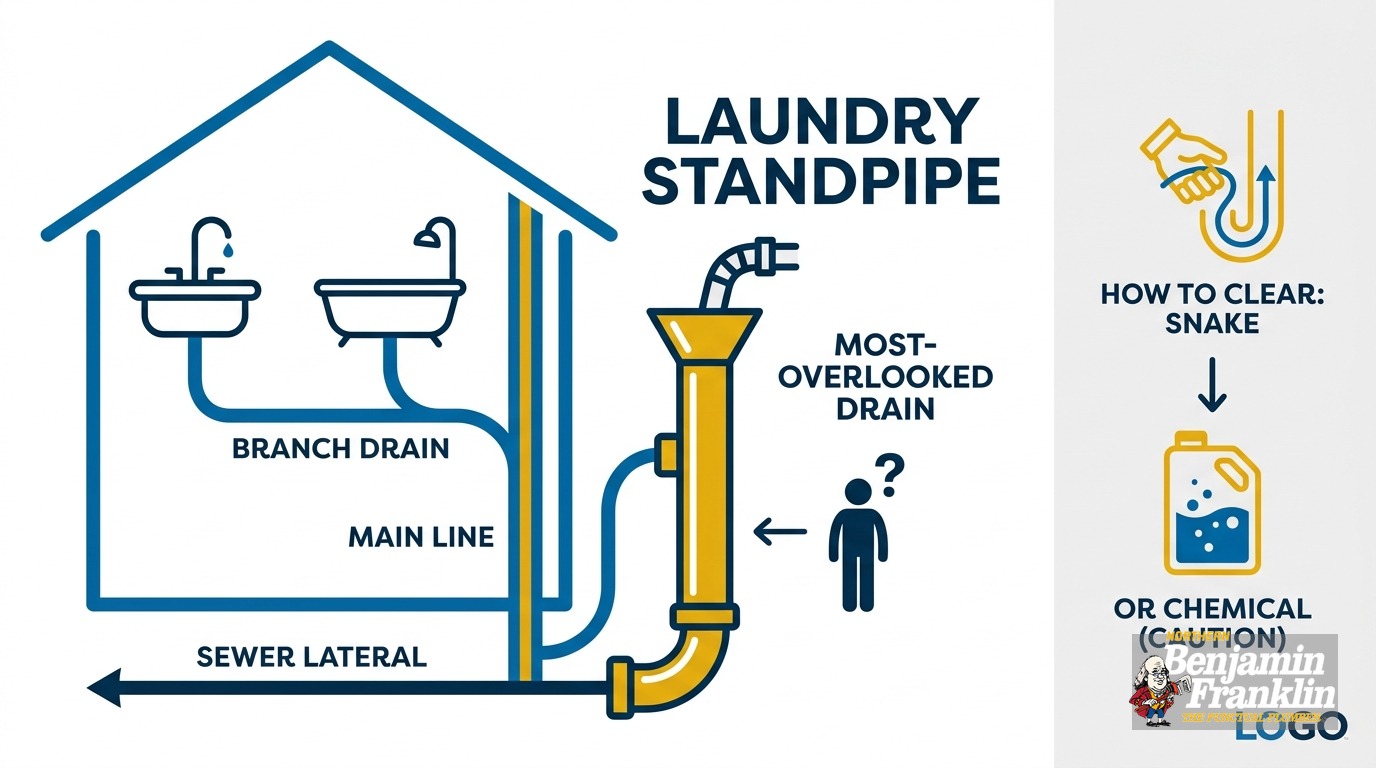
The standpipe is a 2-inch vertical pipe set into your laundry room wall with an open receptor at the top. Your washer drain hose drops into that receptor. Below it, the pipe bends into a trap that holds water to block sewer gas, and then connects to the branch drain line running to the main sewer.
The standpipe is not just a drain opening in drywall. It is a dedicated plumbing fixture with its own code requirements and its own failure modes. The fact that it lives behind the wall is exactly why most homeowners do not know it exists until the floor is wet.
Minnesota Rules 4714 requires each domestic clothes washer to connect to a separate and independent trap. A laundry tub sitting right next to the washer may share that trap, but nothing else can. When a homeowner or contractor reroutes a laundry drain without a permit, the required trap is often omitted entirely. Plumbers find that pattern regularly on service calls for flooded laundry rooms.
The 2-inch interior is a narrow pipe receiving a large, intermittent surge of water, lint, and soap at the end of every wash cycle. That combination creates a clog profile that does not exist in most other household drains.
Why Is My Washing Machine Drain Clogged?
If your washing machine drain is clogged, the most likely cause is lint and soap scum accumulating inside the 2-inch standpipe in your wall, often combined with mineral scale from hard water. The washer itself is usually fine. The drain hose is usually fine. The clog is in the pipe no one sees.
Every wash cycle sends lint, detergent residue, and fabric softener compounds into the standpipe. Those materials coat the inside of the pipe wall. They dry slightly between cycles and catch more lint on the next one. Over months and years, the pipe narrows from the inside. Eventually, the surge from a spin cycle cannot pass through fast enough, and water backs up and overflows the receptor onto the floor.
This is different from a main-line clog, which backs up multiple drains at the same time. It is also different from a machine pump failure, which produces an error code and leaves the drum full of water after the cycle ends.
What Are the Three Things That Clog a Standpipe?
Lint, soap scum, and mineral scale are the three contributors. All three are present in every wash load. All three accumulate on the inside wall of the 2-inch pipe. Over time, they layer on top of each other and narrow the interior until the pipe restricts the drain flow.
Lint is the most visible culprit. Every wash cycle releases fabric fibers into the water. A clothes washer has no secondary filter between the drum and the drain hose - unlike a dryer’s lint trap. Every fiber that leaves the drum goes straight into the standpipe.
Soap scum is the film left by detergent, fabric softener, and body oils. It is sticky. Lint adheres to it. Together, they form a rough coating on the pipe interior that catches more material with every subsequent cycle.
Mineral scale is where Twin Cities homeowners face a specific problem. Hard water leaves calcium and magnesium deposits on every surface it contacts. Inside the standpipe, those deposits bond to the soap scum film and create an even rougher interior surface. The harder the water, the faster this process runs. For suburban homeowners on well water, scale is often the accelerant that turns a slow-building lint problem into a sudden overflow.
How Do You Know the Standpipe Is the Problem?
The key signal: water spills over the top of the standpipe receptor onto the laundry room floor while the washing machine completes its cycle, the pump sounds normal, and no error code appears. The machine is draining. The standpipe cannot pass the flow fast enough, so water backs up and overflows the rim.
Compare that to two other scenarios that look similar but point to different causes:
- Machine not draining at all: The washer stops mid-cycle with a full drum, shows an error code, and the pump sounds strained or silent. That points to the machine’s internal pump filter, the pump itself, or a kinked drain hose.
- Multiple drains backing up at once: If the kitchen sink and a bathroom drain are also slow or gurgling, the problem is further downstream in the main sewer line. Our post on sewer backup vs. drain clog explains how to tell the difference between a branch problem and a main-line problem.
A partial standpipe restriction can also show up as a slow drain without overflow: the washer completes the cycle, no water hits the floor, but the drain sounds labored and takes longer than it used to. That restriction will worsen with each load. It is much easier to address before it becomes a flood.
Does Twin Cities Water Hardness Make This Worse?
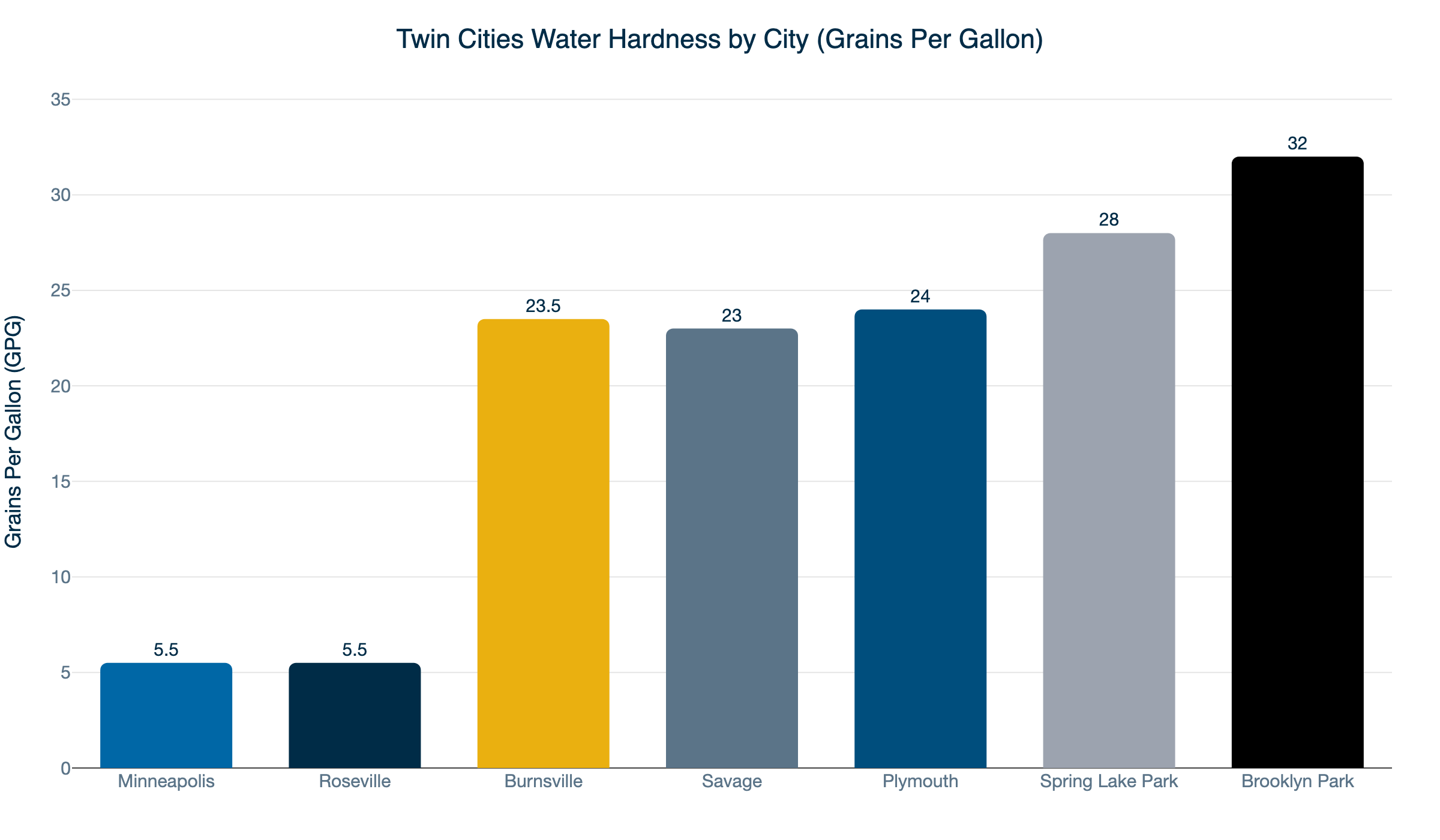
Yes, significantly - especially for suburban homeowners on well water. Minneapolis city water averages about 5.5 GPG after central softening. Many suburban communities on groundwater wells run 20-32 GPG. At that hardness, mineral scale accumulates inside the standpipe alongside lint and soap scum at a considerably faster rate than city homeowners face.
Minneapolis and St. Paul draw from the Mississippi River and centrally treat and soften the water supply. The Minneapolis 2025 annual water analysis puts finished tap water at an average of 94 ppm, about 5.5 grains per gallon. That is on the moderate end and slow to scale.
Suburban communities on groundwater wells are in a different situation. Water hardness data by city shows Brooklyn Park at 32 GPG, Spring Lake Park at 28 GPG, Plymouth at 24 GPG, and Savage at 23 GPG. At 7 GPG and above, water is classified as hard. At 20-30 GPG without a water softener, scale builds inside pipes at a rate that city homeowners rarely encounter.
The chart in this post shows how wide the range is across the metro. The difference between a Minneapolis home at 5.5 GPG and a Brooklyn Park home on a well at 32 GPG is not a minor variation. It is the difference between scale being a slow background process and scale being the primary driver of standpipe narrowing.
If you are on a suburban well without a softener, a whole-home water softener slows scale accumulation throughout your plumbing - the laundry standpipe included. It is one of the most effective long-term maintenance investments available for high-hardness homes.
What Does Minnesota Code Say About Laundry Drains?
Minnesota requires a dedicated trap for every clothes washer and a minimum 2-inch standpipe drain. New installations and significant drain alterations require a licensed plumber and a permit. The rule exists because undersized or trap-free laundry drains create exactly the recurring clogs and sewer-gas problems that plumbers find on service calls.
Minnesota Rules 4714 sets both the trap requirement and the minimum drain sizing. The 2020 Minnesota Plumbing Code took effect December 17, 2021, and is administered by the Minnesota Department of Labor and Industry.
The practical implication: if you finished your basement, moved the laundry area, or had drain work done without permits, the required trap may be missing or improperly configured. A trap-free standpipe does not just clog faster. It also lets sewer gas pass freely into the laundry room. If you suspect a permit-less laundry drain reroute is in your home’s history, ask the plumber to confirm the trap configuration while they are already on the job.
High-Efficiency Washers Make the Standpipe Clog Faster
Modern HE washers use significantly less water per cycle than older top-loaders. That efficiency is good for water bills. It also creates a standpipe problem that most homeowners have not connected to the machine they bought.
Older top-loaders discharged a high-volume, high-velocity flush at the end of each cycle. That surge carried lint and soap residue through the standpipe and into the branch drain beyond it. HE machines discharge lower-volume, lower-velocity water. The flow in the standpipe is gentler and slower. Lint that would have been carried through by an older machine now settles on the pipe wall and stays there.
Minnesota’s laundry loads compound the problem. Heavy work clothes, insulated layers, and athletic gear common to cold-climate winters shed more lint per cycle than lighter fabrics typical in warmer regions. Combined with HE low-flow discharge and hard suburban water, the standpipe clog cycle in a Minnesota home can be considerably shorter than most national estimates suggest.
If you replaced an older top-loader with an HE front-loader in the last five to ten years and have started seeing laundry drain problems, the machine change is very likely a contributing factor.
Can You Clear a Washing Machine Drain Clogged by the Standpipe Yourself?
For a fresh or moderate clog, a 25-foot handheld drum auger can clear the standpipe. Remove the washer drain hose first, feed the auger clockwise through the trap, apply gentle forward pressure at the restriction, retract and repeat, then flush with hot water and run a test cycle while watching for overflow.
Here is the full process:
- Pull the washer drain hose out of the standpipe receptor and set it in a bucket.
- Feed the auger cable clockwise into the standpipe. Work slowly. You are navigating the trap bend before you reach the restriction.
- When the cable meets resistance, continue rotating clockwise with gentle forward pressure. Do not force it hard.
- Retract the cable, clean the tip, and repeat until the cable passes through with minimal resistance.
- Pour several gallons of hot water into the standpipe to rinse loosened debris.
- Reconnect the drain hose and run a short rinse cycle while watching the standpipe for overflow.
Skip the chemical drain cleaners. They are not effective on the lint-and-soap-scum combination that clogs standpipes. They can also degrade pipe materials and create a splash hazard if you need to auger afterward.
If the clog clears but returns within a week or two, the restriction is likely hardened scale that snaking dislodges but cannot remove. Hydro-jetting uses high-pressure water to scour the interior of the pipe and is significantly more effective on mineral deposits and compacted soap scum than a cable auger.
When Should You Call a Plumber?
Call a plumber when the clog returns quickly after snaking, when the auger cannot navigate the trap, when you smell sewer gas near the laundry area, or when the standpipe needs to be replaced or relocated to meet code. Each of those signals points to something a drum auger cannot solve.
- Recurring clogs: Hardened scale that snaking moves but does not remove. Needs hydro-jetting or pipe replacement.
- Auger cannot pass the trap: The trap may be partially collapsed, offset, or installed incorrectly. Opening the wall is required.
- Sewer gas smell: A dry or failed trap seal. The trap needs to be reprimed or replaced.
- Code deficiency: A trap-free or undersized standpipe from a permit-less remodel.
A drain clearing service includes camera inspection that locates the restriction precisely before any cutting or opening starts.
Northern Benjamin Franklin Plumbing is locally owned and operated, serving Minneapolis, St. Paul, Blaine, Bloomington, Brooklyn Park, Coon Rapids, Maple Grove, and the full Twin Cities metro. We arrive in the window you pick, every time. That is our On-Time Guarantee(R): “If there is any delay, it’s you we pay!” - $5 for every minute we are late, up to $300. Call (763) 296-1844 or book online.
One Minnesota Winter Check for the Laundry Standpipe
Standpipe traps in unheated laundry rooms or infrequently used basement utility corners have a cold-weather vulnerability that most plumbing guides skip over.
The trap’s job is to hold a small pool of standing water that blocks sewer gas from entering the house. That pool can evaporate or freeze if the laundry room sits unused for several weeks: a seasonal cabin, a basement utility corner nobody visits in January, a vacation rental between guests. A dry or frozen trap seal lets sewer gas in. Some sewer gas components are odorless, so the problem is not always apparent by smell alone.
The fix is straightforward. If you have not run laundry in a few weeks, pour a quart of water down the standpipe before you leave and again when you return. That refills the trap seal. If the laundry room is in a genuinely unheated space, ask a plumber about a trap primer - a small device that automatically replenishes the trap water level - or a drain configuration that holds a seal more reliably through a Minnesota winter.
The Standpipe Clog Is Predictable. The Flood Is Not.
Most household plumbing either shows wear visually or connects to something homeowners monitor: water heater age, toilet flush quality, faucet flow. The standpipe does neither. It sits behind drywall, has no controls or indicators, and demands no attention until it overflows.
The clog profile is consistent and predictable. Lint, soap scum, and scale accumulate in every home with a washing machine. The timeline depends on water hardness, washer type, and laundry volume. In a suburban Minnesota home on hard well water with an HE washer and heavy cold-weather laundry loads, that timeline is shorter than most homeowners expect.
Knowing the standpipe exists, understanding what clogs it, and recognizing the overflow signal before it becomes a floor-level event is the practical value of this post.
When the floor gets wet anyway - or when the DIY auger pass does not hold - call Northern Benjamin Franklin Plumbing at (763) 296-1844 or book online. We serve the full Twin Cities metro, we show up when we say we will, and we leave the laundry room drier than we found it.
Frequently Asked Questions
What causes a washing machine to overflow onto the laundry room floor? +
How do I clear a clogged laundry standpipe myself? +
Does Minnesota require a trap on a laundry standpipe? +
Does hard water make standpipe clogs worse in the Twin Cities? +
Need a technician now?