
Hydro Jetting vs Snaking a Drain: Which Clears Your Clog?
Key Takeaways
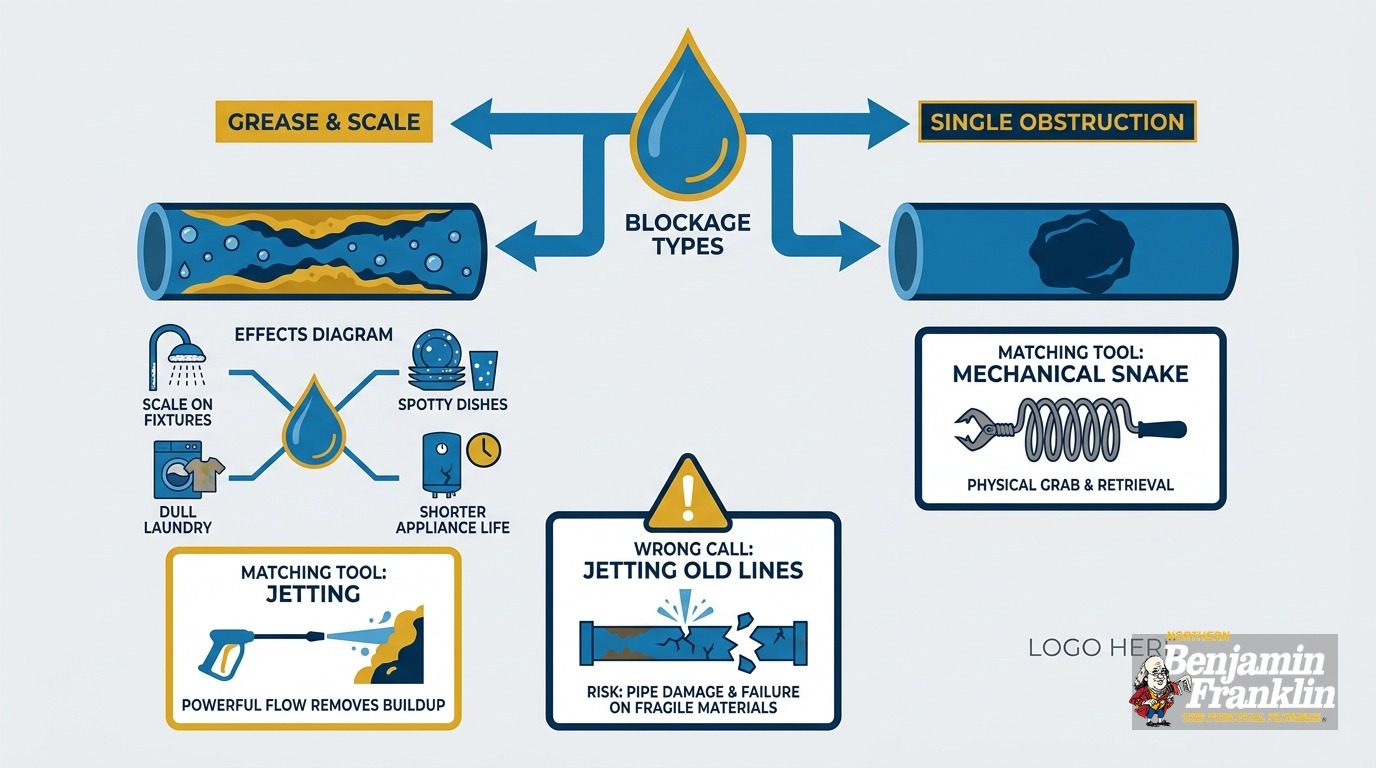
- The decision is about clog type, not clog severity. Grease and mineral scale coat the full pipe wall. A snake punches through and leaves the coating behind. Jetting strips the wall clean. Snaking buys weeks on a grease clog; jetting buys years.
- A point blockage - hair, a foreign object, a single root intrusion at a joint - is what a snake is built for. Jetting adds cost, pressure, and risk without adding benefit over a snake on that type of clog.
- Twin Cities homes built before 1960 often have clay tile lines. Homes from 1960-1985 may have early cast iron. Decades of Minnesota freeze-thaw cycling have stressed those joints. Camera inspection before jetting is not optional on old lines.
- Minneapolis homeowners own their sewer lateral all the way to the public main, including the section and the wye connection under the street. A rupture is your repair bill. Average lateral replacement in Minneapolis costs $13,000.
- When you are not sure what you have, call (763) 296-1844 or book online before choosing a method.
Hydro Jetting vs Snaking a Drain: Start With the Right Question
Most homeowners frame the hydro jetting vs snaking a drain decision around severity. Small clog, cheap fix: use a snake. Big backup, serious problem: bring in the jetter. That framing sounds logical. It is also wrong in a way that sends a lot of Twin Cities homeowners back to the same slow drain within a few weeks.
The real question is not how bad the clog is. It is what kind of clog you have. Two fundamentally different types of blockages exist in residential drains, and the right tool for each is opposite. Choose the wrong one and you either pay for an aggressive method that solved nothing, or you buy a few weeks of relief from a problem that needed wall-cleaning and not a hole punched through it.
What Kind of Clog Do You Have?
The short answer: Grease, soap scum, and mineral scale build up along the full pipe wall over time. A snake punches through the middle and leaves the coating behind. Jetting strips the wall clean. A single solid obstruction - a hair mass, a foreign object, or one root finger at a pipe joint - is a point problem. A snake retrieves or breaks it. Jetting does the same job at higher cost and higher risk on older pipe.
Distributed buildup is the first type. Grease and cooking oils do not collect in one spot. They coat the full interior wall gradually over months, narrowing the flow channel until water drains slowly. The EPA reports that fats, oils, and grease account for 47% of reported sewer blockages in the United States. A drain snake is a rotating steel cable that punches through this narrowed channel and restores flow. But it does not touch the wall. The coating that remains reseals over the opening within weeks, and the drain slows again. This is why kitchen lines and main sewer lines with years of grease accumulation keep coming back after a snake: the snake addressed the symptom, not the buildup.
Jetting sends a high-pressure water stream through a specialized nozzle that scours the pipe wall in every direction. Done on a grease-coated or scale-coated line, the result is a pipe close to its original diameter. Because the buildup is removed rather than bored through, the results last significantly longer.
Point blockages are the second type. Hair collects at a drain basket or in the P-trap. A foreign object drops in and lodges. A single root finger grows in through a mortar joint and catches debris behind it. These are specific, located obstructions. A snake reaches the object and clears it cleanly. Running a jetter down the same line adds cost, adds time, and on an older pipe adds real risk - without doing anything the snake has not already done.
Knowing which type you have narrows the decision before you pick up the phone. A kitchen drain that slows gradually over months is almost certainly grease buildup. A bathroom sink or tub that stopped draining suddenly is more likely a point blockage.
How Does a Drain Snake Work?
The short answer: A drain snake is a flexible steel cable with a corkscrew or cutting tip. The plumber feeds it into the pipe until it contacts the blockage, then rotates it to break up or retrieve the clog. Handheld snakes handle shallow fixture clogs. Motorized drum snakes reach deep into the main line. It is fast, gentle on older pipe, and the correct first tool for any point blockage.
The plumber feeds the snake cable through a drain opening or a cleanout access point. Rotation drives the tip into the obstruction. For a soft clog like compacted hair or a grease mass near the drain, the tip breaks it apart into pieces small enough to flush through. For a harder obstruction - a tangled wad of wipes, a small foreign object - the tip hooks it and the plumber pulls it back out.
Snaking is also a reasonable diagnostic first step when you do not know what you have. A snake opens the line if any kind of blockage is present. A camera inspection after the snake tells you whether the wall is coated in grease (which means jetting is the right next call) or whether the pipe is genuinely clear. Starting with a snake keeps risk low on older lines while still restoring flow.
What Is Hydro Jetting and How Does It Work?
The short answer: Hydro jetting is a drain cleaning service that uses pressurized water to scour the pipe wall. Professional equipment runs at 1,500-4,000 PSI with forward-boring and rear-scouring nozzle heads. The forward jets punch through blockages. The rear jets spin and strip the pipe wall as the nozzle is drawn back toward the access point, cleaning the full circumference of the pipe in both directions.
The plumber accesses the line through a cleanout. The jetting hose runs in and the nozzle moves toward the blockage, boring through with front-facing jets. As the nozzle is pulled back, rear-facing jets spray at an angle against the wall, removing grease, mineral scale, and biological buildup around the full pipe diameter. Done on a grease-coated or scale-coated line, the result is a pipe stripped close to its original interior surface.
This is the method that addresses distributed buildup. When grease has been narrowing a kitchen drain line for two or three years, or when hard water scale has been coating a supply line, jetting removes the problem down to bare pipe. Snaking the same line would open flow temporarily and leave the problem in place.
Cost is a real factor. Angi’s local data puts the average hydro jetting cost for a residential sewer line in Minneapolis at $367-$629. That is the cleaning cost on an intact, accessible line. It does not include camera inspection, and it does not include repairs if jetting uncovers damage that scale was hiding underneath.
Grease and Scale: When Hydro Jetting vs Snaking a Drain Is an Easy Call
Grease is the dominant cause of residential drain problems in the United States. The EPA reports fats, oils, and grease cause 47% of reported sewer blockages nationwide. The same EPA source notes that commercial drain additives marketed as grease dissolvers frequently push the grease further down the line, relocating the blockage rather than removing it.
For any household that cooks regularly and sends cooking oils, meat fats, or pan drippings down the kitchen drain, grease accumulation in that line is a near-certainty over a few years. Add a dishwasher running into the same stack and the buildup accelerates. Jetting is the correct call on those lines because it removes the grease from the wall surface. Snaking opens temporary flow and nothing more.
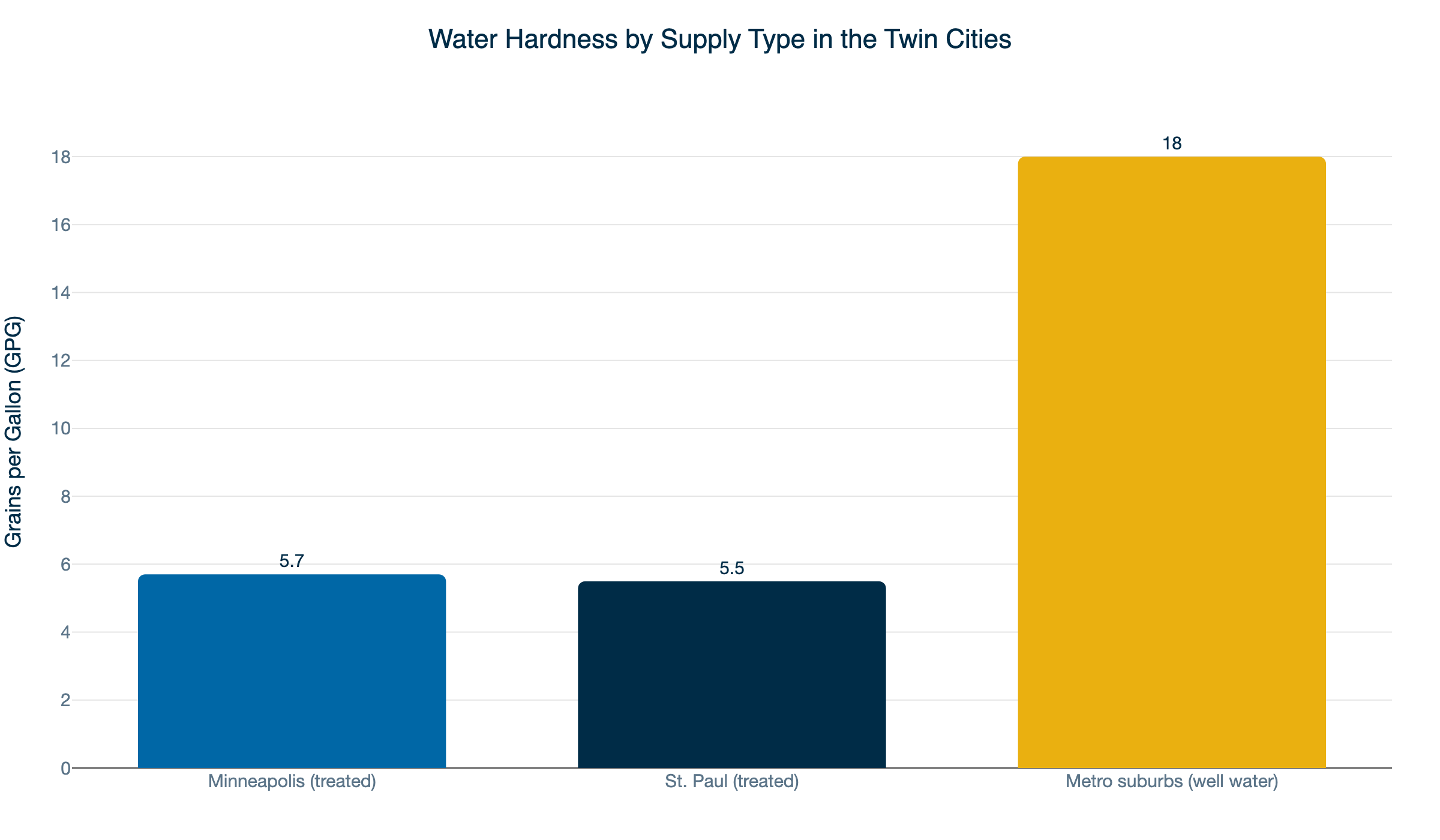
Scale from hard water compounds the problem. Minneapolis treated water runs about 5.5-5.8 grains per gallon according to the city’s January 2026 water analysis. That is moderate hardness. Many Twin Cities metro suburbs draw from private wells that are much harder. The St. Paul Regional Water Services 2025 Water Quality Report shows suburban well supplies can run 14-22 GPG before any treatment. At those hardness levels, scale deposits on hot water lines can become significant within a few years. Grease and scale together narrow a line faster than either problem does alone.
The diagnosis on these lines is straightforward. A camera confirms distributed buildup on the wall. Jetting removes it. The drain flows the way it was designed to flow, and it stays that way.
Is Hydro Jetting Safe for Older Twin Cities Pipes?
The short answer: It depends on the pipe condition, and the only way to know the condition is a camera inspection. Homes built before 1960 often have clay tile lines. Homes from 1960-1985 may have early cast iron. Decades of Minnesota freeze-thaw cycling have stressed the joints in both materials. Jetting at 3,000-4,000 PSI on a cracked or offset joint can convert a cleaning job into a sewer repair. Camera inspection before jetting is not a formality on old lines. It is the information that makes the decision safe.
This is the question that competing articles skip, and it matters more in Minnesota than almost anywhere else in the country.
Minnesota frost penetrates 42-48 inches deep in the Twin Cities metro. Every winter, the soil around a buried sewer lateral freezes and expands by roughly 9% before it thaws in spring. In a home built in 1950, that cycle has run about 75 times. The cumulative effect on clay tile and cast iron lines is joint offset, micro-cracking, and gradual pipe wall thinning.
Clay tile pipe is chemically resistant to wastewater. Its failure point is the joints. Original clay tile lines used mortar joints, and freeze-thaw cycling loosens mortar over decades. An offset joint in an old Minneapolis or St. Paul neighborhood can look minor from the surface and still be a structural failure point. A jetting nozzle at high pressure directed at that joint can blast it apart. You started with a slow drain. You end with a broken sewer line.
Cast iron corrodes from the inside out. The corrosion produces scale on the interior wall, and that scale does two things at once: it narrows the flow channel, which is the symptom you notice, and it reinforces the thinned pipe wall, which is the part you do not see. Strip the scale at high pressure and you can expose holes in walls that were paper-thin underneath. Harris Plumbing documents this failure mode on severely corroded cast iron. It is not rare on lines that are 50 or more years old.
This is not an argument against jetting old lines. It is an argument for the sewer line camera inspection that tells your plumber what the pipe can actually handle. A camera shows joint alignment and condition, corrosion level, existing cracks or offsets, and any root intrusions. From that picture, a licensed plumber makes a specific recommendation: full-pressure jetting, reduced-pressure jetting, snaking only, or repair before cleaning. Without a camera, choosing a jetting pressure on an old line is a guess.
If your home was built before 1960, clay tile is common in the ground below. If it was built between 1960 and 1985, you may have early cast iron or early plastic. If you are not sure, a camera answers the question before anything goes into the line.
Do Minneapolis Homeowners Own Their Entire Sewer Lateral?
The short answer: Yes. Minneapolis Public Works states that homeowners are responsible for the sewer lateral from inside the house all the way to the public main, including the wye connection under the street. If the line fails anywhere along that run, the repair bill belongs to the homeowner, not the city.
Most homeowners assume the city takes over at the property line. That assumption is wrong, and it is an expensive one to discover after a cleaning method decision gone sideways.
Minneapolis Public Works puts the average lateral replacement cost at $13,000, ranging from $2,150 to $62,000 depending on depth, pipe material, access, and how much pavement and street restoration the repair requires. The high end of that range is not a rare edge case. It happens when the lateral runs deep under a paved street with a complicated connection.
Some financial help is available. The Minneapolis Private Sewer Lateral Assessment Program provides assistance up to $10,000 for qualifying lateral repairs. You have to apply and qualify, but the program exists and a licensed plumber can help you understand whether your situation is likely to meet the criteria.
The broader point is context. The stakes on a drain cleaning decision go beyond the service call cost. On an old line in uncertain condition, choosing the wrong cleaning method - or skipping the camera that would have shown what the pipe could handle - can convert a $400 cleaning into a five-figure lateral repair. Getting the method right is worth the camera.
Should You Get a Camera Inspection Before Jetting?
The short answer: If your home was built before the mid-1980s, yes. If the lateral has never been inspected, yes. If there are mature trees anywhere near your sewer path - which describes most of the Minneapolis and St. Paul grid - yes. A camera inspection is not an upsell. It is the information that makes the jetting decision safe and the pressure setting defensible.
A camera inspection identifies the pipe material, shows joint alignment and condition, locates existing cracks or offsets, and reveals whether roots have entered at any joint. From that picture, your plumber makes a specific recommendation for your line on your property. Without it, the recommendation is a generalization.
For a new homeowner, a camera inspection in the first year is one of the most valuable investments in the house. It tells you the pipe material, the general condition of the lateral, and whether any repairs are approaching. For an existing homeowner who has never had the lateral inspected and is now noticing slow drains, the camera is the step that separates a manageable cleaning job from a bad outcome.
Any repair or replacement triggered by a cleaning job that caused a line failure requires a permit. Minnesota Plumbing Code, Chapter 4714, administered by the Department of Labor and Industry, requires that any repair, alteration, or replacement of a sewer lateral be permitted and performed by a licensed master plumber. Routine drain cleaning is typically exempt from permitting. The moment the line needs repair, you are in permitted work territory. That is another reason to confirm the pipe condition before committing to an aggressive cleaning method.
When to Call Northern Benjamin Franklin Plumbing
A single slow drain in one fixture is the easy case. Call us, we assess the line, we camera if the home is older, and we recommend snake or jet based on what the line shows. Several symptoms point to something larger.
- Multiple drains backing up at the same time. A kitchen sink, a bathtub, and a basement floor drain all slowing at once points to a main line problem, not a fixture-level clog. That warrants a camera inspection and main line cleaning, not a quick snake at the sink.
- A drain that returns to slow within a month of being cleared. The line was snaked when it should have been jetted. Grease or scale was the actual problem.
- Sewage smell without a visible source. A cracked or offset joint allows sewer gas into the surrounding soil and sometimes into the home without fully blocking the line. A camera locates the failure point without excavation.
- Gurgling from other fixtures when you flush a toilet. Air movement in the drain system points to a partial main line blockage or a venting problem. Either way, a plumber needs to assess it.
Our drain clearing service is the right starting point for most clog calls. When a camera reveals damage that cleaning cannot fix, the conversation moves to sewer line repair and replacement.
We are locally owned and operated in the Twin Cities. Our plumbers know Minnesota construction eras, which pipe materials are typical by neighborhood and decade, and why an old Minneapolis clay tile line warrants a different approach than a newer PVC line in a 2005 suburb. That local knowledge shapes the recommendation on every call - and it is knowledge a national chain’s scheduler does not carry.
Our On-Time Guarantee(R) backs every appointment. You choose the arrival window. We arrive on time or we pay: “If there is any delay, it’s you we pay!” That is $5 for every minute we are late, up to $300, and it is in writing before we come to your door.
Call (763) 296-1844 or book online to schedule a drain assessment, camera inspection, or service call. If you are not sure whether your drain needs a snake, a jetter, or a camera first, that is exactly the kind of question we answer every day.
Frequently Asked Questions
Is hydro jetting safe for old clay or cast iron pipes in the Twin Cities? +
How long does hydro jetting last compared to snaking a drain? +
Who owns the sewer line under the street in Minneapolis? +
Need a technician now?