
Kitchen Drain Grease Clog: Why Liquid Cleaners Backfire
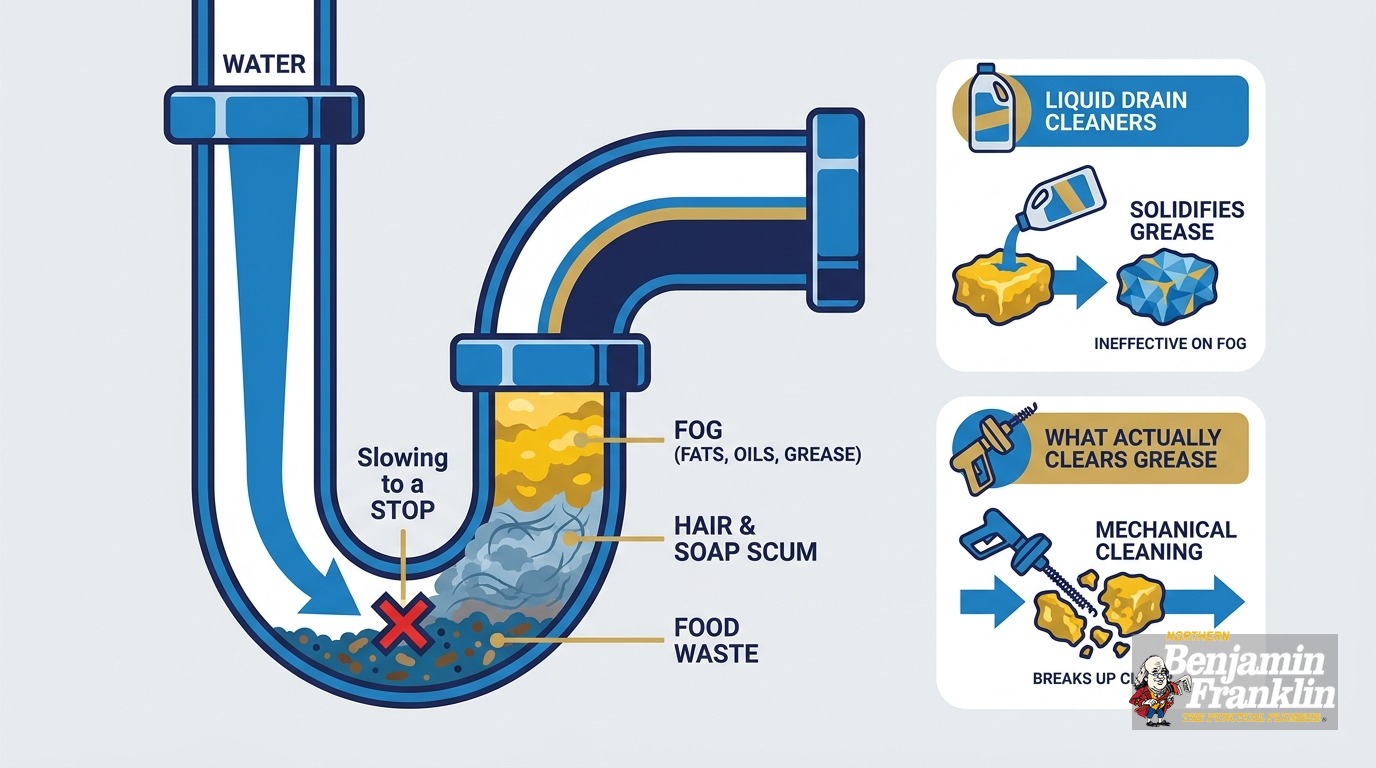
Key Takeaways
- FOG (fats, oils, and grease) is the top cause of kitchen drain clogs and one of the primary causes of sanitary sewer overflows nationwide.
- Liquid drain cleaners do not dissolve grease. They convert the outer layer to soap, leave the dense core intact, and coat the pipe wall so the next clog forms faster.
- Hot water does not clear grease. It melts the surface layer and relocates it downstream, where it re-solidifies in a cooler pipe section or in your sewer lateral.
- Your sewer lateral is your responsibility. A FOG clog that migrates downstream becomes your repair bill, not the city’s.
- Minnesota winters make the problem worse. Cold ground temps and older cast iron drain lines in pre-1950s Twin Cities homes accelerate FOG accumulation significantly.
- The only method that physically removes FOG from pipe walls is hydro-jetting. Snaking restores flow but does not clean the walls.
- Prevention is straightforward: wipe grease into the trash, run cold water during garbage disposal use, and apply a monthly enzyme treatment.
What Is a Kitchen Drain Grease Clog, and How Does It Form?
The short answer: Cooking fats and oils leave the stove as liquids and cool inside your pipes. They harden into layers. Each layer narrows the passage until the drain slows, then stops.
FOG stands for fats, oils, and grease. Plumbers, the EPA, and municipal wastewater systems all use this term. It covers bacon grease, butter, chicken fat, vegetable oil, and cooking residue rinsed off pans.
At the stove, bacon grease is liquid. It looks harmless going down the drain. The problem starts a few feet further in.
As FOG travels through your drain stack, it cools. Pipe walls are not heated. A kitchen drain behind an exterior wall or below a slab sits close to ambient temperature. Fats and oils have melting points. When the pipe wall drops below that point, FOG sticks.
The buildup is not dramatic at first. Each cooking session deposits a thin layer. Food solids and proteins from the drain catch in the sticky film and accelerate accumulation. After weeks or months, the passage narrows, then blocks.
That is a kitchen drain grease clog. It is physics and time, not a single event.
Why Does Grease Solidify Inside Pipes?
The short answer: Animal fats and many cooking oils are solid at room temperature or below. A drain pipe is not a hot pan. Once FOG leaves the stove, it cools and hardens exactly the way it does in a jar on your counter.
Consider butter left on the counter. It softens in a warm kitchen and firms up in a cool one. The fat in bacon grease, lard, chicken drippings, and butter behaves the same way inside a drain.
Vegetable oils are not exempt. Coconut oil solidifies around 76°F. A drain pipe inside an exterior wall in a Minnesota winter can sit at 50°F or below. Olive oil and palm oil have similar characteristics. The oil that poured smoothly into the drain can firm up within a few feet of travel.
Dish soap does not prevent this. Soap coats the FOG briefly, but it does not change the fat’s chemistry. The FOG re-agglomerates further down the line.
Does Liquid Drain Cleaner Fix a Kitchen Drain Grease Clog?
The short answer: No. Lye-based cleaners convert the outer layer of a grease clog into soap through a process called saponification. The soap flushes away. The dense core stays. The soap film coating your pipe wall makes the next clog form faster.
This is what most guides leave out. They say “don’t use chemical cleaners” without explaining the mechanism. The mechanism matters because it explains why the drain seems to clear briefly and then blocks again faster than before.
Here is what happens.
Sodium hydroxide (NaOH) is the active ingredient in most liquid drain cleaners. When it contacts a fat molecule, saponification converts that fat into soap and glycerol. Soap is water-soluble. It washes away.
The problem is reach. Saponification acts only on the surface of the clog. The outer layer converts to soap and flushes. The dense inner core does not react because the cleaner cannot penetrate it.
What remains is a pipe coated in a thin soap film. Soap is tacky. The next round of FOG that travels down the drain has more surface area to bond to. The clog rebuilds faster than it did before the treatment.
There is a physical risk as well. Minnesota requires a licensed plumber for substantive drain repair and replacement under Chapter 326B. Repeated caustic treatments can degrade older cast iron drain joints and accelerate corrosion in pre-1950s Twin Cities homes.
Does Hot Water Actually Clear a Kitchen Drain Grease Clog?
The short answer: No. Hot water melts grease at the drain, but the pipe ahead is cooler. The grease re-solidifies at the next cool section. You move the clog downstream. You do not clear it.
“Flush it with boiling water” is the most-repeated home remedy for a kitchen drain grease clog. It is not chemically harmful the way caustic cleaners are. But it makes the downstream problem worse.
Hot water raises the pipe wall temperature briefly and melts accumulated FOG. A pipe is not a furnace. The heat dissipates quickly. A few feet downstream, the pipe returns to ambient temperature. The liquid grease that just melted off the wall re-solidifies there.
In a warmer climate, that downstream section may be in a heated basement or warm soil. The grease stays mobile longer. In Minnesota, that is not the case.
Minnesota sewer laterals sit at approximately 38-42°F during winter months. The frost depth in the Twin Cities metro runs 42 to 60 inches in a typical winter. Soil above that frost line is cold long before the ground freezes solid. Hot water pushed into a kitchen drain in January travels through progressively colder pipe before reaching a lateral that hovers near freezing. Grease melted at the top of the stack re-solidifies hard in the lateral.
The clog has not been cleared. It has been moved to a section of pipe that is harder to reach and, as the next section covers, is your financial responsibility to repair.
Minnesota’s Cold Ground Multiplies the Risk
Twin Cities winters add compounding factors that make kitchen drain grease clogs form faster and more stubbornly here than in most of the country.
Older cast iron drain lines. Minneapolis, St. Paul, and the inner-ring suburbs have significant housing stock built before 1960. Those homes were plumbed with cast iron. Cast iron drain lines have rougher interior surfaces than modern PVC or ABS. FOG adheres to rough walls faster. A cast iron kitchen drain in a pre-war South Minneapolis bungalow can develop a significant blockage in 6 to 12 months of normal cooking grease disposal.
Hard water. Water hardness in the Twin Cities metro runs roughly 10 to 15 grains per gallon. Minneapolis draws from the Mississippi River; St. Paul uses river water and wells. Calcium and magnesium dissolved in hard water deposit as mineral scale on pipe walls. That scale gives FOG a textured surface to bond to. Liquid drain cleaners do not touch scale. The compound buildup of scale plus FOG is faster and more stubborn than either factor alone.
Cold inlet temperatures. Cooking grease leaves your pan at 350°F or hotter. It is still liquid at 140-180°F when it reaches your kitchen drain. By the time it reaches the outdoor lateral in January, Minnesota ground temperatures bring it close to freezing. Each cooking session deposits a new FOG layer at the point where the pipe cools below the grease’s solidification threshold.
What Happens to Your Sewer Lateral When Grease Goes Downstream?
The short answer: In most Twin Cities municipalities, you own the sewer lateral from your home to the municipal main. A FOG clog in that section is your repair bill, not the city’s.
This is the detail that turns a household nuisance into a significant expense.
The sewer lateral is the pipe that runs from your home’s drain system to the municipal sewer main under the street. It crosses your yard at a depth of roughly 4 to 8 feet before connecting to the city system.
In Minneapolis, St. Paul, and most surrounding suburbs, the homeowner owns and maintains the full lateral. The city is responsible for the main under the street. Everything from your foundation out to that connection is yours. Any clog inside it is yours as well.
A kitchen drain grease clog in the house drain stack is a manageable repair. A plumber can snake or jet the stack without excavation. A FOG accumulation in the sewer lateral, built up by months of hot-water flushes that relocated grease downstream, is a larger job. The lateral may need to be jetted, inspected with a camera, or, in severe cases, excavated. The cost climbs with each step.
Repeated hot-water treatment of a kitchen drain grease clog turns a drain stack job into a lateral job.
How Does Kitchen Grease Affect the Twin Cities’ Regional Sewer System?
FOG is not only a household problem. It is a regional infrastructure problem.
FOG is explicitly named by the EPA as a leading cause of sanitary sewer overflows (SSOs), alongside non-flushable wipes. The EPA estimates 23,000 to 75,000 SSOs occur nationally each year. Those overflows back up into homes, cause property damage, and threaten public health.
The Metropolitan Council Environmental Services treats wastewater for 111 cities and townships, serving 2.8 million people in the Twin Cities metro. The regional network includes 634 miles of sanitary sewer interceptors. The system processes an average of 250 million gallons of wastewater per day.
FOG from residential kitchens that migrates into that network adds to blockage risk across the full system. The Met Council consistently achieves near-perfect compliance with federal and state discharge standards. Residential FOG increases the treatment load and blockage risk that makes that compliance harder to maintain.
You may not feel the effect directly. But the municipal system, the regional treatment facilities, and rate-paying residents across the metro absorb the long-term cost.
What Actually Clears a Kitchen Drain Grease Clog?
The short answer: A drain snake breaks up an active blockage and restores flow quickly. Hydro-jetting scours the pipe walls and removes accumulated FOG. Enzyme treatments slow the rate of new buildup. The right method depends on how far the problem has progressed.
Drain snaking
A drain snake (or drain auger) is a rotating cable that punches through the blockage and restores water flow. For an active kitchen drain grease clog, snaking is fast and effective at clearing the center of the pipe.
The limitation is the wall. A snake breaks up the mass but does not clean the pipe surface. FOG residue and scale stay bonded to the interior. The new clog begins forming again from that residue immediately. Snaking repairs the symptom, not the underlying accumulation.
For a full comparison of both methods, see our hydro-jetting vs. drain snaking guide.
Hydro-jetting
Hydro-jetting uses pressurized water to scour the interior of the pipe. A professional system delivers water at 1,500 to 4,000 PSI through a specialized nozzle. The high-pressure stream cuts through FOG accumulation, strips it from the pipe wall, and flushes the debris downstream.
This is the only method that physically removes the accumulated FOG layer. It does not relocate grease; it emulsifies and flushes it. For a kitchen drain with years of buildup, or a sewer lateral that has received repeated hot-water FOG deposits, hydro-jetting restores the pipe close to its original interior diameter.
A camera inspection before jetting confirms the extent of the buildup and rules out other causes, such as tree root intrusion or a pipe belly, that can produce the same slow-drain symptoms.
Enzyme treatments
Enzyme-based drain products use bacterial cultures to break down organic material, including FOG, inside pipes. They are not a fix for an active clog. Used monthly in a kitchen drain, they reduce the rate of accumulation between professional cleanings.
They work slowly and require consistent use. Treat them as prevention, not repair.
How Do You Prevent a Kitchen Drain Grease Clog?
Prevention costs far less than a hydro-jet service or a sewer lateral repair. These habits stop FOG from entering the pipe system in the first place.
Wipe before you rinse. Let pans cool. Wipe grease into a can, a paper towel, or the trash before washing. This applies to the pan you fried bacon in, the bowl you mixed ground beef in, and the pot you made stock in. The most effective prevention is simply not putting grease in the drain.
Cold water during garbage disposal use, not hot. Hot water melts fats and sends them into the drain as a liquid. Cold water keeps fats solid so the disposal shreds them before they reach the drain stack. Run cold water for 30 seconds before and after running the disposal.
No cooking grease in the garbage disposal. Liquid bacon grease, butter residue, and cooking oil do not belong in the disposal regardless of water temperature. The disposal handles food solids. It does not stop FOG from coating the drain line.
Monthly enzyme treatment. A bacterial enzyme product used once a month in your kitchen drain will reduce FOG accumulation. Dose it at night, after the last dishes are done, so the cultures have time to work.
Annual drain inspection on older homes. If your home was built before 1960, a camera inspection every one to two years gives you a current view of your drain line. Cast iron pipe that is scaling or corroding is an early warning. Catching FOG accumulation at 20% blockage is routine maintenance. Catching it at 80% is an emergency call.
When Should You Call a Plumber for a Kitchen Drain Grease Clog?
The short answer: Call when the kitchen drain is running slowly and has not responded to standard troubleshooting. Call sooner if multiple drains are slow at the same time, which points to a problem further down the line.
You do not need to wait for a complete blockage. A persistently slow kitchen drain is the early warning. If water pools in the sink for more than a few seconds after you run the tap, FOG accumulation is the likely cause.
Call sooner if any of these are present:
- A gurgling sound from other drains when the kitchen sink runs.
- A sewer smell from the kitchen drain opening.
- Multiple drains running slowly at the same time.
- The slow drain returned within a few weeks of snaking.
That last point is the key indicator. A kitchen drain grease clog that comes back quickly after snaking signals heavy pipe-wall accumulation. The snake cleared the passage. The walls are still coated. Hydro-jetting is the correct next step.
For more context on what a slow drain signals across your home, read our post on slow drains and what your pipes are trying to tell you.
Clear It Right the First Time
Northern Benjamin Franklin Plumbing is locally owned and operated in the Twin Cities. Our team handles drain clearing, hydro-jetting, sewer lateral inspections, and the full range of residential plumbing services across Minneapolis, St. Paul, Blaine, Bloomington, Brooklyn Park, Coon Rapids, Maple Grove, and the wider metro.
We back every appointment with our On-Time Guarantee(R): arrive in the window you choose, or we pay. “If there is any delay, it’s you we pay!” That is our commitment, in writing, on every job.
Call us at (763) 296-1844 or book online to schedule your drain inspection or service today.
Frequently Asked Questions
Does hot water fix a kitchen drain grease clog? +
Is liquid drain cleaner safe to use on a grease clog? +
Who is responsible for a sewer lateral grease clog in the Twin Cities? +
What is the most effective way to clear a grease clog? +
Need a technician now?