
Garbage Disposal Installation: Electrical Code and Drain Setup
Key Takeaways
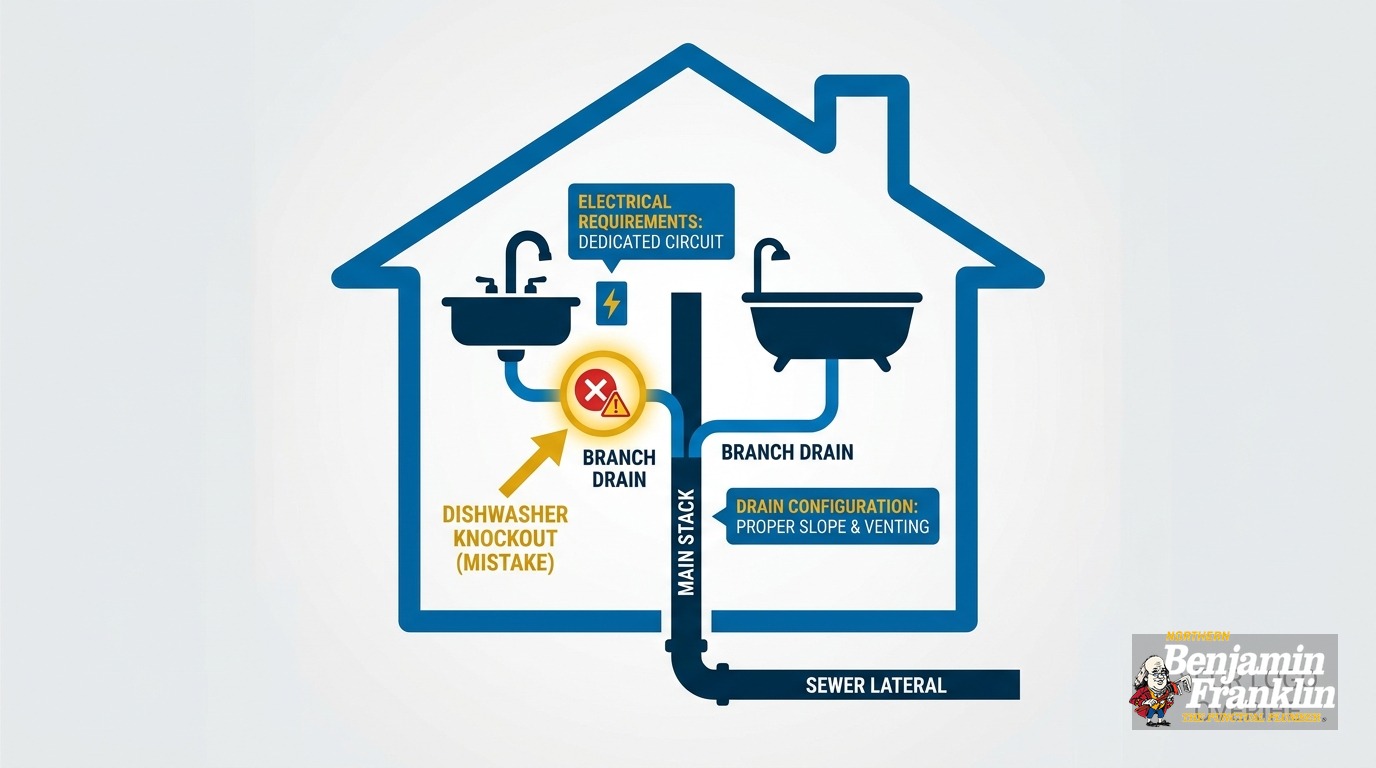
- Garbage disposal installation requires a dedicated, properly grounded circuit. A shared outlet under the sink does not meet NEC requirements.
- Any outlet powering a disposal must be GFCI-protected. Many Twin Cities kitchens built before the 1990s are not, making the existing outlet a code violation the moment a disposal is connected.
- The dishwasher knockout is a two-step failure. Leaving the factory plug in prevents the dishwasher from draining. Removing it without retrieving the plastic slug from inside the grinding chamber can jam or destroy the grinder plate.
- The drain arm must slope at least 1/4 inch per foot toward the main drain stack. Less than that causes standing water, biofilm buildup, and the persistent sour odor that no amount of sink cleaning resolves.
- Minneapolis exempts disposal installation from permit requirements. Many suburbs, including Burnsville, require a plumbing permit. Confirm with your city before starting.
- Minnesota homeowners may install their own disposal on a primary, owner-occupied residence. Rental and commercial work requires a licensed plumber.
- Motor size determines the circuit spec. Half-HP and under needs a 15-amp circuit. One HP and above needs 20 amps and 12-gauge wire.
What Makes Garbage Disposal Installation More Complicated Than It Looks
A disposal swap looks like a one-afternoon job. Twist the old unit off, twist the new one on, plug it in. That version of the job skips three things: the electrical circuit check, the drain slope measurement, and the dishwasher knockout plug.
Every generic install guide covers the mounting ring and wire colors. What those guides consistently miss is the GFCI gap in older kitchens, the Minnesota permit picture that varies by city, and a two-part failure in the dishwasher knockout that can destroy the unit before the first cycle finishes. Each one of those omissions is the shape of a callback: a leaking cabinet, a tripped breaker, a dishwasher that backs up on day one, or a grinding noise that ends with a replacement.
This guide covers all three, with the specifics Twin Cities homeowners actually need. If you would rather hand this off from the start, Northern Benjamin Franklin Plumbing handles garbage disposal installation and replacement across the metro. We are locally owned and operated, backed by the On-Time Guarantee(R).
What does garbage disposal installation actually involve?
Garbage disposal installation spans three systems: the mounting assembly at the sink drain, the drain arm connecting to the P-trap, and the dedicated electrical circuit. Getting all three right separates an installation that holds from one that leaks, smells, or trips the breaker.
The mounting assembly is a three-bolt ring that seats around the drain opening, typically 3.5 inches in diameter. Plumber’s putty seals the gap between the mounting flange and the sink basin surface. The disposal body twists onto that ring and locks with a quarter-turn. If the ring isn’t seated flat, or if the putty bead is uneven, the seal fails. The first sign is usually a ring of water on the cabinet floor after the next dish-washing session.
On a like-for-kind swap, the mounting ring from the old unit often stays in place. Most replacement units lock onto a standard mounting system. Some brands use proprietary mounting hardware, which means replacing the entire assembly when you switch manufacturers. Check compatibility before purchasing the new unit.
The drain side connects the disposal outlet to the drain arm that runs to the P-trap. Most disposals use a 1.5-inch outlet. The P-trap arm position often needs adjustment because the disposal outlet sits lower and to one side compared to a standard basket strainer. If the arm isn’t configured for clean drainage toward the wall stub-out, you will see slow drainage or gurgling within days of installation.
The electrical side is where DIY garbage disposal installation most often leaves homeowners with a code violation they don’t know about.
Does a garbage disposal need a dedicated circuit?
Yes. The NEC requires a dedicated circuit for garbage disposals. Sharing a circuit with a dishwasher, microwave, or refrigerator risks overloaded breakers and GFCI shutoffs every time the disposal runs alongside another appliance. Tommie’s Plumbing covers the dedicated circuit requirement in detail.
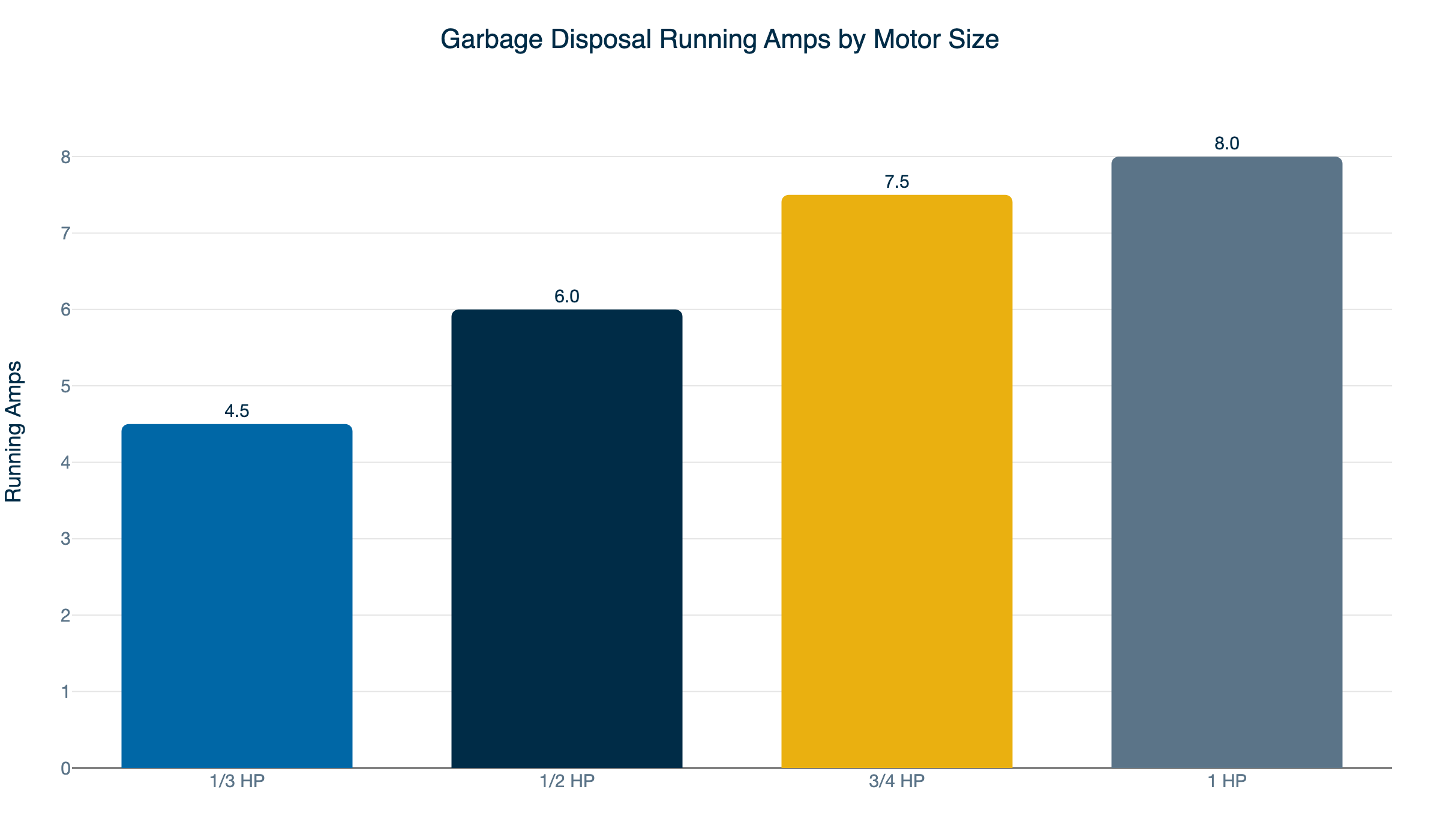
Running amps by motor size, per Nassau National Cable’s wiring guide:
- 1/3 HP: 4-5 amps at running load
- 1/2 HP: 5.5-6.5 amps at running load
- 3/4 HP to 1 HP: 7-8 amps at running load
Startup surge is the number that drives breaker sizing. On any disposal, regardless of HP rating, the startup surge can briefly hit 15 amps. That inrush is short. But it is enough to trip a shared circuit breaker that is already carrying the load of other kitchen appliances.
GE Appliances specifies a 120V individual, properly grounded branch circuit with a 15-amp breaker or time-delay fuse as the minimum electrical requirement for a disposer. For motors at 1 HP and above, the recommendation upgrades to a 20-amp circuit with 12-gauge wire. Using 14-gauge wire on a 20-amp circuit is a fire risk. It doesn’t announce itself immediately. The problem builds in the wiring insulation over time. It surfaces years after installation, often in a way that is difficult to trace back to the original job.
If your panel doesn’t have a spare breaker slot, or if your kitchen was wired without a disposal circuit, bring a licensed electrician into the project before the installation starts. Trying to run the disposal off an existing shared circuit is the fix that creates the next problem.
What are the GFCI and wiring requirements for a disposal?
GFCI protection is required for any under-sink outlet powering a disposal, whether new or existing. A GFCI outlet directly under the sink or an upstream GFCI breaker protecting the entire circuit both satisfy the requirement. A standard outlet, even on a dedicated circuit, does not meet code for this application.
This is the gap that every installation guide skips. They tell you to plug the disposal into the outlet under the sink. They don’t mention that the outlet needs to be GFCI-protected first. In many Twin Cities homes built before the 1990s, the under-sink outlet predates the GFCI requirement for that location. The outlet works. It is not code-compliant for a disposal connection. Plugging a new unit into that outlet won’t trigger an immediate consequence. The violation appears during a home sale inspection, or when a licensed plumber opens the cabinet for an unrelated repair months or years later.
Upgrading to a GFCI outlet is a straightforward fix. The problem is recognizing that it needs to happen before the disposal goes in, not after the inspector writes it up.
Hardwired installations carry a separate NEC requirement. When a disposal is wired directly to the circuit rather than plugged in, a disconnect switch must be installed within the sight line of the unit. Many manufacturers ship disposals without a power cord; the cord kit is an add-on. Whether to go plug-in or hardwired typically comes down to what the cabinet setup will support. A plug-in installation is simpler for future replacement. A hardwired setup is sometimes preferred where under-sink space is tight and a cord-and-plug arrangement would be awkward.
The dishwasher knockout: the most common garbage disposal installation mistake
This is the step buried in every install guide as a single bullet. It has two parts, and missing either one causes a distinct failure.
Part one: remove the factory plug. Most disposals ship with a solid plastic plug blocking the dishwasher drain inlet port on the side of the unit. That port is only needed if your dishwasher connects to the disposal for drainage, which most built-in dishwashers do. If the plug is still in place when you connect the dishwasher drain hose and run the first cycle, the dishwasher can’t drain. Water backs up into the tub. The machine may throw an error code, or it may simply leave standing water the next time you open the door.
Part two: retrieve the plastic slug. When you knock the factory plug loose from the outside using a screwdriver and a hammer, the plug breaks free and drops into the disposal grinding chamber. That slug is small, hard, and sits directly above the grinder plate. Per InSinkErator’s installation documentation, you must remove the slug from inside the unit before connecting the drain line and powering on. If the slug stays in the grinding chamber and you run the disposal, it strikes the grinder plate immediately. Depending on its position, it either jams the unit on the first run or scores the grinding plate. A scored plate means unit replacement.
The retrieval step is easy to skip. Nothing about the exterior of the disposal signals that it needs to happen. You knock the plug out, it disappears from view, you move on to the drain hose connection. If you are not specifically reaching into the grinding chamber to retrieve the slug before sealing the unit up, you will miss it.
To retrieve the slug safely, power must be disconnected first. Reach through the drain opening with a narrow tool or gloved hand. The slug is a disc of hard plastic roughly the same diameter as the inlet port. Pull it out before connecting anything.
If your dishwasher does not drain through the disposal, leave the factory plug in place. Removing it when there is no drain hose creates an open port. Water will leak directly into the cabinet every time the disposal runs.
How should the drain arm be configured?
The drain arm must slope at least 1/4 inch per foot toward the main drain stack. That is the minimum standard under the Uniform Plumbing Code and Minnesota Plumbing Code Chapter 4714. Less than that, water pools in the drain arm between uses. Pooled water develops biofilm, the layered bacterial growth that produces the persistent sour smell that appears a few weeks after installation. That odor cannot be cleaned away from the drain opening because the source is in the horizontal pipe, not at the sink.
Minnesota Plumbing Code Chapter 4714 also governs the dishwasher drain connection. The dishwasher drain hose must route through a high loop or an air gap before connecting to the disposal inlet. The high loop runs the hose up to the underside of the countertop and back down, creating an elevation break. An air gap fitting mounts through the countertop near the faucet and vents the drain line. Either approach prevents contaminated water from siphoning back from the disposal into the dishwasher. Without either one, you have a direct backflow path between the two appliances. That is a sanitation problem, not just a code item.
The Minnesota DLI’s Plumbing Code FAQ specifies that dishwasher drain piping must be adequately supported per Sections 312.2 and 313.5. That means clips or hangers, not the weight of the hose resting on the cabinet floor. An unsupported hose sags over time. A sagging hose loses the high loop and creates a low point where water pools and stagnates.
To check slope on an existing arm, hold a short level against the pipe and measure the drop across 12 inches. You need at least 1/4 inch of drop per foot. A flat or reverse-pitched arm needs to be reset before the disposal installation is complete.
If the disposal outlet sits higher than the drain stub-out in the wall, no slope adjustment fixes the problem. The outlet needs to sit lower than the stub-out for gravity drainage to work. If the cabinet geometry doesn’t allow that, the P-trap arm position needs to be reconfigured before the drain arm is set.
Do you need a permit for garbage disposal installation in the Twin Cities?
Permit requirements vary by city. There is no uniform Twin Cities answer.
Minneapolis explicitly lists garbage disposal installation as permit-exempt, both for new installations and like-for-kind replacements, provided the project meets all applicable code conditions.
Burnsville requires a plumbing permit. So do several other suburbs across the metro. Assuming your city follows Minneapolis’ approach is the kind of assumption that surfaces during a real estate transaction when the buyer’s inspector pulls the permit history and finds work done without one.
Before starting, call your city’s building or inspections department and ask directly whether disposal installation requires a permit. That call takes five minutes and gives you a documented answer. A nominal permit fee up front is far less disruptive than explaining an unpermitted installation to a buyer’s inspector or title company.
What can a Minnesota homeowner legally install?
Minnesota homeowners may replace a like-for-kind disposal on their primary, owner-occupied residence without a plumbing license. The homeowner exemption covers routine maintenance and replacement work on owner-occupied homes.
The exemption does NOT extend to:
- Rental properties, single-family or multi-unit
- Commercial buildings
- Homes under active renovation for resale
- Any new drain or supply line work beyond existing connection points
- Pipe relocation
Adding a disposal to a kitchen that has never had one almost always requires new drain connections. That work requires a licensed plumber in Minnesota, regardless of property type or owner-occupancy status.
A note for homeowners on septic systems. Disposals significantly increase the organic load entering the septic tank. For homes on private septic in the outer Twin Cities suburbs - parts of Anoka, Washington, Scott, Carver, and Dakota counties - plan for more frequent pumping after adding or continuing to use a disposal. Check your tank capacity and current pumping schedule before the installation. Adding a disposal to an undersized or infrequently pumped system accelerates the arrival of a much larger problem.
When does garbage disposal installation need a licensed plumber?
Call a plumber before proceeding if any of these apply. A swap that starts simple can surface a code issue or configuration problem within 20 minutes of opening the cabinet.
Move to a licensed plumber when:
- The under-sink outlet is not GFCI-protected and you are not comfortable with electrical work
- There is no outlet under the sink (requires a new dedicated circuit from the panel)
- This is a first-time installation in a kitchen that has never had a disposal (new drain connections required)
- The drain configuration can’t achieve proper slope without reconfiguring the P-trap
- The dishwasher high loop or air gap is absent and the piping needs modification to add one
- Your permit research shows the city requires a licensed plumber for this work
- The property is a rental, commercial space, or home being prepped for resale
Proceeding incorrectly in any of these situations creates electrical code violations, active drain problems, or potential issues with the unit’s warranty. Stopping and calling a plumber at that point is the lower-cost outcome.
For a closer look at the dishwasher side of the under-sink plumbing, see our guide on dishwasher plumbing connections and installation. If drain odors persist after installation, our guide on drain clogs covers what to check next.
Schedule Your Garbage Disposal Installation
Northern Benjamin Franklin Plumbing handles garbage disposal installation and replacement throughout Minneapolis, St. Paul, Blaine, Bloomington, Brooklyn Park, Coon Rapids, Maple Grove, and the rest of the Twin Cities metro.
We are locally owned and operated. Our licensed plumbers know the permit picture in this market, and we can address the GFCI and circuit questions in the same visit as the plumbing. No subcontractors, no runaround.
Book online or learn more about our disposal services - or call (763) 296-1844. We schedule around your availability, and the On-Time Guarantee(R) backs every appointment: “If there is any delay, it’s you we pay!”
Frequently Asked Questions
Do I need a permit to install a garbage disposal in Minneapolis? +
Does a garbage disposal need a dedicated electrical circuit? +
What is the dishwasher knockout and why does it matter? +
Can a Minnesota homeowner install a garbage disposal without a plumber? +
Need a technician now?