
Dishwasher Drain and Water Line Installation in Minnesota
Key Takeaways
- MN Rule 4714.0807 requires either an approved air gap device or a drain hose run “as high as possible under the countertop, securely fastened.” A sagging high loop is a code violation.
- A new dishwasher drain or supply connection is not an ordinary repair. It requires a permit under MN Rule 1300.0120.
- The garbage disposal inlet ships with a knockout plug inside it. That plug must be physically removed before the drain hose connects. Left in place, it causes immediate backflow.
- Supply line sizing matters in hard-water Twin Cities homes. A full-port ball valve and a 1/2-inch braided stainless supply line reduce mineral buildup over time.
- MN Statute 326B.46 requires a licensed master plumber to be in charge of any plumbing work done for hire. Most appliance delivery crews are not licensed plumbers.
- Call Northern Benjamin Franklin Plumbing at (763) 296-1844 or book online to get the job done to code.
Replacing an old dishwasher or adding one for the first time sounds like a one-afternoon project. Buy the appliance, pull out the old unit, connect the drain and water line, and you’re done. That’s the pitch. The reality of dishwasher drain and water line installation in Minnesota involves more than most DIY guides let on. There are code requirements, permit rules, and at least one connection step that trips up even experienced do-it-yourselfers. This post covers what Minnesota code actually says and where the work most often goes wrong. It explains when a licensed plumber is the right call for your Twin Cities home.
What Does Dishwasher Drain and Water Line Installation Actually Involve?
Two connections are required: a drain line that routes from the machine to the sink drain or garbage disposal, and a hot-water supply line from a branch valve under the sink to the machine’s water inlet valve.
At its core, the job has three parts.
First, the drain hose exits the back of the dishwasher and connects to either a garbage disposal inlet or a wye on the sink drain. That connection needs either an air gap device or a properly secured high loop to prevent drain water from siphoning back into the machine.
Second, the hot-water supply line runs from a shutoff valve under the sink to the water inlet valve on the dishwasher. This uses a 3/8-inch compression fitting or a 1/2-inch flexible braided stainless line. Supply pressure must be between 20 and 120 PSI.
Third, both connections must be made with the right fittings, routing, and support to comply with Minnesota plumbing code. The under-sink cabinet usually leaves limited room to route, fasten, and inspect what you have done.
For kitchen remodels where this is part of a larger plumbing project, see our post on bathroom remodel plumbing considerations for how scope can expand once walls are open.
What Does Minnesota Code Say About Your Drain Connection?
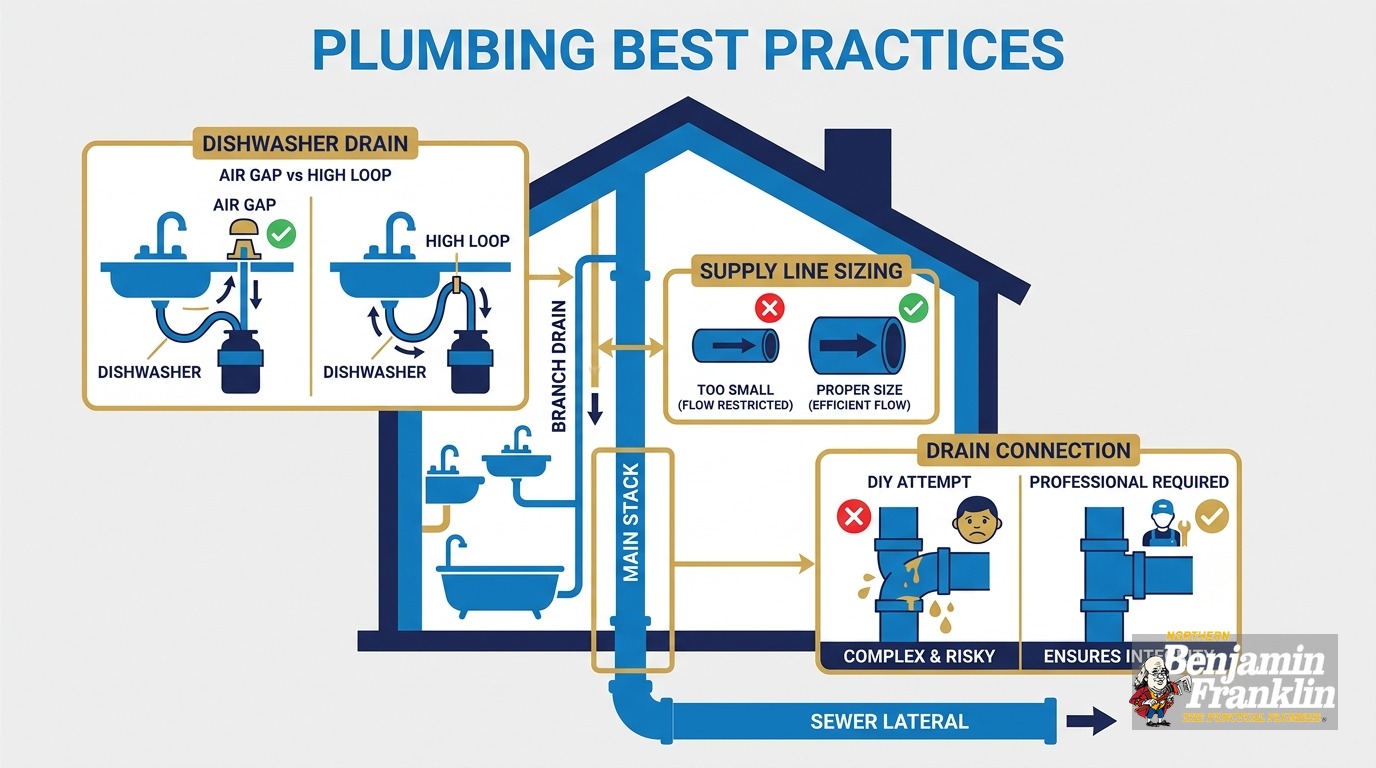
MN Rule 4714.0807 requires a physical backflow barrier between the dishwasher drain and the household drain system. That barrier must be either an approved air gap device or a drain hose run “as high as possible under the countertop, securely fastened.”
The rule amends UPC Section 807.3. Two things in that language matter most.
The first is “securely fastened.” A high loop that loses its bracket, shifts in the cabinet, or was never supported at its apex is not compliant. A sagging high loop is a potential siphon. The code does not say to run the hose up near the countertop. It says to run it as high as possible and fasten it there.
The second is “approved dishwasher air gap fitting.” The flood level marking on that device must sit at or above the flood level of the sink or drainboard. This detail matters when the sink rim is higher than a standard installation.
The foundation for all of this is MN Rule 4714.0602. That rule requires any used water to be discharged through an air-gapped indirect waste or other approved method. The dishwasher drain rule applies that broader requirement to dishwashers specifically.
MN Rule 4714.0603 also requires that backflow prevention devices be approved before installation and tested at the time of installation. An air gap device is a form of backflow prevention. A licensed plumber knows which devices are listed and approved in Minnesota and which are not.
Air Gap or High Loop: Which One Is Right for Your Kitchen?
Both are code-compliant in Minnesota when installed correctly. The air gap creates a physical break in the drain line and does not depend on a fastener staying in place. The high loop depends on correct routing and a bracket that holds its position permanently.
The air gap is a small chrome or stainless fitting that mounts through the sink deck or countertop. The drain hose runs up to the air gap inlet, then from the air gap outlet back down to the disposal or drain connection. The device introduces a physical break in the line. Even if the sink drain backs up completely, the water cannot siphon back into the dishwasher. It is accessible for cleaning when it clogs. The one drawback is that it requires a hole in the countertop.
The high loop threads the drain hose up to the highest possible point under the countertop, where a bracket or clamp holds it in place before routing down to the disposal or drain. Nothing is added to the countertop surface. The risk is that the loop depends entirely on the fastener staying in place and the hose keeping its routing. Under-sink cabinets get used every day. Things get moved around, and a dislodged bracket removes the code compliance.
For most Twin Cities kitchens, the air gap is the more reliable long-term choice. Many older homes in Minneapolis and St. Paul already have an open countertop hole from a removed soap dispenser or filtered-water line. An air gap drops right in. If the countertop is fully occupied and you prefer a clean surface, a high loop is allowed. Fasten it with a proper bracket - not a zip tie to a nearby pipe - and check it periodically to confirm it has not shifted.
If neither option can be installed correctly given the specific cabinet layout, that is a signal to call a plumber. Routing the drain through a cabinet wall or over an obstacle affects the slope and fastening, which affects code compliance.
Why the Garbage Disposal Knockout Plug Creates Problems
This is the detail most DIY installation guides skip. It is also the most common reason a new dishwasher backs up the first time it runs.
The garbage disposal has a dishwasher inlet port on its side. That port ships from the factory with a knockout plug inside it. Removing the outer cap on the inlet does not remove the knockout. The knockout is a separate metal disc inside the body of the disposal. It must be punched out with a screwdriver and hammer, then pulled out through the inlet opening before the drain hose goes on.
If the knockout stays in place and you attach the drain hose, the dishwasher drain has nowhere to go. The water backs up into the hose and into the machine, and sometimes onto the kitchen floor. The fix is straightforward: disconnect the hose, punch out the plug, pull out the disc, and reinstall. But you have to know it is there to look for it.
Beyond the knockout, three things must all be right at this connection: the knockout removed, the hose clamp properly seated on the inlet, and the drain hose routed with a compliant high loop or air gap before it reaches the disposal. Getting all three right inside a crowded under-sink cabinet takes the right tools and some experience.
If your drain connection bypasses the disposal and needs to connect directly to the sink drain line, that typically requires adding a wye fitting to the existing drain. That is not ordinary repair work. It is licensed-plumber work under Minnesota code.
For more on what garbage disposal connections involve, see our garbage disposal installation.
Do You Need a Permit for Dishwasher Drain and Water Line Installation in Minnesota?
Yes, in most cases. MN Rule 1300.0120 requires a permit for any new plumbing installation or alteration. A new dishwasher drain connection and supply line are not ordinary repairs and are not exempt from that requirement.
The rule’s exemption list defines what does not count as an ordinary repair. It explicitly excludes “addition to, alteration of, replacement, or relocation of any water supply, drainage, waste, vent, or similar piping.” A new dishwasher drain connection and a new supply branch both land inside that list.
If your kitchen already has a dedicated dishwasher stub-out in the drain and a branch valve under the sink, the scope of new work is narrower. But if you are adding a drain connection where none existed, running a new supply branch, or modifying the disposal to accept a drain hose for the first time, a permit is required.
The permit process matters beyond compliance. A permitted installation is inspected. An inspector verifies the drain connection, checks the air gap or high loop configuration, and confirms the supply line is properly sized and supported. When you sell your home, that documentation tells the next buyer the work was done correctly by a licensed contractor.
Can the Appliance Delivery Crew Do the Plumbing Work?
Usually not when new connections are required. MN Statute 326B.46 requires a licensed master plumber to be responsible for plumbing work done for hire. Most appliance retailer delivery crews are not licensed plumbers.
Delivery teams are trained to swap out existing appliances where a compliant connection is already in place. They disconnect the old unit, slide in the new one, and connect to a stub-out that is already there. When the project requires modifying the drain line, pulling a permit, or running a new supply branch, that work goes beyond what a delivery crew is licensed to do in Minnesota.
Hiring an unlicensed person for permit-required plumbing work creates real liability. Unpermitted work by an unlicensed person is a coverage problem if water damage later triggers an insurance investigation. The homeowner exception in MN Statute 326B.46 allows you to do plumbing work on your own residence yourself. It does not allow you to hire an unlicensed person to do it for you.
Supply Line Sizing: What You Need to Know for Hard-Water Homes
Dishwashers require a hot-water supply at between 20 and 120 PSI. The line tees off the hot side under the sink. Bob Vila’s installation guide specifies 1/2-inch flexible copper tubing for new installations.
In the Twin Cities, water hardness is a real factor. Minneapolis draws water from the Mississippi River, which is moderately hard. St. Paul Regional Water Services uses groundwater sources with typically higher mineral content. Hard water deposits scale on every surface it flows through regularly. That includes the supply valve under the sink, the water inlet valve on the machine, the heating element inside the tub, and the spray arm nozzles.
Supply line sizing affects how fast flow restriction builds up. A 3/8-inch compression fitting on older supply valves restricts flow more as mineral deposits accumulate. A 1/2-inch braided stainless line handles that buildup better over time. The difference is minor on day one. Over several years in a hard-water home, it becomes a low-flow complaint that is difficult to trace back to the supply valve.
The type of valve also matters. A full-port ball valve opens completely and shuts off cleanly. A needle valve or older compression valve may not fully open, reducing flow from the start. It may also be difficult to close quickly in an emergency.
There is one more angle specific to Minnesota winters. If your kitchen is on an exterior wall with limited insulation, the shutoff valve and the first few inches of supply line can be at risk during extreme cold. A -20°F January night is not when you want to discover that. A plumber installing your dishwasher can check that exposure and add pipe insulation where it is needed.
A worn or partially closed supply valve also creates a longer-term risk. When the valve fails to close fully during a repair, the only fallback is the main water shutoff. In older Twin Cities homes, that main shutoff can be in a utility room, near the water meter, or in a pit near the foundation. A plumber evaluating the dishwasher connection can flag a valve that needs replacement at the same time, before it becomes an emergency.
ENERGY STAR certified dishwashers cost about $50 per year to run. They save approximately 5,800 gallons of water over their lifetime compared to hand-washing. Scale buildup on the heating element cuts into both that efficiency and that lifespan. Addressing the water supply side at installation protects that investment.
For more on how Twin Cities water hardness affects your plumbing and appliances, see our water softeners page.
When Should You Call a Licensed Plumber for Dishwasher Drain and Water Line Installation?
Call a plumber when any new connection is required or when existing connections are not in good shape. The clearest triggers: no existing stub-out, the drain requires modifying the existing line, or the disposal connection is new.
Beyond those three, call us when:
- The supply valve under the sink is old, corroded, or not a full-port ball valve
- The under-sink space is too confined to fasten the drain hose at the required high-loop height
- The drain hose needs to pass through a cabinet wall or around obstacles that affect its slope or routing
- You are replacing both the dishwasher and the garbage disposal at the same time
- You want the permit pulled and the work inspected before the appliance is used
Northern Benjamin Franklin Plumbing is locally owned and operated. We serve Minneapolis, St. Paul, Blaine, Bloomington, Brooklyn Park, Coon Rapids, Maple Grove, and the greater Twin Cities metro. We pull permits when they are required, use approved air gap devices, and leave the under-sink cabinet exactly as it should be.
Our On-Time Guarantee(R) means we arrive in the window you choose. If there is any delay, it’s you we pay - $5 for every minute we are late, up to $300.
Call us at (763) 296-1844 or book online to schedule your installation. We handle the permit, the connections, and the code compliance. Your new dishwasher runs the day it arrives.
Frequently Asked Questions
Do I need a permit to install a dishwasher in Minnesota? +
What is the difference between an air gap and a high loop for a dishwasher drain? +
Can appliance delivery crews do the plumbing work for a new dishwasher installation? +
Need a technician now?