
Cost to Replace a Water Heater with Tankless in Minnesota
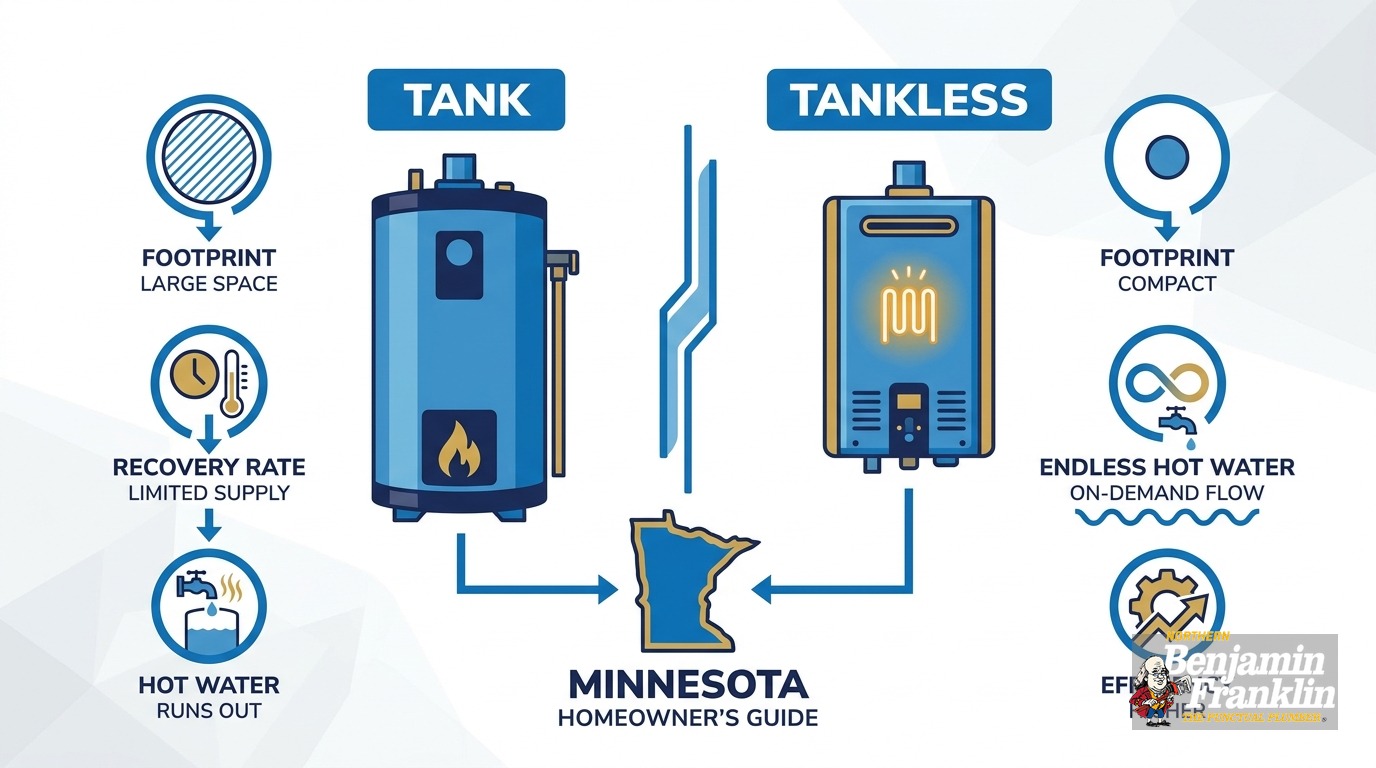
Key Takeaways
- The cost to replace a water heater with tankless in Minnesota runs $2,000-$5,500 for a standard gas conversion nationally, and $5,500-$8,000 when gas line and venting upgrades are needed, per Hot Water Guys.
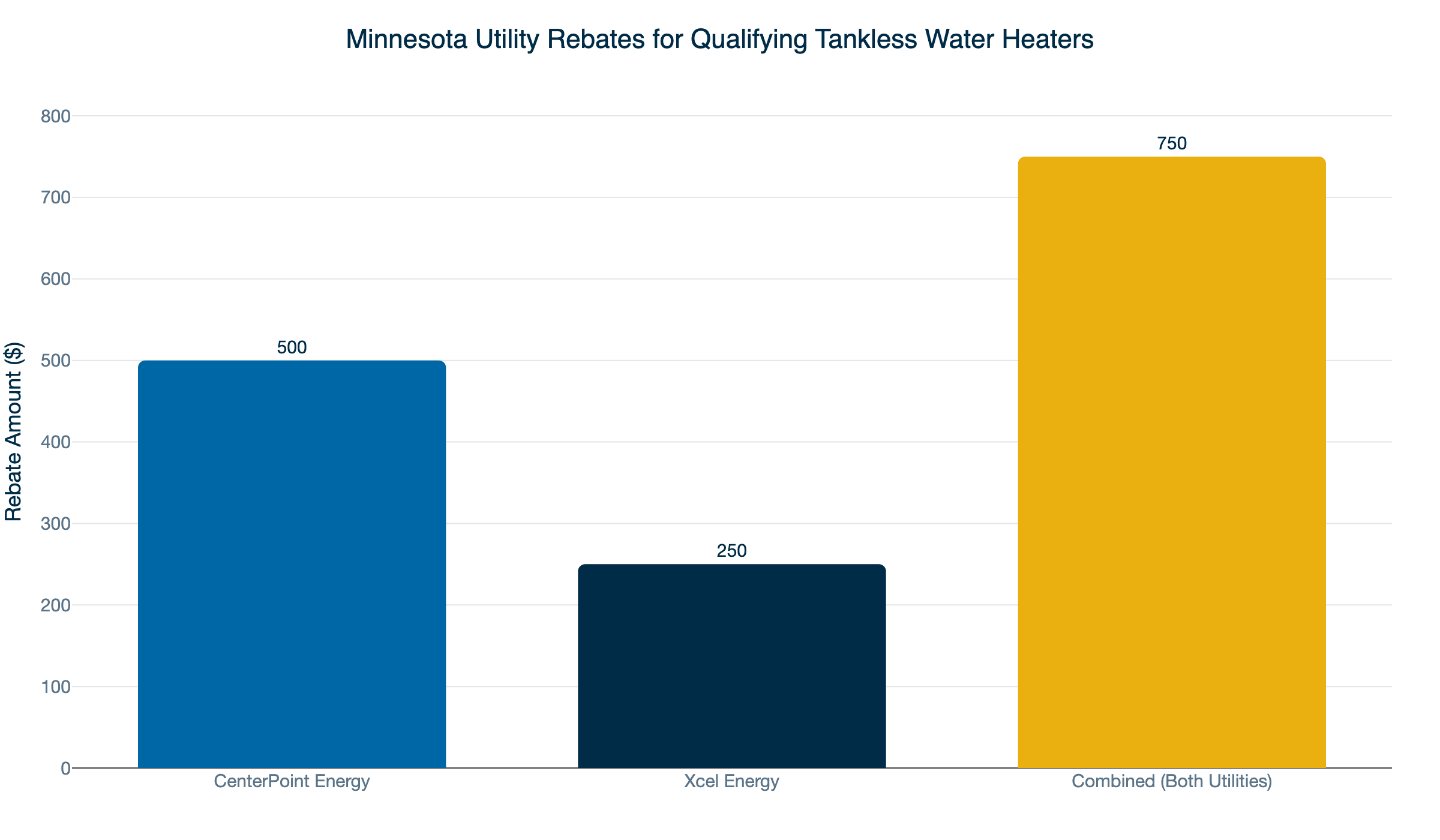
- Minnesota homeowners can stack a CenterPoint Energy rebate ($500) and an Xcel Energy rebate ($250) for up to $750 off installed cost. Both require a UEF rating of 0.87 or higher.
- The federal Section 25C tax credit is terminated for equipment installed on or after January 1, 2026. Units installed by December 31, 2025 still qualify for the 2025 tax return.
- A plumbing permit is always required in Minnesota for a water heater replacement. Gas line work may require a separate gas permit.
- Minnesota groundwater runs 37-40°F in winter. You need to size up versus national spec sheets.
- Minneapolis water averages 5.5 grains per gallon. St. Paul averages 7.6 GPG. Annual descaling or a water softener protects the heat exchanger.
What Does It Cost to Replace a Water Heater with Tankless?
Quick answer: A standard tank-to-tankless gas conversion runs $2,000-$5,500 installed nationally, according to Hot Water Guys. Conversions requiring a gas line upsize and new venting reach $5,500-$8,000. Minnesota-specific permit costs, cold-climate sizing requirements, and older Twin Cities housing stock push totals higher on many jobs.
The wide range comes from four variables: the unit itself, labor, gas line work, and venting. A simple same-location swap lands at the low end. A full conversion in an older Minneapolis home with undersized gas supply and a tight mechanical room lands at the high end.
Here is what each line item typically involves in a retrofit:
The unit. Whole-house gas tankless units vary by BTU rating and by condensing versus non-condensing design. Minnesota homes generally require a higher-BTU unit than national spec sheets suggest. Condensing units cost more upfront. They vent through PVC, which saves on installation.
Labor. A plumber disconnects and removes the old tank, mounts the new unit, connects the water lines, and commissions the system. A simple swap in the same location takes several hours. Jobs that add vent penetrations or extend the gas line take longer.
Gas line work. Most whole-house tankless units need 150,000-199,000 BTUs. The existing 1/2” gas supply line often is not large enough. Upsizing to 3/4” or 1” runs $300-$1,500 depending on run length and wall access, per Tankless Geek. Older Twin Cities homes with original gas supply lines hit this cost regularly.
Venting. Non-condensing units require stainless Category III or IV metal venting at $20-$40 per linear foot, per Remodelcostcalc.com. Condensing units vent through PVC and allow a horizontal wall penetration. When you have flexibility, a condensing model typically reduces venting cost.
Permit and inspection. Budget $50-$200 for the permit fee, per Angi. In Minnesota, this is not optional.
Does Minnesota Require a Permit for a Water Heater Replacement?
Quick answer: Yes, always. Minnesota Rules Chapter 4714 requires a plumbing permit for any water heater replacement. The work must be performed or supervised by a licensed plumber. A separate gas permit under MN Rules Chapter 1346 may be required for any gas line work, including a new appliance connection.
Skipping the permit creates two risks homeowners often underestimate. An unpermitted install can void your homeowners insurance. It can also surface during a home sale and require a retroactive inspection or correction. The permit fee is a small line item compared to either outcome.
When Northern Benjamin Franklin Plumbing handles your install, we pull the permit before the job starts. The inspection record stays with the property, and the documentation protects you at resale.
What Happened to the Federal Tax Credit for Tankless Water Heaters?
Quick answer: The Section 25C Energy Efficient Home Improvement Credit was terminated for equipment placed in service on or after January 1, 2026. The One Big Beautiful Bill Act, signed July 4, 2025, ended it early. Units installed by December 31, 2025 can still be claimed on the 2025 tax return using IRS Form 5695.
This is the update most national articles have not yet made. Before the law changed, the credit covered 30% of qualified costs, up to $600, for a gas tankless unit with a Uniform Energy Factor of 0.95 or higher. That incentive does not apply to a 2026 install.
If you installed a qualifying unit in late 2025 and have not yet filed your taxes, Tankless Geek’s 2026 credit guide has the IRS form reference and full eligibility criteria.
The practical impact for 2026 buyers is that utility rebates are now the primary financial offset. In Minnesota, those rebates are meaningful.
Can Minnesota Homeowners Get Rebates on a Tankless Install?
Quick answer: Yes. CenterPoint Energy offers $500 and Xcel Energy offers $250 on qualifying tankless units. If your home has both utilities, you can stack them for up to $750 off the installed cost. Both programs require a Uniform Energy Factor of 0.87 or higher.
Here is how each program works:
CenterPoint Energy. The rebate is $500 for a qualifying tankless replacement with a UEF of 0.87 or greater. The application deadline is December 31 of the year following installation. Program details are at CenterPoint’s website.
Xcel Energy. The rebate is $250 for a qualifying unit with a UEF of 0.87 or greater, medium or high draw. The contractor submits the application on your behalf. The rebate application is on Xcel’s site.
If your home runs CenterPoint for natural gas and Xcel for electricity, both rebates apply to the same install. That is $750 off the job. Our team submits the Xcel application as part of the install process. Ask about financing options when you schedule.
A note on the UEF rating: the Uniform Energy Factor replaced the older Energy Factor metric in June 2017 under a DOE rulemaking. Energy Star explains the difference if you want to compare spec sheets before choosing a unit. Use UEF when checking rebate eligibility.
For information on financing the remaining balance, see our tankless water heater service page.
Why Does Minnesota’s Cold Water Change the Sizing Math?
Quick answer: Minnesota groundwater runs 37-40°F in winter, per DOE cold-climate research. National spec sheets assume 60-70°F inlet temperatures. A unit rated for 5 GPM at a 35°F temperature rise delivers only about 3.2 GPM at the 55°F rise needed here, per ASPE’s technical analysis. You must size up versus the national recommendation.
This is the gap most national articles skip entirely. When a spec sheet says a unit delivers 5 gallons per minute, that figure assumes a warmer inlet. Minnesota’s groundwater in January is cold enough to cut actual output significantly.
To put a number to it: DOE data documents Minnesota groundwater at around 37°F, compared to 77°F in southern Florida. That 40°F difference is not a rounding error. It is the difference between a unit that meets your peak demand and one that leaves a shower cold when the dishwasher starts.
For a household running a shower and a dishwasher at the same time, undersizing means complaints on the coldest mornings of the year. The right approach is to size based on your home’s actual peak demand and your real inlet temperature. A licensed plumber familiar with Minnesota winters will spec the unit for the right temperature rise, not the national midpoint.
This is also why whole-house electric tankless is rarely the right choice here. Jake the Plumber notes that whole-house electric units often cannot achieve adequate flow at low inlet temperatures, and they frequently require a panel upgrade on top of the install. Gas tankless is the standard choice for whole-house use in Minnesota’s climate. The key is sizing for a 55-60°F temperature rise from a cold-ground inlet.
What Does Hard Water Do to a Tankless Water Heater?
Quick answer: Minneapolis averages 94 mg/L (5.5 grains per gallon) and St. Paul averages 130 mg/L (7.6 GPG). At these levels, mineral scale builds on the heat exchanger fast enough to reduce efficiency and void the manufacturer’s warranty without annual descaling or an upstream softener.
Scale buildup is a slow problem. It reduces efficiency over months and years, and it is easy to miss until the unit underperforms or a service call reveals the buildup. Most manufacturers void the warranty on a heat exchanger that has not been maintained on the recommended schedule.
The standard fix is annual descaling. Our post on tankless water heater descaling and maintenance covers what that process involves and how often it should be done for Twin Cities water hardness levels.
If your home does not already have a whole-house softener, this is a reasonable time to add one. A softener upstream from the unit eliminates scale accumulation at the source and preserves the efficiency gains you paid for. Our water softener service can be bundled with the water heater install. Ask about it when you call.
Build this into your planning from the start. Annual descaling is a small recurring cost. A heat exchanger replacement is not.
Is a Tankless Water Heater Worth It in Minnesota?
Quick answer: For most Twin Cities homes, yes. The efficiency gains, longer lifespan, and utility rebate stack make the math work for homeowners who plan to stay in the home several years. On a complex conversion with significant gas line and venting work, the payback takes longer, but the long-term operating cost advantage holds.
The U.S. Department of Energy reports:
- Homes using 41 gallons per day or less see 24-34% greater water heating efficiency with a tankless unit versus a storage tank.
- High-use homes at around 86 gallons per day see 8-14% improvement.
- Standby heat loss from a storage tank can account for up to 18% of a home’s energy bill.
The lifespan difference matters too. Most tankless units last 20 years or more, compared to 10-15 years for a storage tank. Because parts are replaceable, a well-maintained unit often outlasts two or three tank replacements.
One way to think about the comparison: a tankless unit that costs more upfront but lasts 20 years versus a tank that needs replacement at 12 years changes which option is actually cheaper over time. Add lower monthly energy costs and the rebate offset, and the investment case gets clearer for most households in Minnesota’s older housing stock.
For a full side-by-side comparison across cost, efficiency, lifespan, and space requirements, see our guide on tank vs. tankless water heaters.
Hidden Costs That Raise the Cost to Replace a Water Heater with Tankless
Three line items trip up most budgets. They are hard to spot from the outside and easy to underquote. Get each one addressed before the job starts.
Gas line upgrade. If your home has a 1/2” gas supply line, a whole-house tankless unit will likely require it upsized to 3/4” or 1”. This is a known cost for older Twin Cities homes with original supply lines. Ask your plumber to inspect the gas line before finalizing the quote. A good estimate either includes this cost or explicitly states the existing line is adequate.
Venting change. Moving from a traditional tank with a B-vent flue to a tankless unit usually means a new vent system. The material changes and the exit point on the home may change too. Condensing units use PVC. Non-condensing units need stainless metal venting. This affects both cost and the permit scope. It needs to be in the estimate before anyone starts work.
Descaling plan or softener. If you have hard water and no softener, build ongoing maintenance into your budget from day one. Annual descaling is a few hours of plumber time per year. A whole-house softener is a larger upfront cost but a one-time fix. Skipping both shortens the unit’s life and voids most warranties. Factor it in now rather than after the first heat exchanger problem.
A transparent estimate addresses all three before the job starts. If an estimate does not mention the gas line or venting configuration, ask directly. An honest answer before the job is far better than a line item on the final invoice.
Ready to Schedule Your Tankless Assessment?
The cost to replace a water heater with tankless in your home depends on your peak demand, your inlet temperature, your gas supply line, your vent path, and which rebates apply to your utilities. No national cost range substitutes for a real quote on your specific situation.
Northern Benjamin Franklin Plumbing is locally owned and operated in the Twin Cities. We show up in the window we agree on, every time. That is the On-Time Guarantee(R). If there is any delay, it’s you we pay!
Call (763) 296-1844 or schedule online to set up an assessment. We size the unit for Minnesota’s actual inlet temperature, pull the permit, and submit your Xcel rebate application as part of the install.
If your current tank may be nearing end of life and you want to compare your options first, our guide to tank vs. tankless water heaters is a good place to start.
Frequently Asked Questions
How much does it cost to replace a water heater with tankless in Minnesota? +
Is there still a federal tax credit for a tankless water heater in 2026? +
Do I need a permit to replace a water heater in Minnesota? +
Why do Minnesota homeowners need a bigger tankless unit than national specs show? +
Need a technician now?