
Tankless Water Heater Maintenance for Twin Cities Homes
Key Takeaways
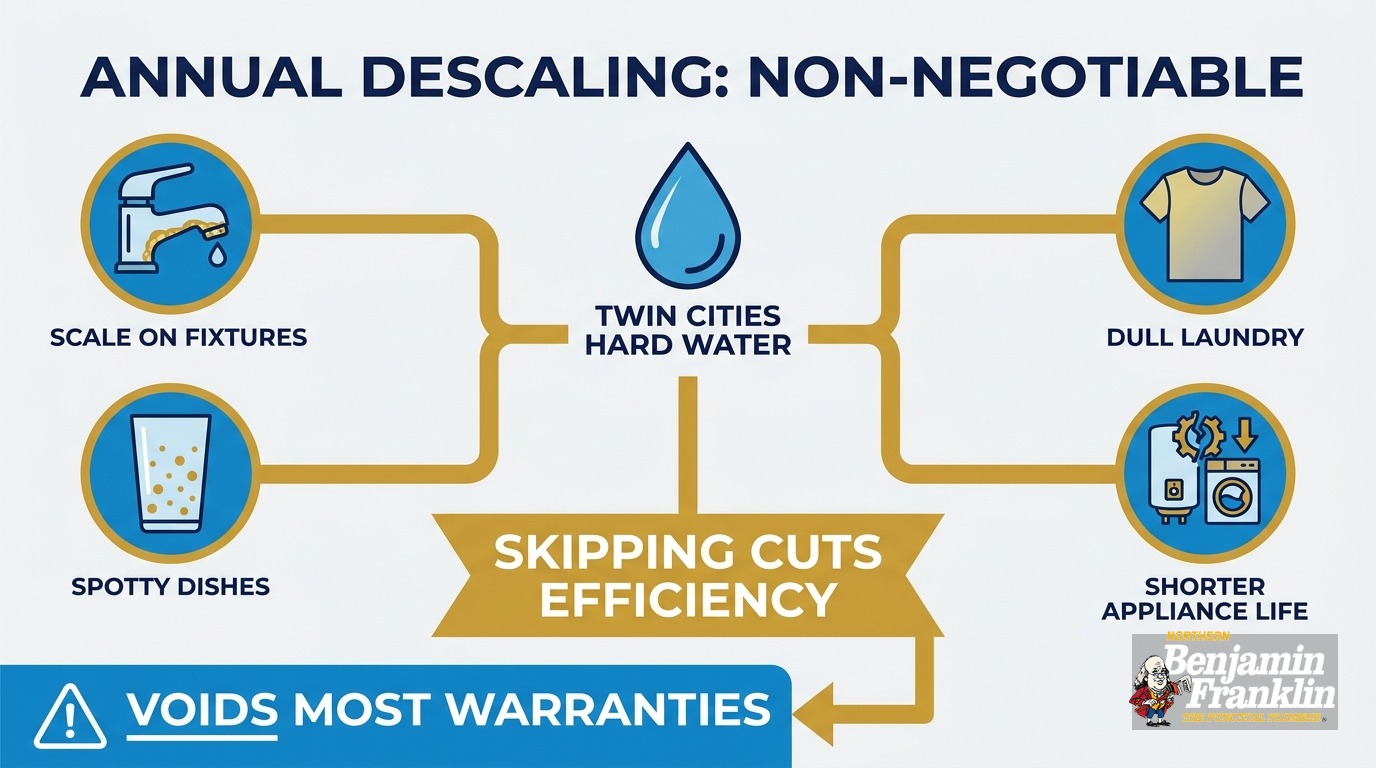
- Most Twin Cities suburbs have water hardness between 15 and 32 GPG. Manufacturers cite 7-12 GPG as the range where warranty exposure begins. Annual descaling is mandatory, not optional.
- Minneapolis city water sits at about 5.5 GPG but has a pH near 9.0 that drives scale formation independent of hardness. A low hardness reading does not mean the service is optional.
- A service record matters as much as the service itself. A heat exchanger warranty claim without documented annual maintenance is likely to be denied.
- Minnesota requires a licensed plumber for water heater work. DIY descaling that causes damage can leave a homeowner with no warranty and no insurance coverage.
- Schedule service once a year. Consistency and a filed invoice are what protect a unit’s full rated lifespan.
What Is Tankless Water Heater Maintenance?
Annual tankless water heater maintenance means descaling the heat exchanger, cleaning the inlet filter screen, inspecting the condensate line, and checking the venting. The service typically takes one to two hours. The dated service record from that visit is what keeps a manufacturer warranty claim alive if you ever need it.
The heat exchanger is the core of a tankless unit. Cold water flows through narrow channels while a burner or heating element brings it to temperature on demand. Scale - the hard mineral deposit left behind when hard water is heated - builds on those channel walls over each heating cycle. A thin layer reduces heat transfer. A thick one forces the unit to run harder, throws error codes, and causes premature failure.
Most Twin Cities homeowners have heard that a tankless unit needs to be flushed once a year. The number is right. But in this metro, where water hardness in most suburbs runs 2-4 times the level at which manufacturers explicitly cite warranty exposure, the reasoning behind that number matters more than the calendar reminder.
How Hard Is the Water in the Twin Cities?
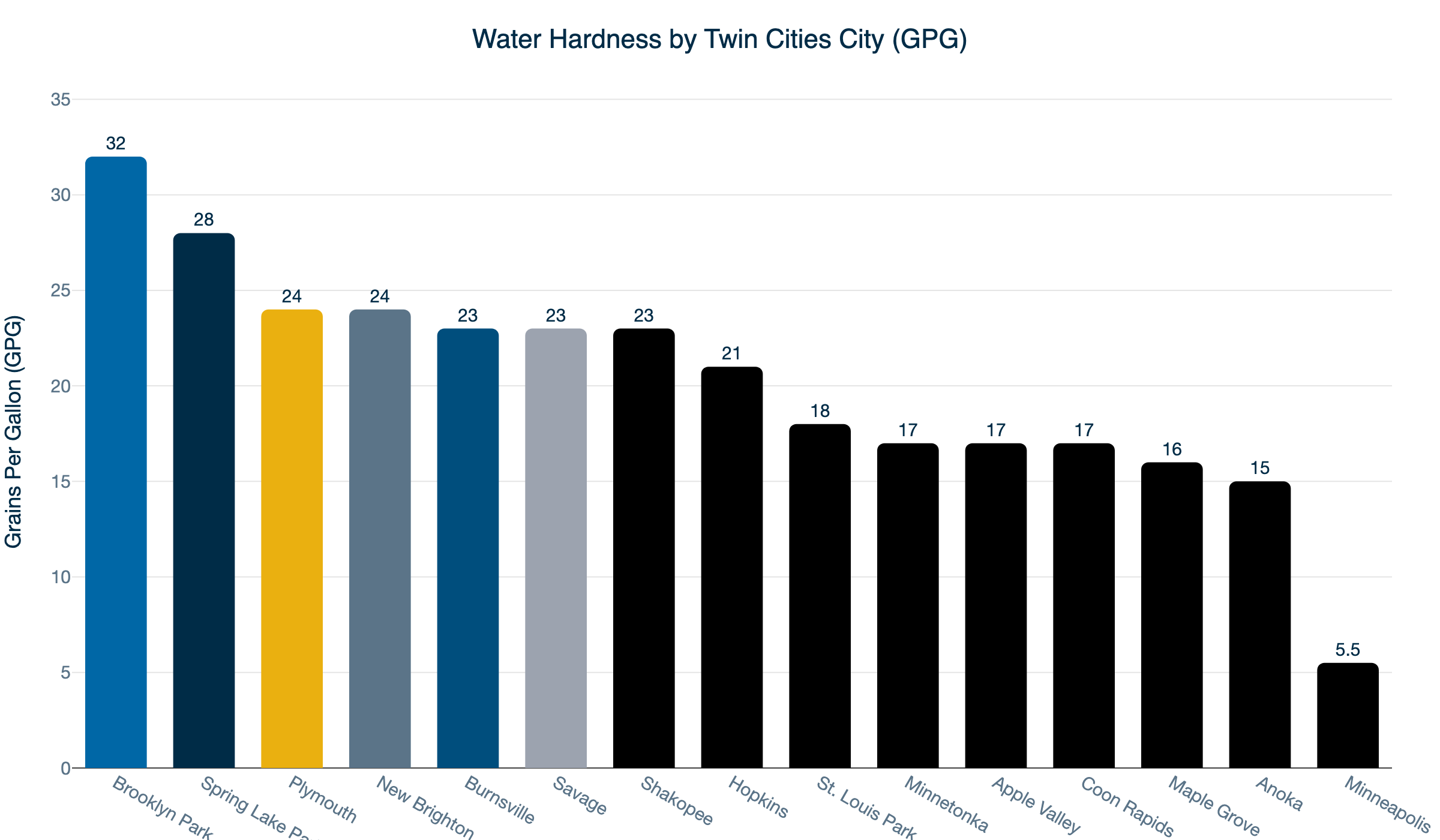
Hard. Most Twin Cities suburbs draw groundwater that tests between 15 and 32 GPG - 2-4 times the threshold at which manufacturers explicitly cite warranty exposure. Minneapolis built large-scale hardness removal at its treatment plants. Most of the suburbs surrounding it have not.
According to Bethel Plumbing’s city-by-city hardness data, here is where the metro lands:
- Brooklyn Park: 32 GPG
- Spring Lake Park: 28 GPG
- Plymouth: 24 GPG
- New Brighton: 24 GPG
- Burnsville: 22-25 GPG
- Savage: 23 GPG
- Shakopee: 23 GPG
- Hopkins: 21 GPG
- St. Louis Park: 18 GPG
- Coon Rapids: 16-18 GPG
- Maple Grove: 16 GPG
- Apple Valley: 17 GPG
- Minnetonka: 17 GPG
- Anoka: 15 GPG
The EPA WaterSense water softener guide (May 2026) identifies 7 GPG as the point where softening begins to benefit a home, and 10 GPG as where it is recommended. Brooklyn Park at 32 GPG is more than four times that upper threshold.
Robbinsdale offers a useful reference point. The Minnesota Department of Health documented that Robbinsdale’s raw groundwater measured 24 GPG before the city built a central softening plant. Finished water dropped to 5 GPG. That investment was made because 24 GPG hardness is genuinely damaging to appliances, fixtures, and water heaters.
If your home does not have a whole-house water softener and you are in any of the suburbs listed above, your tankless unit is processing water at hardness levels that manufacturers built maintenance requirements around. Annual descaling is the minimum service that keeps pace with that rate of scale formation.
Why Minneapolis City Water Is a Special Case
Minneapolis is an outlier in the metro. The 2025 city water plant analysis puts finished water hardness at 94 mg/L, roughly 5.5 GPG. According to Minneapolis Water Treatment and Distribution Services, the city removes approximately 65,000 pounds of hardness per day before water reaches home taps. By hardness alone, Minneapolis city water is soft.
But hardness is not the whole story.
Minneapolis city water has a pH near 9.0. At that alkalinity, calcium carbonate can precipitate and deposit on heated metal surfaces even when the water would be classified as soft by hardness standards. The mechanism is different from a suburb running 24-32 GPG, but the result is the same: scale forms inside a heat exchanger with each heating cycle.
A Minneapolis homeowner who checks the city water report, sees a low hardness number, and concludes annual maintenance is optional is working from incomplete information. The pH chemistry still warrants annual service and a dated service record.
Does Hard Water Void a Tankless Water Heater Warranty?
It can. Most manufacturers specify a hardness threshold - typically 7-12 GPG - and list annual descaling as a required maintenance item. A heat exchanger claim in a suburb with 24-32 GPG water, with no service record, is a warranty claim that is likely to be denied.
According to SureWay Comfort’s breakdown of tankless warranty terms, most manufacturers require water hardness below 7 GPG and state that exceeding 12 GPG can void the warranty. Annual flushing and descaling are listed as mandatory maintenance items. A claim filed without proof of service may be denied regardless of the apparent cause of failure.
Navien’s maintenance documentation makes this explicit: descaling and flushing are required items under warranty terms, not optional. Rinnai and Noritz carry similar language in their own warranty terms.
The math that matters: a tankless unit is rated for roughly 20 years. In Brooklyn Park at 32 GPG, you are running water through that unit at more than four times the hardness threshold manufacturers cite for warranty exposure. Scale accumulates with every heating cycle. Annual descaling does not just preserve efficiency. It is the documented proof that you maintained the unit as required - proof a warranty claim depends on.
What Happens When You Skip Annual Descaling?
The unit loses efficiency first, then lifespan, then warranty protection. Industry and manufacturer sources indicate that skipping annual service can reduce efficiency by more than 30% and shorten a rated 20-year lifespan to 8-10 years. The failure sequence from there is predictable.
The cascade:
- Error codes appear. Most units display diagnostic codes when the heat exchanger operates outside normal parameters. Scale buildup is one of the most common triggers for codes in the 10s and 20s ranges across major brands.
- Hot water delivery becomes inconsistent. The unit fires and cuts out under simultaneous demand from multiple fixtures.
- The pressure relief valve trips more frequently - an early sign that internal pressure is spiking due to restricted flow through the exchanger.
- The heat exchanger fails. This is the expensive repair. It is the core component of the unit, and without a service record, a warranty claim on it is likely to be denied.
In a suburb like Brooklyn Park or Spring Lake Park, where water hardness is 3-4 times the manufacturer threshold, these outcomes move from possible to probable on a consistent timeline. Annual descaling is not cautious maintenance. It is the minimum service the unit requires to reach its rated life.
For more on how hard water affects different types of water heaters, the post on anode rods and hard water covers how tank-style units handle the same chemistry.
What Does a Tankless Water Heater Maintenance Service Include?
A full annual service covers several components, not just the heat exchanger flush. The descaling protects the most expensive part, but the other components matter too, and skipping any of them leaves the unit only partially checked.
Descaling the heat exchanger. A pump circulates a diluted food-grade acid solution through the heat exchanger for 45-60 minutes. The acid dissolves calcium and mineral deposits that have built up since the last service. The unit is flushed clean before the system is reconnected.
Cleaning the inlet filter screen. Most tankless units have a small screen on the cold-water inlet. Sediment collects here and reduces flow to the unit. A clogged screen triggers pressure fluctuations and error codes that look like larger problems than they are.
Inspecting the condensate line. Condensing tankless units produce acidic condensate as a byproduct of combustion. The drain line can collect debris over time. A blocked condensate line can shut the unit down.
Checking the venting. Direct-vent and power-vent units draw combustion air and exhaust through PVC or stainless piping. Gaps, loose fittings, or blockages are safety issues. Annual service is the right time to inspect the full vent run.
Recording the service. Date, technician, scope of work. This is the record you present if a warranty question comes up three or five years from now. A verbal history is not documentation.
Our water heater maintenance page has details on scheduling a service visit.
Can I Do Tankless Water Heater Maintenance Myself in Minnesota?
Straightforward descaling is a maintenance task and does not automatically require a permit under Minnesota law. But if DIY work damages the unit, the repair likely requires a licensed plumber and a permit, and the manufacturer may deny the warranty claim. That is the risk most national guides do not mention.
Minnesota Rules Chapter 4714, the state plumbing code, requires a permit and a licensed plumber for water heater replacement or installation. Gas connections fall under a separate gas permit requirement. A homeowner descaling without touching the gas line or main water connections is performing maintenance and does not trigger the installation permit requirement.
The problem is the boundary case. If descaling damages a component - a fitting that cracks under pressure, a valve that does not reseat after being disconnected - the repair that follows is installation-level work. The manufacturer will know the unit was serviced without a licensed contractor and may deny a warranty claim on the damaged part.
Skipping permits on any qualifying repair work can also void homeowners insurance coverage and create title and resale complications when you sell.
The cleaner path is annual service from a licensed plumber from the start. The service record is in the name of a licensed contractor. The warranty stays intact.
How Does a Water Softener Change the Equation?
A working whole-house softener significantly reduces scale load on the heat exchanger. In Brooklyn Park at 32 GPG, a properly maintained softener can bring incoming water near 0 GPG. At that level, scale formation slows substantially and annual descaling becomes lighter work.
Two caveats apply. First, the softener itself has to be maintained. A depleted resin bed passes hard water as if the softener is not there. If regeneration is not running on schedule and salt levels are not being checked, you may have protection on paper that you do not actually have.
Second, a water softener does not address pH. If you are on Minneapolis city water with a softener, the hardness is low - but a pH near 9.0 still warrants an annual service and a service record.
For more on water treatment options for Twin Cities homes, our water softener service page has details on sizing and what to expect from installation.
If you are on well water in the outer metro, the post on iron and manganese in well water is worth reading. Both minerals accelerate scale formation and can damage heat exchangers faster than calcium alone.
When Should You Schedule Tankless Water Heater Maintenance?
Once a year. Fall and spring both work in Minnesota - fall puts the unit in peak condition before winter demand spikes, spring clears winter scale before it can harden further. Consistency and a filed invoice are what matter, not the specific month.
What matters most is that the service happens on a consistent annual cycle and that the invoice is stored somewhere you can find it if a warranty question comes up years later.
If you moved into a home with an existing tankless unit and have no service records, start now. A technician can assess the current scale load, descale the unit, and set a schedule going forward. The service record begins with the first visit.
Signs Your Tankless Unit Needs Service Now
These symptoms do not mean the unit is failing. They mean it needs attention before the problem gets worse.
- Hot water temperature is inconsistent: starts hot and drops, or fluctuates under simultaneous demand from multiple fixtures.
- Error codes are appearing. Codes in the 10s and 20s ranges on most brands often point to flow, heat exchanger, or ignition conditions linked to scale.
- The unit runs longer than it used to for the same output temperature. This often shows up as a higher gas bill before it registers as a performance change.
- The sound during firing has shifted. Scale buildup changes the acoustic signature of the heat exchanger.
- It has been more than 12 months since the last service and you are in a suburb with water hardness above 12 GPG.
If you are seeing any of these signs, call before the unit throws a fault that shuts it down completely. A unit in good condition is far easier and less expensive to service than one that has gone several years without attention.
Schedule Tankless Water Heater Maintenance in the Twin Cities
Northern Benjamin Franklin Plumbing is locally owned and operated in the Twin Cities. We serve Minneapolis, St. Paul, Blaine, Bloomington, Brooklyn Park, Coon Rapids, Maple Grove, and the rest of the metro.
Every appointment is backed by the On-Time Guarantee(R). If there is any delay, it’s you we pay! We arrive in the window you choose, or we pay you $5 for every minute we are late, up to $300. That is backed by a 100% satisfaction guarantee.
For a tankless unit in Brooklyn Park, Plymouth, or Spring Lake Park, annual descaling is not optional. It is the documented proof that a future warranty claim depends on - and the difference between a 20-year appliance and one that wears out in half that time.
Call (763) 296-1844 or book a service visit online. If your project includes a water treatment upgrade alongside your water heater service, ask about financing options when you call.
Frequently Asked Questions
How often should I schedule tankless water heater maintenance in Minnesota? +
Does skipping descaling void my tankless water heater warranty? +
Can I descale my tankless water heater myself in Minnesota? +
How hard is the water in Minneapolis compared to the suburbs? +
Need a technician now?