
Heat Pump Water Heater for Minnesota Basements: Worth It?
Key Takeaways
- A heat pump water heater is 2-3x more energy-efficient than a standard electric model, per the U.S. Department of Energy.
- Twin Cities unfinished basements hold 50-55°F year-round, keeping the unit inside its 40-90°F operating window all winter.
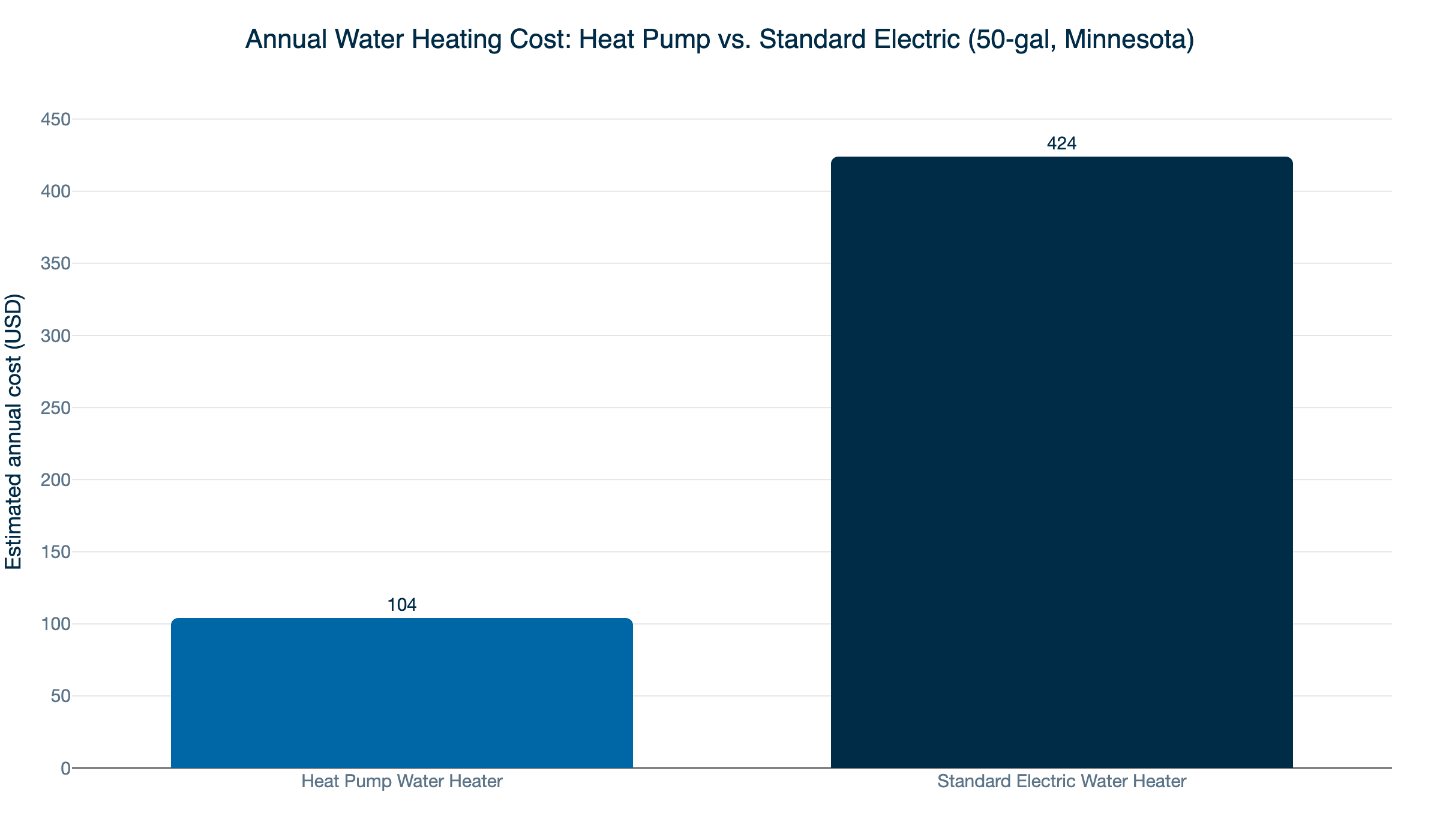
- Estimated annual operating cost: roughly $104 for a heat pump water heater versus roughly $424 for a standard electric model at Minnesota electricity rates, according to Structure Tech.
- The federal Section 25C tax credit expired December 31, 2025. It does not apply to 2026 installations.
- Xcel Energy customers can capture a $400-$500 rebate this year. Minnesota’s state HEAR/HOMES program has not launched.
- Every water heater replacement in Minnesota requires a plumbing permit and a licensed plumber under Minnesota Rules Chapter 4714. There is no like-for-like exemption.
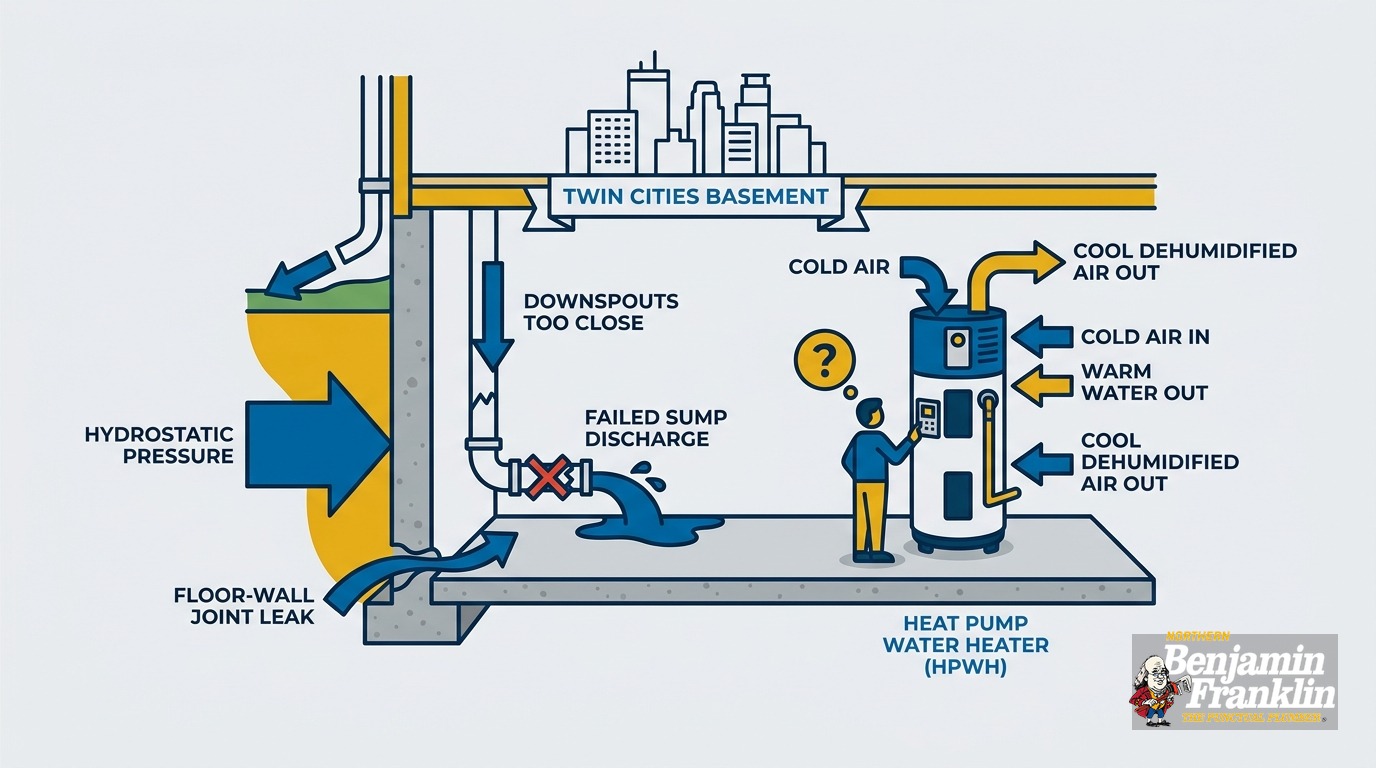
- The unit needs at least 450-700 cubic feet of surrounding air space and a floor drain or condensate line for water removal.
What Is a Heat Pump Water Heater?
A heat pump water heater does not create heat the way a conventional electric tank does. It moves heat. The unit pulls warmth from the surrounding air and transfers it into the water tank, using the same physics a refrigerator applies in reverse.
Most integrated units operate in three modes. Heat-pump-only mode is the most efficient option and the one the unit defaults to. Electric resistance mode is faster for high-demand recovery. Hybrid mode blends both depending on demand. In a typical household, the unit runs in heat-pump mode the vast majority of the time.
Because it moves heat rather than generates it, a heat pump water heater uses a fraction of the electricity a standard electric tank requires. The U.S. Department of Energy’s FEMP program reports these units are 2-3x more efficient than conventional electric resistance water heaters.
There is also a secondary effect worth knowing about. As the unit pulls heat from the surrounding air, it removes moisture from that air at the same time. In a Minnesota basement in July, that free dehumidification matters.
The question most Twin Cities homeowners ask first is a fair one: does this technology actually work when your outdoor temperature is -10°F? The answer is yes, and the reason is worth understanding.
Do Minnesota Basements Stay Warm Enough?
The short answer: Yes. Twin Cities unfinished basements hold 50-55°F year-round, well inside the 40-90°F range where a heat pump water heater operates efficiently.
The earth is a thermal buffer. At a depth of 8-10 feet, Minnesota ground temperature stays around 45-50°F even in the middle of January. Your unfinished basement floor and walls absorb that stability. The air in an unfinished basement stays far warmer than the outdoor temperatures and far cooler than the living floors above it, through all four seasons.
The U.S. Department of Energy notes that in cold ambient temperatures, these units fall back to electric resistance mode and lose most of their efficiency advantage. A typical Twin Cities unfinished basement never drops to 40°F.
That is the single strongest argument for this upgrade in Minnesota. The region’s winters look like a problem on the surface. They are not. Your basement’s ambient temperature is what feeds the heat pump, and the ground keeps it comfortably in the operating range all year.
If your basement is fully finished and located on a slab with no earth contact, the answer is different. Have a plumber measure the winter temperature before assuming.
How Much Can You Save on Energy Costs?
The short answer: Switching from a standard electric water heater to a heat pump model can cut your water heating bill by roughly 75% at Minnesota electricity rates.
Structure Tech puts the estimated annual operating cost at roughly $104 for a 50-gallon heat pump water heater, compared to roughly $424 per year for a standard electric tank. That is a difference of about $320 annually, using Minnesota electricity rates.
Over ten years, that gap is more than $3,000, before incentives. Even before factoring in a rebate, the energy math makes a strong case on its own.
If you are currently on natural gas, the comparison is more nuanced. Minnesota natural gas rates are competitive, and switching fuels as part of this upgrade is not automatically a win on operating cost. Whether the math works in your favor depends on your current usage, your utility rates, and how efficiently your gas unit was running. Run both numbers before committing to a fuel switch.
For households already on electric water heating, the payback case is clear. A $320 annual savings against an installed cost difference puts most projects in the 5-8 year payback range on energy alone, and the Xcel rebate shortens that further.
Our post on water heater replacement costs for Twin Cities homeowners walks through what to expect on total installed cost.
What Incentives Are Available in 2026?
The short answer: Xcel Energy customers can get $400-$500. The $2,000 federal tax credit expired at the end of 2025 and is not available for this year’s installs.
Here is the current picture.
Federal Section 25C tax credit: This credit covered 30% of installed cost up to $2,000. It expired December 31, 2025. As Furnace Direct notes, the credit does not apply to 2026 installations. Any content still advertising a $2,000 federal incentive has not been updated. Do not budget for it.
Xcel Energy rebate: Xcel Energy customers in Minnesota may qualify for a rebate on an ENERGY STAR-certified heat pump water heater. That increases to $500 with Demand Management enrollment. Customers who completed qualifying insulation or air sealing work within the previous two years may also be eligible for a bonus of up to $600, per the Xcel Energy MN Residential Rebate sheet. Confirm your eligibility directly with Xcel before purchasing.
Minnesota state HEAR/HOMES program: This state rebate program has not yet launched, according to mn.gov Commerce. No timeline is published. Do not factor it into your current purchase decision.
Other utilities: If you are served by a Minnesota utility other than Xcel, contact them directly. Programs and rebate amounts vary.
The realistic incentive for most Twin Cities homeowners right now is $400-$500 from Xcel. That is worthwhile, but a fraction of what older articles still claim. Verify before you buy.
What Does Installation Require?
A heat pump water heater is more demanding to site than a standard tank. Four things need to line up before you select a model.
Air volume: Standard integrated units need 450-700 cubic feet of surrounding air space, per the ENERGY STAR Heat Pump Water Heater FAQ. Some manufacturer specs go up to 1,000 square feet. A 10x10x8 room gives you 800 cubic feet and qualifies. A cramped utility closet with a closed door does not. The unit needs to draw air freely to operate in heat-pump mode.
Ceiling height: Heat pump water heaters are taller than standard tanks, often by 12-18 inches. If your basement ceiling is low, measure the available height before selecting a unit.
Electrical: Most models require a dedicated 240V/30A circuit. Some 120V/15A models exist, but these carry lower efficiency ratings. Check your panel before picking a unit. If you are near capacity, factor in the cost of an electrical upgrade.
Drainage: The unit extracts moisture from the air as it runs. That condensate has to go somewhere. You need a floor drain, a laundry tub, or a condensate pump nearby. Most Minnesota basements have a floor drain already. If yours has been backing up or has not been used in years, have it checked before you rely on it for daily condensate from a new appliance.
Water connections: Most units use standard 3/4-inch supply and discharge connections. A plumber can assess whether your existing lines work or need adjustment.
Does the Winter Heating Penalty Cancel the Savings?
The short answer: No. The energy math still favors the heat pump water heater, even after accounting for the extra furnace load.
Here is the dynamic. The unit pulls heat from your basement air to warm the tank. In winter, that slightly cools the basement, which means your furnace may run a few more minutes per day to compensate. That is a real cost increase on your heating bill. It is not zero.
But the efficiency gain on the water heating side is large. Cutting your water heating electricity by roughly 75% is a meaningful number. The marginal furnace cost is much smaller, particularly in a basement that is not airtight.
In summer, the equation swings in your favor. The ENERGY STAR FAQ reports that a heat pump water heater in heat-pump-only mode delivers 2,500-5,000 BTU per hour of cooling to the surrounding space. That is free dehumidification and cooling for your basement on humid Minnesota days, with no additional equipment.
Across a full Minnesota year, the summer cooling dividend offsets the winter heating penalty. The dominant number remains the water heating savings.
Do You Need a Permit in Minnesota?
The short answer: Yes, always. Minnesota has no exemption for like-for-like water heater swaps, even for an identical replacement.
Minnesota plumbing rules require a permit for any water heater replacement. The work must be performed by a licensed plumber. This applies regardless of what type you are installing: gas-to-gas, electric-to-electric, or a new heat pump model going in where a tank once sat.
The Minnesota Plumbing Code also requires a drain pan under any water heater installed above the basement floor. The pan must be at least 1.5 inches deep, with a 3/4-inch drain line.
If you are converting from a gas water heater to a heat pump model, the gas line must be properly capped and inspected. That work falls under a separate gas permit under Minnesota Rules Chapter 1346. Our post on gas line safety and permits in Minnesota covers what that process involves.
Permits are not just paperwork. An inspected installation is documented. When you sell your home, a buyer’s inspector will ask whether the work was permitted. A licensed plumber handles the permit application as a standard part of the job. If a contractor suggests skipping it, that is your cue to call someone else.
What Does the Installation Process Look Like?
The job runs one to three days from permit to running hot water, depending on how quickly your local jurisdiction processes the application.
Assessment first. The plumber measures the space, confirms air volume clearances, checks the electrical panel, and looks at drainage options. If anything falls short, you know before the unit is purchased.
Permit application. The plumber applies for the plumbing permit before any work starts. Some jurisdictions process same-day. Others take a couple of days.
Removal. The old unit is drained and disconnected. If it is a gas water heater, the gas line is properly capped.
Installation. The heat pump water heater is positioned in a spot with adequate air volume. The plumber connects supply and discharge lines, installs or confirms the drain pan, runs the condensate line to a floor drain or pump, and makes the electrical connection.
Inspection. A local inspector verifies that the installation meets code. This is a normal step for permitted work and takes under an hour in most cases.
Startup. The plumber confirms the unit fills correctly, heats to the set temperature, and drains condensate without issues before closing out the job.
If you are on gas now and want a full picture of what a fuel-switching replacement costs, our post on gas water heater replacement costs in Minnesota covers the variables that shape the final number.
Is a Heat Pump Water Heater Right for Your Home?
This upgrade makes the most sense when several conditions line up together.
Good fit:
- You have an existing electric water heater and want to cut operating costs
- Your basement has at least 450-700 cubic feet of open space around the planned location
- A floor drain, laundry tub, or condensate pump is accessible nearby
- Your electrical panel can support a dedicated 240V/30A circuit
- You are an Xcel Energy customer and want to capture the $400-$500 rebate
Worth pausing on:
- You are currently on natural gas and your local rates make the fuel-switch savings a wash
- Your utility space is too small for the unit’s air volume requirement
- Your basement is a finished addition with little ground contact and runs cold in winter
- You need very fast hot water recovery and are not prepared for the heat pump cycle time
If you are unsure which category applies to your home, the right first step is an on-site conversation with a licensed plumber. Measurements take 15 minutes. They answer the question without guessing.
Ready to Talk About a Heat Pump Water Heater?
This is one of the higher-return water heater upgrades available to Twin Cities homeowners right now, especially for households replacing an aging electric tank. The cold-climate concerns that seem like a problem for Minnesota homes are largely solved by the earth. Your basement holds a temperature that keeps the unit in efficient heat-pump mode all year long.
The federal credit is gone. The Xcel rebate is real and worth capturing now. The permit is required. The job needs a licensed plumber.
Northern Benjamin Franklin Plumbing is locally owned and operated in the Twin Cities. We handle water heater installations, permit applications, and everything in between. Our On-Time Guarantee(R) means we show up in the window you pick, or we pay you $5 for every minute we are late, up to $300. If there is any delay, it’s you we pay!
Call us at (763) 296-1844 or book an estimate online.
Frequently Asked Questions
Does a heat pump water heater work in a Minnesota basement in winter? +
What rebates are available for heat pump water heaters in Minnesota in 2026? +
Do I need a permit to install a heat pump water heater in Minnesota? +
Need a technician now?