
Water Heater Replacement Cost in the Twin Cities
Key Takeaways
- Water heater replacement cost in the Twin Cities ranges from roughly $900 for a basic tank swap to $10,000 or more for a full tankless conversion with gas-line and venting upgrades.
- CenterPoint Energy offers $250 to $1,000 on qualifying replacements. Xcel Energy offers $75 to $500. A qualifying heat pump water heater also earns a 30% federal tax credit, up to $2,000 per year through 2032.
- Minnesota requires a plumbing permit for every water heater replacement. Gas units typically need a second gas permit. Permit fees run $50 to $150 each in the Twin Cities metro.
- Minneapolis and Saint Paul tap water runs 4 to 6 grains per gallon after municipal softening. That is moderate hardness. Suburban homes drawing from harder groundwater accumulate sediment faster and may see shorter heater life.
- Heat pump water heaters cost $104 to $160 per year to run. Payback against a standard electric unit runs 3 to 6 years when rebates are included.
- Northern Benjamin Franklin Plumbing is locally owned and operated in the Twin Cities. Call (763) 296-1844 or book online for a quote.
What Does Water Heater Replacement Cost in the Twin Cities?
For most Twin Cities homeowners, water heater replacement cost runs $900 to $4,000 or more for a standard tank unit, fully installed. The exact number depends on unit type, labor, permit fees, and whether gas-line or venting work is needed.
Two pricing ranges appear consistently in local contractor data. One Twin Cities plumbing contractor publishes a standard tank swap price range. Labor runs $150 to $400, and permits add $50 to $150 on top. A separate local contractor’s published pricing reflects the cost of tank installation in the Twin Cities market. Complex jobs at that company reach $4,000 or more. For a national planning range, one cost guide puts a 50-gallon gas tank at $2,900 to $5,050 installed.
The spread between those numbers is real and explainable. A direct swap - same fuel type, same location, no code corrections - lands at the low end. Add a larger gas line, new venting, or a difficult access situation and the number climbs. A unit with corrosion around fittings or mineral scale at connections signals a job that may take more time.
Understanding that spread matters before you call for a quote. Ask the plumber to walk through each line item so you know what you are paying for.
These are third-party ranges from named sources. Your actual quote will reflect your home.
What Does a Tankless Installation Cost in Minnesota?
Tankless water heater installation typically runs $1,800 to $3,500 for a basic swap of an existing unit. A first-time conversion from tank to tankless can reach $6,000 to $10,000 or more once gas-line and venting upgrades are included. The heater itself is often not the most expensive line item.
One Twin Cities contractor’s published data covers what tankless installs cost in this market. With full gas-line and venting work, that contractor reports costs reaching $10,000 or more. Another contractor publishes a price range for unit and labor, before any infrastructure changes.
Why such a wide spread? Tankless water heaters demand more gas flow than tank units. Many older Twin Cities homes, especially those built before 1980, have half-inch gas supply lines running to the water heater location. Most high-efficiency condensing tankless units need three-quarter-inch lines to maintain full output. Upgrading the gas line adds cost. So does installing the Category III stainless steel venting that most condensing units require.
If you are replacing an existing tankless unit with the same type, the infrastructure is likely already in place. If you are converting from a tank for the first time, budget for gas-line and venting work before you commit. Get a quote on the full scope, not just the heater.
On performance: tankless units heat water on demand and never run out. For larger households with overlapping hot water use, that matters. Our post on tank versus tankless water heaters covers the performance trade-offs in detail.
Is a Heat Pump Water Heater Worth the Higher Upfront Cost?
Heat pump water heaters cost more upfront but run at $104 to $160 per year in energy costs. ENERGY STAR estimates annual savings of roughly $550 compared to a standard electric unit, and lifetime savings of about $1,800. With available rebates, payback against standard electric runs 3 to 6 years. The key Minnesota constraint is ambient temperature: sustained heat above 40 degrees F is required for efficient operation.
Heat pump water heaters pull warmth from surrounding air rather than generating it directly. That makes them 3 to 4 times more efficient than standard electric and gas models, according to ENERGY STAR. Their UEF ratings run 3.3 to 4.0, versus 0.9 for a standard electric tank or 0.6 to 0.9 for gas.
The Department of Energy estimates average lifetime savings of roughly $1,800 when replacing a traditional electric resistance unit with a heat pump model. ENERGY STAR puts the payback period at 3 to 6 years against standard electric. Annual fuel cost for an HPWH runs much lower, versus several hundred dollars for a standard gas or electric tank.
The Minnesota install constraint:
The EPA recommends a minimum of 700 cubic feet of surrounding air and sustained ambient temperatures above 40 degrees F. In Minnesota, that rules out unheated garages and any basement space that dips below that threshold in winter. A well-insulated basement utility room that stays above 40 degrees year-round is a strong candidate.
Today’s cold-climate HPWHs have improved substantially. ENERGY STAR notes they “have proven to be highly efficient and effective, even in cold climates.” The 40-degree floor is a site constraint to verify, not a reason to dismiss the option. An in-home assessment will confirm whether your utility space qualifies.
If the upfront cost is a barrier, ask about financing when you call. The rebate section below shows how to stack incentives and close part of that gap.
What Rebates Are Available for Twin Cities Homeowners?
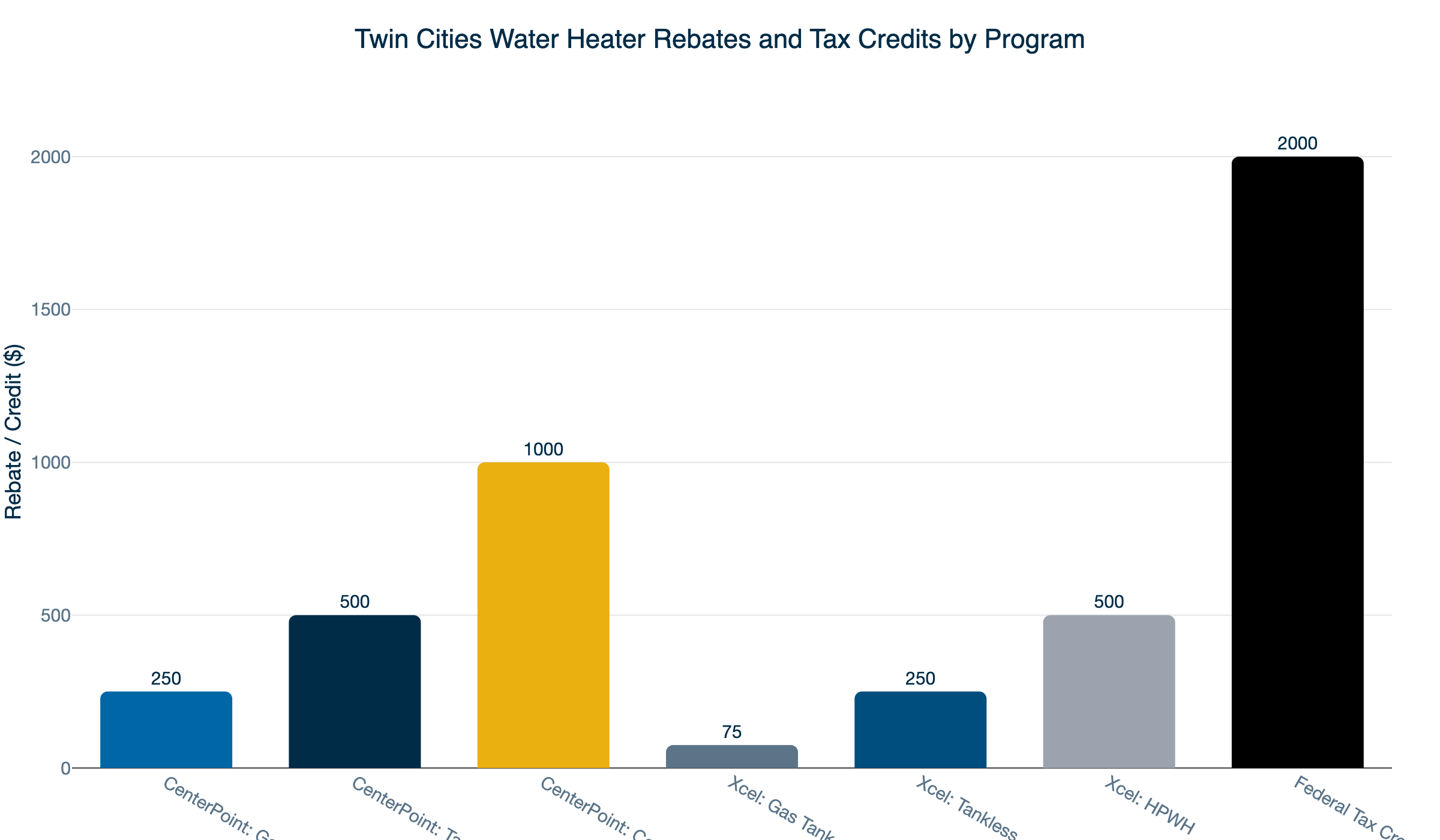
CenterPoint Energy customers can recover $250 to $1,000 on a qualifying replacement, depending on unit type. Xcel Energy customers can get $75 to $500. A qualifying heat pump water heater also earns a 30% federal tax credit, up to $2,000 per year through 2032. Stacked correctly, those incentives can offset $900 to $2,500 of the installed cost.
This is the largest information gap in most Twin Cities water heater content online. Here is the complete breakdown:
CenterPoint Energy (natural gas customers):
- Gas storage tank with UEF 0.64 or higher: $250 rebate
- Gas tankless with UEF 0.87 or higher: $500 rebate
- Combination tankless plus air handler: $1,000 rebate
- Applications must be postmarked by the program deadline; allow 10 weeks for processing
Xcel Energy (electric customers):
- Gas storage tank meeting the minimum efficiency requirement: $75 rebate
- Gas tankless meeting the minimum efficiency requirement: $250 rebate
- ENERGY STAR heat pump water heater: $400, or $500 with demand management enrollment
Federal tax credit:
The Inflation Reduction Act provides a 30% tax credit on unit and installation cost for a qualifying heat pump water heater. The cap is $2,000 per year, and the credit runs through 2032.
To claim the CenterPoint or Xcel rebate, you need the purchase receipt and the product specification sheet showing the UEF rating. Save those at installation. A plumber who does this regularly will know what documentation you need.
Do You Need a Permit to Replace a Water Heater in Minnesota?
Yes. Minnesota requires a plumbing permit for every water heater replacement under MN Rules Chapter 4714 and 4715. Gas units typically need a second gas permit under MN Rules Chapter 1346. All work must be performed by or under a licensed plumber per MN Statutes 326B.
The Minnesota Department of Labor and Industry’s Plumbing Board sets the licensing and permitting requirements. Permit fees in the Twin Cities metro add to the overall project cost. For a gas unit, that is two permits. Both are included in any professional plumber’s quote.
What happens when permits are skipped? Unpermitted water heater work can void your homeowners insurance and create problems at resale. A home inspector will flag it. That disclosure can complicate or delay a sale.
When you work with Northern Benjamin Franklin Plumbing, permits are part of the job. We pull them, schedule inspection, and handle the paperwork. You do not have to track any of it separately.
How Does Twin Cities Water Hardness Affect Your Water Heater?
Minneapolis treated tap water runs 5.4 to 5.5 grains per gallon (92 to 94 ppm), classified as moderately hard. Saint Paul runs 4 to 6 GPG after lime softening. At those levels, scale buildup is modest. Suburban areas drawing from harder groundwater can run 15 to 25 GPG before softening, which accelerates sediment accumulation and shortens heater life.
Minneapolis Monthly Water Analysis shows treated tap water hardness levels in the Twin Cities. The plant removes roughly 65,000 pounds of hardness daily before distribution. Saint Paul Regional Water Services reports 4 to 6 GPG after lime softening at the McCarrons plant.
Scale forms when dissolved minerals precipitate out of water as it is repeatedly heated. At 5 to 6 GPG, city residents see moderate, manageable scale over a heater’s lifetime. Annual tank flushing removes sediment before it builds up and insulates the burner. Our post on how to flush water heater sediment walks through the process step by step.
Suburban homeowners on systems drawing from harder groundwater face a different situation. Water running 15 to 25 GPG deposits scale much faster in tank units where heated water sits at high temperature. Hard water signs include scale around faucets and soap that won’t lather. If you are seeing those, your heater is working harder than it should. A properly functioning water softener extends heater life.
If you are hearing popping or rumbling from your water heater, sediment has likely built up on the tank floor. That is a good time to flush and assess the unit’s condition.
What Factors Drive the Final Water Heater Replacement Cost?
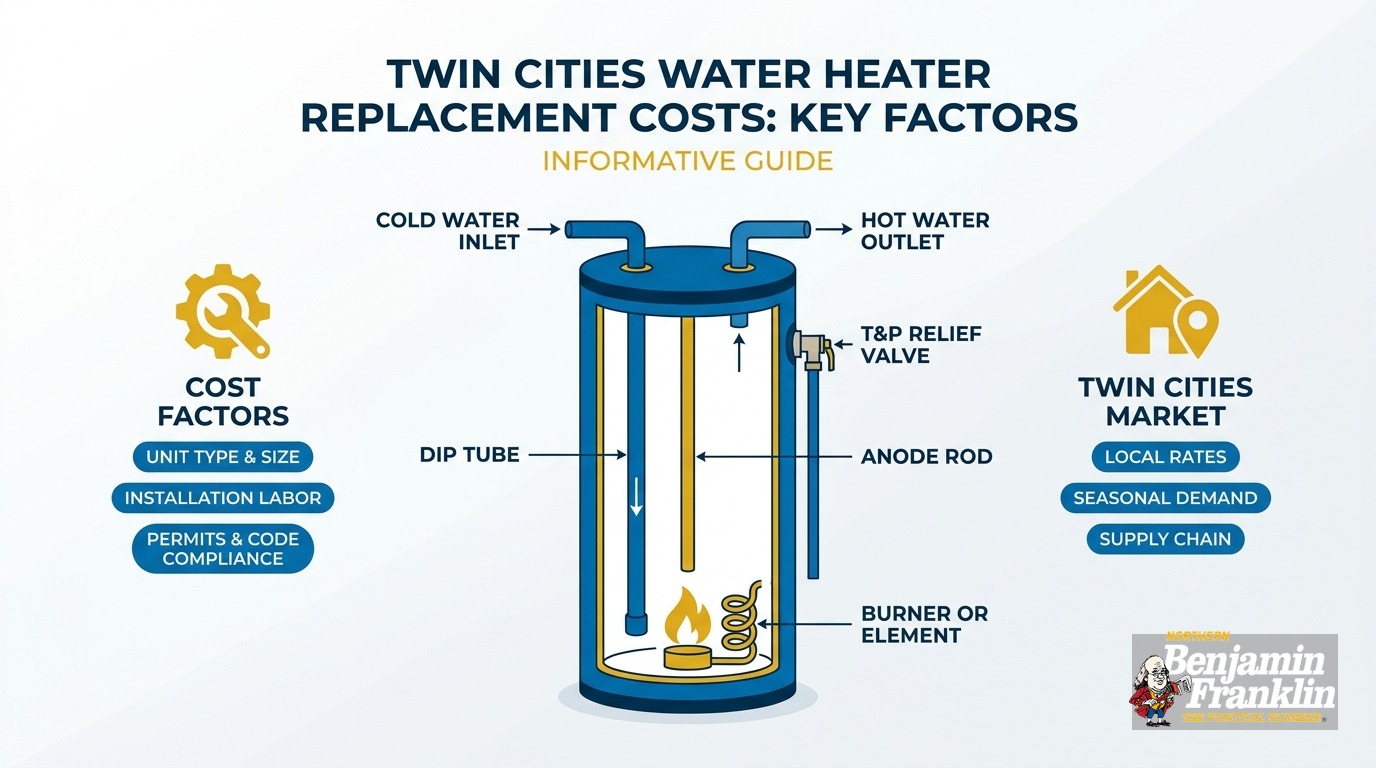
The main variables are unit type, size, labor, permits, gas-line and venting upgrades, site access, and emergency timing. Type and any needed infrastructure work are the two biggest cost swings. Everything else stacks on top.
Understanding these variables helps you read a quote and ask the right questions before you sign off.
Unit type and efficiency tier: A standard 40-gallon gas tank sits at the lower end. A high-efficiency condensing tankless or heat pump unit costs more to buy and usually more to install. The efficiency tier also affects rebate eligibility.
Unit size: A 75-gallon tank for a large household costs more than a 40-gallon unit for a two-person home. Tankless sizing is based on peak flow rate, which varies by household demand.
Labor: A direct swap in an accessible basement utility room is the simplest job. Moving the heater, converting fuel types, or correcting code issues takes more time. Labor costs in the Twin Cities market vary by contractor and job complexity.
Gas line and venting: This is the largest variable in a first-time tankless conversion. Running a larger gas supply line and installing new stainless steel venting adds meaningfully to the project.
Permits: One plumbing permit for electric units, two for gas. Each runs $50 to $150 in the Twin Cities metro.
Site access: A heater in a crawlspace or surrounded by finished walls takes more time. An open basement utility room is the easiest scenario.
Emergency timing: Holiday, overnight, and weekend calls run up to 2 times the standard rate in the Twin Cities. If the unit fails on a Saturday night in January, that premium is real. Replacing an aging heater before it fails almost always costs less than replacing it in an emergency. If your unit is showing symptoms and is past 10 years old, getting a quote now saves money later.
When Should You Replace Instead of Repair?
If the unit is 10 or more years old and showing symptoms, replace it. If it is leaking, replace it. If repair costs exceed half the cost of a new unit installed, replace it. Otherwise, a targeted repair on a younger, intact tank is usually the right call.
Not every failing water heater needs a full replacement. Here is a straightforward guide:
Replace when:
- The unit is 10 years old or more and showing symptoms: slow recovery, discolored hot water, rumbling or popping sounds, rust on the tank body
- The tank is actively leaking. A leaking tank cannot be repaired
- Repair costs exceed half the cost of a comparable new unit, installed
- You are upgrading for efficiency, capacity, or rebate eligibility
- The unit has been repaired repeatedly and performance is still declining
Repair when:
- The unit is less than 8 to 10 years old and the tank shows no corrosion or mineral fouling
- The problem is an anode rod, thermostat, heating element, or pilot light
- The tank holds water without signs of exterior rust or weeping at fittings
If you are not sure how old your unit is, our post on how to decode your water heater’s serial number shows how to find the manufacture date. A unit over 10 years old with any active symptom is usually a replace conversation. If you are unsure which path makes sense, a plumber can assess the unit and give you a straight answer before you commit to either.
Ready for an Accurate Quote?
Water heater replacement cost in the Twin Cities has too many home-specific variables for a single number to be useful. Type, size, access, permits, gas-line condition, and timing all move the final figure.
Northern Benjamin Franklin Plumbing is locally owned and operated, serving Minneapolis, Saint Paul, Blaine, Bloomington, Brooklyn Park, Coon Rapids, Maple Grove, and the rest of the Twin Cities metro. We arrive when we say we will. That is what the On-Time Guarantee(R) is built on. If there is any delay, it’s you we pay!
Call (763) 296-1844 or visit our water heater services page to book an assessment online. If you are weighing a tankless conversion or a heat pump water heater, ask about financing options when you call.
Frequently Asked Questions
How much does water heater replacement cost in the Twin Cities? +
What rebates are available for water heater replacement in Minnesota? +
Do I need a permit to replace a water heater in Minnesota? +
Is a heat pump water heater a good choice for a Minnesota home? +
Need a technician now?