
How Often Should You Clean Your Sewer Line? Camera Guide
Key Takeaways
- Set your cleaning interval from a camera inspection, not from a fixed number of months.
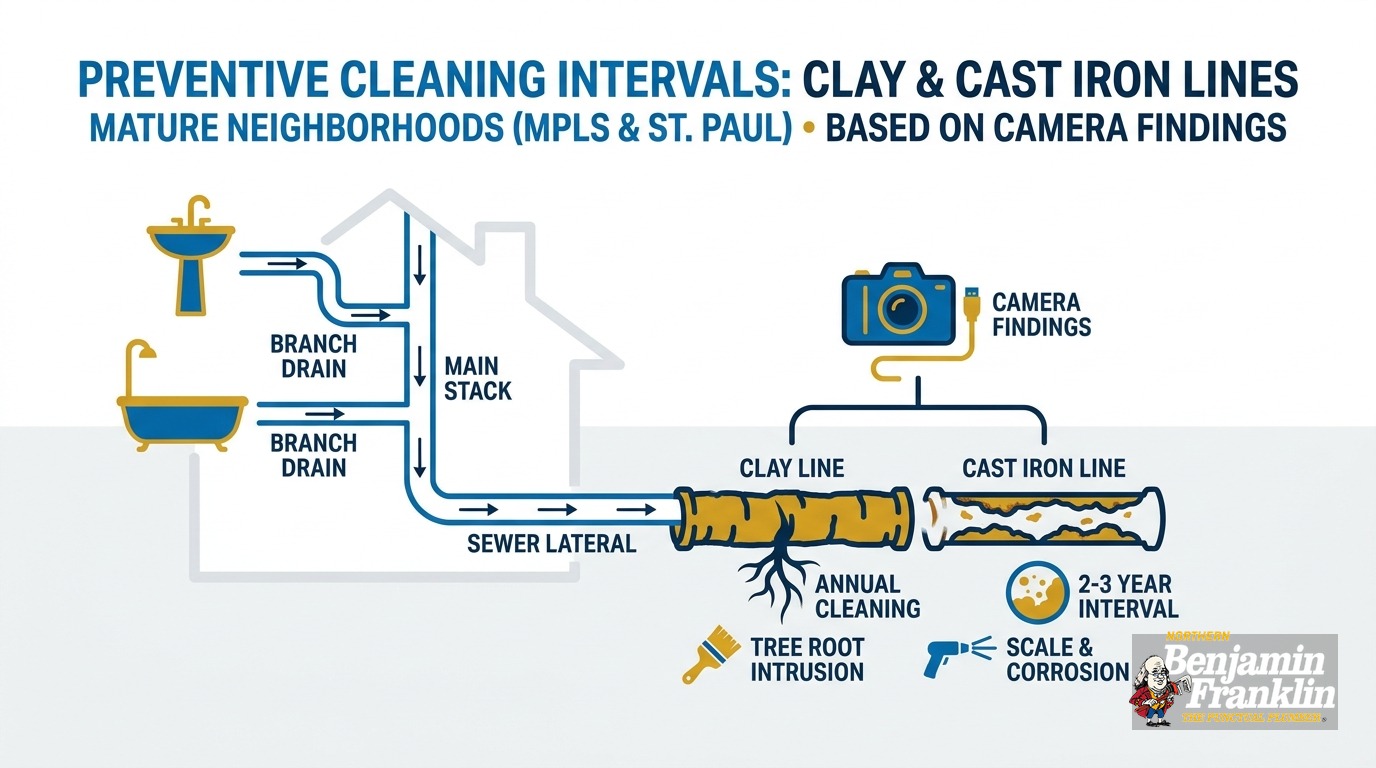
- Clay lines fail at the joints, where roots find their way in.
- Cast iron lines fail from scale and corrosion that roughen the inside of the pipe.
- In Minneapolis and St. Paul, the homeowner owns and maintains the private sewer line.
- Cleaning is a bridge. It buys time before relining or replacement. It is not a permanent plan.
- Re-camera the line after the first cleaning. Regrowth tells you the next interval.
- For a real quote, call (763) 296-1844.
How Often Should a Sewer Line Be Cleaned?
Short answer: it depends on what a camera shows inside your pipe, not on the calendar. A clean clay line with tight joints may need no routine cleaning. A clay line with active roots may need cleaning every year or sooner. Cast iron with heavy scale falls in between. Camera first, interval second.
Older homes in Minneapolis and St. Paul stack the odds against a sewer line. Mature boulevard trees, clay pipe, and cast iron all work against it. The usual advice says “every 18 to 24 months” or “only when it clogs.” Neither fits a house with a 60-year-old silver maple in the front yard.
We are Northern Benjamin Franklin Plumbing, a locally owned and operated Twin Cities plumbing company. The schedule below is our own working guidance. It is not a city code or a published standard.
Why Does a Camera Beat a Calendar?
Short answer: a calendar guesses at the pipe’s condition. A camera shows it. Two homes on the same block can need very different schedules. One line may have tight joints and a smooth wall. The next may have roots at every seam. The camera tells you which house you have.
Most schedules online lump every home together. They say “every 18 to 24 months” or “once a year.” Some say cleaning “shouldn’t be needed on a regular basis.” Both can be true, depending on the pipe.
A camera inspection answers four questions:
- What material is the pipe, and what shape is it in?
- Are there roots, and where do they enter?
- Is the wall smooth, scaled, cracked, or offset?
- Does water pool anywhere along the run?
With those answers, the interval nearly writes itself. We cover the inspection itself in our guide to sewer camera inspection in the Twin Cities.
Our Camera-Based Cleaning Guide
This is the decision table we start from. The intervals are our own rule of thumb, and no city or code body sets them. Your camera footage and your plumber’s judgment come first.
| What the camera shows | Pipe type | Our starting interval |
|---|---|---|
| Clean wall, tight joints, no roots | Clay | No routine cleaning. Re-camera on a longer cycle. |
| Fine root hairs at the joints | Clay | Clean preventively. Re-camera after the first cut. |
| Active root masses in the pipe | Clay | Clean on a short cycle and plan a permanent fix. |
| Light scale, smooth flow | Cast iron | Clean only if flow slows. Watch the scale. |
| Heavy scale or tuberculation (rust bumps) | Cast iron | Clean on a regular cycle. Plan for relining or replacement. |
| Bellied or offset section holding water | Either | Cleaning will not fix it. Repair the section. |
The pattern is plain. The worse the footage looks, the less cleaning helps. At the bottom of the table, cleaning only delays the real repair.
Why Do Clay and Cast Iron Need Different Schedules?
Short answer: they fail in different ways. Clay pipe comes in short sections joined at seams. Roots enter at those seams. Cast iron is one rigid run that corrodes from the inside. Roots drive the clay schedule. Scale and rough walls drive the cast iron schedule.
Clay: the joint problem
Many older Minneapolis and St. Paul homes have clay sewer laterals. A lateral is the pipe that carries waste from your house to the city main. Clay comes in short lengths, and each length meets the next at a joint.
Joints are where trouble starts. Roots seek out moisture and nutrients, and a tiny gap at a joint gives them a way in. A hair-thin root thickens over time. Then it catches paper and waste, and a clog forms.
On clay, we watch three things:
- Root hairs at joints, which signal early intrusion
- Thick root masses, which signal an active problem
- Offset or cracked sections, which signal a structural problem
Minneapolis notes that a cracked, deteriorated, or root-filled lateral can allow groundwater to seep into the sanitary lateral. So roots can mean more than a clog. They can also point to a leaking pipe.
Our deeper look at this is in tree roots in sewer lines in Minnesota.
Cast iron: the scale problem
Cast iron was common in homes built through the mid-1900s. It is tough, but it does not last forever. Over decades, the inside of the pipe corrodes. Rust forms bumps and scale, sometimes called tuberculation.
A rough wall catches grease, paper, and debris. Flow slows and clogs come more often. Eventually the pipe wall thins and can crack or collapse.
On cast iron, we watch:
- How thick the scale is
- Whether the pipe is still round
- Any cracks, holes, or flaking sections
- Where the cast iron meets other pipe materials
Cleaning scale off cast iron can restore flow for a while. It does not rebuild a thinned wall. If the wall is failing, the schedule ends in replacement. See our guide to cast iron drain pipe failure signs in the Twin Cities for what to look for.
Why Do Mature Minneapolis and St. Paul Lots Change the Math?
Short answer: older neighborhoods combine old pipe with big, thirsty trees. Boulevard and yard trees have had decades to spread roots. Clay and cast iron lines in these areas see more root pressure. And the pipe is yours to maintain, so the schedule is your decision.
Picture a typical older street. The houses date from the early to mid-1900s, and the pipes under them are the original clay or cast iron. The boulevard trees are huge, and their roots reach well past the dripline.
Roots follow moisture. A sewer line leaking even a little at a joint is a steady water source.
You own the lateral
Many homeowners are surprised by this. In Minneapolis, the property owner is responsible for the sanitary service lateral. The same page says the connection at the sewer pipe is part of your lateral and is also the owner’s responsibility. You are responsible for maintenance and, if needed, repair.
St. Paul sets a similar rule. A property owner is responsible for maintaining and repairing their private sewer service. That runs from the property to where it connects to the city sewer mainline.
So nobody at City Hall is watching your lateral. If roots build up and the line backs up, the repair is on you. A planned schedule keeps that from becoming a midnight emergency.
To reach the city, the Minneapolis home sewer page lists a 24-hour hotline at 612-673-5625. Check the Minneapolis home sewer maintenance page for current contact details.
Check for improper connections
Minneapolis also says you must correct improper connections. Examples include roof drains, sump pumps, or downspouts tied into the sanitary sewer. Extra clear water in the sanitary line adds load and can move debris. If your camera shows a strange flow source, ask about this.
How Do You Know Where Your Cleanout Is?
Short answer: the cleanout is a capped pipe, usually in the basement near the main stack or by the foundation wall. It gives a plumber direct access to the line. Without one, cleaning and camera work get harder. Older homes often lack a good one.
Every schedule depends on the cleanout. It is the doorway into your line. If it is easy to reach, cleaning and camera work are simpler. If it is buried or missing, the work gets harder.
Look for a round cap, often 3 or 4 inches wide, near where the main line leaves the house. Do not open it yourself. Sewage can rush out.
Learn more in our guide on finding and using your main sewer cleanout. If your older home has none, see sewer cleanout installation in an older home.
What Drives the Cost to Clean a Sewer Line?
Short answer: the cost depends on the method, the pipe condition, access, and how much root growth is inside. A real quote starts with a look at your line. Call (763) 296-1844 or book online.
You may see numbers online. Be careful with them. Many are national averages, which describe the whole country and quote nothing for your home.
Here is what moves the price:
- Access. A clear cleanout is simpler than a line that needs a new access point.
- Method. Cable cutting and hydro jetting use different equipment. We compare them in hydro jetting vs. drain snaking.
- Root load. A few root hairs take less work than a pipe packed with roots.
- Pipe condition. Scaled cast iron or fragile clay calls for more care.
- Camera work. Footage before and after tells you whether the job worked.
You can read about our approach on our sewer line cleaning page.
Cleaning also costs less than an emergency. A basement backup brings cleanup, restoration, and lost time. But repeated cleaning on a failing pipe can cost more over time than fixing the pipe. The camera answers that question.
How Long Do Sewer Lines Last?
Short answer: it depends on the material, the soil, the trees, and the home’s age. We do not give one number, because it would be a guess. Clay and cast iron can serve for decades, but both wear out. The camera shows how much life remains.
Two identical pipes can age differently. Here is what affects them:
- Material. Clay cracks and shifts. Cast iron corrodes.
- Soil movement. Minnesota freeze and thaw cycles move the ground. Pipes shift with it.
- Water flow. Heavy use and grease speed up wear.
- Roots. Constant root pressure pries joints open.
For general lifespans of home pipes, see our post on how long home pipes last. For a single line, footage of your own pipe gives the best answer.
Think of each cleaning as a data point. If the pipe stays clear for years after a cut, it has life left. If roots return in months, the pipe is near the end of its useful life.
How Often Should I Clean Drains in My House?
Short answer: indoor drains need less attention than the main line. Use hot water flushes and good habits monthly. Treat a slow drain as a warning and clear it early. Do not wait for a full clog. A slow drain in several fixtures at once points to the main line.
This covers the drains inside the home: sinks, tubs, and showers. They are separate from your main sewer lateral.
For everyday care:
- Use drain strainers in showers and tubs to catch hair.
- Keep grease out of kitchen drains.
- Flush only toilet paper. Wipes labeled “flushable” still cause clogs.
- Flush drains with hot water now and then.
- Clear a slow drain early, before it stops.
For more, see how to prevent drain clogs before they start and our post on flushable wipes and sewer clogs in Minnesota.
When it is more than one drain
One slow drain is usually local. Several slow drains at once point elsewhere. If the basement floor drain gurgles when you run the washer, the main line may be partly blocked. Our guide on sewer backup vs. drain clog helps you tell the difference.
Odors can also be a clue. A sewer smell without a clear source can point to a dry trap or a line problem. Our room-by-room sewer smell guide walks through the checks.
What Is the Re-Camera Rule After the First Cut?
Short answer: after the first cleaning, camera the line again. Compare the new footage with the old. If the pipe is clean and the joints look tight, you can stretch the interval. If roots are already back, shorten it and plan a permanent fix.
Here is the process we recommend:
- Camera first. Record the pipe before any cutting.
- Clean the line. Choose the method that fits the pipe condition.
- Camera again. Confirm the pipe is clear. Check the joints and walls.
- Wait, then re-camera. Look again after a set period, such as a year.
- Compare regrowth. Fast regrowth means a short cycle. Slow regrowth means a longer one.
This replaces guesswork with a measured schedule. You stop cleaning “because it has been two years.” You clean because the footage says it is time.
Research backs the idea that cutting is temporary. A study reported by the U.S. Forest Service found root cutting does not last, and in some heavy-root areas it must be repeated yearly. We could not confirm the full text, so treat that as a general pattern, not a rule for your pipe.
When Does Cleaning Stop Making Sense?
Short answer: cleaning stops making sense when the pipe keeps failing faster than you can clear it. Short cycles, thick roots, bellies, and thinning walls all signal this. At that point, cleaning is a bridge to relining or replacement. It is not a permanent plan.
Cleaning treats the symptom. The cause is an open joint, a cracked wall, or a corroded pipe. If the cause stays, the symptom returns.
Signs you have passed the cleaning stage:
- Roots return within months of a cut.
- The camera shows cracks, breaks, or offset joints.
- Water pools in a low spot, called a belly. See sewer line belly symptoms.
- Cast iron walls are thin, flaking, or collapsing.
- You are paying for cleaning more than once a year.
Your options after that
You have two main paths. You can dig up and replace the pipe, or you can use a trenchless method, which lines or replaces the pipe with little digging. Both have trade-offs. We compare them in trenchless vs. traditional sewer line replacement. For cost drivers, see sewer line replacement cost in Minnesota.
You can also read about our sewer line repair and replacement service.
Financing and permits
Bigger jobs can strain a budget. Ask us about financing when you get your quote. Some cities also offer help. St. Paul describes a sewer assessment program that is a low interest loan that spreads sewer repair costs over a 20-year period. The page says most property owners are eligible. It also lists a deferred emergency loan program for low-income households. Check your city for current terms.
Permits vary by city, so check before work begins. For example, Duluth says exterior sewer replacement needs a plumbing permit before work starts. We did not confirm permit rules for Minneapolis or St. Paul here, so ask your plumber and your city.
Also ask who will do the work. Minnesota’s Department of Labor and Industry says people certified as pipelayers are not required to have a plumber license for water service, sanitary sewer, and storm sewer work outside of buildings. Ask what they hold.
What Does a Sensible Schedule Look Like?
Short answer: start with a camera inspection. Clean based on what you see. Re-camera after the first cut. Then set a repeat cycle from real regrowth. Review the plan any time you notice slow drains, gurgling, or smells. Plan for repair if cleaning cycles keep shrinking.
Here is a simple plan for a mature-tree lot with clay or cast iron:
- Year one. Get a camera inspection. Know your pipe type and condition.
- After the first cleaning. Camera again to confirm the result.
- Months later. Look again to measure regrowth.
- Each year after. Adjust the interval. Longer if clear, shorter if not.
- When cycles shrink. Start planning repair or relining.
Buying an older home? A camera check before closing can save you a surprise. See sewer line camera inspection before buying.
Warning Signs That Cannot Wait
Skip the schedule if you see any of these:
- Toilets bubbling when a shower drains
- Water backing up in a floor drain
- Gurgling from several fixtures
- A sewer smell that does not go away
- Wet spots or sinking ground in the yard
These point to a line that is already partly blocked or damaged. Stop using water and call a plumber. Our guide on toilet bubbles when the shower drains explains one of the most common patterns.
Why Choose a Local Plumber for Your Sewer Line?
We are locally owned and operated, and we work on Twin Cities homes every day. We know the older housing stock, the clay and cast iron laterals, and the tree-lined streets. Local knowledge helps you read what the camera shows.
We also respect your time. Our On-Time Guarantee(R) means we arrive in the window you pick. If we do not, we pay you $5 for every minute we are late, up to $300. In our words: “If there is any delay, it’s you we pay!”
Book Your Sewer Camera Inspection
Let the camera set your cleaning schedule. We will inspect your line, show you the footage, and explain what we see. Then we will recommend an interval that fits your pipe, not a generic calendar.
Call Northern Benjamin Franklin Plumbing at (763) 296-1844 or book online. If your line needs a bigger fix, ask us about financing.
Frequently Asked Questions
Who owns the sewer line from my Minneapolis house to the street? +
Who maintains the private sewer line in St. Paul? +
Does cutting roots fix a sewer line for good? +
Should I schedule cleaning on a fixed calendar? +
Need a technician now?