
Sewer Camera Inspection: What It Finds and What It Costs
Key Takeaways
- You own your sewer lateral from the foundation wall to the city main, including the section under the street.
- Clay tile pipe is common in Twin Cities homes built before the 1980s. Freeze-thaw soil movement separates its joints year after year. That is the leading local failure mode.
- A sewer camera inspection is the only way to confirm your lateral’s condition before a backup forces the decision.
- Minneapolis accepted an MCES grant to help homeowners repair or replace failing laterals. Individual awards run $5,000 to $10,000.
- St. Paul’s 2026 MCES funds are fully allocated. Check the program page early for the next cycle.
- Minnesota requires a permit before any sewer repair. Any excavation also requires a Gopher State One Call ticket at 811.
Who Owns the Sewer Lateral in Your Minnesota Yard?
Quick answer: In Minneapolis and St. Paul, the property owner is responsible for the entire sanitary lateral from the foundation wall to the tap at the city main. That includes everything under the yard, sidewalk, boulevard, and street. You own all of it.
This surprises most homeowners. The pipe runs under public right-of-way, but the maintenance obligation stays with the property owner. Minneapolis Public Works confirms it: responsibility runs from the house to the connection point on the city’s main sewer line. St. Paul follows the same boundary: from the foundation wall to the tap at the city main.
There is one exception worth knowing. If a camera inspection shows the fault is in the city’s main rather than in your lateral, Minneapolis will reimburse part or all of the repair cost. Claim forms are available through the Risk Management Claims Office. That reimbursement path only works if you have documentation. A camera inspection provides that documentation.
Knowing the ownership boundary before a backup or a soggy yard changes your position. You can time a repair, apply for a grant, and work from an informed baseline. Without a camera scope, you are guessing at what you have and who is responsible for fixing it.
Why Do Twin Cities Homes Need Sewer Camera Inspection More Than Most Areas?
Quick answer: Most of the metro was built before the 1980s using clay tile sewer pipe. Freeze-thaw soil movement separates clay tile joints every single year. You cannot see that failure from above ground, and a camera is the only tool that confirms what is happening inside the pipe.
Minneapolis has a high share of pre-1940 housing. Those homes drain through original clay laterals that may be many decades old, per research on Twin Cities pipe materials. Clay tile performs reliably for decades. Then the mortar-sealed joints start to give.
Here is how the local failure pattern works. The Twin Cities frost depth runs at least 42 inches in a normal winter, and can reach 60 inches in extreme years. The sewer pipe sits below the frost line and stays unfrozen. But the soil above it does not. It freezes and expands each fall. It thaws and contracts each spring. Decades of that cycling separate clay tile joints. The gaps invite tree roots. Roots trap grease and solids. The lateral backs up.
Orangeburg pipe, made from compressed wood fiber and used in some postwar Twin Cities construction, appears in certain neighborhoods too. It degrades faster than clay under freeze-thaw cycling and can fail by collapsing inward rather than cracking.
A camera inspection is the only tool that tells you what material is in your ground and what condition it is in. A plumber can make an educated guess based on your home’s age and address. Only the camera confirms it for your specific lateral.
What Does a Sewer Camera Inspection Find?
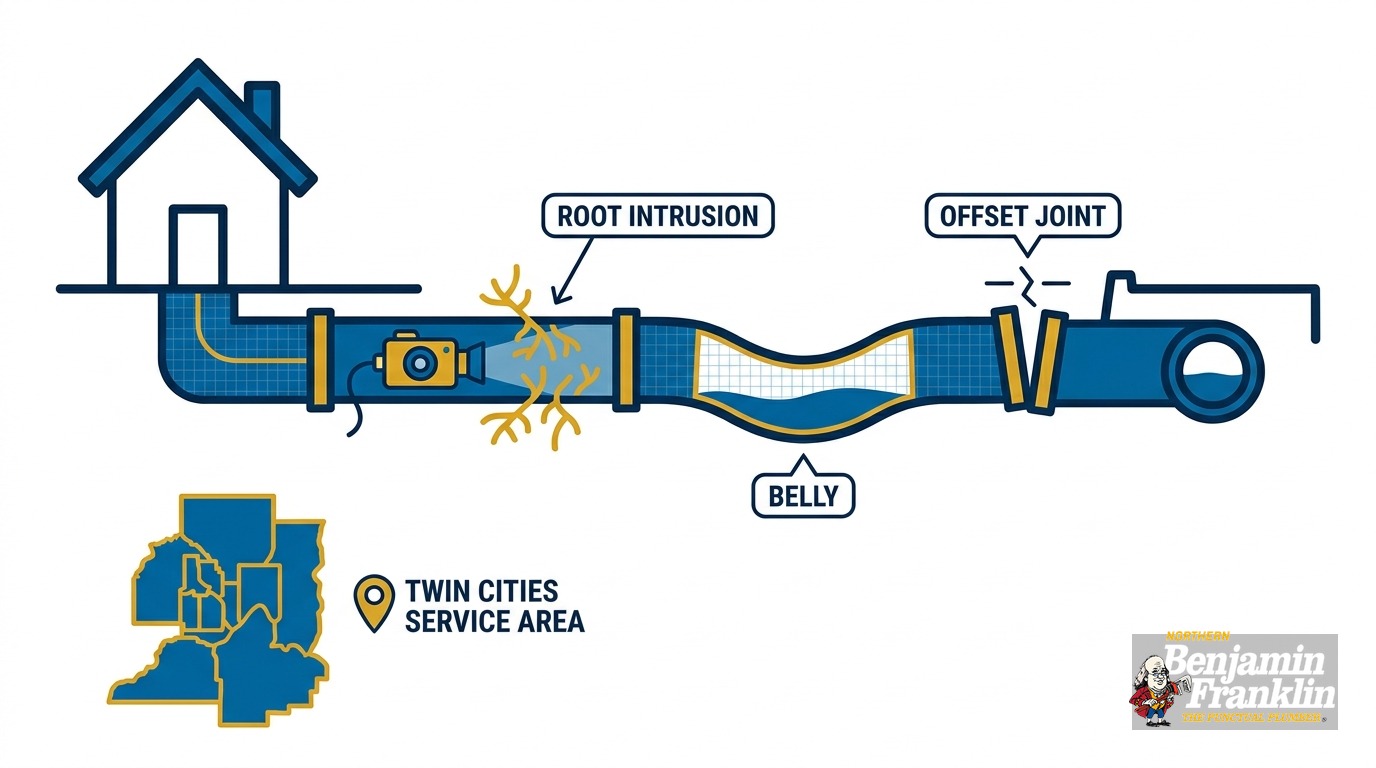
Quick answer: The camera shows root intrusion, clay tile joint separation, cracks, pipe belly, grease buildup, offset joints, and any section that is near failure. Findings are recorded on video. You receive the footage and a written report after the inspection.
The plumber feeds a waterproof HD camera on a flexible cable through the pipe, usually via a cleanout access point. The footage plays live on a monitor. You can watch the entire inspection with the technician in real time. After the visit, you receive the recorded video and a written summary of what was found and what it means.
Common findings in Twin Cities homes:
- Root intrusion. Roots enter through cracked joints or small fractures. A drain that slows again within months of being snaked often has root intrusion that clearing alone does not resolve.
- Clay tile joint separation. Freeze-thaw soil movement opens mortar joints. A small gap now becomes a larger one over time. Roots fill it.
- Bellied pipe. A low section holds standing water and builds up solids faster than the rest of the line. It becomes a recurring clog point.
- Cracks and fractures. Settlement or heavy equipment above the pipe can crack it. A fracture that allows root entry today can collapse under load later.
- Grease buildup. Years of kitchen drain use coat the interior. The camera shows how much clearance remains before flow becomes restricted.
- Offset joints. Two sections that no longer align restrict flow and create a ledge where solids catch.
- Infiltration. Groundwater seeping through cracks adds volume to the city’s treatment system and is often a compliance concern.
Not every finding requires immediate action. The inspection delivers a condition report. Some issues need repair within a season. Others can be monitored. The written report lets you and your plumber prioritize based on what is actually there, not on what tends to happen to homes of a certain age.
If the camera finds root intrusion or heavy buildup, our team may recommend hydro-jetting to clear the line before deciding on any structural repair. If the pipe shows structural damage, the conversation shifts to repair or replacement.
How Does a Sewer Camera Inspection Work?
Quick answer: The plumber locates your cleanout access point, feeds a waterproof camera through the lateral up to 200 feet, records live footage, and delivers a written report. Most residential inspections take 45 to 90 minutes from start to finish.
The main cleanout is the primary access point. It is usually a capped pipe at the foundation wall or in the basement floor. If your home does not have one, a toilet removal creates access. Adding a cleanout during the visit is worth discussing. It speeds every future service call and gives the camera a clean path with no restrictions.
The camera feed is live. A thorough technician narrates the findings as the footage records. Homeowners who watch the inspection alongside the technician come away with a clear picture of what they have and what it means. It is one of the better ways to understand your own plumbing system.
National inspection cost data from Plumbing Guider shows residential camera inspections ranging from $125 to $350 for a basic scope and $250 to $500 with recorded video and a written report. Difficult access or after-hours scheduling can push costs to $1,200 or more. Those are national benchmarks, not our pricing. Call (763) 296-1844 for a quote specific to your home and situation.
After the inspection, you receive the recorded footage and a written condition summary. That documentation matters if you plan to apply for a grant, get repair estimates, or list the home for sale. A buyer’s inspector who sees a recent camera report has fewer unknowns to factor into an offer.
What Does a Sewer Camera Inspection Cost in the Twin Cities?
Quick answer: National benchmarks from Plumbing Guider put a basic residential camera inspection at $125 to $350. A full inspection with recorded video and a written report runs $250 to $500. Those are national averages, not our pricing. Call (763) 296-1844 for a quote specific to your home.
What pushes the cost higher:
- No existing cleanout (toilet removal or cleanout installation adds time and scope)
- After-hours or emergency scheduling
- Long lateral or unusual access point
- Combined service such as camera plus snaking or hydro-jetting in the same visit
The camera inspection is typically the least expensive step in a sewer project. A plumber who scopes first works from a map. One who digs before scoping is working on assumptions. The cost of the inspection often prevents a much larger cost: excavating the wrong section, or replacing a pipe that needed only a targeted spot repair.
If the camera finds damage that requires repair or full replacement, different cost factors come into play: pipe material, linear footage, depth, permit fees, and surface restoration. Our post on sewer line replacement cost in Minnesota covers those variables in detail.
Are There Grants to Help Pay for Sewer Lateral Repairs in the Twin Cities?
Quick answer: Yes. The Metropolitan Council Environmental Services (MCES) sewer lateral grant program funds private lateral repair and replacement in Minneapolis and St. Paul. Award amounts depend on location and census tract criteria. Demand consistently exceeds supply, so acting early matters.
Minneapolis
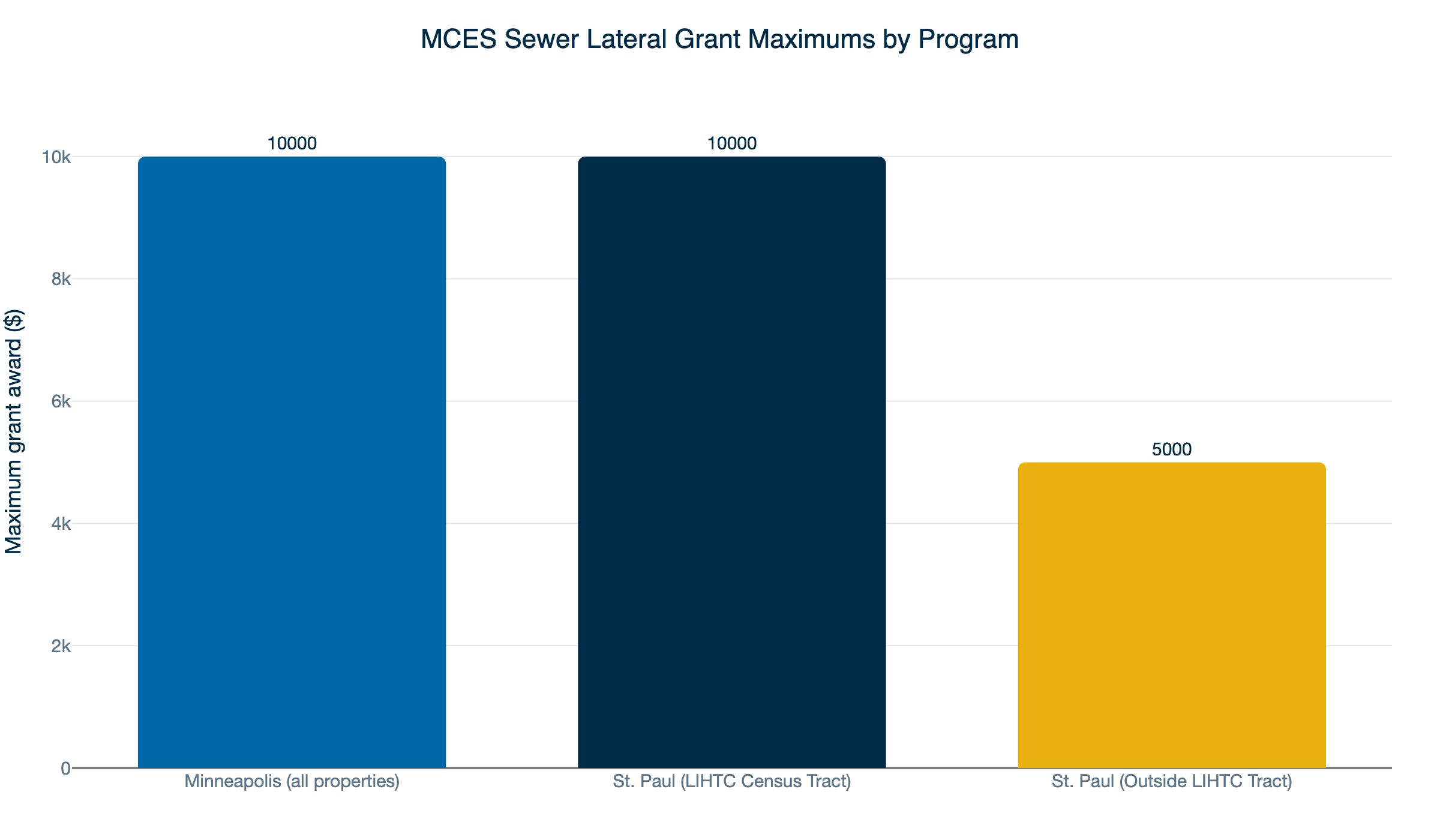
Minneapolis accepted an MCES grant to fund private sewer lateral repairs. Individual property awards run $5,000 to $10,000 depending on location.
Demand far exceeds available funding. In 2025, 172 applications competed for 34 grants. A lottery was required to allocate them. If the 2026 application window opens, apply immediately. Contact Minneapolis Public Works for requirements and timing.
Eligible work typically includes lateral repair, full lateral replacement, and related televising and cleaning costs. A camera inspection is often a required documentation step before the application can be processed. Scheduling a scope before the window opens puts you in position to apply on day one.
St. Paul
St. Paul’s MCES Sewer Lateral Grant Program is structured by location:
- Properties inside LIHTC Qualified Census Tracts: 90% of eligible costs, up to $10,000.
- Properties outside those tracts: 50% of eligible costs, up to $5,000.
The 2026 St. Paul funds are fully allocated. Watch the program page early in 2027 and apply as soon as the window opens. Applications fill quickly.
Eligible work includes lateral repair and replacement, foundation drain disconnection, and televising and cleaning costs. A camera inspection is often required application documentation. If you are on the fence about scheduling an inspection now or waiting, the grant program is a reason to act sooner. The camera documentation is what the application needs.
What Happens After the Sewer Camera Inspection?
Quick answer: The result determines the next step. A clean lateral needs only a follow-up schedule. Root intrusion or buildup may call for hydro-jetting. Structural damage leads to a repair or replacement estimate. You are not committed to any action until you choose to be.
No significant issues. The pipe is in good shape for its age. You have a baseline. Schedule a follow-up inspection every five to ten years, or sooner if slow drains or gurgling returns.
Root intrusion or buildup. Hydro-jetting clears roots and grease from the pipe interior. It does not repair a cracked or separated joint, but it restores flow and can extend the functional life of a lateral that is structurally sound. If the roots have not yet caused structural damage, clearing and monitoring is a reasonable short-term path. If they have returned multiple times and the pipe shows physical deterioration, jetting buys time but does not solve the underlying problem. A follow-up camera after jetting confirms whether the line is actually clear.
Structural damage. Offset joints, a pipe belly, or a cracked section typically leads to a repair estimate. Options include a targeted spot repair on the damaged section, trenchless pipe lining, or full lateral replacement. Our post on trenchless vs. traditional sewer line replacement walks through those choices and what drives the decision toward each path.
Damage that may be in the city main. If the camera shows the fault at or beyond the connection point, document the finding carefully. Minneapolis homeowners can file a reimbursement claim through the Risk Management Claims Office. The camera footage is the evidence that supports that claim. Without it, the homeowner has no leverage.
In every case, the inspection gives you time to plan. A backup gives you none.
Do You Need a Permit for Sewer Lateral Work in Minnesota?
Quick answer: Yes. Minnesota Plumbing Code (Chapter 4714) requires a permit before any plumbing work begins. For any excavation, Minnesota law requires a Gopher State One Call ticket at 811 before digging starts.
The licensed contractor typically pulls the permit. An inspection by the authority having jurisdiction is required before the repaired or replaced pipe is buried. Skipping the permit creates liability and can complicate coverage if a claim arises later.
The Gopher State One Call number is 811, or (651) 454-0002. Call at least two business days before any planned excavation, including small exploratory digs. The requirement protects gas lines, water mains, and fiber lines that may not appear on any existing map at your specific address.
A pre-inspection camera scope ties directly into this process. It documents pipe condition, location, and scope of work. That documentation makes the permit application faster and gives the inspector a clear picture of what was found and what was done.
Schedule a Sewer Camera Inspection in the Twin Cities
Northern Benjamin Franklin Plumbing is locally owned and operated. Our team serves Minneapolis, St. Paul, Blaine, Bloomington, Brooklyn Park, Coon Rapids, Maple Grove, and the surrounding metro.
We schedule sewer camera inspections in the Twin Cities around your timetable. The On-Time Guarantee(R) backs every appointment: “If there is any delay, it’s you we pay!” That means $5 for every minute we are late, up to $300.
Don’t wait for a backup to tell you what is in your pipe. Call (763) 296-1844 or book online to schedule your inspection.
Frequently Asked Questions
How long does a sewer camera inspection take? +
Do I own the sewer pipe under the street in Minneapolis? +
Is there financial help for sewer lateral repairs in the Twin Cities? +
Need a technician now?