
Sewer Cleanout Installation Cost for Older Twin Cities Homes
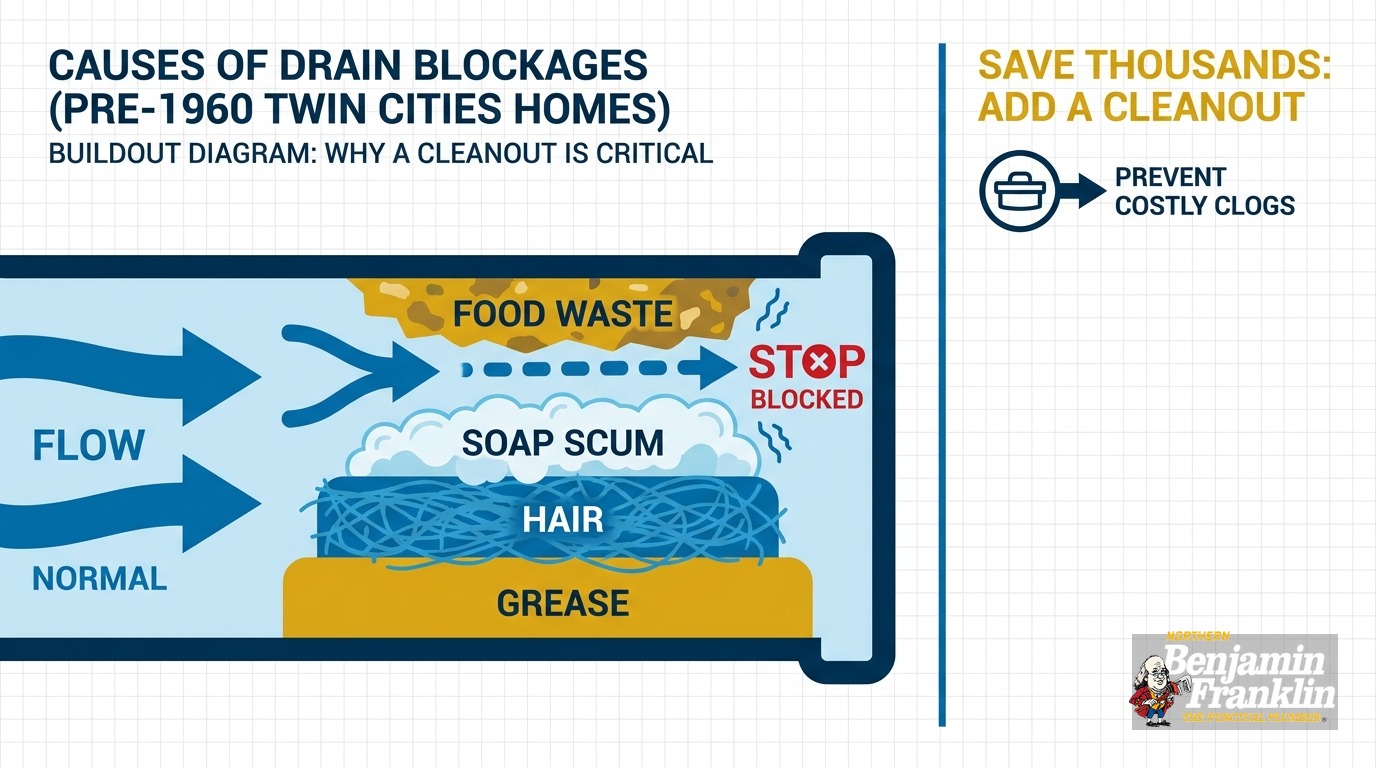
Key Takeaways
- Sewer cleanout installation cost in the Twin Cities runs from $1,400 for a one-way unit and $2,000 to $5,000 for a two-way, per Angi and HomeGuide.
- Pre-1960 Twin Cities homes frequently have no accessible cleanout - or one that was buried under a slab remodel or corroded shut over decades.
- Minnesota plumbing code MN Rules 4714.0707 requires cleanouts at every cumulative horizontal turn exceeding 135 degrees and every 100 feet of horizontal pipe. Most older homes predate that requirement.
- Without a cleanout, clearing a blockage requires a camera inspection first ($200 to $400) and adds hydrojetting labor on top.
- Minneapolis homeowners own the lateral all the way to the city main - including the section running under the street.
- No rebate or utility program covers proactive cleanout installation. The Minneapolis assessment program applies only after a failure.
- A permit is required for any lateral work in Minneapolis. We pull it.
- Fall is the best window: before hard frost closes exterior access and before spring blockage season peaks.
- Call (763) 296-1844 or book online to schedule an assessment.
What Is a Sewer Cleanout and Why Does Every Home Need One?
A sewer cleanout is a capped access point built into your drain system. It gives a plumber a direct route to the sewer lateral without pulling a toilet, lifting a floor drain cover, or threading equipment up through a vent stack from the roof.
The cleanout is typically a threaded cap - either flush with the basement floor or raised a few inches near the foundation outside. When a plumber opens it, they can send a snake, a hydrojetting hose, or a camera straight down the line. Without that access point, every service call starts with a workaround.
Minnesota plumbing code MN Rules 4714.0707 requires a cleanout at every cumulative horizontal turn exceeding 135 degrees and at intervals no greater than 100 feet of developed horizontal pipe. A home built today gets them by code. A home built in 1952, before that standard was uniformly enforced, may have gotten none.
The City of Minneapolis requires at minimum two cleanouts in the building drain: one near the base of the vent stack and one near the connection between the building drain and building sewer. Many pre-1960 homes are missing one or both.
Does Your Pre-1960 Minneapolis Home Actually Have a Cleanout?
Maybe - but accessible is different from exists. In pre-1960 Twin Cities homes, cleanouts were commonly buried during basement finishing, poured over when a slab was added, or corroded over decades until the threads stripped and the cap stopped turning.
To check, walk your basement and look for a threaded or capped pipe stub near the main drain stack. It will be within a few feet of where the drain line exits toward the street. Outside, check along the foundation for a round plastic or brass cap at grade.
If you find one, try to turn it by hand or with a wrench. If the cap shears or the threads strip, it is gone for practical purposes. If you cannot locate one at all, it may have been buried under a later concrete pour.
Your pipe material matters here. Clay sewer pipe was standard in Twin Cities homes built before the 1950s. Its expected service life is 50 to 60 years. Many original clay laterals are past that mark. Orangeburg pipe is a compressed wood fiber and pitch material. It was widely used during the WWII-era housing boom and the construction surge that followed. It was rated to last 50 years but often began failing within 30. If your home was built between 1940 and 1960, the lateral under your yard may be one of these materials. A cleanout is how a camera gets eyes on that pipe before it fails.
For a look at what failing sewer pipe looks like in Twin Cities homes, see cast iron drain pipe failure signs in Twin Cities homes.
What Is the Sewer Cleanout Installation Cost in the Twin Cities?
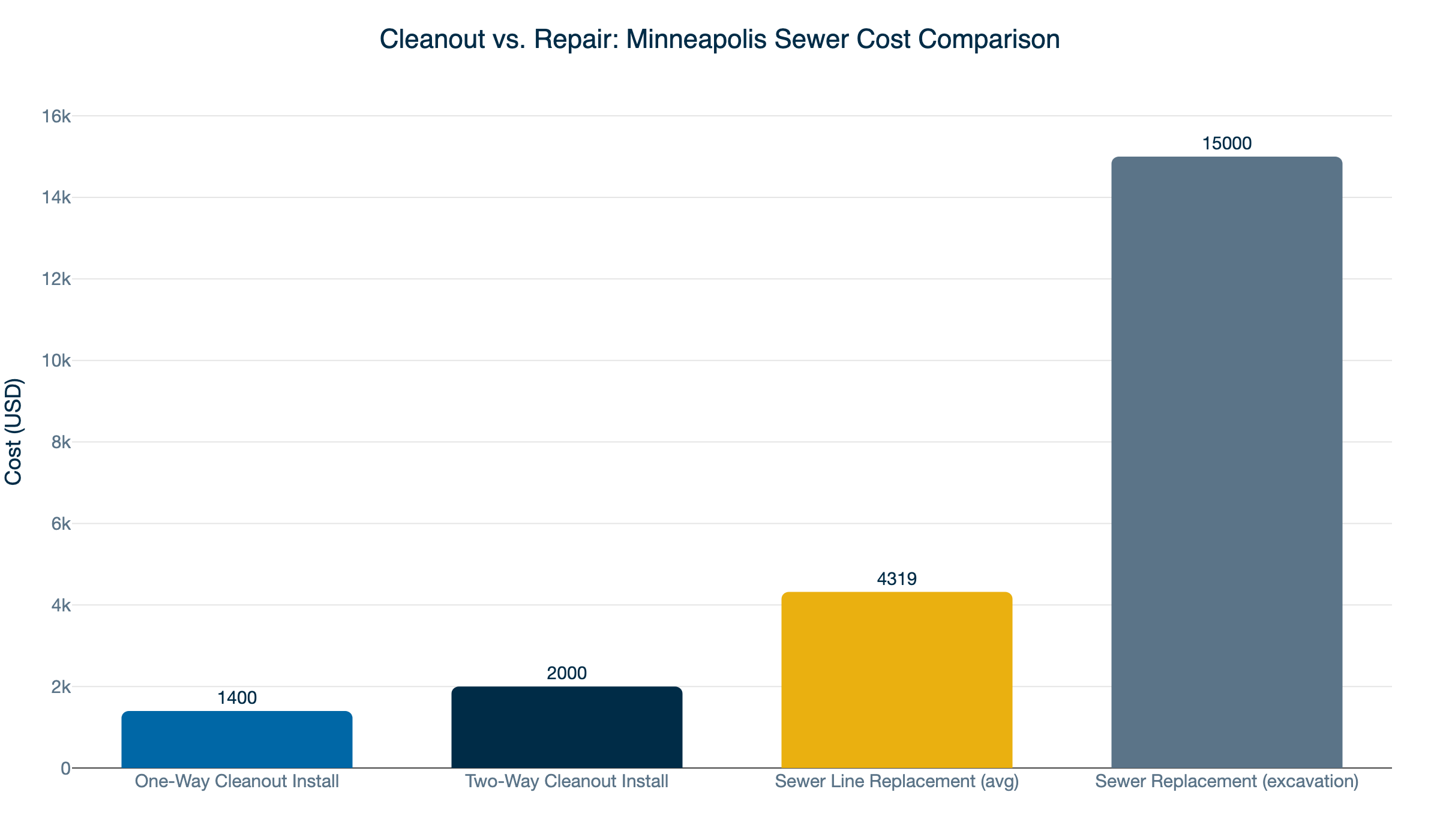
A one-way cleanout runs $1,400 to $2,500 installed. A two-way cleanout, which gives access from both directions, runs $2,000 to $5,000.
Angi shows one-way cleanout costs from $1,400. HomeGuide covers two-way cleanout pricing and notes that labor makes up the majority of the total. Material for the fitting and cap runs $50 to $150.
What drives your number within that range:
- Location. A basement cleanout in an open utility room is the straightforward case. Cutting through a concrete slab or excavating near the foundation costs more.
- Pipe condition. If the drain near the planned cleanout location is corroded or cracked, a short section may need repair before the cleanout can go in.
- Access. A tight crawl space or an unusually deep lateral adds labor time.
- One-way vs. two-way. A two-way cleanout lets a plumber work toward the house and toward the street from the same opening. For laterals longer than 50 feet, or ones with a known offset, the two-way configuration is often worth the difference.
A Minneapolis utility permit is required for this work. A base fee applies for sewer and water work within a standard distance. We pull the permit as part of the job, not as a surprise line item afterward.
These are third-party ranges for the Twin Cities market. For a number specific to your home and pipe layout, call (763) 296-1844 or book online.
How Sewer Cleanout Installation Cost Compares to Emergency Repair
The national cost articles show what a cleanout costs to add. They do not show what you pay when you skip it.
When you call for a sewer blockage and there is no cleanout, a plumber must route equipment through a toilet pull, a floor drain, or a vent stack. Before clearing anything, they need to see what is happening. HomeGuide puts a camera inspection starting at $200 when no cleanout access is available.
Then comes clearing the blockage. Hydrojetting without cleanout access means working around a worse entry point, which adds labor time. HomeGuide notes that hydrojetting labor runs $45 to $200 per hour. Emergency or after-hours service - which is when most Twin Cities sewer backups actually happen - adds $150 to $500 to the base rate, or 50% to 150% more.
One emergency clearing call without a cleanout can approach the cost of installing one. That is assuming the line clears cleanly.
If the camera reveals a cracked pipe, a belly, or root intrusion, you are scheduling a repair on top of the clearing call. The worst case is a full replacement. Angi’s Minneapolis data covers typical sewer line replacement costs for homeowners in the metro. Traditional open excavation can reach $15,000.
A cleanout does not stop a lateral from aging. But it is the diagnostic tool that catches a cracked joint or early root intrusion before it becomes a full collapse. It also reduces the labor cost on every service call that follows, for as long as you own the house.
There is no rebate or program that offsets proactive cleanout installation in Minneapolis. The Minneapolis Private Sewer Lateral Assessment Program finances repairs after a failure. It does not apply to this step. If you are waiting for a program to appear before acting, you are waiting for something that does not exist in this category.
Why Frost Heave Makes This a Minnesota Urgency
This does not appear in national sewer cost articles. It is specific to living in the Twin Cities.
The metro has a code-required frost depth of at least 42 inches, with actual ground frost reaching 60 inches in severe winters. The lateral itself, buried below that depth, does not freeze. The soil around it does - and it moves every year.
Decades of freeze-thaw cycles shift clay and Orangeburg pipe joints. They crack seams, offset pipe sections, and create low points where debris settles and roots find entry. A lateral that cleared cleanly 20 years ago has had 80-plus freeze-thaw cycles since then. That movement does not reverse.
The failure mode is gradual until it is not. A shifted joint admits a root tendril in October. By March it is a root mass. By April, when snowmelt saturates the soil and water tables peak across Minneapolis and St. Paul, that mass meets full flow. That is when backups happen. That is also when call volumes are highest and emergency windows are tightest.
A cleanout installed in fall gives you camera access to the lateral before freeze-up. Confirm the pipe’s condition in November. Know what is there. Exterior cleanout caps can freeze shut in a hard Minnesota winter. Interior basement cleanouts in heated spaces stay accessible year-round. That placement choice is worth asking about when you schedule.
See also: tree roots in a sewer line in Minnesota.
Who Is Responsible for the Sewer Lateral in Minneapolis?
You are - including the section of pipe running under the street to the city main.
The City of Minneapolis is direct about this: property owner responsibility extends to the lateral even for the portion running under the street, all the way to the city main. The city cannot install a cleanout for you.
The city also confirms that Minnesota plumbing code requires at least two cleanouts in the building drain: one near the base of the vent stack and one near the connection between the building drain and building sewer. If your home lacks both, it is not compliant with current code. That can surface as a deficiency when you sell or refinance.
A permit is required for any lateral repair or modification. Minnesota law also requires calling Gopher State One Call at (651) 454-0002 before any excavation begins. That is the state law requiring underground utility marking before digging. We handle both the permit and the Gopher State notification as part of the installation.
Can Minneapolis Help Finance a Larger Repair?
Yes - but only for repairs that come after a failure, not for proactive cleanout installation.
If a camera inspection through a new cleanout finds a problem worth repairing - a cracked lateral section, a root intrusion, a significant belly in the pipe - the Minneapolis Private Sewer Lateral Assessment Program can spread that repair cost through your property taxes.
The 2026 terms: up to $10,000 financed at 3.80% over 5 years or 4.10% over 10 years. From $10,001 to $15,000, the rate is 4.40% with terms up to 15 years. Over $15,000, the rate is 4.70% with terms up to 20 years. A $50 administrative fee applies to all tiers. You must use a City Target Market Program contractor and obtain at least three bids.
This program is a useful backstop if a camera inspection surfaces a bigger problem. It does not apply to the cleanout installation itself. If cost is the concern, get a real estimate first rather than waiting for a program that covers the next step, not this one.
We offer financing options on larger jobs. Ask about it when you call (763) 296-1844.
What the Installation Process Looks Like
A cleanout installation is a targeted job in most homes. Here is what the process looks like from start to finish:
- Assessment. We review the existing drain layout - visually or with a camera - to confirm pipe condition and identify the right placement before we open anything.
- Permit. We pull the Minneapolis utility permit before work starts.
- Access. Depending on placement, this may mean cutting a floor drain section, opening a wall chase, or a targeted excavation near the foundation.
- Installation. We cut into the drain line, fit the cleanout tee, and install a threaded cap that is accessible for every future service call.
- Camera pass. With the cleanout in place, we run a camera down the lateral. If we find a crack, a root intrusion, or a belly, you see the footage and get a clear report on what it means for your home.
For pre-1960 homes, we recommend the camera pass every time. You are paying for access to that pipe. You should see what is there.
For more on what a camera inspection finds in older Twin Cities laterals, see sewer camera inspection in the Twin Cities.
When Is the Right Time to Schedule This?
Fall - before hard frost closes exterior access and before spring blockage season makes scheduling tightest.
In the Twin Cities, the window is roughly September through early November. Exterior excavation before the ground freezes hard is standard work. After that, the project costs more and takes longer.
Spring is the worst time to need emergency sewer service in Minnesota. Snowmelt saturates the soil. Water tables rise. Call volumes peak across the metro. The homeowners who get through April without a backup are typically the ones who confirmed their pipe’s condition the fall before.
A cleanout installed this fall gives you camera access before freeze-up. If the camera shows a developing problem, you can address it on your own timeline rather than at emergency rates in March.
Northern Benjamin Franklin Plumbing is locally owned and operated in the Twin Cities. Our On-Time Guarantee(R) means we arrive in the window you pick - or we pay $5 for every minute we are late, up to $300. “If there is any delay, it’s you we pay!” That commitment is real. It is how a local company earns trust in the neighborhoods it serves.
Call (763) 296-1844 or schedule a sewer assessment online before the ground freezes.
For a broader look at what a sewer problem can cost once it has reached the repair stage, see sewer line replacement cost in Minnesota.
Frequently Asked Questions
How much does sewer cleanout installation cost in Minneapolis? +
Does my pre-1960 Twin Cities home need a sewer cleanout? +
Who owns the sewer cleanout in Minneapolis? +
What happens if I skip adding a sewer cleanout before a blockage? +
Need a technician now?