Toilet Bubbles When Shower Drains: Main Line Warning
Key Takeaways
- A toilet that bubbles when the shower drains usually means air cannot move freely through your drain system.
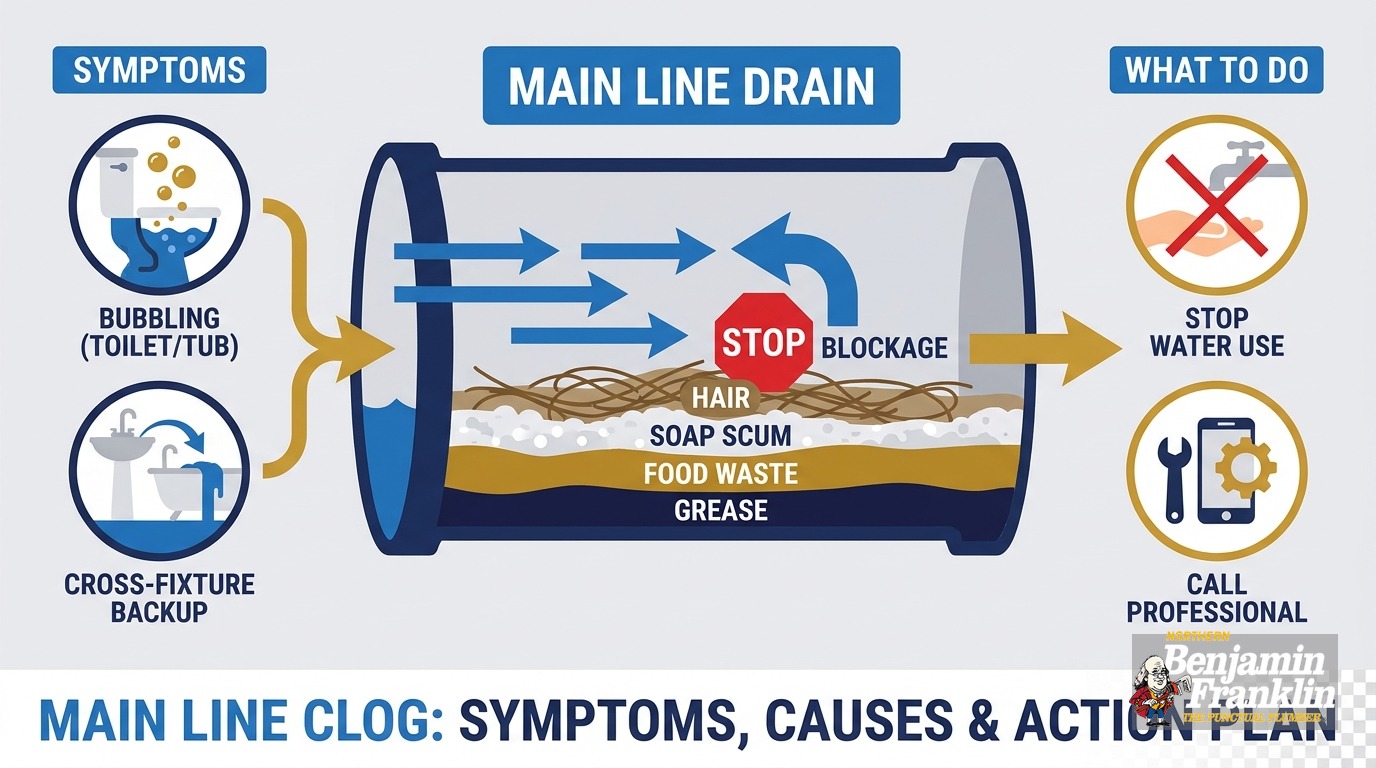
- One bubbling fixture can mean a local clog or a vent problem. Bubbling plus a second fixture reacting points to the main line.
- Test in order: lowest fixture first (basement floor drain or laundry standpipe), then the toilet, then upstairs fixtures.
- Stop using water the moment you suspect the main line. Every shower and load of laundry adds to the problem.
- Never pour chemical drain cleaner into a bubbling system. It can sit in the pipe and hurt the people who clear it.
- Learn where your sewer cleanout is before you need it. In many Twin Cities homes, it sits in the basement.
- In Minneapolis, the homeowner owns the private sewer lateral. Check your own city’s rules if you live elsewhere.
Why are bubbles coming out of my toilet when I shower?
Bubbles in the toilet while the shower drains mean air is being pushed or pulled through the toilet’s water seal. A partial clog, a blocked vent, or a main line blockage can cause it. If another fixture reacts too, suspect the main line.
Your shower sends a rush of water down a drain pipe. That water has to go somewhere, and so does the air in the pipe.
When the path is clear, the air slips away through the vent and the water flows out. You hear nothing. When the path is partly blocked, the air takes the easiest exit it can find.
Often that exit is the toilet. The bowl holds a pool of water called a trap. Air pushes through that pool and makes a gulp or a bubble.
The bubble is a message: something is restricting the flow. Your job is to find out how far down the line it sits.
What is actually happening inside your pipes?
Your drain system carries air as well as water. Each drain connects to a vent, a pipe that runs up through the house and out the roof.
The vent lets fresh air in behind the water as it flows down. That keeps pressure balanced. Without it, water leaving a drain would pull a vacuum behind it.
A vacuum pulls on the nearest trap. The trap is the water seal under every fixture that keeps sewer gas out of the room. A strong pull can suck that seal down or drag air through it.
Pressure can build the other way too. When a main line is partly blocked, shower water cannot drain fast enough. It backs up and squeezes the air ahead of it. That air has to leave somewhere.
A running shower sends a lot of water down the line in a short time. That is why the toilet may sit quiet all day and then bubble the minute someone showers.
Three problems cause most of these symptoms. One published homeowner guide on bubbling toilets lists a blocked vent stack, a blocked sewer main line, and a partial drain clog. We see the same three in Twin Cities homes.
- A partial clog in a branch drain. Hair, soap scum, and debris narrow the pipe serving the bathroom.
- A blocked or restricted vent. A bird nest, leaves, or frost buildup at the roof opening can starve the system of air.
- A main line blockage. Roots, grease, a belly in the pipe, or a collapsed section slows everything leaving the house.
Each one makes air misbehave. The difference is how many fixtures notice.
How can you tell a vent or local clog from a main line clog?
Run a fixture-order test. Start at the lowest drain in the house, then move up. If low fixtures bubble, gurgle, or back up while water runs elsewhere, the main line is the likely culprit. If only one bathroom reacts, a branch clog or vent is more likely.
Water follows gravity. A main line blockage shows itself at the lowest point first, which is why this test works.
Use a helper if you can. One person runs water. The other watches and listens at the drains.
Step 1: Check the lowest fixture. This is usually a basement floor drain or a laundry standpipe. Look for bubbling, gurgling, or rising water. Shine a flashlight into the drain.
Step 2: Run the shower and watch the floor drain. If the floor drain gurgles or water creeps up while the shower runs, stop. That is a strong sign of a main line problem.
Step 3: Run the washer or flush a toilet while the shower runs. The washer dumps a lot of water fast. Together with the shower, it stresses the line. If the toilet bubbles harder, the line is struggling with the load.
Step 4: Check the toilet. Watch the bowl water level. A bowl that rises or drops sharply while other fixtures run is a warning sign.
Step 5: Check upstairs fixtures. If the main line is blocked, upstairs sinks and tubs may drain slowly too.
Stop the moment you see water rising. Do not push the system to prove a point. A basement backup costs far more than a delay in diagnosis.
How to read the results:
- Only the toilet bubbles, and only near that bathroom: likely a branch clog or vent issue.
- Toilet bubbles and the floor drain reacts: likely the main line.
- Several fixtures drain slowly at once: likely the main line or a long-running partial blockage.
- Gurgling at many fixtures but no standing water: could be a vent problem, though a main line clog can look the same.
Our post on gurgling drains and plumbing vent problems covers the vent side in more detail. To see whether a floor drain is already reacting, our guide to the causes of a basement floor drain backing up walks through what to look for.
Why does my shower drain bubble?
A bubbling shower drain means air is escaping through the shower’s trap as water moves through the system. The cause is often the same as a bubbling toilet: a partial clog downstream, a vent issue, or a main line restriction pushing air back up.
The shower drain is one more exit for trapped air. When water in the main line slows, the air ahead of it needs a way out. The shower drain is open, so air may rise through it and burp up through the water.
Look for other clues:
- Slow draining in the shower. Water pools around your feet.
- A gurgle after you turn the water off. The pipe is still equalizing.
- Odors from the drain. A bad smell can mean a trap is losing its seal.
- Dark water or debris rising. That points to backup from below, not a hair clog.
A hair clog right at the shower drain is common and easy to fix. It causes slow draining, but it rarely makes the toilet bubble. If your toilet reacts too, the problem is deeper than the shower drain.
Our guide to a slow shower drain and hair clogs covers the local fix. Use it only when no other fixtures react.
What should you do before the main line backs up?
Stop using water, find your sewer cleanout, and call a plumber. Do these in order. Acting at the first bubble can keep sewage out of your basement.
Most main line backups give warning: bubbles, gurgles, and slow drains. Homeowners who catch those signs early often avoid the worst outcome.
1. Stop water use. No more showers, laundry, dishwasher cycles, or long flushes. Every gallon you send down adds to the pressure.
2. Tell the household. Kids and guests will keep flushing unless someone says otherwise. Put a note on the bathroom doors.
3. Check the lowest drain. Look at the basement floor drain with a flashlight. If you see water rising, move valuables off the floor.
4. Find your cleanout. The next section covers where to look.
5. Call a plumber. Tell them what you saw. Say which fixtures bubbled, which one reacted second, and what you were running at the time.
Those details help the plumber arrive ready. Useful facts include:
- Which fixture bubbled first.
- Which other fixtures reacted.
- Whether the washer or dishwasher was running.
- Whether any water has come up from a drain.
- When the house last had a drain or sewer service.
If water is already coming up from a floor drain, treat it as urgent. The Minneapolis page on home sewer maintenance warns that blockages between your property and the sewer can cause backups into your basement. Those backups bring property damage and potential health concerns.
Our team is locally owned and operated, and we serve homeowners across the Twin Cities. We back every visit with our On-Time Guarantee(R). We arrive in the window you pick, or we pay you $5 for every minute we are late, up to $300. As we put it: “If there is any delay, it’s you we pay!”
What should you avoid doing when the drain is bubbling?
Avoid chemical drain cleaner, more showers, more laundry, and plunging a toilet that is full of rising water. These moves can push the problem deeper or worsen a backup. They can also expose you or a plumber to harsh chemicals.
The do-not list:
- Do not pour chemical drain cleaner. It rarely clears a main line. It can sit in standing water, and it can burn skin or eyes if the line backs up.
- Do not keep showering “just one more time.” Each shower sends more water toward a blocked pipe.
- Do not run the washer or dishwasher. They dump large volumes fast.
- Do not keep flushing to test it. A full toilet can overflow.
- Do not pour grease down a drain. The Minneapolis guidance says to not dispose of fats, oil, and grease down any sink drain or the toilet inside your home.
- Do not open the cleanout cap if water is high in the pipe. More on that below.
A plunger can help with a local toilet clog. It will not fix a main line problem. If the bowl rises as other fixtures run, a plunger only moves water around.
Backed-up sewer water is not clean water. If it reaches the floor, keep children and pets away. Wear gloves and boots if you must go near it, and wash up afterward.
Where can you find your sewer cleanout, and why does it matter?
A sewer cleanout is a capped pipe that gives access to your sewer lateral. In many Twin Cities homes, it sits in the basement. Knowing where it is lets a plumber reach the line fast, and it lets you spot a backup source.
The City of Minneapolis describes a cleanout as a capped pipe that provides access to a property’s sanitary sewer lateral. It is usually a 4-inch capped pipe with a steel or plastic cover.
Location varies by home. The same city page says it is typically in the basement so it stays reachable in winter. That makes sense in Minnesota, where nobody wants to dig through snow to reach a cap.
It may instead be in the front yard. The page notes it could be under or behind bushes close to the exterior walls of the building.
Look in these places:
- Near the main stack in the basement. Check along the lowest wall where the sewer leaves the house.
- Near the floor drain or water heater. Cleanouts often sit in the same area.
- Outside, along the front foundation. Check behind shrubs.
- In a utility room or crawl space. Older homes may hide it in odd spots.
The same page says Minnesota plumbing code requires at least two cleanouts in the building drain. Older homes may have fewer, and some have none that are easy to reach.
If you cannot find yours, you are not alone. The city’s own advice is to contact a plumber for help locating your sewer cleanout. We find them every week.
Our guide on how to find and use your main sewer cleanout shows what to look for. Read it before you need it.
One safety note: do not unscrew the cap if you see water backing up toward it. A cleanout under pressure can release sewage fast. Leave the cap to the plumber if there is any sign of high water.
Who is responsible for the sewer line in Minneapolis?
In Minneapolis, the property owner is responsible for the private sanitary lateral. The city maintains the main sanitary sewer in the street. Other Twin Cities suburbs have their own rules, so check with your city.
This surprises many homeowners. The lateral is the pipe that runs from your house to the city sewer main. It may cross your yard, your driveway, or even the boulevard. It still belongs to you.
The City of Minneapolis states plainly that the property owner is responsible for their sanitary lateral. The city is only responsible for maintaining the main sanitary sewer.
Two more points from that page are worth knowing.
First, the city says it is not the City’s responsibility to determine the cause of a blockage in a private sanitary lateral. You or your plumber must find where the problem sits.
Second, there is a safety net. If you paid a plumber for a problem that turned out to be in the public sewer, the city says it will reimburse the homeowner for a portion or all of the repair cost. Keep your invoice and any camera footage.
Minneapolis also lists a few numbers on that page:
- Sewer Operations 24-hour hotline: 612-673-5625.
- After-hours standby line: 612-490-5568.
- Gopher State One Call: 651-454-0002, required before excavation or lateral repair.
We have not verified lateral rules for every city, so we keep this section to Minneapolis. If you live in St. Paul or a suburb, call your city’s public works office. Ask who owns the lateral and who handles the main.
A cracked or root-filled lateral also invites groundwater. The city notes that a cracked, deteriorated, or root-filled lateral can let groundwater seep into the sanitary line. That adds flow to the pipe and can worsen backups during wet spells.
How do you unclog a toilet that is backing up into the shower?
If a toilet is backing up into the shower, the main line is almost certainly blocked. Do not plunge or run more water. Stop all water use, avoid chemicals, and call a plumber. The blockage is below both fixtures and needs line-clearing equipment.
This is the clearest sign of a main line problem. Toilet wastewater is finding the shower drain because it is the next-lowest open path. The pipe downstream cannot carry the flow.
Water from the toilet should leave through the main line. It cannot, so it rises until it finds a weak point, often the lowest drain on that branch.
A plunger will not help. The blockage is not at the toilet, and you could push waste back and make a bigger mess.
What you can do:
- Stop all water use in the house.
- Close the toilet lid and keep people out of the bathroom.
- Place towels around the shower drain to slow any spread.
- Move items off the basement floor if the floor drain is active.
- Call a plumber and tell them the toilet is backing into the shower.
That detail tells us right away this is a main line call. We bring the right equipment and treat it as urgent.
Once the line is open, cleanup comes next. Wear gloves, use a disinfectant meant for sewage contact, and dry the area fast. Porous materials like carpet and drywall that got wet with sewage may need professional cleanup.
How do plumbers clear and fix a main line clog?
Plumbers clear main line clogs with a drain machine or hydro-jetting, then inspect the pipe with a camera. Roots may need cutting. The camera shows whether a simple cleaning is enough or the pipe needs repair.
A good visit has three parts: clear it, look at it, and fix the cause.
Clearing the line. A drain machine, or snake, uses a rotating cable to break through a blockage. For grease or heavy buildup, hydro-jetting uses high-pressure water to scour the pipe walls. Roots may call for a cutting head first.
Inspecting the pipe. A camera on a flexible cable shows what is down there. We can see roots, cracks, offset joints, a sagging section, or heavy scale buildup. Without a camera, you are guessing.
Fixing the cause. A one-time grease clog may be solved by cleaning. A pipe full of roots will clog again unless the entry point is repaired. A bellied or collapsed pipe needs more than cleaning.
What the camera finds shapes the next step. Common outcomes include:
- Clean and monitor. The pipe is sound, and a cleaning is enough.
- Routine cleaning on a schedule. Roots keep returning in an older clay or cast iron line.
- Spot repair. One damaged section gets fixed.
- Full replacement. The pipe is failing along much of its length.
For a larger job like a sewer line replacement, we talk through financing options so the cost does not force a bad choice. We do not quote prices in a blog post. Every home is different, and a real number needs a real look at your line.
Cost drivers include pipe material, depth, access, permits, and restoration of landscaping or flooring. A quote after a camera inspection tells you far more than any general estimate.
You can read about our sewer line cleaning service to see how we approach it. We are a local team, and we show up when we say we will.
How do you stop a toilet from gurgling for good?
Fix the cause, not the sound. A gurgle that comes and goes can mean a vent issue, a branch clog, or a main line restriction. A plumber who tests fixtures in order and runs a camera can find the true source.
The FAQ below answers the full question. The short version: a gurgle is a symptom. Silencing it without fixing the cause only delays the backup.
Some patterns help narrow it down.
- Gurgling only when the washer drains: check the laundry drain and the main line.
- Gurgling only in cold weather: a frost-narrowed vent opening on the roof is worth checking.
- Gurgling plus slow drains in several rooms: think main line.
- Gurgling after a plumber snaked one fixture: the clog may be further down.
Minnesota winters can be hard on vents. Frost can build up at the roof opening during long cold spells and narrow the airflow. Cold climate also pushes many of our basements to be the first place a backup shows.
How can you prevent the next backup?
Keep grease out of drains, flush only toilet paper, and schedule a camera look if your home is older or has big trees. Know where your cleanout is. Act on the first bubble instead of waiting for water on the floor.
Prevention is mostly habits.
- Keep fats, oil, and grease out of every drain. Wipe pans with a paper towel and toss it.
- Flush only toilet paper and human waste. Wipes labeled “flushable” often are not.
- Use drain screens in showers and tubs. Hair is a leading cause of branch clogs.
- Watch your trees. Roots look for water and find old joints. Our team can tell you if roots are in play.
- Run a camera inspection if your home is older. Older cast iron, clay, and other materials wear out over time.
- Think about a backwater valve. It can help block sewage from flowing back into the house. Minneapolis lists a backwater valve line at 612-673-2406 on its sewer pages. Check current code and your city’s rules before you plan one.
Little signs count too. A slow drain, a gurgle, or a faint sewer smell is cheaper to address than a flooded basement. If something feels off, trust it.
Timing matters in Minnesota. Spring thaw and heavy rain add groundwater and runoff pressure to older, cracked laterals. A line that coped all winter can start to struggle in April. Checking in fall or early spring gives you time to act before storms arrive.
Call us before the bubble becomes a backup
A toilet that bubbles when the shower drains is a warning. It may be a small vent or branch problem. It may also be the first sign that your main line is closing up.
If more than one fixture reacts, stop the water and find your cleanout. Then call someone who can clear the line and tell you what caused it.
Northern Benjamin Franklin Plumbing is locally owned and operated. We serve homeowners across the Twin Cities, from Minneapolis and St. Paul to Blaine, Bloomington, Brooklyn Park, Coon Rapids, and Maple Grove. We clear drains, camera the line, and explain what we find in plain language.
Our On-Time Guarantee(R) means we arrive in the window you pick. If we are late, we pay you $5 for every minute, up to $300. “If there is any delay, it’s you we pay!” We also stand behind our work with a 100% satisfaction guarantee.
Do not wait for water on the floor. Call (763) 296-1844 or book online today.
Frequently Asked Questions
How do I stop my toilet from gurgling? +
Is a bubbling toilet an emergency? +
Who fixes a clogged sewer line in Minneapolis, the city or the homeowner? +
Need a technician now?