Flushable Wipes Clog Sewer Line: Why It Keeps Happening
Key Takeaways
- Yes, flushable wipes clog a sewer line. The label says “flushable,” but the Met Council says this kind of product does not dissolve in water.
- The wipe is only half the problem. It snags on something already wrong in the pipe, such as a root, a rough joint, or scale.
- Clearing the clog does not fix the snag point. The next wipe can catch in the same place.
- If a line clogs twice, get a camera inspection before it clogs a third time.
- Flush only human waste and toilet paper. Everything else goes in the trash.
- In many Twin Cities suburbs, the homeowner owns the pipe from the house to the street. Check your own city’s rules.
- Locally owned and operated Northern Benjamin Franklin Plumbing can inspect, clear, and repair your line. Call (763) 296-1844 or book online.
Do Flushable Wipes Really Clog a Sewer Line?
Yes. Flushable wipes clog sewer lines. The “flushable” label describes how a wipe fits through a toilet trap, not how it behaves in your pipes. Wipes do not break down like toilet paper, so they collect, tangle, and block lines.
If your home is older, this matters even more.
Toilet paper falls apart in water within moments. A wipe is built to stay together, because makers want it to survive scrubbing. It holds its shape in a pipe too.
The Met Council runs wastewater service across the Twin Cities. Its What Not To Flush page is blunt. It says, “If you can throw it in the trash, don’t wash it down the drain or flush it down the toilet.” It names “flushable” wipes on the list, along with feminine hygiene products, grease and oils, and rags.
The agency says of these items, “This stuff doesn’t dissolve in water.” It links them to “expensive problems like clogged pipes and pumps, and sewer backups into homes.”
The EPA agrees. In a news release dated March 29, 2020, the agency told Americans to flush only toilet paper. It said disinfecting wipes and other non-flushable items belong in the trash.
The same release warns that these items “can damage internal plumbing, local sewer systems and septic systems.” It adds that “Preventable toilet and sewer backups can pose a threat to human health.”
Most homeowners flush a wipe now and then without a problem. That is how the habit survives. The damage is slow, and it often shows up months later in a pipe you cannot see.
Why Do Wipes Cause Repeat Clogs in Older Lines?
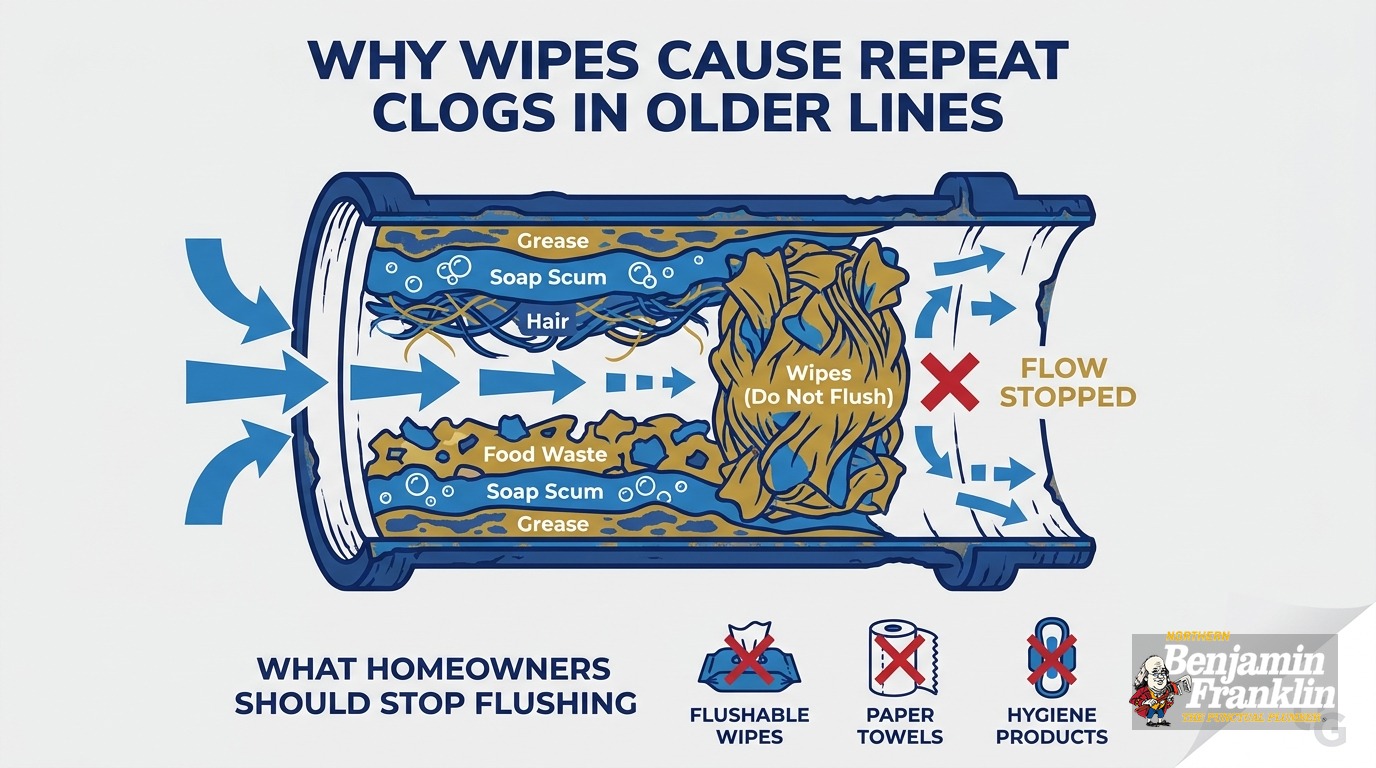
Wipes cause repeat clogs because they snag on a defect in the pipe, such as a root intrusion, an offset joint, or a rough scale ridge. A plumber clears the wipes, but the defect stays. The next wipe catches in the same spot.
Most articles skip this part. They tell you to stop flushing wipes, which is good advice. But it treats the wipe as the whole story.
In a smooth, healthy sewer pipe, a wipe moves with the water and keeps going. In a pipe with a rough spot, the wipe drags. Toilet paper catches on the wipe. Grease and soap residue stick to the paper.
A small snag becomes a plug. The plug backs up your drains. A plumber clears it, and everything works again.
But the rough spot is still there. Clearing a clog removes the material. It does not repair the pipe. So the next wipe, or the next wad of paper, catches in the same place.
That is why some homes get the same clog every few months. The household is not doing anything new. The pipe is holding the same trap in the same place.
Common snag points in older lines
Older homes often have older sewer pipes, and both the material and its condition matter. These are the usual trouble spots:
- Root intrusion. Tiny roots work into joints and open seams. They form a net that catches anything passing by.
- Offset joints. Soil shifts over the years. Two pipe sections can sit slightly out of line, and the lip catches debris.
- Scale and corrosion. Older metal pipes can build rough ridges inside. Cast iron is a common example in older homes.
- Cracks and breaks. Damaged clay or other older pipe can leave edges that grab paper and wipes.
- Sags, or bellies. A low spot holds water and waste. Solids settle there instead of moving on.
Our post on signs of cast iron drain pipe failure in Twin Cities homes shows what aging pipe looks like and what to watch for.
Roots and wipes work together
Minneapolis says it plainly. On its sewer problems page, the city says “Most back-ups occur when the sanitary lateral gets clogs with roots.” The lateral is the private pipe that runs from your house to the city main.
The same page lists “Misuse of the sewer system in your home” as another cause. That is where wipes come in.
Roots create the snag. Wipes and paper fill the net. The clog grows faster than either would alone.
If you suspect roots, read our guide to tree roots in sewer lines in Minnesota.
What Happens If You Flush Baby Wipes Down the Toilet?
Baby wipes can clog your toilet trap, your home drain line, or the city main. They do not dissolve. They tangle with paper and debris and form a plug. In a healthy pipe, they may pass through. In a pipe with a snag point, they often stay.
Baby wipes are on the EPA’s list. The agency’s septic care page says “An easy rule of thumb is not to flush anything besides human waste and toilet paper.” Its list of items to never flush includes “Non-flushable wipes, such as baby wipes or other wet wipes.”
The EPA does not split wipes into good and bad groups. Baby wipes, disinfecting wipes, and wet wipes all land on the same side of the line.
Here is what usually happens:
- You flush a wipe. It clears the toilet and disappears.
- It travels down your home’s drain line toward the main.
- It catches on a rough joint, a root hair, or a scale ridge.
- Toilet paper and other waste pile up behind it.
- Your drains slow down, gurgle, or back up.
Step three is why the problem may not show up right away. The wipe may sit in the pipe for days or weeks before the plug is big enough to notice.
Small clogs show up first
The early warning signs are easy to ignore:
- A toilet that flushes slower than it used to.
- Gurgling sounds from drains after a flush.
- Water that backs up in a tub or floor drain when the toilet runs.
- A faint sewer smell near a basement drain.
If a toilet is the main problem, our post on whether a toilet that won’t flush is a clog or a vent problem helps you sort out the cause. Read it before you call anyone.
What Wipes Do Beyond Your House
Wipes also hit the pumps and sewer mains in your city.
The Met Council wrote about this in a 2015 newsletter dated July 15, 2015. It said the agency runs eight wastewater treatment plants, about 600 miles of regional sanitary sewers, and 62 pumping stations. A weekend crew cleared non-flushable materials from lift-station screens. The manager of interceptor services called the cost “difficult to quantify.”
That article is more than a decade old, so treat it as history. The problem it describes has not gone away.
In May 2024, CBS Minnesota reported on Roseville. City crews saw “an influx of incidents of backed-up sewer pipes” tied to wipes and paper products. The city’s Public Works Director said, “The only paper product safe to flush is toilet paper.”
Roseville’s list of items not safe to flush is long:
- Personal hygiene wipes
- Baby wipes
- Disinfectant wipes
- Toilet cleaning pads
- Feminine hygiene products
- Paper towels
Use that list in your own home. Paper towels and cleaning pads feel like paper, but they are not.
Who Pays When the Line Backs Up?
In many Twin Cities cities, the homeowner owns the private sewer lateral, which runs from the house to the city main. The city handles the main. Rules differ by city, so check yours before you assume who pays.
A sewer backup is stressful, and you want to know who to call and who pays.
The research on this topic points to a common split. In Roseville, homeowners pay for repairs from the house to the main, and the city handles the main. Minneapolis also puts the private lateral on the property owner, according to its sewer problems page.
That page also says Minneapolis crews assess a backup at no charge through the 24-Hour Hotline, 612-673-5625. It says the property owner can submit a damage claim.
Other cities do things differently. We did not verify the rules for every Twin Cities suburb here. Call your city’s public works office and ask who owns what.
If you have a backup, do this:
- Stop using water. Do not run the washer or flush.
- Call your city’s sewer line if you live in Minneapolis, or your own city’s public works office.
- Ask the city to check the main.
- Call a plumber to check your private line.
Roseville’s advice is to call both a plumber and the utility. That is sound. If the main is clear, the problem is on your side. If the main is blocked, the city needs to know.
How Can You Tell a Wipe Clog from a Root Clog?
A wipe clog often follows a pattern: it starts after heavy flushing and clears with a snake. A root clog tends to return on a schedule, even when nobody flushes anything unusual. Only a camera can confirm the cause for sure.
Symptoms alone will not settle it. Both clogs make drains slow and gurgle, and both can back up a basement floor drain. Some clues do point one way.
Clues that point to wipes
- The clog showed up soon after someone started using wipes.
- The line cleared fully after snaking.
- A plumber pulled out a mass of fabric-like material.
- The problem began with a toilet and moved to other drains.
Clues that point to roots
- The clog returns every few months, even after careful flushing.
- Your yard has large trees near the sewer path.
- Several drains back up at once, not just one toilet.
- Cleaning pulls out fine, hair-like fibers.
Clues that point to a bad pipe
- Clogs return in the same place.
- Water sits in a low spot in the line.
- You smell sewer gas near a floor drain.
- Your home is older and has the original sewer line.
Most real cases mix two or three of these. Roots create the snag, wipes fill the net, and an aging pipe gives both a place to start.
If your symptoms look like a bigger line problem, read our post on sewer backup versus a simple drain clog. It helps you judge how urgent the situation is.
The Second Clog Rule: Camera the Line
One clog can be bad luck. Two clogs in the same line point to a cause.
Here is the rule we recommend: if a line clogs twice, schedule a camera inspection before the third clog.
A sewer camera is a small waterproof camera on a flexible cable. A technician feeds it into your line through a cleanout, and you watch the picture on a screen. It shows roots, cracks, offsets, scale, and low spots.
The camera answers the question that matters: why did the wipe stick there?
Without that answer, you are guessing. You may clear the line again and pay for the same visit twice. With it, you can fix the actual problem.
Our guide to sewer camera inspections in the Twin Cities explains the process and what you can expect to see.
Why not just keep snaking?
Snaking and cleaning have a place. They clear the blockage and get your drains working again. For a one-time clog in a healthy pipe, that may be all you need.
On damaged older lines, they fall short. A cable can scrape through a clog and leave the rough spot behind. Aggressive cleaning on a fragile pipe can make a crack worse. That is another reason to look before you pick a fix.
We offer sewer line cleaning and camera work together for this reason. The camera tells us which tool is right for your pipe.
What about chemical drain cleaner?
Skip it for a main-line problem. Store-bought cleaners are made for small, local clogs. They do not clear a wipe mass deep in a sewer line. They can also sit in the pipe and harm older materials.
They also add a safety risk. If a plumber opens the line later, leftover chemical can splash. Tell your plumber if you used any.
How Do You Clear a Main Sewer Line?
A plumber clears a main sewer line by accessing the cleanout and using a drain machine or hydro jetting to break up or flush the blockage. A camera then checks the pipe. DIY attempts can miss the cause or damage the pipe.
Your main sewer line carries all your home’s wastewater out to the city main. When it clogs, several drains back up at once. The lowest drain in the home, often in the basement, shows it first.
Many homes have a cleanout, a capped pipe that gives access to the main line. Our post on how to find and use your main sewer cleanout shows where to look and what to expect.
This is the order we follow on a main line call:
- Confirm the blockage is in your private line and not the city main.
- Open the cleanout and clear the clog with the right tool.
- Run a camera through the line to see what caused it.
- Explain what we found and show you the footage.
- Recommend repair only if the pipe needs it.
Step five matters. A clog does not always mean a broken pipe. Sometimes the camera shows a clean line, and the fix is a change in household habits.
When the pipe itself is the problem
If the camera shows a cracked, collapsed, or badly rooted pipe, cleaning only buys time. Repair or replacement makes sense then. Options include digging up the damaged section or using a trenchless method that avoids tearing up your yard.
A sewer line repair or replacement is a larger job. We can walk you through your options and discuss financing so the cost does not catch you off guard. Ask for a real quote. We never guess at a price over the phone.
What You Should Stop Flushing
Here is the list we hand to homeowners. It is simple on purpose. If it is not human waste or toilet paper, do not flush it.
Never flush these
- All wipes, including baby wipes, disinfecting wipes, and wipes labeled “flushable”
- Toilet cleaning pads
- Paper towels and tissues
- Feminine hygiene products
- Dental floss
- Cotton balls and swabs
- Diapers
- Cat litter
- Rags and cloth scraps
- Condoms
- Medications
The EPA lists many of these. Its septic care page names non-flushable wipes, cooking grease or oil, feminine hygiene products, condoms, dental floss, diapers, and cat litter.
Never pour these down any drain
- Cooking grease and oil
- Coffee grounds
- Food scraps
Grease works alongside wipes. It coats the pipe wall and gives wipes something sticky to grab. We cover the kitchen side in our post on preventing grease clogs in your kitchen drain.
Make it easy to follow
Rules only work if the whole household follows them. A few small steps help:
- Put a small lidded trash can next to every toilet.
- Tell guests and kids. Wipes often come from visitors.
- Keep wipes out of the bathroom if you cannot stop the habit.
- Post a short “toilet paper only” reminder in the bathroom.
If you have teenagers or small children, talk to them directly. Most people who flush wipes believe the package. Tell them the label is marketing, not a promise.
Does Minnesota Have a Law About Flushable Labels?
No, at least not that we found. Lawmakers have tried.
In 2020, Minnesota bills HF3181 and SF3139 would have restricted “flushable” labeling on wipes. The Minnesota House Session Daily article from March 31, 2020 said the bills were awaiting committee action. We found no sign that they passed.
So do not assume the state has checked or approved a “flushable” label. The Met Council and the EPA both tell you to keep wipes out of the toilet. Follow their advice, not the package.
Is the Wipe Habit Hurting Your Own Home?
Ask yourself a few honest questions:
- Does anyone in the house flush wipes, even “just sometimes”?
- Has a drain clogged more than once in the last year?
- Do you hear gurgling when a toilet flushes?
- Is your home older, with the original sewer line?
- Are there large trees near the path of your sewer line?
If you answered yes to two or more, a camera inspection is a smart next step. It costs less to look than to wait for a basement backup.
Preventing a backup is easier than cleaning one up. Water damage in a finished basement is stressful, and it can be a health issue. The EPA has warned that preventable toilet and sewer backups “can pose a threat to human health.”
What Northern Benjamin Franklin Plumbing Does
We are locally owned and operated, and we serve Twin Cities homeowners in Minneapolis, St. Paul, Blaine, Bloomington, Brooklyn Park, Coon Rapids, Maple Grove, and nearby suburbs. We work on drains and sewers every day, so we know what older lines look like inside.
When you call about a clog that keeps coming back, here is what we do:
- Listen to your history, including how often it has clogged.
- Clear the line safely.
- Run a camera to find the snag point.
- Show you what we see.
- Explain your options in plain language.
We also back our timing with the On-Time Guarantee(R). We arrive in the window you pick, or we pay you $5 for every minute we are late, up to $300. In our words: “If there is any delay, it’s you we pay!”
A backed-up line does not wait for a convenient day. We built our service around showing up when we say we will.
Next Steps
The label on the package does not change what happens in your pipe. Stop flushing wipes, and give your household a clear list.
If your line has clogged more than once, the pipe may need attention. A wipe is often just what finds the weak spot.
- Put a trash can next to every toilet today.
- Share the do-not-flush list with your household.
- If a line has clogged twice, book a camera inspection.
- If you see a backup, stop using water and call.
Call Northern Benjamin Franklin Plumbing at (763) 296-1844 or book online. We will help you find the cause, clear the line, and keep your drains moving.
Frequently Asked Questions
Can flushable wipes clog your septic tank? +
Are there any wet wipes you can put down the toilet? +
Need a technician now?