Remove Hard Water Stains and Scale Buildup: Twin Cities
Key Takeaways
- To remove hard water stains and scale buildup, use an acid-based cleaner such as white vinegar, give it time to work, and scrub gently.
- Hard water stains are mineral deposits. They come from calcium and magnesium left behind when water dries.
- Twin Cities city water is moderately hard, not extreme. Cleaning may be all you need.
- Suburbs on wells or other supplies can run much harder. Check your own utility report.
- Acid can harm chrome, natural stone, and coated finishes. Read the manufacturer’s care guidance first.
- Scale also builds inside your water heater and appliances, where you cannot see it.
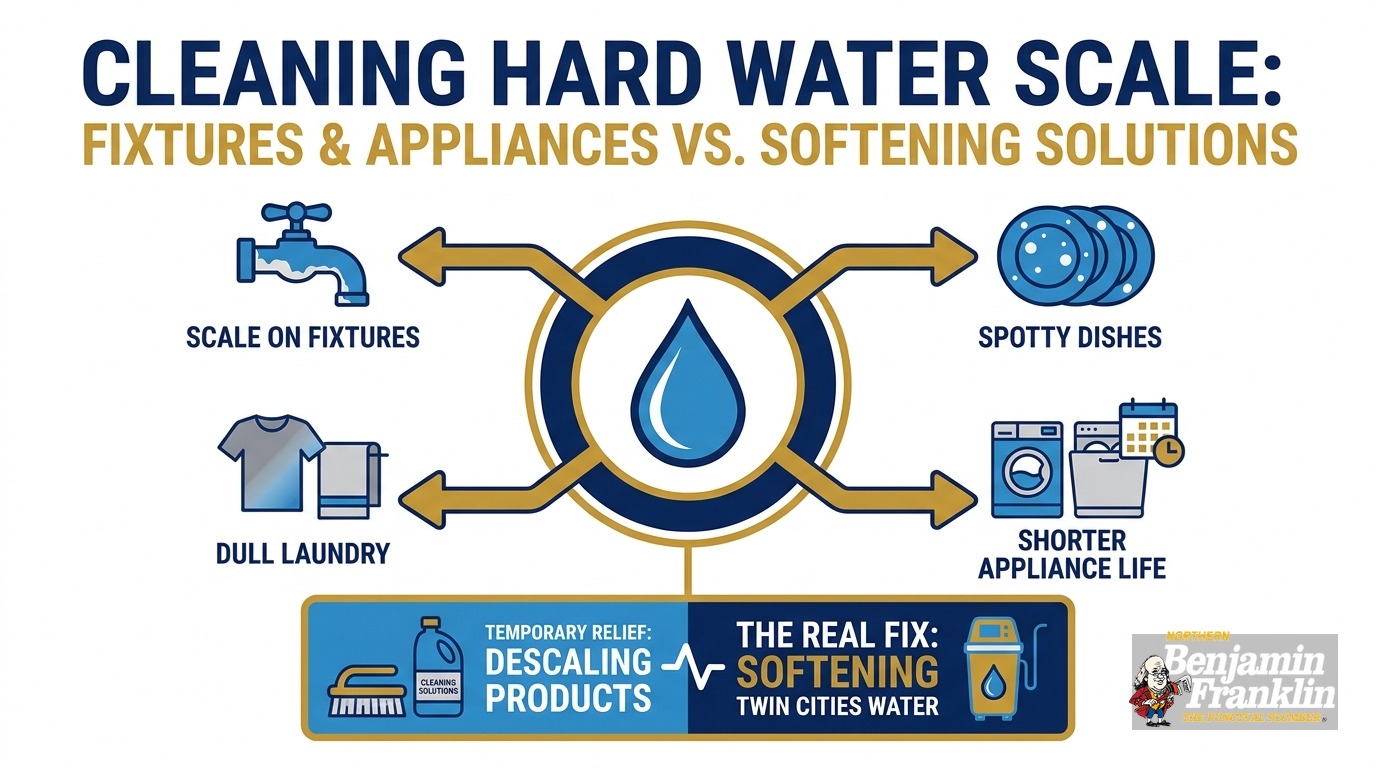
- If stains return within days or appliances suffer, softening is the real fix.
- Softeners carry tradeoffs in Minnesota, including salt and chloride. Set yours correctly.
What causes hard water stains?
Dissolved calcium and magnesium in your water cause them. When a drop dries on glass, tile, or metal, the water leaves and the minerals stay behind. Repeat that thousands of times, and a thin film becomes a hard crust called scale.
The U.S. Geological Survey explains that hardness comes from these minerals. They dissolve as water moves through rock and soil on its way to your tap. The water itself is safe to drink. It just leaves evidence.
Three things make stains worse:
- Heat. Warm water drops minerals out of solution faster. That is why scale piles up in kettles, coffee makers, and water heaters.
- Evaporation. Water that sits and dries leaves the most residue. Think shower doors and faucet bases.
- Time. Fresh film wipes off easily. Old scale bonds to the surface and fights back.
A weekly wipe-down takes seconds. A year of neglect can take an afternoon.
How hard is Twin Cities water, really?
Twin Cities water is usually moderate, not extreme. The U.S. Geological Survey classes hardness in four bands. Zero to 60 mg/L as calcium carbonate is soft. Water at 61 to 120 mg/L is moderately hard. Water at 121 to 180 mg/L is hard. Anything above 180 mg/L is very hard.
Now the local numbers. St. Paul Regional Water Services says its finished water hardness is moderately hard. That lands in the moderately hard band.
The utility also softens its water at the plant. Its water supply plan describes raw Mississippi River water as noticeably harder than the finished water. Softening brings finished water down to about 4 to 5 grains per gallon.
Your street may not match the city average. Homes on private wells, and some suburbs with their own supplies, can see much harder water. Hardness can also shift with the season and the water source.
So don’t guess. Pull up your utility’s latest water quality report, or have your water tested. Our guide to Twin Cities grains-per-gallon numbers shows how to read the results.
How do I remove hard water stains from glass?
To clean glass, soak a cloth in white vinegar, press it on the stain for 10 to 15 minutes, then wipe and rinse. Use a non-scratch pad on stubborn spots. Dry the glass with a clean towel to stop new spots from forming.
Shower doors take the most abuse. This routine works:
- Warm equal parts white vinegar and water in a spray bottle. A quick spell in the microwave is fine.
- Spray the glass and let it sit for 10 minutes.
- Spray again on dry patches so the solution never dries on the glass.
- Scrub with a soft sponge or a non-scratch pad.
- Rinse with clear water and dry with a microfiber towel.
For thick, crusty spots, make a paste of baking soda and a little water. Rub it on gently with a damp cloth. Baking soda is a mild abrasive, so keep the pressure light.
Do not use steel wool or razor blades on coated or tempered glass. Scratches trap minerals, and the next layer of scale sticks even faster.
Then change one habit. Squeegee the glass after each shower. It takes 20 seconds and removes the water before it can dry. This single step cuts glass staining more than any cleaner.
How do I get thick limescale off my toilet bowl?
For heavy limescale, lower the water in the bowl, coat the crust with white vinegar, and let it sit for several hours or overnight. Then scrub with a stiff nylon brush. A pumice stone made for toilets can lift the last bits when you keep it wet.
Toilet scale is stubborn because it sits at the waterline, where water evaporates a little at a time. Follow these steps:
- Lower the water. Turn off the supply valve and flush. Most of the water leaves the bowl. Use a cup to remove any remainder if you can.
- Apply the acid. Pour white vinegar around the rim and onto the stained area. Soak paper towels in vinegar and press them onto the ring so they stay in place.
- Wait. One hour helps with light stains. Overnight works better for thick rings.
- Scrub. Use a stiff nylon brush. Skip wire brushes, which scratch porcelain.
- Restore the water. Open the supply valve and flush. Repeat if needed.
A word on safety. Never mix vinegar with bleach. Never mix any acid cleaner with a chlorine product. The combination releases dangerous gas. If you used a bleach tablet in the tank or bowl, flush several times before you use vinegar.
Watch for stains that are not scale. Brown or rust streaks can point to iron in the water. Pink film is often bacteria growth. Those need different fixes. Our post on iron and manganese in well water covers the rust-colored kind.
If the toilet runs constantly, you may be leaving water to evaporate in odd places. That is a separate problem. Our team can handle toilet repair and replacement when cleaning does not solve it.
How do I fix hard water in my shower?
Fixing hard water in the shower is two jobs: clean the buildup now, then reduce what causes it. Soak the showerhead in vinegar, scrub the tile and tub, and wipe the glass after use. If scale returns within weeks, treat the water itself.
Start with the showerhead. Mineral crust blocks the small spray holes and weakens the stream. You do not always need to replace it.
- Fill a plastic bag with white vinegar.
- Slip the bag over the showerhead and secure it with a rubber band.
- Let it soak for one to four hours, depending on the buildup.
- Remove the bag, run hot water for a minute, and brush the nozzles with an old toothbrush.
If the finish looks cloudy or pitted after soaking, stop. That is a sign the vinegar is affecting the surface. Rinse it well and switch to a gentler method, such as a damp cloth with a little baking soda.
For tile and grout, spray a diluted vinegar solution and scrub with a soft brush. Do not use acid on natural stone tile. The next section covers that.
Some showerheads wear out faster in hard water. Rubber nozzles clog and rubber washers harden. When cleaning stops working, read our guide on shower head replacement after hard water buildup. It explains when a new head beats another soak.
If your shower has temperature swings or a weak flow that cleaning does not cure, the problem may sit deeper. Scale can stick shower cartridges and valves. A plumber can check faucets and fixtures without guesswork.
Which finishes can acid damage?
Acid can damage chrome, brass with a lacquer coating, natural stone, and some matte or brushed finishes. It can also etch marble, travertine, and limestone. Check the manufacturer’s care guidance before you soak or spray anything. When in doubt, test a hidden spot and keep contact time short.
Most cleaning guides skip this. Vinegar is mild, but it is still an acid. Left on too long, it can strip a finish. One homeowner comment on a popular DIY guide reported vinegar left overnight dulling chrome fixtures. We have seen similar results in homes.
Use this quick guide:
- Chrome and polished nickel: Use short contact times, five to ten minutes. Rinse and buff dry. Do not soak overnight.
- Brushed, matte, and oil-rubbed finishes: These can be sensitive. Start with warm water and mild soap, then try diluted vinegar on a hidden spot.
- Natural stone: Skip acid entirely. Use a stone-safe cleaner. Acid eats the surface and leaves a dull patch that no scrubbing fixes.
- Porcelain and ceramic: These handle vinegar well. Avoid abrasive pads that scratch the glaze.
- Stainless steel sinks: Vinegar works, but wipe with the grain and rinse thoroughly.
- Plastic and rubber parts: Short exposure is fine. Long soaks can harden or discolor them.
Skip muriatic acid for home cleaning. It is a harsh industrial acid. It can damage fixtures, grout, and metal, and it is dangerous to handle. If vinegar will not touch a stain, you probably have a deeper issue than a cleaner can solve.
For small parts, remove the piece and soak it separately. That protects the rest of the fixture. Our guide to cleaning a faucet aerator walks through the steps for the most common one.
How does scale affect your water heater and appliances?
Scale forms wherever hot water sits, so your water heater, dishwasher, and coffee maker collect it first. The U.S. Geological Survey notes that heating hard water can leave calcium carbonate deposits. Those deposits can shorten equipment life and raise water heating costs.
You don’t see this damage. USGS says that when hard water is heated, as in a home water heater, solid deposits of calcium carbonate can form. It adds that scale can reduce the life of equipment, raise the cost of heating water, lower the efficiency of electric water heaters, and clog pipes.
Here is what that looks like at home:
- Water heater. Sediment settles on the bottom of the tank. You may hear popping or rumbling as water boils under the layer. Scale on elements can also cut performance.
- Tankless water heater. Scale collects inside the heat exchanger and narrows the water path. These units need periodic descaling.
- Dishwasher. Spots on glasses, a white film on the tub, and weaker spray arms are common signs.
- Coffee maker and kettle. White flakes and slower brewing point to scale in the heating parts.
- Washing machine. Stiff towels and a gray tint on whites can trace back to minerals.
For the water heater, flushing helps. Our guide on flushing sediment from a water heater tank covers the steps and the warning signs. If you have a tankless unit, read about tankless descaling and maintenance.
A noisy tank may mean more than sediment. Our team can inspect it during water heater maintenance and tell you whether flushing is enough.
For small appliances, follow the maker’s directions. Many call for a vinegar and water cycle. Run clear water through afterward so no vinegar taste stays behind.
When is cleaning enough, and when do you need a softener?
Cleaning is enough when scale builds slowly, stains wipe off easily, and appliances run well. A softener is worth a look when stains return within days, fixtures clog often, or your water heater and appliances show scale damage. Your actual hardness level decides which side you land on.
Many sales pitches skip this honest middle. Here is how we think about it.
Cleaning is usually enough if:
- Your water comes from a Minneapolis or St. Paul-type city supply that is treated at the plant.
- Your tested hardness is moderate, around the five grains per gallon St. Paul reports.
- You squeegee glass, wipe fixtures, and run a vinegar cycle on appliances now and then.
- Your water heater stays quiet and heats well.
A softener starts to make sense if:
- Your water test shows hard or very hard water. Many wells and some suburban supplies fall here.
- Shower glass and faucets spot up again within a few days of a deep clean.
- Aerators and showerheads clog every few months.
- Your water heater makes noise or loses performance despite flushing.
- Dishwasher and washing machine results keep declining.
What you need is a number. Guessing leads to buying a system you do not need, or skipping one you do. A home water test gives you a hardness figure for your own tap.
Not sure what type of system fits? Our comparison of softeners and filtration systems explains the difference. Our hard water solutions page shows what we offer.
What are the downsides of softening water in Minnesota?
Softeners use salt, and that salt ends up in Minnesota’s lakes and rivers as chloride. Poorly set systems waste more of it. You can limit the impact by setting your softener correctly and keeping outdoor spigots on hard water. Some homes also consider salt-free conditioners.
This is a real state issue. The Minnesota Pollution Control Agency’s chloride reduction program lists road salt as a major source of chloride pollution. It puts water softeners and other wastewater at 25 percent, and fertilizer at 23 percent. The agency also says a lot of that pollution comes from inefficient softeners.
You can do your part without giving up soft water. The MPCA’s advice on softener salt use is simple. Check and adjust your softener settings. Limit how many faucets use softened water. Outdoor spigots and sprinklers can use hard water.
In practice, that looks like this:
- Set the hardness level to match your water. An old setting from a prior owner may waste salt. Have a plumber check it.
- Soften only what needs it. Lawn watering and hose bibs gain nothing from soft water.
- Keep up maintenance. A neglected brine tank or tired resin works poorly and uses more salt. See our notes on softener maintenance in the Twin Cities.
- Consider the alternatives. Salt-free conditioners change how minerals behave, but they work differently than true softening. Read our comparison of a salt-free conditioner versus a softener before you decide.
A softener is a good tool when the numbers call for it. It is not a default purchase. Our water softener options page lists what we install. If a whole-home system is a big job for your budget, ask us about financing.
How can you keep scale from coming back?
You can slow scale with small daily habits and a few scheduled tasks. Wipe wet surfaces, clean aerators and showerheads on a schedule, and flush your water heater. These steps cost little and protect your fixtures. They also tell you whether you have outgrown a cleaning routine.
Try this simple plan:
Daily
- Squeegee shower glass after each use.
- Wipe faucet bases and sink edges with a dry cloth.
Monthly
- Spray tile and fixtures with diluted vinegar, then rinse. Respect the finish rules above.
- Check the showerhead and faucet aerators for slow flow.
Every few months
- Run a vinegar cycle through your coffee maker and dishwasher.
- Clean the toilet waterline before a ring forms.
Yearly
- Flush your water heater tank, or have us do it.
- Check softener settings if you have one.
Track how fast the scale comes back. That is your best clue. If a deep clean holds for weeks, your water is manageable. If it fails in days, the water is the problem, not your cleaning.
When should you call a plumber?
Call a plumber when cleaning does not restore flow, when appliances show damage, or when you suspect scale inside your pipes. Also call when you want a real hardness number or help choosing a softener. A plumber can test the water and check your heater, fixtures, and settings.
Signs that cleaning will not fix it:
- Low flow at several faucets, even after aerators and showerheads are clean.
- A water heater that pops, rumbles, or runs out of hot water early.
- Faucets or cartridges that stick or drip from mineral buildup.
- A softener that no longer softens, or salt use that keeps climbing.
- Scale returning within days of a deep clean.
Some of these overlap with other problems. A hot water shortage can come from a failed heating element or dip tube, not scale. Low flow can come from a pressure issue. A trained eye keeps you from treating the wrong thing.
Our team handles plumbing repair, water heater service, and water treatment across the metro. We are locally owned and operated, and we know Twin Cities water.
We also respect your time. Our On-Time Guarantee(R) means we arrive in the window you pick, or we pay you $5 for every minute we are late, up to $300. In short: “If there is any delay, it’s you we pay!”
Stubborn scale does not have to be a weekly chore. Call (763) 296-1844 or book online, and we will help you find out whether you need a better routine or a better water system.
Frequently Asked Questions
What cleans hard water stains in the toilet? +
Can vinegar damage my faucets and fixtures? +
Do I need a water softener if I live in Minneapolis or St. Paul? +
Need a technician now?