Salt Free Water Softener Alternative: The Twin Cities Guide
Key Takeaways
- Minneapolis and St. Paul city water runs 5-6 grains per gallon (GPG). Many city residents do not need a softener at all.
- Twin Cities suburbs on groundwater often see 17-32 GPG. That range is where the treatment choice carries the most weight.
- TAC conditioners have reasonable research support at moderate hardness (roughly 9-15 GPG). At 25+ GPG, the published evidence becomes inconsistent.
- Potassium chloride is not an environmental free pass. It still discharges chloride, which the MPCA identifies as the actual pollutant harming Minnesota lakes and streams.
- The MPCA’s guidance is not “switch to salt-free.” It is “use salt smarter” with a demand-initiated, metered softener.
- Brooklyn Park residents may qualify for a $100 rebate on a demand-initiated softener, through June 30, 2026.
- A water hardness test is the right first step before buying any treatment equipment.
Is There Really Such a Thing as a Salt-Free Water Softener?
Sort of - but the term misleads more than it helps. Salt-free conditioners do not remove calcium and magnesium from your water. They change how those minerals behave, so they form suspended crystals instead of sticky scale. That is not softening in the technical sense. But for the right hardness level and the right problem, the result can matter.
Traditional ion-exchange softeners replace calcium and magnesium with sodium (or potassium) ions. Water leaving the tank genuinely contains fewer hardness minerals. That is the definition of soft water. Salt-free systems skip that swap entirely. The most common salt-free technology is template-assisted crystallization, or TAC. Water flows through a proprietary resin media. Calcium and magnesium attach briefly, then release as microscopic crystals. Those crystals rinse through your pipes instead of coating them. The hardness number in your water stays the same. Limescale just forms much more slowly.
That distinction matters before you spend any money. If scale on fixtures and appliances is your main complaint, a well-chosen salt-free system can help at the right hardness level. If you want soft water for skin sensitivity, better soap lather, or laundry results, a conditioner will not give you the same outcome as a true ion-exchange softener.
The answer is not “salt-free systems are a scam” or “they’re as good as conventional softeners.” It is: your zip code determines which conversation you are actually having.
What Does Hard Water Look Like Across the Twin Cities?
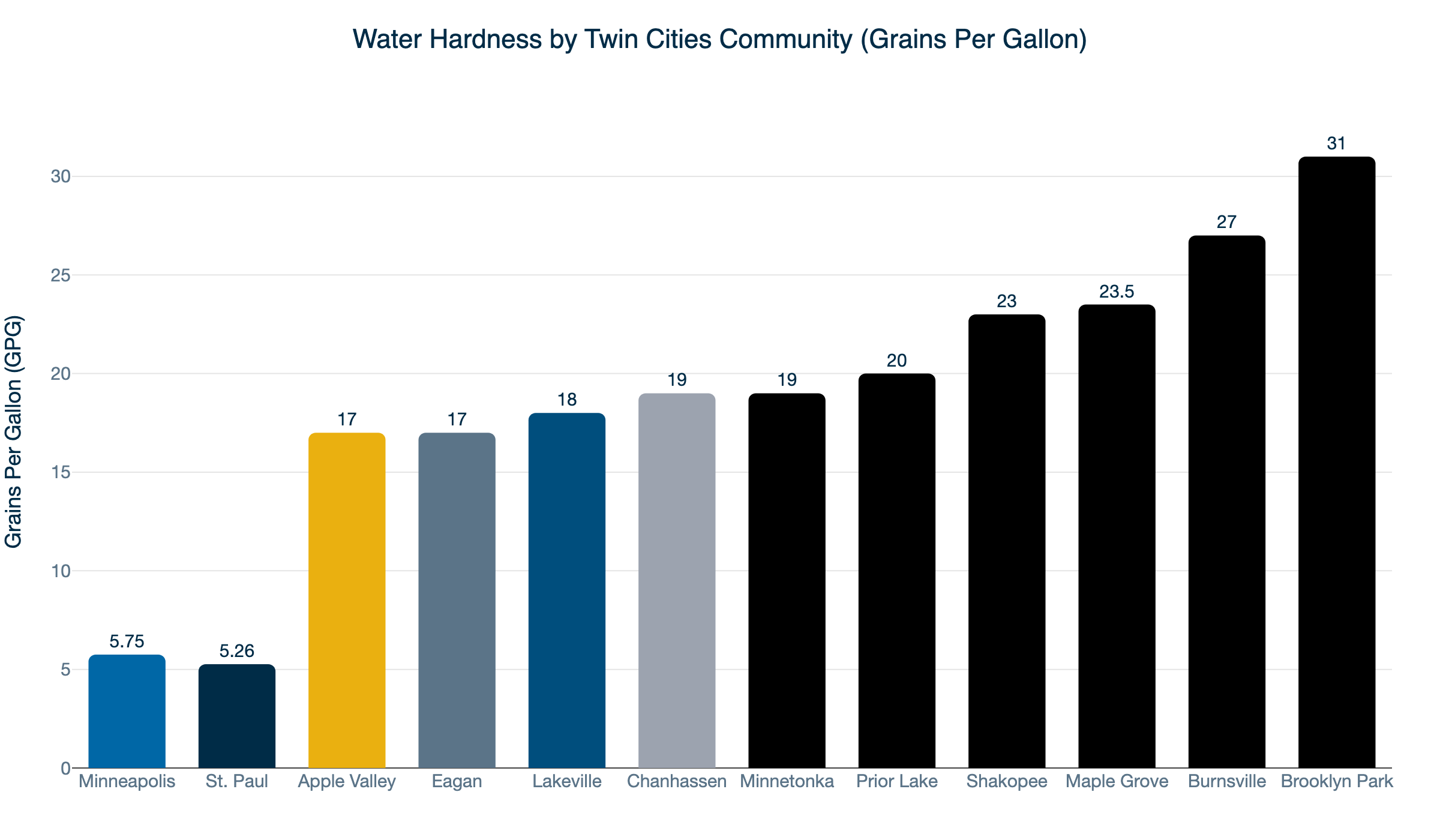
Very different, depending on where your water comes from. Minneapolis and St. Paul city water runs 5-6 GPG - moderately hard at most. Most Twin Cities suburbs draw from groundwater, which runs 17-32 GPG in many communities. That six-fold range means the right treatment strategy varies significantly by zip code.
Minneapolis draws from the Mississippi River and treats water at the plant. Monthly water quality reports from the city show hardness that varies across seasons. St. Paul also treats Mississippi River water. The SPRWS April mineral report documents the city’s water hardness level. For Minneapolis and St. Paul customers, scale is possible but often minor. Many households in both cities won’t notice significant problems.
Suburbs are a different story. Most communities draw from groundwater, tapping into aquifers with much higher mineral content. Municipal hardness data compiled from utility records shows a wide spread: Apple Valley and Eagan sit at 17 GPG. Lakeville runs 18 GPG. Chanhassen and Minnetonka come in at 19 GPG. Prior Lake is 20 GPG, Shakopee is 23 GPG, and Maple Grove runs 22-25 GPG. Burnsville reaches 25-29 GPG. Brooklyn Park sits at the high end, at 30-32 GPG - roughly six times harder than Minneapolis city water.
Why is Minnesota groundwater so hard? The state sits on limestone and dolomite bedrock, and aquifer water dissolves calcium and magnesium as it percolates through. Treated surface water gets some of that mineral load removed at the plant. Private wells and most suburban municipal systems do not.
At 5-6 GPG, you might reasonably ask whether any treatment is necessary. At 30 GPG, you are dealing with rapid scale buildup on water heaters, shower heads, dishwashers, and faucets. The useful lifespan of appliances shortens. The right treatment choice looks very different at each end of that range, and skipping a hardness test before buying equipment is the most expensive mistake homeowners make.
How Can You Soften Your Water Without Salt?
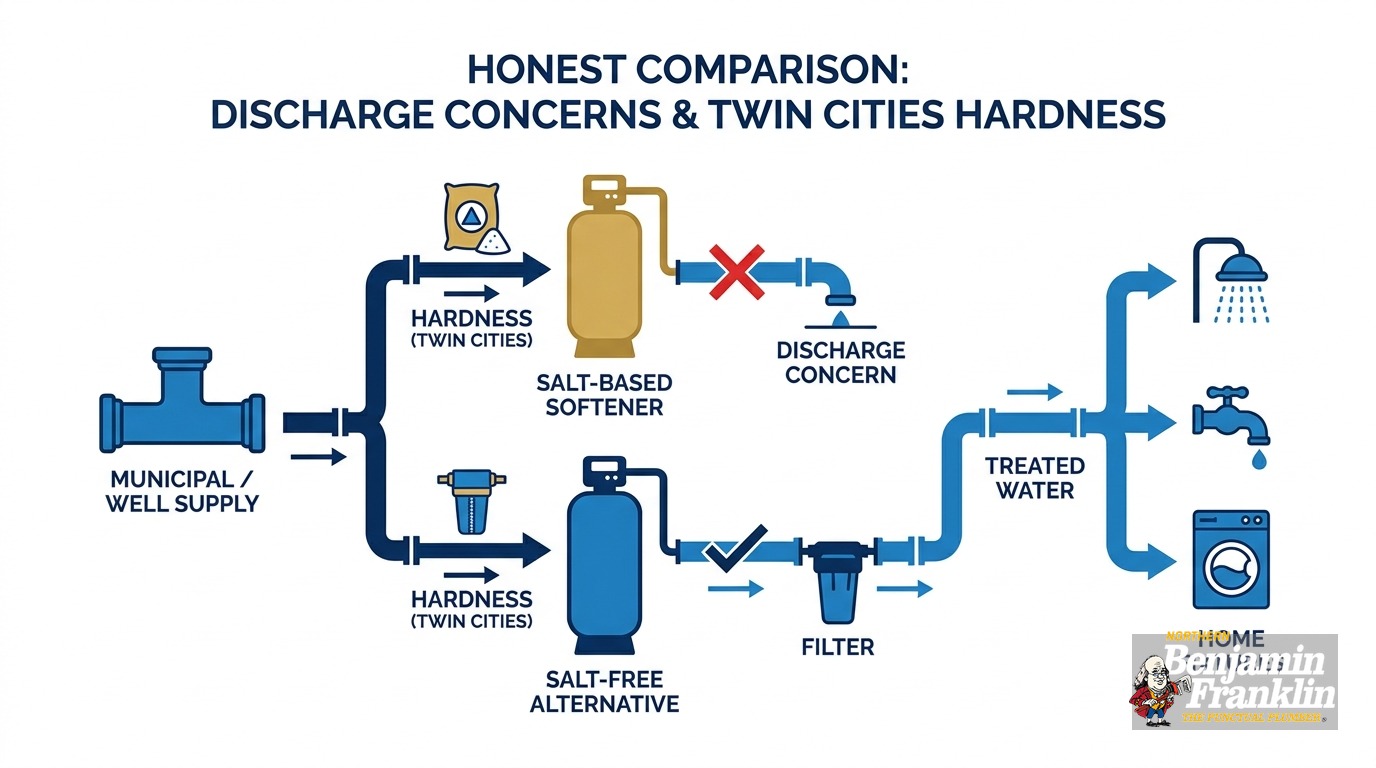
The main options are TAC conditioners, potassium chloride in a standard softener, and high-efficiency demand-initiated softeners. TAC prevents scale without removing hardness minerals and discharges nothing. Demand-initiated softeners use sodium or potassium chloride but regenerate only when needed, cutting salt use dramatically. The MPCA points most Minnesota homeowners toward that last option.
Here is how each one actually works:
TAC conditioners (template-assisted crystallization)
TAC uses a resin media to transform dissolved calcium and magnesium into suspended microscopic crystals. Those crystals pass through your plumbing without adhering to surfaces. No salt required, no brine discharge, no electricity draw. Media lasts several years before replacement. The system works passively.
The critical caveat: TAC does not remove hardness minerals. Run a hardness test before and after installation - the number won’t change. The benefit is scale prevention, not mineral removal. That is the right tool for protecting appliances from deposits. It is not the right tool if soft water itself is your goal.
Potassium chloride in an ion-exchange softener
You keep your existing softener and swap sodium chloride pellets for potassium chloride. The water genuinely softens - calcium and magnesium are removed from the water, just as with sodium chloride. You also keep sodium out of your drinking water, which matters for households managing sodium intake for health reasons.
Potassium chloride typically costs more per bag than sodium chloride. And as the next section covers, swapping one chloride salt for another does not solve the environmental problem that drives interest in salt-free systems in the first place.
High-efficiency demand-initiated softeners
These use sodium chloride but regenerate only when the resin is actually exhausted - not on a fixed timer. That change in programming cuts salt use and brine discharge substantially. Residents in Marshall, MN who switched from time-clock to demand-initiated softeners reduced their salt use by 86%, dropping from roughly four bags a month to about two bags per year. That is achievable without abandoning salt-based softening entirely. It is the route the MPCA recommends most consistently.
Pairing any softener with proper maintenance keeps it running efficiently. Our water softener maintenance checklist for Twin Cities homes covers what to check and how often.
What Does the Research Actually Show About TAC?
At moderate hardness levels, TAC has reasonable evidence behind it. At very high hardness - common in Twin Cities suburbs - that evidence becomes thin and inconsistent. The gap between studies is the most important thing to understand before buying.
An Arizona State University and California Water Resources Control Board study tested TAC at hardness levels of 180-250 mg/L (roughly 10-15 GPG). Their results showed significant scale reduction. German DVGW W512 testing of certified systems found consistently above 90% scale reduction in a similar hardness range.
The University of Waterloo ran its own study on TAC and found roughly 5% scale reduction. Same technology category. Dramatically different result.
What explains the gap? Feed hardness and temperature are major variables. TAC performs most reliably within a specific operating range. Nearly all the strong evidence comes from moderate hardness conditions - the 150-250 mg/L range (about 9-15 GPG). As hardness climbs toward 25-32 GPG, the research base thins out and results become less predictable. Most peer-reviewed literature on TAC is also limited in volume, and manufacturer-sponsored studies outnumber independent ones.
Quality Water Lab’s TAC explainer covers the mechanism clearly if you want to understand how the crystallization process works. The bottom line: TAC is real technology, not snake oil. But if you are in Burnsville or Brooklyn Park on 27-32 GPG water, you are making a decision where the supporting data is sparse. That is worth naming honestly before you spend the money.
What Are the Downsides of a Saltless Water Softener?
Salt-free conditioners leave hardness minerals in your water - the GPG reading does not change. At 25+ GPG, their scale reduction is uncertain. The slick feel of softened water and improved soap lather are absent. Media needs periodic replacement, and upfront cost can be significant for a system that may underperform at high hardness.
Here is the full picture:
Performance at high hardness is uncertain. The strongest TAC evidence comes from studies at 9-15 GPG. If your incoming water is 25+ GPG, you may not see the results those studies reported. That is not a manufacturer’s talking point - it is what the independent research gap actually shows.
Hardness minerals stay in your water. A salt-free conditioner does not lower your GPG reading. Soap does not lather as freely with hard water. Skin and hair still feel the effects. If mineral content itself is the concern, a conditioner will not address it.
No change to drinking water mineral profile. Ion-exchange softeners swap hardness minerals for sodium, which some people can detect in taste. TAC leaves the mineral profile unchanged. For some households, that is a positive. For others, it is simply a feature they are not getting.
Media replacement is a real cost. TAC media typically lasts three to five years depending on hardness and flow volume. A conventional softener needs salt on an ongoing basis. Both technologies carry a maintenance cost - they just look different.
You may end up buying a softener anyway. If a TAC conditioner underperforms at your hardness level, the practical outcome is often buying a conventional softener to replace it. That is an expensive detour.
For a broader look at how softeners and filtration systems compare, our post on water softeners versus water filtration systems walks through the differences in plain terms.
Does Potassium Chloride Actually Solve the Chloride Problem?
No. Potassium chloride removes sodium from the exchange, but the actual environmental pollutant in Minnesota waterways is chloride. Potassium chloride still contains chloride, and it still discharges when the softener regenerates. Swapping salts changes one half of the equation and leaves the other half untouched.
The MPCA’s chloride reduction program is explicit on this point: potassium chloride still contributes to chloride pollution in waterways. Chloride is permanent and irreversible once it reaches receiving water. There is no cost-effective wastewater treatment process to remove it.
The scale of chloride pollution in Minnesota is significant. Many lakes and streams in the state already exceed the water quality standard for chloride. Wastewater treatment plants are the largest point source statewide at approximately 22% of total chloride loading - and water softener brine is a primary driver of that figure. Many Minnesotans draw their drinking water from groundwater, which is typically hard, making residential softener discharge a widespread issue.
Potassium chloride has one genuine benefit: it keeps sodium out of your drinking water. That matters for households managing sodium intake for medical reasons. It is a real reason to choose it. But if your goal is reducing environmental impact, the more effective action is cutting total salt use through a properly sized demand-initiated softener - regardless of which type of pellet you put in it.
What Rebates Are Available Right Now in Minnesota?
Brooklyn Park offers a $100 rebate for demand-initiated (metered) softeners, funded by the Metropolitan Council through the Clean Water Land and Legacy Amendment, expiring June 30, 2026. A proposed state bill would add a $200 statewide rebate for upgrading time-clock softeners to demand-based units, but it has not yet passed.
Brooklyn Park: $100 rebate, through June 30, 2026. Brooklyn Park residents who install a demand-initiated (metered) water softener can apply for a $100 cash rebate. Details and the application are at the Brooklyn Park Water Efficiency Rebate Program page.
Proposed statewide rebate - SF 3519. The Minnesota legislature is considering legislation that would create a $200 statewide rebate for homeowners who replace time-clock softeners with demand-based units. As of the 94th Legislature (2025-2026 session), this bill is proposed but not yet enacted. Check with your municipality for any local programs that may run alongside a future state program.
Both programs target demand-initiated softeners specifically, not salt-free conditioners. That reflects where the environmental data points most clearly. A demand-initiated softener that runs in good condition cuts discharge substantially. Keeping the brine tank clean is part of that equation. Our guide to water softener brine tank cleaning covers the steps before buildup becomes a problem.
Which Option Is Right for Your Twin Cities Home?
It depends on your hardness number. City water customers at 5-6 GPG may not need treatment at all. At 15-20 GPG, a TAC conditioner is a reasonable option. At 25+ GPG, a high-efficiency demand-initiated softener is the more defensible choice for both scale control and environmental responsibility.
Here is a practical framework by hardness level:
Minneapolis or St. Paul city water (5-6 GPG): Ask whether you need any treatment before buying anything. Scale buildup at this hardness level is possible but often minor. If you do want protection, a TAC conditioner is reasonable here - the evidence supporting it is stronger at 5-6 GPG than at high hardness. A quick water test confirms whether the problem you are trying to solve is real.
Suburbs at 15-20 GPG (Apple Valley, Eagan, Lakeville, Chanhassen, Minnetonka): A TAC conditioner may handle scale reasonably well. You will not get fully softened water. If scale protection for appliances and fixtures is your goal, there is a defensible case for TAC in this range. A demand-initiated ion-exchange softener is worth comparing if you want actual soft water for its other benefits.
Suburbs at 25+ GPG (Burnsville, Brooklyn Park, Maple Grove, Shakopee): This is the range where TAC evidence thins out. A high-efficiency demand-initiated softener is likely the more reliable choice for scale control and appliance protection. It uses dramatically less salt than an older time-clock model and delivers fully softened water. If you are in Brooklyn Park, the $100 rebate makes the upgrade worth pursuing before it closes in June 2026.
If reducing chloride discharge is the priority: A demand-initiated softener sized to your actual household water use is the MPCA-backed route. The salt reduction can be dramatic - the Marshall, MN case study showed 86% less salt per year after the upgrade. A properly maintained system running at the right settings does not over-regenerate, which is where most of the unnecessary chloride discharge comes from.
There is also a longer-term trend worth watching. A peer-reviewed study in PMC examined centralized municipal softening, where utilities treat water at the plant. Robbinsdale, MN reduced hardness from 24 GPG to 5 GPG at the plant level, eliminating individual household discharge entirely. That approach won’t help today’s homeowner, but it suggests where some municipalities may eventually go.
Whatever your situation, the team at Northern Benjamin Franklin Plumbing is locally owned and operated. We know Twin Cities water because we work in it every day across Minneapolis, St. Paul, Brooklyn Park, Maple Grove, Burnsville, and the surrounding metro. Our water softeners service page covers the full range of options we install and service.
We show up in the window we commit to - that is the On-Time Guarantee(R). If we don’t make it, “If there is any delay, it’s you we pay!” You’re covered up to $300, at $5 for every minute we’re late.
Call us at (763) 296-1844 or book your water treatment consultation online.
Frequently Asked Questions
Is there an alternative to a salt water softener? +
Need a technician now?