Dishwasher Backing Up Into Kitchen Sink: Causes and Fixes
Key Takeaways
- Your dishwasher, garbage disposal, and kitchen sink share one drain path. A clog anywhere along it can push dishwasher water up into the sink.
- Where the water surfaces is a clue. Water at the air gap cap points to one segment. Water in the sink basin points to another.
- Minnesota code now allows either an air gap or a drain line run high under the countertop. Many pages online still call the air gap mandatory.
- The loop built into the machine is not the same as a high run under the counter.
- Check the disposal, the knockout plug, and the filter first. These are safe DIY steps.
- If other fixtures also gurgle, back up, or drain slowly, the problem is likely a branch or main line. Call a plumber.
Why does my sink fill up when I use the dishwasher?
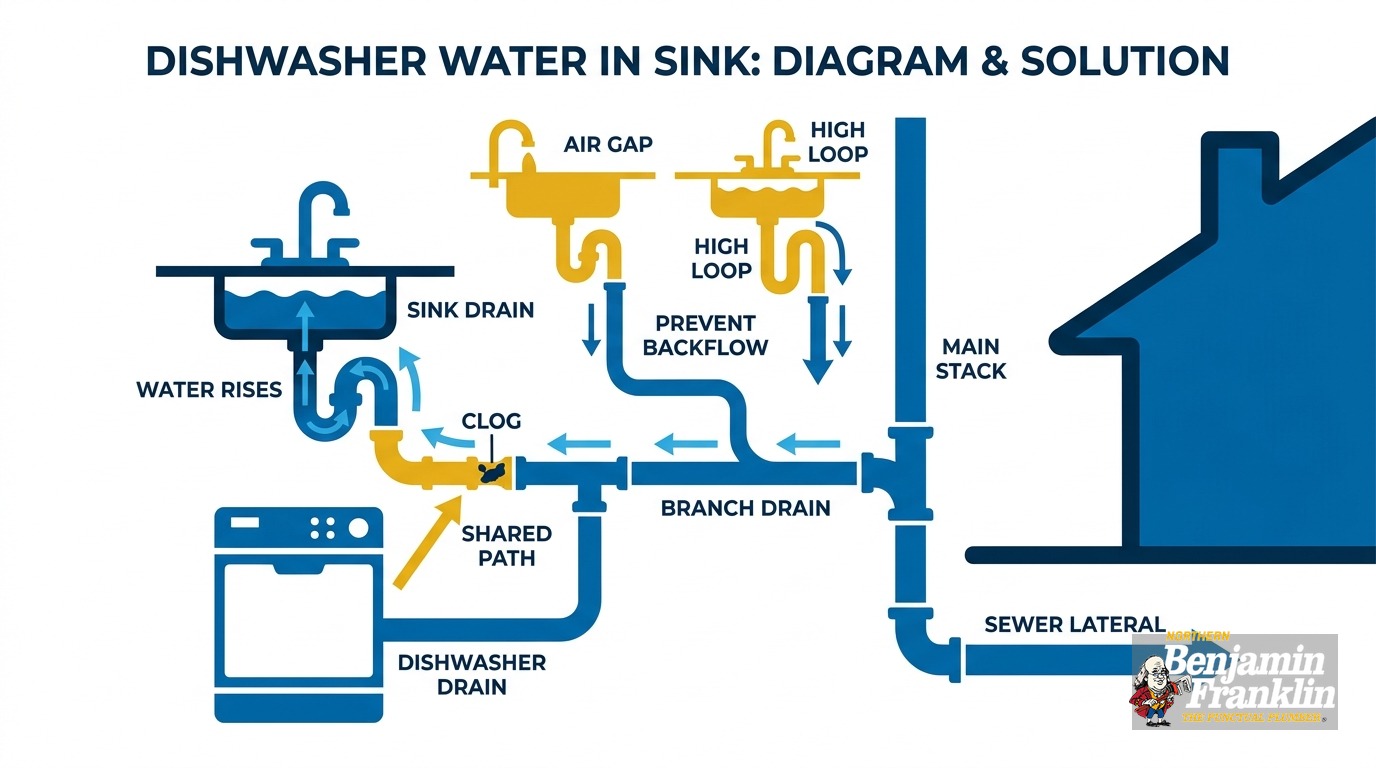
Your dishwasher drains into the same pipe as your kitchen sink. When something blocks that shared pipe, the pump has nowhere to send the water, so it rises in the sink. The blockage is usually in the disposal, the sink trap, or the line just past it.
The fix depends on where the block sits.
Most people picture the dishwasher as a separate machine with its own exit. It borrows the sink’s drain instead. When the sink drain slows down, the dishwasher shows it first. A dishwasher dumps a lot of water in a short burst. A partly clogged line can handle a trickle from the faucet but fail under that surge.
You may notice a few signs before the full backup:
- Gray, soapy water in the sink after a cycle.
- Gurgling from the sink drain while the machine runs.
- A sour smell from the sink.
- Standing water in the bottom of the dishwasher after the cycle ends.
The same thing can happen in reverse. Fill the sink with water, then run the dishwasher. If the drain cannot keep up, the line is already narrowed.
Slow drains are easy to ignore. We wrote about that in our post on what slow drains are trying to tell you. A dishwasher backup is often the moment a slow drain becomes a real problem.
What path does dishwasher water take?
Dishwasher water follows a fixed route. Knowing each stop helps you find the clog.
- The drain pump. At the end of a cycle, a pump inside the machine pushes dirty water out.
- The drain hose. A flexible hose carries the water from the pump toward the sink cabinet.
- The high loop or air gap. The hose either rises into a loop high under the countertop or runs up to an air gap fitting on the sink deck.
- The disposal inlet or sink tailpiece. The hose connects to a small nipple on the side of the disposal. Without a disposal, it connects to a fitting on the sink tailpiece.
- The trap. The U-shaped pipe under the sink holds a water seal that blocks sewer gas.
- The branch line. The trap connects to a pipe in the wall or floor. That pipe carries water toward the main drain.
Each stop can clog. Food bits collect in the disposal. Grease builds up in the trap. Soap scum and debris narrow the branch line. The hose can kink or fill with sludge.
A clog at stop 4 or 5 is a kitchen problem. A clog at stop 6 may be a bigger one.
What does the spot where water surfaces tell you?
Watch where the water appears. It tells you which segment is blocked.
Water comes out of the air gap cap. An air gap is a small fitting on the sink deck or countertop, next to the faucet, with a cap on top. When water spits from that cap, the dishwasher is pushing water out correctly. The block is downstream: the disposal, the trap, or the branch line. The air gap is giving the water a safe place to go.
Water rises in the sink basin. With a high loop and no air gap, the overflow has no other exit, so water rises in the sink. This points to a block at the disposal inlet, the tailpiece, the trap, or the line beyond.
Water stays in the dishwasher and the sink stays empty. The blockage may be between the pump and the sink. Check the dishwasher filter, the drain hose, and the pump itself. A kinked hose behind the machine can also cause this.
Water rises in the sink and the other side of a double sink. The blockage is past the point where both sides join. That is usually the trap or the branch line.
This kind of trace saves time. Many quick-fix guides list every possible cause with no order. One home-repair troubleshooting guide asks where the water surfaces and works from there. We agree with that method. Start with the clue, then follow the path.
Do you need an air gap or a high loop in Minnesota?
Minnesota code allows either one. A homeowner does not have to install an air gap in every case. The rule offers two ways to keep dirty water from flowing back into your dishwasher.
Minnesota’s plumbing rules say that no domestic dishwashing machine may be directly connected to a drainage system or food waste disposer. The same rule then offers two options. One is an approved air gap fitting on the discharge side. The other is a discharge line run as high as possible under the countertop and securely fastened.
The rule text does not use the term “high loop.” That is plumbers’ shorthand for the second option.
A lot of online advice says an air gap is required. That was true under the earlier wording. An older version of the rule said listed air gaps had to be installed with the flood-level marking at or above the flood level of the sink. That wording has been superseded, and it explains why older pages are so firm about air gaps.
The change came with the 2018 Uniform Plumbing Code and Minnesota amendments. According to the trade group Housing First Minnesota, the code took effect Dec. 17, 2021. That page says the dishwasher air gap for residential construction “will no longer be mandated.” It also says the traditional looped method “will be reinstated as an alternative to the air gap.”
Housing First Minnesota is a builders’ association, not the regulator. The rule text is the better reference. Both agree you have two options.
Do not confuse this with commercial rules. A separate Minnesota rule on indirect wastes says food-handling equipment must be indirectly connected by an air gap. That covers commercial food equipment, not a home dishwasher. A home kitchen follows the dishwasher rule above.
Air gap or high loop: which is better?
Both protect your dishwasher. They work differently.
An air gap is a physical break in the line. Water leaves the hose, crosses open air inside the fitting, and enters a second hose to the drain. Dirty water cannot flow backward into the machine, even if the drain backs up.
A high loop relies on height. The hose rises as high as possible under the counter before dropping to the drain. Gravity keeps sink water from flowing back into the dishwasher.
Here is how they compare in everyday use:
- Air gap: Extra protection. It adds a fitting on your countertop. It can clog with debris. It also gives a clear warning when the drain is blocked, because water spits from the cap.
- High loop: No extra hardware on the counter. It hides under the sink. It depends on correct installation, and a sagging hose defeats it.
Neither one cures a clog. Both guard against backflow. If your sink is backed up, the loop or gap is not the cause. It is a clue.
Is the loop on the machine the same as a high run under the counter?
No. This is a common mix-up, and it causes real problems.
Many dishwashers have a short bend of hose built in at the factory. Some owners see that bend and assume the job is done. It is not. That bend sits low inside the cabinet or the machine frame. It does not rise to the underside of the countertop.
The code language is about running the discharge line “as high as possible under the countertop” and fastening it. The hose should reach the top of the cabinet space and be secured there with a hook, strap, or clamp.
Here is how to check yours:
- Turn off the dishwasher and clear the cabinet under the sink.
- Find the drain hose where it leaves the dishwasher.
- Follow it toward the disposal or the sink drain.
- Look for a section that rises to the underside of the countertop and is held in place.
- If the hose sags or runs low the whole way, the loop is missing or has fallen.
A missing high run does not usually cause water to rise from a clog. It can let sink water flow back into the dishwasher. You might see dirty water sitting in the tub after a cycle, or smell it.
If you find a sagging hose, a plumber can secure it. It is a quick fix, and a good time to check the rest of the path.
Our post on dishwasher drain and water line installation shows how these connections should look when done right.
How do you clear a clog without removing the drain hose?
Start at the sink side. Most clogs sit in the disposal, the trap, or the inlet. You can often clear them without taking the hose off.
Step 1: Stop the dishwasher. Turn it off and wait. Do not run another cycle.
Step 2: Remove standing water. Bail the sink with a cup or small container until you can see the drain. Dump the water in a bucket.
Step 3: Clean the dishwasher filter. Open the dishwasher and remove the bottom rack. Find the filter in the base of the tub. Twist it out and rinse off the food and grease. A blocked filter can slow the drain from the machine side.
Step 4: Run the disposal. If you have one, run it with cold water for 20 to 30 seconds. This clears loose food bits. If it hums but does not spin, stop. Our post on a jammed or humming disposal covers the reset.
Step 5: Plunge the sink. Use a cup plunger. With a double sink, plug the other drain with a wet rag first. That forces the pressure toward the clog. Give it several firm pumps.
Step 6: Check the trap. Place a bucket under the trap. Loosen the slip nuts by hand and remove the trap. Clear out sludge and debris. Reinstall it with the washers in place.
Step 7: Test. Run water in the sink. If it drains well, run a short dishwasher cycle and watch the sink.
You can also try a drain snake on the sink side. A short hand-crank snake can reach past the trap into the branch line. Feed it slowly. Stop if you feel it scrape a hard bend.
None of these steps require you to detach the dishwasher drain hose. That hose is the last place to look, not the first.
For the limits of DIY, see our guide on when drain clogs are a DIY job and when to call a plumber.
What should you check first when you have a disposal?
If your sink has a garbage disposal, check it before anything else. The dishwasher drain hose connects right to it, so it is the most common culprit.
The knockout plug
New disposals ship with a small plastic plug in the dishwasher inlet. It is called a knockout plug. The installer is supposed to remove it when connecting a dishwasher. If it stays in, the dishwasher cannot drain through the disposal.
This shows up right after a new disposal install. The dishwasher worked before the swap. Afterward, water backs up. A leftover plug is a likely cause.
You can check it yourself:
- Unplug the disposal or turn off its breaker.
- Disconnect the dishwasher hose from the inlet nipple.
- Look inside the nipple with a flashlight.
- If you see a solid disc, the plug is still there.
- Knock it out with a screwdriver and hammer, then fish out the piece.
Wear gloves and do not drop the plug into the disposal chamber. If it falls in, retrieve it before turning the unit back on.
Packed food at the inlet
Even with the plug removed, the inlet nipple can fill with food scraps. Dishwashers do not rinse perfectly. Tiny bits wash into the disposal and pack into that short stub. Over time, they form a solid plug.
Pull the hose and clear the nipple with a long screwdriver or a bottle brush. Wear gloves. This is the one time you might detach the hose.
Grease in the disposal and trap
Grease coats the walls of the disposal and the trap. It narrows the opening, and then food bits stick. Our post on why the disposal can make a clogged sink worse explains how this builds up. If your disposal is old or often jams, a garbage disposal replacement may be the better fix.
Do I have an air gap problem or a drain problem?
If you have an air gap, you can learn a lot from it.
An air gap that spits water during a cycle is telling you the drain beyond it is blocked. The air gap is the safety valve, not the problem.
It can clog too. Debris collects inside the fitting. If water leaks from the cap but the drain below is clear, the air gap may be dirty.
Here is how to check:
- Lift the cap off the air gap. It usually pulls straight off or twists.
- Remove the inner cover if there is one.
- Look for sludge, food bits, or a plug of debris.
- Clean it with a small brush or a bent wire.
- Rinse and reassemble.
Two hoses attach to the bottom of the air gap. One comes from the dishwasher. The other runs to the disposal or drain. A clog in either hose can cause trouble. If you clean the fitting and the problem remains, the block is past it.
When is it more than a kitchen clog?
Check whether other fixtures act up. That separates a simple clog from a deeper one.
A kitchen sink and dishwasher clog stays in the kitchen. A branch line or main line clog shows up elsewhere. Watch for these signs:
- Gurgling in a nearby bathroom sink or tub when the dishwasher drains.
- A toilet that bubbles when the dishwasher runs.
- Slow drains in more than one fixture.
- Water backing up in a basement floor drain.
- Sewer odors that come and go.
If two or more fixtures misbehave at once, the clog is likely beyond the kitchen, in a branch line or the main sewer line. A plunger and a hand snake will not reach it.
Our post on telling a sewer backup from a simple clog lays out the differences. If a toilet bubbles when something else drains, read about why toilets bubble when a shower drains. If water shows up in your basement floor drain, see what causes a floor drain to back up.
In the Twin Cities, older homes add another factor. Many have aging cast iron or clay lines. Rough interior walls collect scale and grease over decades. Tree roots also invade lines in older neighborhoods. These conditions make branch and main line clogs more common.
A plumber can run a camera through the line to see what is wrong. That tells you whether you need a cleaning, a repair, or a replacement. Cleaning methods include snaking and hydro jetting. Which one fits depends on what the camera shows.
If the line needs a larger repair, ask about financing. Big jobs do not have to land all at once.
What should you avoid doing?
A backed-up sink invites quick fixes. Some of them make things worse.
Do not keep running the dishwasher. Each cycle pushes more water into a drain that cannot take it. You can flood the sink, the counter, and the floor.
Do not pour harsh chemical cleaners into standing water. The liquid sits on the clog and can splash on your skin and eyes when you plunge. It can also damage older pipes and fittings. If you later hire a plumber, say you used a chemical so they can take care.
Do not mix cleaners. Combining products can release harmful fumes.
Do not force a snake. Pushing hard can scratch a pipe or damage a trap. Feed it slowly.
Do not ignore a leak at the trap. If the slip nuts drip after you reassemble, tighten them or replace the washers. A slow leak under the sink can rot the cabinet. Our guide to finding and fixing a slow leak under the kitchen sink can help.
Do not assume the dishwasher is broken. Most backups come from the drain path, not the appliance. Replacing a working machine will not fix a clogged line.
How do you keep it from happening again?
A few habits reduce the odds of a repeat.
- Scrape plates, do not rinse them down the disposal. Scrape food into the trash first. Dishwashers handle small scraps, but big chunks end up in the trap.
- Run the disposal before starting the dishwasher. Clear it with cold water for half a minute. That leaves room for the dishwasher’s discharge.
- Run hot water before a cycle. Let the kitchen tap run hot for a minute. Warm pipes move grease along more easily.
- Keep grease out of the sink. Pour cooking fat into a can and throw it away. Our guide on preventing grease clogs in kitchen drains has more tips.
- Clean the dishwasher filter often. Check it every month or so. A clean filter helps the pump work.
- Check the hose. Make sure it is not kinked, crushed, or sagging when the machine is pushed back.
- Clean the air gap, if you have one. Do it a few times a year.
- Watch for early signs. Gurgles and slow drains are warnings. Act before a full backup.
For a broader plan, see how to prevent drain clogs before they start.
When should you call Northern Benjamin Franklin Plumbing?
Call when the DIY steps do not work, or when the clues point past the kitchen. Specifically, call if:
- The sink still backs up after you clear the disposal, trap, and filter.
- Water backs up in more than one fixture.
- You smell sewage.
- The knockout plug, air gap, or hose problem is beyond your comfort level.
- The backup keeps coming back.
- You are not sure whether your dishwasher drain meets code.
Our team is locally owned and operated. We serve homeowners across the Twin Cities, including Minneapolis, St. Paul, Blaine, Bloomington, Brooklyn Park, Coon Rapids, and Maple Grove. We clear drains and fix the cause, not just the symptom.
We also respect your time. Our On-Time Guarantee(R) means we arrive in the window you pick, or we pay you $5 for every minute we are late, up to $300. In plain words: “If there is any delay, it’s you we pay!” A backed-up kitchen is not something you want to wait on.
After we see the clog and trace the path, we give you a real quote for the work. We back our work with a 100% satisfaction guarantee.
Call (763) 296-1844 or book online. We will find the blocked segment, clear it, and check that your air gap or high loop is set up correctly.
The bottom line
A dishwasher backing up into the sink is a drainage clue. The water has nowhere to go because something along the shared path is blocked. Check the simple spots first: the filter, the knockout plug, the inlet, and the trap.
Minnesota allows an air gap or a high run under the countertop, so do not let an outdated page tell you only one is legal.
If more than one fixture complains, stop and call. That points to a branch or main line clog, and it needs the right tools.
Frequently Asked Questions
What can I pour down the kitchen sink to unclog it? +
Does pouring boiling water down the drain help unclog it? +
Need a technician now?