
Kitchen Sink Won't Drain: Why the Disposal Makes It Worse
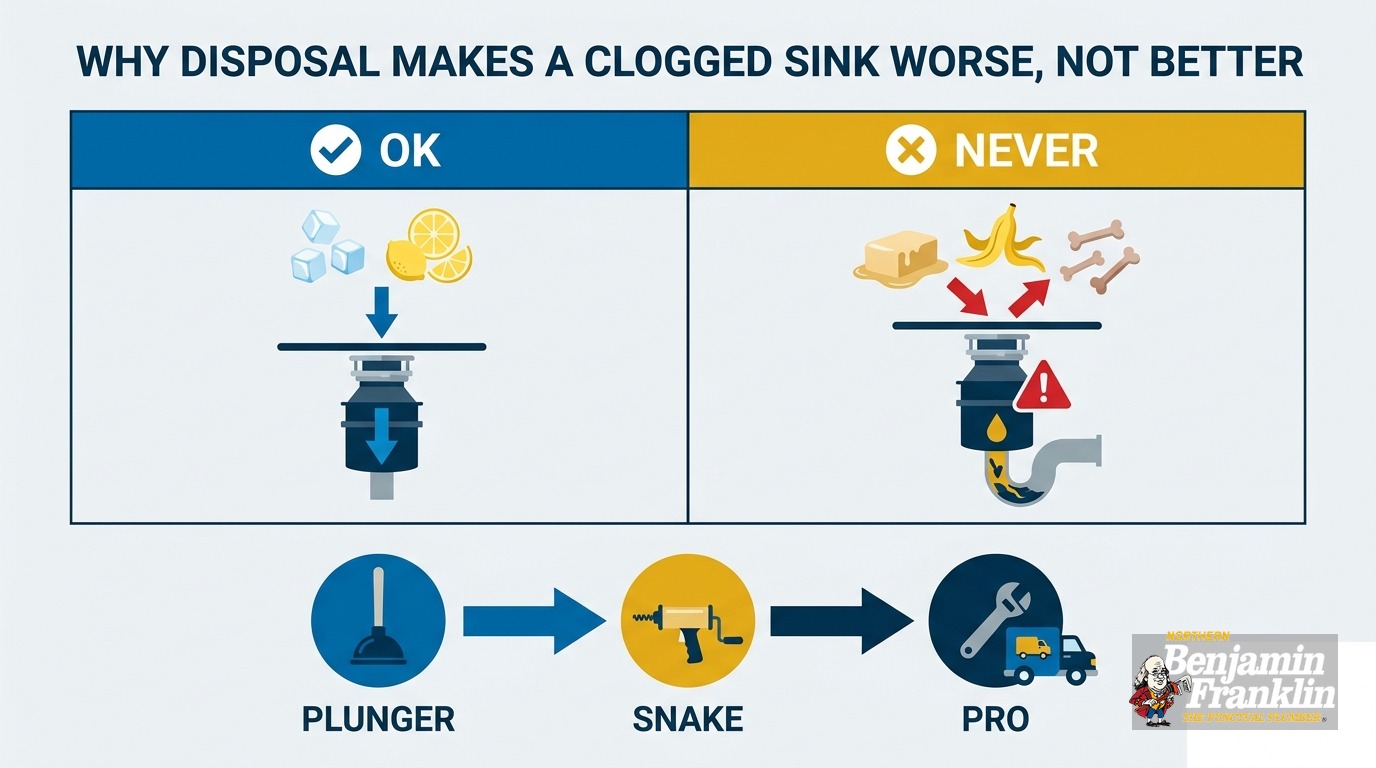
Key Takeaways
- A disposal grinds food into smaller particles, but those particles still enter the drain pipe. Smaller pieces coat more pipe wall before cooling grease solidifies them in place.
- Grease is a leading cause of reported sanitary sewer blockages nationally, according to the EPA, which notes that sanitary sewer overflows occur regularly across the United States.
- Minneapolis and St. Paul both tell homeowners not to put fats, oils, and grease down the disposal. Minneapolis spent nearly $500,000 in three years cleaning grease from city pipes.
- If one side of a double sink backs up, the clog is likely in the disposal drain or P-trap. If both sides back up together, the blockage is in the shared drain section or lateral.
- Both cities require homeowners to maintain and repair the sewer lateral from the house to the city main. A FOG clog in 70-year-old clay pipe can crack it.
- Safe DIY: plunge, check the reset button, clean the P-trap. When those steps fail, or when the slow drain keeps returning, call a professional.
Your kitchen sink won’t drain, the garbage disposal is running, and the water is climbing toward the rim. Most homeowners assume the disposal jammed or caused the blockage directly. The actual problem is usually more stubborn, and more expensive.
A garbage disposal does not remove food from your pipes. It grinds it. Smaller particles travel further down the drain line before cooling grease causes them to coat the pipe wall. By the time a sink backs up completely, the blockage may be well past the trap, deep in the horizontal drain run, or into the sewer lateral.
Here is what is actually happening inside your drain, and the step-by-step path from plunger to professional.
Why Does a Garbage Disposal Make a Kitchen Sink Clog Worse?
The short answer: a disposal turns greasy food scraps into a fine slurry that coats a longer section of your pipe before it solidifies, creating a buildup spread across many feet rather than a single lodged piece.
A whole food scrap entering a drain without a disposal either passes through or gets stuck visibly at the P-trap. That is a findable, removable problem. The disposal changes that completely. It grinds the same scrap into thousands of tiny particles mixed with emulsified fat and warm water. That mixture clears the trap without effort. Three to five feet downstream, the water cools. The fat solidifies and adheres to the pipe wall in a thin film. The next meal adds another layer. Over weeks, the pipe narrows. Over months, it stops draining.
That gradual, distributed narrowing is harder to diagnose and harder to clear than a single lodged piece. A basic drain snake often punches through the center of the buildup without stripping the coating from the walls. The drain flows for a few days, then slows again. The homeowner repeats the cycle while the buildup keeps accumulating.
The foods that cause the worst buildup are the ones that seem safe to grind: meat scraps and pan drippings, butter, cooking oil, pasta, and rice. Grease emulsifies in warm water and travels far before it sets. Starches absorb water, swell inside the wet pipe, and bind to the FOG deposits already on the walls. Both belong in the trash or compost, not in the disposal.
How Does a Garbage Disposal Turn Grease into a Pipe Problem?
The short answer: the disposal emulsifies fat into tiny uniform droplets that mix with water, travel further down the drain, and deposit across a wider section of pipe than whole grease ever would.
Fats, oils, and grease - FOG in plumbing and wastewater terms - are the core culprit. The EPA identifies grease as the most common cause of sewer blockages nationwide. The agency estimates 23,000 to 75,000 sanitary sewer overflows occur in the United States every year.
Most of that grease originates in residential kitchens. The disposal accelerates the problem. When fat from meat scraps, butter, or cooking oil hits the spinning blades with hot water, it breaks into tiny droplets that mix uniformly with the water. That emulsified mixture passes the trap easily. When it cools further into the drain line, it deposits along the full stretch of pipe it traveled, not at one congeal point.
Minneapolis Public Works states it directly: do not “grind up FOG and flush it down the drain.” The city spent nearly $500,000 in three years on grease-related pipe cleaning, taking resources away from other infrastructure maintenance. The Metropolitan Council treats 250 million gallons of Twin Cities wastewater each day across nine regional plants and reports a continuing increase in FOG over the past five years. It launched a regional task force in 2024 dedicated to addressing the trend.
Starchy foods compound the problem. Pasta, rice, and potato peels absorb water and expand inside the wet pipe. Ground fine by the disposal, they act as a binder: they stick to the FOG deposits already on the pipe wall and accelerate the buildup. The disposal creates a false sense of security. Because the scraps disappear from the sink, it is easy to assume they are gone from the system. They are not. They are just smaller, and spreading further.
Is the Clog in the Trap, or Has It Gone Deeper?
The short answer: if only the disposal side of a double sink backs up, the clog is likely in the disposal drain or P-trap. If both sides back up at the same rate, the blockage is in the shared drain section below the tee, and possibly further into the lateral.
Fill both sides of the sink slowly and watch. One side backing up while the other runs clear points to the upstream section: the disposal drain chamber, the rubber splash guard, or the P-trap directly below. Both sides draining slowly together points to a blockage downstream of where the two lines meet. Add the dishwasher to the test: if a dishwasher drain cycle also backs up into the sink, the clog is well into the drain line, past where a P-trap cleaning will reach.
Location matters because it determines what tools clear it. A P-trap clog is a 10-minute job with a bucket and your hands. A shared-drain or lateral blockage requires a long snake or professional hydro-jetting equipment.
What Should I Try First When My Kitchen Sink Won’t Drain?
The short answer: three steps in order - plunge the disposal side, check the disposal for a mechanical jam, then clean the P-trap. Each takes 10-15 minutes. If none of them clears the drain, or the slow drain returns within a few weeks, call a professional.
Safety first. Turn off the disposal at the wall switch and unplug the unit or flip the circuit breaker before working near the drain opening. An unexpected activation near the drain inlet causes serious injury.
Step 1: Plunge the disposal side
Use a standard cup plunger. On a double sink, plug the other drain opening with a wet rag before plunging. Plunging pressure follows the path of least resistance: without the rag, it exits through the unclogged side instead of driving toward the blockage. Add 3-4 inches of water to the backed-up side and plunge with firm, steady strokes for 20-30 seconds.
If the drain clears, run hot water for a full minute to flush loosened debris. If it is still slow, continue to step 2.
Step 2: Check the disposal for a mechanical jam
A disposal that is not spinning traps food and water at the drain entry. Look at the bottom center of the unit under the sink. There is a small hex socket. Use a 1/4-inch Allen wrench - some units use 3/16-inch - and work it back and forth until the blades rotate freely.
Then find the reset button on the bottom of the unit: usually red or black, it pops out when the motor trips on overload. Press it firmly until it clicks. Restore power and run the disposal with cold water flowing.
If the disposal spins freely and the sink still will not drain, the problem is in the pipe, not the machine.
Step 3: Clean the P-trap
The P-trap holds a small amount of water to block sewer gas, and it also catches ground food and grease debris before they travel deeper. Place a bucket under the curved pipe section directly below the disposal outlet. The slip-joint nuts on plastic traps unscrew by hand. Remove the trap, clear the packed material inside and from the drain stub-out going into the wall, reinstall the trap hand-tight, and run water to test.
If all three steps fail to fully clear the drain, a FOG buildup deeper in the line is the likely cause. That is past what basic tools reliably reach.
When Is It Time to Stop DIY and Call a Pro?
The short answer: call when the drain does not clear after those three steps, when both sink sides back up together, when the drain clears but returns slow within a few weeks, or when you smell sewer gas rising from the drain opening.
A hand auger - a store-bought drain snake - can reach 15-25 feet and break up a soft clog. It is less effective on FOG buildup. A snake punches a hole through the center of a grease deposit and leaves the walls coated. The drain flows for a few days or a week, then narrows again as more FOG accumulates on the remaining coating.
Hydro jetting uses pressurized water to scour the pipe walls, not just clear an opening. It strips FOG coating back to near-original pipe diameter and addresses the full length of buildup, not just the densest point. Drain snaking handles softer, simpler blockages and is the right first professional tool for many clogs. Our team can assess which approach fits your drain line before any work begins.
Northern Benjamin Franklin Plumbing is a locally owned and operated Twin Cities plumbing company backed by the Benjamin Franklin Plumbing franchise. We schedule by the appointment window you choose. With our On-Time Guarantee(R), we arrive in that window or pay you $5 for every minute we are late, up to $300. As we say: “If there is any delay, it’s you we pay!”
Call (763) 296-1844 or book online to get a drain assessment from a plumber who shows up when promised.
What Happens If a FOG Clog Reaches Your Sewer Lateral?
The short answer: once a clog migrates past the trap and into the sewer lateral, it becomes a property maintenance obligation. Minneapolis and St. Paul both require homeowners to maintain, clean, and repair the lateral from the house to the city main at their own cost.
Minneapolis Public Works is direct: “The property owner is responsible for the sanitary service lateral connecting your property to the public sanitary sewer system.” A clog or failure in that section is not the city’s repair - it is yours.
St. Paul Public Works states the same: “Property owners are responsible for cleaning, inspecting, and repairing their sewer service lateral from the house to the sewer main connection.” St. Paul has over 74,000 sanitary sewer laterals in the city. Most are clay tile pipe more than 70 years old. A FOG clog in aging clay pipe builds pressure as the blockage grows. That pressure can crack already-fragile tile. A crack is no longer a cleaning job - it is a repair or replacement, with permit costs and potentially excavation.
If you have a recurring kitchen backup and have not had a sewer camera inspection, that is the diagnostic step worth taking before another cleaning attempt. A camera run shows exactly where the buildup is and what condition the pipe is in, before a snake run finds a crack instead of grease. See When to Schedule a Sewer Camera Inspection for a full walkthrough of what that process covers.
St. Paul homeowners: The 2026 Metropolitan Council Sewer Lateral Repair Grant covers a portion of eligible repair costs for qualifying properties. Properties in LIHTC Qualified Census Tracts qualify for 90% of eligible costs up to $10,000. Other qualifying properties receive 50% of costs up to $5,000. Full eligibility details are in the St. Paul program flyer. If a camera inspection finds lateral damage, check that program before scheduling repairs.
What Minneapolis and St. Paul Say About FOG and Your Disposal
Both cities are direct: the disposal is not a solution for cooking grease.
Minneapolis says do not grind up FOG and flush it down the drain. St. Paul says use the disposal sparingly, run clean cold water for at least one minute after every use, and compost or trash large food scraps rather than grinding them.
The cold water instruction matters. Hot water emulsifies FOG and carries it further into the pipe before it cools and deposits. Cold water congeals grease closer to the trap, where it is more accessible. Better still: keep cooking grease out of the drain entirely. Scrape oil and fat into a jar, let it solidify, and throw it in the trash. That single habit removes the primary driver of kitchen drain clogs.
The high-risk food list: meat scraps and pan drippings, butter and cooking oil, pasta, rice, potato peels, and egg shells. Egg shells are a particular problem because grinding produces a very fine grit that clings to FOG deposits and accelerates wall buildup. Fibrous vegetables - celery, corn husks, artichoke leaves - create a different problem. They do not cause FOG buildup, but they wrap around disposal blades and can reduce drain flow mechanically before any clog forms.
How Do You Keep Your Kitchen Drain Clear Going Forward?
The short answer: keep grease out of the drain entirely, run cold water the full time the disposal operates and for one minute after, and treat starchy and fibrous foods as compost, not disposal fodder.
The maintenance habits that actually work:
- Scrape grease into a container before rinsing. Let cooking fat solidify and throw it in the trash. Never rinse a greasy pan or pot directly into the sink.
- Cold water before, during, and after disposal use. One full minute after the last grind. Cold water congeals grease near the drain entry rather than pushing emulsified fat further downstream.
- Compost or trash starchy and fibrous foods. Pasta, rice, celery, potato peels, and corn husks do not belong in the disposal.
- Monthly hot-water flush. A full kettle of near-boiling water dissolves thin FOG films before they build into a blockage. Use near-boiling rather than a full rolling boil if you have plastic P-trap fittings.
- Act on slow drainage before it backs up completely. A drain running slower than last month is a warning. Waiting until the sink is fully backed up means the blockage has had more time to set and spread.
The disposal is a useful appliance when used correctly. The problem is not the machine - it is using it as a substitute for proper grease disposal. For a broader look at what changing drain speed usually signals about the pipe downstream, see Slow Drains Now, Big Problems Later.
If your kitchen sink won’t drain and a garbage disposal is part of the system, our team at Northern Benjamin Franklin Plumbing can assess whether the blockage is at the trap, in the drain line, or further into the lateral. We serve Minneapolis, St. Paul, Blaine, Bloomington, Brooklyn Park, Coon Rapids, Maple Grove, and the surrounding Twin Cities metro. Call (763) 296-1844 or book online to get a plumber who shows up when they say they will.
Frequently Asked Questions
Can I use liquid drain cleaner to unclog a kitchen sink with a garbage disposal? +
Why does my kitchen sink keep clogging after I clear it? +
What should I never put in a garbage disposal? +
Who is responsible for a clogged sewer lateral in Minneapolis or St. Paul? +
Need a technician now?