What to Do While Waiting for Emergency Plumber Help
Key Takeaways
- Stay safe first. Never touch electrical panels, cords, or outlets while standing in water.
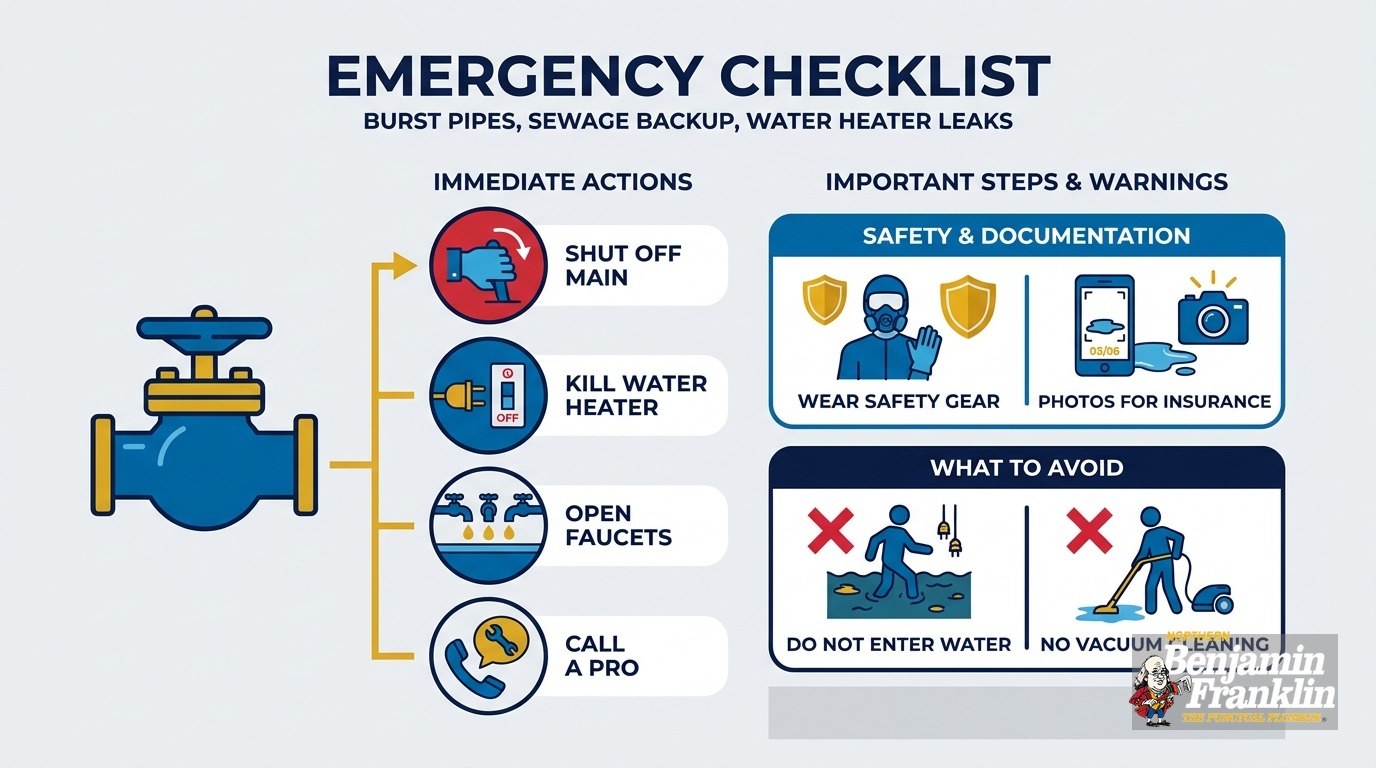
- Burst pipe: shut off the main water, then open a faucet low in the house to drain the lines.
- Sewage backup: stop using every drain, wear gloves, boots, and goggles, and keep children and pets away.
- Water heater leak: turn off the power or gas, close the cold-water valve, and contain the water.
- Smell gas? Leave the house and call the gas utility or 911 from outside.
- Photograph and video everything before you clean up. Keep damaged items and every receipt.
- Skip the risky shortcuts. Do not run gas engines indoors, mix chemicals, or force a stuck valve.
- Call (763) 296-1844 or book online. Our team is locally owned and operated, and we back every visit with our On-Time Guarantee(R).
What should you do first while waiting for an emergency plumber?
Protect people first, then stop the water, then limit the damage. Check for electrical hazards, shut off the main water valve or the affected fixture, and move belongings out of the wet area. Then call a plumber and keep the line open for questions.
Water moves fast, and panic leads to bad choices. Working in a set order keeps you steady.
This checklist is for Twin Cities homeowners. It covers a burst pipe, a sewage backup, and a leaking water heater. Each needs a different first move.
Step 1: Check for electrical danger
Water and electricity do not mix. The CDC gives this rule for flooded homes: never turn power on or off yourself or use an electric tool or appliance while standing in water.
That applies to any plumbing flood in a basement or on a floor with outlets nearby. Here is what to do:
- Stay out of standing water if you see cords, outlets, or a panel nearby.
- Do not reach for a breaker in a wet basement.
- If you must wade in to reach the main power switch, call an electrician to turn it off.
- Have an electrician check the system before power is restored.
The same CDC page says electrical equipment and appliances must be completely dry before they go back into service. Don’t rush that.
Step 2: Stop the water at the source
For a burst pipe, use the main water shutoff. For a leaking fixture, use the small valve under the sink or behind the toilet. For a water heater, use the cold-water valve on top of the tank.
Do you know where your main shutoff is? Many homeowners don’t. Our guide on how to find and test your main water shutoff valve walks you through it. Do that on a calm day, not during a flood.
In most Twin Cities homes, the main valve sits near the water meter, often in the basement near the front wall. Turn it clockwise until it stops.
Step 3: Move valuables and call for help
Lift boxes, rugs, and electronics off the floor if the area is dry and safe. Don’t carry heavy items through standing water.
Then call us at (763) 296-1844. Tell us what you see, what you smell, and what you have already shut off. That helps us send the right tools.
How do you handle a burst pipe until help arrives?
Shut off the main water valve right away. Then open a faucet at the lowest point in the house to drain the lines. Contain the water with towels and buckets, and photograph the damage before you clean. A burst pipe can release a lot of water in minutes.
Minnesota winters make burst pipes a real risk. Water expands when it freezes, and the pipe can split. The split often shows up only after a thaw, when water starts flowing again.
Burst pipe steps
- Close the main shutoff. Turn it clockwise until it stops.
- Open the lowest faucet. This drains water still sitting in the lines.
- Open a faucet upstairs, too. This lets air in so the lines drain faster.
- Check the power. If water is near outlets or a panel, follow the electrical rules above.
- Contain the water. Use towels, buckets, and a wet vacuum if the outlets are dry and safe.
- Move belongings. Lift furniture legs onto blocks, and pull rugs and boxes to dry ground.
If the pipe is frozen but has not yet burst, the situation is different. Our guides on how to tell if pipes are frozen and how to thaw frozen pipes in Minnesota cover that.
Keep the heat on
If the house is cold, keep it warm while you wait. That helps prevent more freezing in other pipes. Open cabinet doors under sinks on exterior walls so warm air reaches the pipes.
Dry the space fast
The CDC says to dry the home as soon as possible to prevent mold. It also says a home that was flooded and closed up for several days should be assumed to have mold. Open windows if the weather allows. Run fans only if the electrical system is safe.
What should you do about a sewage backup?
Stop using every drain and toilet in the house. Do not flush, run the dishwasher, or start a load of laundry. Keep people and pets out of the area. If you must enter, wear rubber boots, gloves, and goggles. Call a plumber right away.
Sewage is not like burst-pipe water. It isn’t clean, it can carry germs, and it can make people sick.
Not sure whether you have a backup or just a clog? Our post on sewer backup versus drain clog lists the signs. Common clues include several drains clogging at once and water rising in a basement floor drain.
Stop adding water to the system
Every flush, shower, and washing machine cycle sends more water into a blocked line. That water has nowhere to go. It comes up through the lowest drain in your house, which is usually in the basement.
Tell everyone in the household to hold off. Put a note on the toilets if you need to.
Protect your health
The CDC has guidance for floodwater that also applies to sewage-contaminated water. It is written for floods, not for a household sewer backup. It is still a sound baseline for what to wear and how to wash up.
- Wear protection. The CDC says that if you must enter floodwater, wear rubber boots, rubber gloves, and goggles.
- Wash your hands. Use soap and water. Use alcohol-based wipes or sanitizer if you have no soap or water.
- Wash your clothes. The CDC says to wash clothes contaminated with flood or sewage water in hot water and detergent before reusing them.
- Do not bathe in suspect water. The CDC says not to bathe in water that may be contaminated with sewage or toxic chemicals.
- Cover wounds. Avoid exposure if you have an open wound. Cover clean wounds with a waterproof bandage. Seek medical attention if a wound develops redness, swelling, or oozing.
- Keep children away. Don’t let children play in affected areas or with contaminated toys that have not been disinfected.
What to throw out
The CDC says to throw away food that may have touched flood water. Its rule: “When in doubt, throw it out.” Apply that to food stored in a flooded basement or on a low shelf.
For hard surfaces, the CDC suggests a disinfectant mix of 1 cup of bleach and 1 gallon of water. Wait until the plumber has fixed the cause. Cleaning too early can mean cleaning twice.
Check whether the problem is in the city main
In Minneapolis, the property owner is responsible for the sanitary service lateral. The city explains that the lateral connects your property to the public sewer. It also warns that lateral blockages can back up into your basement, causing property damage and potential health concerns.
If you think the city main may be the problem, the city lists these numbers:
- Sewer operations 24-hour hotline: 612-673-5625
- After-hours stand-by employee: 612-490-5568
- 311: 612-673-3000
Regular hours for sewer operations are 7 a.m. to 3:30 p.m. Other Twin Cities suburbs run their own public works departments. If you live outside Minneapolis, check your city’s website for its sewer line.
The city’s common questions page adds a detail worth knowing. It says it is not the City’s responsibility to determine the cause of a blockage in a private sanitary lateral. For a suspected private blockage, it suggests televising the lateral.
Say you hire a plumber for a lateral problem and it turns out to be in the public sewer. The city says it will reimburse the homeowner for a portion or all of the repair cost. Keep the plumber’s invoice and findings, because you will need them for the claim.
Private wells
Most Twin Cities homes use municipal water. On a private well, flooding adds another worry. The Minnesota Department of Health says that if flood water reached the well or covered the casing top, assume the well is contaminated. Stop using it for drinking and cooking until a lab says the water is safe.
What if a water heater is leaking?
Turn off the power or gas to the heater, then close the cold-water valve on the supply line. This stops new water from entering the tank. Contain the leak with towels or a bucket. If you smell gas, leave the home and call the gas utility or 911.
A water heater leak can look small and still do a lot of harm. A slow drip can soak a basement floor over a day. A failed tank can release dozens of gallons at once.
Water heater steps
- Cut the energy source. For an electric heater, turn off its breaker, but only if the panel area is dry. For a gas heater, turn the gas control to off.
- Close the cold-water valve. It sits on the pipe feeding the top of the tank. Turn it clockwise.
- Do not touch the hot pipes. Water and metal near a failed tank can be scalding.
- Find the source. Is the water coming from the bottom of the tank, the top fittings, or the relief valve?
- Contain the water. Use towels, a shallow pan, or a wet vacuum if the outlets are dry.
Gas smell? Leave first
Gas water heaters add a second risk. If you smell gas, do not turn lights on or off. Do not use a phone inside. Leave the house, then call the gas utility or 911 from outside.
Do not try to relight a pilot or repair a gas fitting yourself. That job belongs to a licensed professional.
Find the likely cause
Where the water appears tells you a lot. Our guide to a water heater leaking from the bottom explains what that usually means. A leak at the bottom often points to a tank that has failed inside. In that case, the heater usually needs replacing.
A drip from the relief valve is a different problem. Read our post on a leaking pressure relief valve. Never cap or plug that valve. It is a safety device.
If your heater is on its way out, a drain pan under the tank can limit future water damage. Ask your plumber whether one makes sense for your setup.
Carbon monoxide and the garage or basement
Many Twin Cities homes keep the water heater in a basement or utility room. If you must run a pump or generator to clear water, follow the CDC’s warning. Never run a gasoline engine inside a home, basement, garage, carport, or porch. The CDC page says to keep engines outside and away from those openings. A distance of less than 20 feet from any door, window, or vent is not the rule. Use electric equipment only when the area is dry and the power is safe.
How do you document damage for insurance?
Take photos and video of everything before you clean up. Capture the source of the leak, the water line on walls, and each damaged item. Keep damaged belongings and all receipts until your insurer says otherwise. Then call your insurance company as soon as you can.
Many homeowners clean first and photograph later. That is backward. Once the evidence is gone, it is hard to prove what happened.
Our post on a burst pipe insurance claim in Minnesota goes deeper on the process. Here is the short version.
What to capture
- Wide shots of each affected room
- Close-ups of the broken pipe, fitting, or tank
- The water line on walls, cabinets, and furniture
- Damaged flooring, drywall, and ceilings
- Serial numbers and labels on damaged appliances
- A short video walking through the space, narrated with the date and time
What to keep
- Damaged items, if you can store them safely, until the adjuster has seen them
- Receipts for emergency repairs, hotel stays, and supplies
- The plumber’s invoice and written findings
- Any notes about who you called and when
Know your policy
Standard homeowners policies often treat sewer backup differently from other water damage. Check your policy for a sewer backup endorsement. If you are not sure what you have, call your agent. Ask before you start permanent repairs.
We are plumbers, not insurance advisers. We can write down what we found and what we fixed. That documentation often helps your claim.
What should you never do while you wait?
Do not use electrical items near water, run gas engines indoors, force a stuck valve, or mix drain chemicals. Do not start permanent repairs before documenting damage. Do not ignore a gas smell. A few bad moves can turn a repairable problem into a costly one.
Here is a “do not” list for each scenario.
Burst pipe: do not
- Do not touch outlets, cords, or panels in wet areas.
- Do not wait to close the main valve.
- Do not use a torch or open flame on a frozen pipe.
- Do not make permanent repairs before you photograph the damage.
Sewage backup: do not
- Do not flush toilets or run water down any drain.
- Do not pour chemical drain cleaners into a backed-up line. They can splash back, and the next person to work on the line must handle them.
- Do not mix bleach with other cleaners.
- Do not let children or pets wade through the water.
- Do not use suspect water for dishes, teeth brushing, food preparation, handwashing, ice, or baby formula. The CDC lists each of these.
Water heater leak: do not
- Do not leave the power or gas on.
- Do not plug the relief valve.
- Do not try to relight a pilot if you smell gas.
- Do not run the heater empty after draining it.
Any emergency: do not
- Do not force a stuck shutoff valve. A broken valve can make things worse. Our post on a shutoff valve that will not turn explains what to try instead.
- Do not assume the leak has stopped because the dripping slowed.
- Do not skip the call because the problem looks small.
What should you tell the plumber to speed the repair?
Describe what happened, where the water is, and what you have already shut off. Share any smells, sounds, or recent work on the system. Send photos if you can. Good details help the plumber bring the right parts and tools on the first trip.
The more we know before we arrive, the faster we can fix the problem. Have these answers ready when you call:
- What do you see? Water on the floor, sewage in a drain, a hissing pipe, or a tank dripping.
- Where is it? Basement, kitchen, bathroom, utility room, or outside.
- When did it start? A sudden burst and a slow leak need different responses.
- What have you shut off? Tell us if the main valve is closed and whether it held.
- Any smells? Rotten eggs or gas means leave the home. A sewage smell points to the drain system.
- How old is the equipment? For a water heater, check the label for the age and size.
- What changed recently? Cold snaps, new appliances, remodeling, or other plumbing work all matter.
- Is there safe access? Tell us about locked gates, stairs, pets, and narrow basement paths.
Send photos of the problem and the label on any appliance. Keep your phone nearby so we can reach you.
Why a clear answer on arrival time matters
Waiting with water on the floor is stressful. That is why we built our service around punctuality. Under our On-Time Guarantee(R), if we are late for the window you pick, we pay you $5 for every minute, up to $300. In our words: “If there is any delay, it’s you we pay!”
Not every plumber puts a promise like that in writing. When you compare options, ask about it. Our guide on how to choose the right plumbing service in the Twin Cities lists other questions worth asking.
What can you do if you cannot afford a plumber?
Stop the damage yourself, then ask for a clear written quote and ask about financing for larger jobs. Shutting off water, containing the leak, and documenting damage costs nothing and can cut the final bill. Check your insurance, and ask your city about reimbursement if the problem is in a public sewer.
Money worries are real, but they shouldn’t hold you back from acting quickly. A small leak left alone can become a large repair.
Here are practical steps:
- Contain the problem. Close the main valve and stop using the affected fixtures. This limits the damage while you plan.
- Get a clear quote. Ask what the job includes before work begins. Request the quote in writing.
- Ask about financing. For larger jobs, such as a sewer line replacement or a repipe, ask us about financing options. Call (763) 296-1844 and we will explain what is available.
- Check your insurance. Sudden pipe bursts are often covered, though policies differ. Call your agent early.
- Ask your city about reimbursement. In Minneapolis, the city may reimburse the homeowner for a plumber’s work if a lateral problem turns out to be in the public sewer. Keep your invoice and the plumber’s findings.
- Ask what can wait. Some repairs are urgent. Others, like a slow faucet drip, can be scheduled. Our guide to small plumbing fixes that save big bucks shows which repairs belong on that list.
We won’t guess at prices here. Costs depend on the pipe material, depth, access, permits, and any cleanup needed. A real quote beats a rough estimate.
Why call a local team for a plumbing emergency?
A locally owned company knows Twin Cities homes, from older cast iron and galvanized lines to deep winter freezes. We answer to our neighbors. We also stand behind our work with a 100% satisfaction guarantee.
Northern Benjamin Franklin Plumbing is locally owned and operated. Our crews work in Minneapolis, St. Paul, Blaine, Bloomington, Brooklyn Park, Coon Rapids, Maple Grove, and the rest of the metro. We see how Minnesota weather, aging pipes, and spring runoff stress home plumbing.
We handle plumbing only. That includes drains and sewers, water heaters, water treatment, garbage disposals, frozen and burst pipes, sump pumps, gas lines, faucets, fixtures, and toilets. We do not do heating, cooling, or electrical work. If your emergency involves a panel or wiring, call a licensed electrician.
What happens when you call
- You describe the problem. We ask a few quick questions.
- You pick an arrival window.
- We arrive in that window, or we pay under our On-Time Guarantee(R).
- We explain the problem and the options before we start work.
- We fix it, clean up, and share what we found.
Need help right now? Call (763) 296-1844 or book online. Keep this checklist handy, and share it with anyone in your household who might be home when something goes wrong.
A quick recap
- Check for electrical hazards. Stay out of standing water near outlets or panels.
- Close the main valve for a burst pipe. Stop using drains for a sewage backup. Cut power or gas and the cold-water valve for a water heater leak.
- Wear gloves, boots, and goggles, and wash your hands carefully.
- Photograph first. Clean second.
- Avoid the shortcuts on our “do not” list.
- Call us. We will show up in the window you picked.
Frequently Asked Questions
What should you do during a water outage? +
How much does a plumber cost for three hours? +
Need a technician now?