
Chloramine in Tap Water Filter: What Actually Works
Key Takeaways
- Chloramine is a mix of chlorine and ammonia that utilities use to keep water disinfected as it travels through pipes.
- Check your utility’s annual water quality report to see whether you get chlorine or chloramine.
- Basic carbon filters rated for chlorine may not reduce chloramine at the same level.
- Catalytic carbon breaks chloramine down. It needs far more contact time than chlorine does.
- The breakdown leaves ammonia behind. Ion exchange or reverse osmosis can remove it.
- Tank size and flow rate matter as much as the media label on a whole-house system.
The Short Answer on Chloramine and Water Filters
Yes, a water filter can remove chloramine. But not every filter does. A basic carbon filter built for chlorine often falls short. Chloramine needs catalytic carbon and enough time in contact with it.
Check your utility first. Then match the filter’s contact time to your flow rate, not just the chlorine rating on the box.
Not every Twin Cities home gets chloramine. St. Paul’s published water report lists chlorine. Other utilities may add ammonia to their chlorine. Confirm what is in your water before you spend money on a fix.
What Is the Difference Between Chloramine and Chlorine?
Chlorine is a single disinfectant. Chloramine is a compound that contains both chlorine and ammonia. The type used in drinking water is called monochloramine, according to the CDC. Chloramine lasts longer in pipes and forms fewer disinfection byproducts than chlorine does.
Why utilities choose chloramine
Water leaves the treatment plant clean. Then it travels through miles of mains before it reaches your faucet. The disinfectant has to keep working the whole way.
The EPA explains that chloramines most commonly form when ammonia is added to chlorine. They provide longer-lasting disinfection as water moves through the distribution system. Utilities call this secondary disinfection.
The CDC adds that chloramine can keep killing germs in water pipes longer than chlorine. It also makes fewer disinfection byproducts. For a utility with a large, old network, that is a real advantage.
Why it matters at your tap
Chlorine is a fast, reactive chemical, and it leaves the water quickly. Let a glass sit on the counter, and much of the chlorine smell fades.
Chloramine is more stable. Utilities like that about it. It is also why chloramine is harder to filter out. A pitcher or a basic carbon block that handles chlorine well may barely touch chloramine.
Does Your Twin Cities Home Have Chloramine?
Maybe. It depends on your utility. Some metro systems use chloramine, and some use chlorine alone. Look it up for your address instead of guessing.
When we checked, the St. Paul Regional Water Services annual water quality report page listed chlorine as the disinfectant. It reports a range of 3.02 to 3.52 ppm. The EPA limit it lists is 4.0 ppm. The page does not mention chloramine.
For Minneapolis and the suburbs, we have not confirmed the details from here. Many suburbs buy water from a neighbor or run their own wells and plants. Each one publishes its own report. A neighbor’s answer may not apply to you, because a street can sit on a different system than the next town over.
How to read your report
Every community water system must publish an annual consumer confidence report. Look for these items:
- The disinfectant name. It may say chlorine, chloramine, or total chlorine.
- The range of results and the highest level found.
- The limit it compares against.
- Any notes about the water source and any recent changes.
The limit for chloramine is a maximum residual disinfectant level of 4.0 mg/L, measured as chlorine. The Water Quality Association lists that figure in its chloramine fact sheet.
If the report says chlorine, you may only need a chlorine filter. If it says chloramine, keep reading.
How Can You Detect Chloramine in Your Water?
Your nose is not a reliable test. Chlorine and chloramine can both give water a pool-like smell, and the strength varies by home. Start by reading your utility’s report. A home test kit or a lab test can then confirm what reaches your faucet.
Start with the report
The report tells you what the utility adds. It is free, and it is specific to your system. Most utilities post it online. You can also call the water department and ask which disinfectant they use at your address.
Then test at your tap
A report shows system-wide results. Your tap can differ. Pipes, plumbing age, and how long water sits all play a part.
Home test kits can measure chlorine in water. Check the kit label to see whether it reads total chlorine, free chlorine, or both. Chloramine shows up in the total reading, not the free one.
For a closer look, we can run a full water test. Our home water testing service checks what is actually coming out of your taps. Our guide to a tap water quality test in the Twin Cities explains what the results can tell you.
Signs that point to a disinfectant issue
Taste and smell are clues, not proof. Watch for these:
- A swimming pool or bleach smell from the cold tap.
- A flat or chemical taste in coffee, tea, or ice.
- A smell that does not fade when water sits in a glass.
- Dry-feeling skin after showers. Many things can cause this, hard water included.
A rotten-egg smell from hot water only is a different problem. Our guide on hot water that smells like rotten eggs covers it.
Will a Water Filter Remove Chloramine?
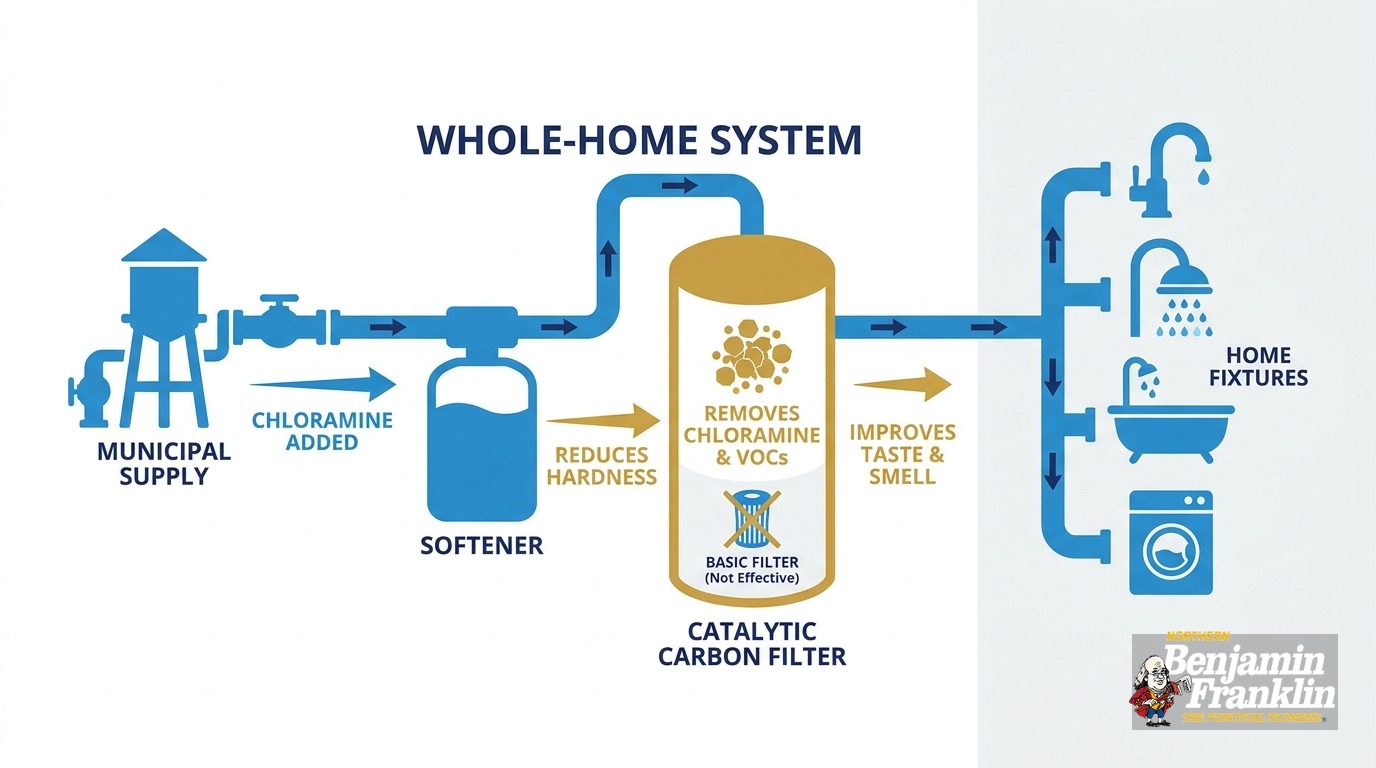
Yes, the right filter will. Catalytic activated carbon removes chloramine by breaking it down. Standard carbon is built for chlorine and may reduce chloramine far less. Reverse osmosis and ion exchange handle the ammonia left behind. The label and the design both matter.
The chlorine rating trap
Many filters carry a certification for chlorine reduction. That sounds like the whole story, but it is not.
A water treatment manufacturer warns that water filter systems certified to reduce chlorine may not reduce chloramines at comparable levels. The same page says chloramine removal is not 100 percent. That source sells filters, so treat it as a caution and not as hard test data.
Do not buy on the word “chlorine” alone. Ask whether the filter is made and sized for chloramine.
What the filter is actually doing
Carbon works in two ways. With chlorine, it mostly adsorbs the chemical onto its surface. Chloramine is different.
The WQA states that activated carbon does not adsorb chloramines but rather removes them. The carbon breaks them down in a catalytic reaction. That reaction takes more time and a more active carbon.
Why Catalytic Carbon Beats Basic Filters
Catalytic carbon is treated to speed up the chemical breakdown of chloramine. Basic carbon has fewer reactive sites for that job. So a basic filter may let more chloramine through, and it may wear out sooner.
What breaks down
According to the WQA, carbon breaks chloramine down into chlorides. The byproducts are ammonia, chloride, and nitrogen gas. Ion exchange or reverse osmosis can remove the ammonia.
Many product pages skip this. A carbon filter can strip the chloramine and still leave ammonia in the water. Whether that matters to you depends on how you use the water.
What to look for on the spec sheet
The WQA notes a few traits that help carbon work on chloramine:
- Catalytic carbons perform better at higher pH.
- Finer mesh removes chloramine faster.
- Manufacturers may list a peroxide number alongside the iodine number.
You do not need to memorize these. They do help you ask better questions. Ask any seller which carbon is in the filter and how it was rated for chloramine. If they cannot answer, move on.
Why Does Flow Rate Matter as Much as the Filter Label?
Chloramine breaks down slowly. The water has to stay in contact with the carbon long enough for the reaction to finish. That contact time depends on tank size and flow rate. A fast flow through a small tank cuts the time short, and chloramine slips through.
Contact time in plain terms
Think of a slow cup of coffee versus a fast one. Water that drips through grounds slowly pulls out more flavor. Carbon works the same way.
The WQA says that a bed contact time of 10 minutes or greater can be required. It states this for traditional activated carbons. That is much longer than chlorine usually needs.
A larger tank gives water more time with the carbon at the same flow. A higher flow gives it less.
Why this matters for a whole house
A whole-house system must serve a shower, a dishwasher, and a washing machine, sometimes all at once. Flow spikes. If the system is too small, contact time drops when you need it most.
That is why sizing matters. A plumber should look at your household size, your peak flow, and your pipe size. Then they should match a tank to that demand.
Why it matters at a single tap
A small under-sink filter has a small bed. The faucet limits flow, which helps. Even so, a filter that was not built for chloramine will not do the job just because the flow is low.
If you also plan under-sink work, think about the rest of the setup. Our post on replacing flexible supply lines under the sink explains how to keep that space leak-free.
How Can I Remove Chloramine From My Water at Home?
You have three practical routes. Use a catalytic carbon filter at the tap, a whole-house carbon system, or reverse osmosis for drinking water. Many homes combine two of them. The right pick depends on what bothers you and where you use the water.
Option 1: Catalytic carbon at one tap
This is the simplest fix for taste. A catalytic carbon cartridge at the kitchen sink treats the water you drink and cook with. It does not treat showers or laundry.
It suits households that notice a chemical taste or smell and want a focused fix. It also suits renters and small budgets, where a whole-house system would be too much.
Option 2: Whole-house catalytic carbon
A tank of catalytic carbon at your main water line treats every faucet. You get filtered water in the shower, the laundry room, and the kitchen.
It works best when sized to your flow. Our whole-home water filtration service starts with that sizing. For a larger job like this, we also talk through financing options.
Option 3: Reverse osmosis for drinking water
Reverse osmosis pushes water through a fine membrane. It removes many dissolved substances, including the ammonia left over after carbon breaks chloramine down. The WQA names ion exchange and reverse osmosis as the ways to remove that ammonia.
Many homes pair a carbon stage with an RO unit at the kitchen sink. Our reverse osmosis systems page explains how that setup works. You can also read our guide to reverse osmosis drinking water in the Twin Cities.
What about pitchers and fridge filters?
Some pitchers and fridge filters list chloramine reduction. Others list only chlorine. Read the fine print on the package. A small cartridge also has limited contact time, so expect modest results compared with a properly sized system.
Drinking Water or the Whole House: How to Choose
Start with what you want to fix. If it is the taste of your coffee and ice, treat one tap. If it is the smell in the shower or the whole house, treat the whole house. Many homes choose both: a whole-house tank plus RO at the kitchen sink.
Treat drinking water if
- Your main complaint is taste or smell in drinks and food.
- You want the lowest-effort fix.
- You want the cleanest drinking water possible and plan to add reverse osmosis.
Treat the whole house if
- You notice the smell in showers and bathrooms.
- You want filtered water for the whole family at every tap.
- You are already adding other treatment and want one coordinated system.
What about hard water?
Chloramine and hardness are two separate issues. A carbon filter does not soften water. If you also see white scale on fixtures, a softener handles that. Our post on removing hard water stains and scale in the Twin Cities explains the difference.
We can design both into one plan. Our water treatment team looks at the whole picture, so you do not buy a piece that fights another.
What Does a Chloramine Filter Cost, and What Drives It?
Call (763) 296-1844 or book online. We can explain what moves the cost, so you know what you are paying for.
These factors shape the final job:
- System type. A single-tap cartridge, a whole-house tank, and an RO unit are very different jobs.
- Tank size and flow. A larger tank gives more contact time for your household’s peak demand.
- Media quality. Catalytic carbon grades differ, and so does how long each lasts.
- Pipe layout and access. Where your main line sits and how easy it is to reach changes the labor.
- Add-on stages. Sediment pre-filtering, RO, or softening add parts and time.
- Replacement media. Plan for cartridge or media changes over the life of the system.
A pre-filter can help protect your carbon from sediment. Our guide to a whole-house sediment pre-filter explains when that makes sense.
For a larger job, ask about financing. We can walk you through options when we give you a quote.
When Should You Replace the Filter Media?
Replace it on the maker’s schedule, or sooner if the taste or smell returns. Carbon wears out as it breaks down chloramine and traps other compounds. A spent filter stops working long before it looks dirty. Stretching the interval to save a few weeks costs you more than it saves.
Signs your carbon is spent
- The pool-like smell comes back at the tap.
- Taste changes in coffee, tea, or ice.
- Flow drops, which can mean a clogged cartridge.
- You have passed the manufacturer’s date or volume limit.
Keep a simple routine
Write the install date on the housing. Set a calendar reminder. Check your utility’s report each year, because disinfection methods can change. If your utility switches disinfectants, your filter may need a different media.
Our plumbing maintenance visits can fold filter checks into your regular service.
Is Chloramine a Health Concern?
Utilities use it to keep water safe, and the EPA sets a limit for it. Most Twin Cities homeowners filter it for taste and smell. Some people have special needs. If you have a medical device or keep fish, ask your doctor or a specialist what your situation requires.
We are plumbers, not doctors. We can tell you what a filter does and how to size it. We cannot give medical advice.
Our chlorine in water page covers related questions. If you worry about other contaminants, our guide to PFAS in Minnesota drinking water is a good next read.
Why Call Northern Benjamin Franklin Plumbing
We are a locally owned and operated Twin Cities plumbing company. We know the metro’s water systems, and we know that one suburb may differ from the next. That local knowledge shapes how we size a system.
Here is how we help:
- We check your utility’s report with you and test your tap.
- We size the system to your flow so contact time is enough.
- We install it cleanly and explain how to maintain it.
- We stand behind the work with a 100 percent satisfaction guarantee.
We also keep our word on time. Our On-Time Guarantee(R) means we arrive in the window you pick. If there is any delay, it’s you we pay! That is $5 for every minute we are late, up to $300.
Next Steps
Do these three things this week:
- Find your utility’s latest water quality report and note the disinfectant.
- Decide whether you want to treat one tap or the whole house.
- Call us before you buy a filter, so the media and tank match your water.
Ready to fix the taste and smell? Call (763) 296-1844 or book online. We will tell you what your water needs and what it does not.
Frequently Asked Questions
Does St. Paul use chloramine in its drinking water? +
Is chloramine in tap water safe to drink? +
Do I need a whole-house system or just a drinking water filter? +
Who can install a chloramine filter in the Twin Cities? +
Need a technician now?