Propane Water Heater Replacement Minnesota Guide
Key Takeaways
- Propane and natural gas are not interchangeable. A unit and its burner parts must match the fuel.
- Check the chimney first. Minnesota’s fuel gas code calls for an examination before you connect a vent or replace an appliance.
- Chimney liners and vent sizing matter. Minnesota amended the national model code to be stricter in some vent sizing tables.
- Your propane supplier and installer should confirm the tank, regulator, and pipe sizing together.
- Many cities require a plumbing permit for a water heater replacement. Rules vary by city and township.
- A sealed-combustion, direct-vent unit is a strong option for avoiding backdrafting.
- We do not quote prices in a blog post. Call (763) 296-1844 or book online for a real quote.
Propane Water Heater Replacement in Minnesota: The Short Answer
If your home sits outside the natural gas mains, your water heater likely runs on propane. Replacing it is not a simple like-for-like swap. Venting, chimney condition, gas piping, and permits all shape the job. A good plumber checks each one before ordering a unit.
This guide is for rural and exurban Twin Cities homeowners, whether you live in a township, on a lake lot, or on acreage past the suburbs.
Northern Benjamin Franklin Plumbing is locally owned and operated. We serve homeowners across the Twin Cities and greater Minnesota.
One note up front. We did not find a Minnesota rule written only for propane water heaters. The state fuel gas code covers both fuels in many places. So we won’t invent a “propane-only” rule. We’ll show what the code says and where your installer must confirm details.
Why Does Propane Change the Replacement Plan?
Propane changes the plan because the fuel, the supply system, and often the home itself differ from a city gas setup. Your tank, regulator, piping, and vent all affect which water heater fits. A good replacement starts with those details, not with the unit on the shelf.
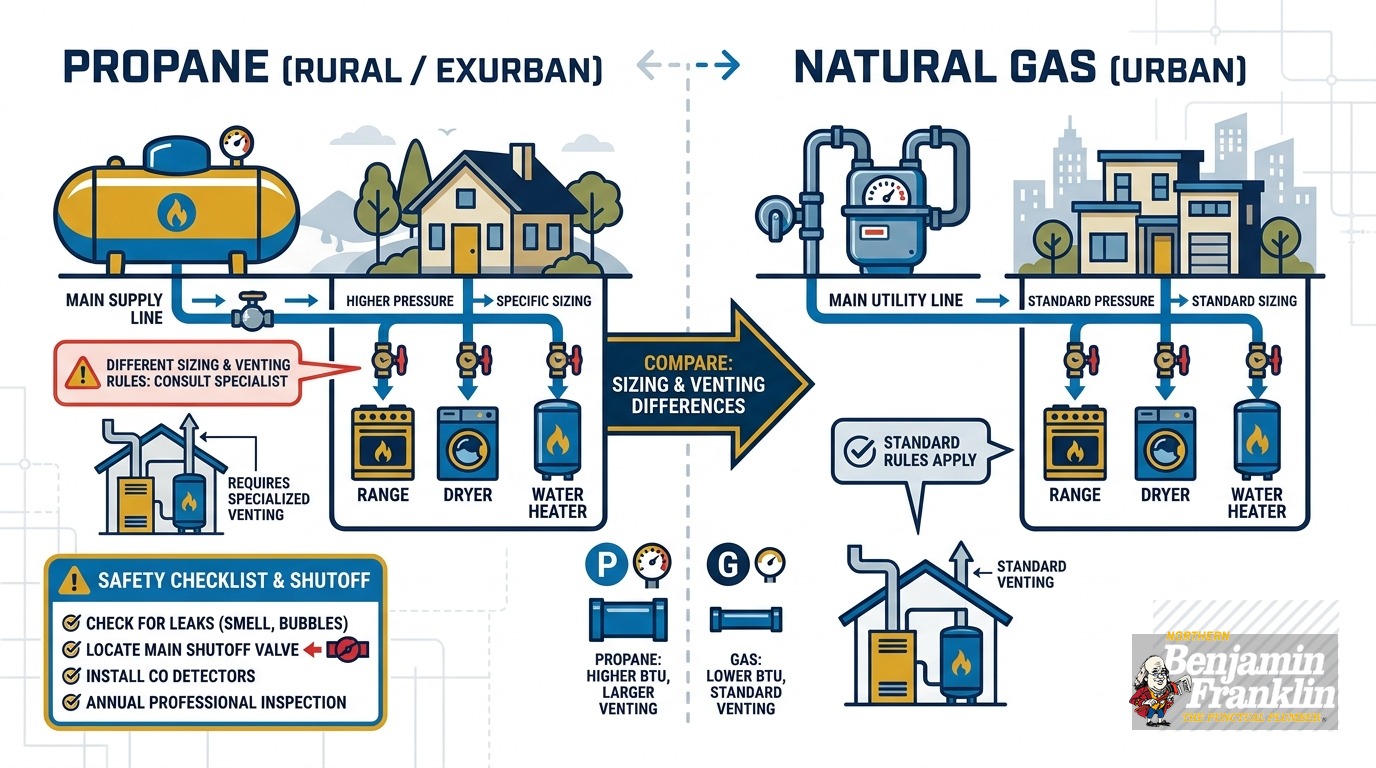
Homes on natural gas get fuel from a utility main. Propane homes get it from a tank on the property, filled by a supplier. The tank, the regulator, and the lines to the house are all part of the system.
That system was sized for the appliances you had when it was built. A bigger water heater may ask more of it. A tankless unit may ask much more.
Exurban homes also tend to share a few traits:
- Older chimneys that once served an oil or wood appliance
- A water heater tucked in a utility room or basement corner
- Gas lines that run from a tank outside, across the yard, and into the house
- Local permit rules set by a township instead of a large city
None of these is a problem alone. Together they explain why a quick online price rarely matches the real job. We look at the full picture first.
Can You Convert a Natural Gas Water Heater to Propane?
Maybe, but only if the manufacturer allows it for that exact model. Conversion usually needs a model-specific kit and a careful setup by a qualified installer. Never guess at it. A wrong setup can cause poor burning, soot, or unsafe operation.
Many homeowners ask this after a move. They buy a house that had natural gas, or they bring a heater from another home. Then the fuel doesn’t match.
Some models are made for one fuel only. Others offer a conversion kit that swaps parts so the burner works with the new fuel at the right pressure.
Our rule: follow the unit’s manual and the installer’s judgment. We don’t publish conversion steps here. They differ by brand and model, and the manual wins.
When you shop, ask the seller three things:
- Is this model rated for propane as sold?
- If not, is there a kit approved for this exact model?
- Who installs and tests the conversion?
A unit made for propane from the start skips the question. That is often the cleaner route.
What Does Minnesota’s Fuel Gas Code Say About Chimneys and Vents?
Minnesota’s fuel gas code requires you to examine the chimney before connecting a vent or replacing an appliance. It also tightens vent sizing in some tables and reduces liner capacity in masonry chimneys. These rules shape which water heater can safely use your existing chimney.
The Minnesota Fuel Gas Code is Minnesota Rules chapter 1346. It amends the model national code. We reviewed the rule text on the state revisor site, but the version we read was an older posted edition. Your installer should check the current edition before work starts. You can find the chapter at the Minnesota Revisor of Statutes.
Here is what the text we reviewed says, in plain terms.
The chimney must be checked first. Before you connect a vent or replace an appliance, the chimney passageway must be examined to make sure it is clear and free of obstructions. A blocked chimney can send exhaust back into your home. Birds’ nests, old liner pieces, and debris are common causes.
Vent size has a limit. The Minnesota rule says the flow area of the vertical vent shall not exceed four times the flow area of the listed appliance. The state amendment changes “seven times” to “four times” in two vent tables. In practice, a vent too big for a small water heater can cool exhaust too fast. Cool exhaust may not rise well.
Liners lose capacity. For listed corrugated metallic liners in masonry chimneys, maximum capacity is reduced by 20 percent. That matters when an old chimney gets a new liner.
The code’s scope includes LP-gas with an operating pressure of 20 psig or less. LP-gas is the technical name for propane. The text we read had no propane-specific vent rule, so we treat these as the baseline for all gas appliances.
Why Does the Old Chimney Matter So Much?
The old chimney matters because a new water heater often vents differently from the one it replaces. A modern, efficient unit makes cooler exhaust. Cooler exhaust may not rise well in a large, cold masonry chimney. That can cause backdrafting, condensation, and damage.
Many older Twin Cities and exurban homes have masonry chimneys. They were built for hotter, higher-volume exhaust, and a furnace or boiler once shared them.
Today, many homes have a newer furnace that vents through the wall. That leaves the water heater alone in a big chimney. This is the setup that causes trouble.
Watch for these signs during a replacement visit:
- Rust or staining at the draft hood
- White or brown streaks on the chimney or vent pipe
- Soot near the burner
- A musty smell near the water heater
- Crumbling mortar or brick dust in the cleanout
Any of these tells us to stop and look closer. We may suggest a liner, a smaller vent, or a different type of water heater. We explain the options before we recommend one.
For more on venting types, read our guide to power vent versus direct vent water heaters in Minnesota.
Is a Sealed-Combustion Water Heater Worth Considering?
Often, yes. The U.S. Department of Energy recommends a sealed-combustion, direct-vented gas storage system for avoiding backdrafting. It draws air from outside and sends exhaust outdoors. For many exurban homes with tricky chimneys, it solves the problem at the source.
The Department of Energy says a high-efficiency natural gas or propane water heater can be installed. It recommends a sealed-combustion, direct-vented unit, which draws combustion air from outside and vents exhaust outdoors. The agency says this makes backdrafting nearly impossible.
It also notes that a high-efficiency power-vented gas hot water heater also can be used to avoid backdrafting.
For a propane home, this often means you can skip the old chimney. Exhaust leaves through a pipe in the wall, so you no longer depend on a cold, oversized masonry flue.
There are tradeoffs. A power-vent unit needs an electric outlet and makes more noise than an atmospheric unit. A wall vent also needs a clear path outside. In deep snow country, drifts can block an exterior vent termination, so placement is key.
Energy cost is another reason to look closely. The same agency page cites an Energy Information Administration figure: water heaters can take up 19% to 32% of a homeowner’s utility bill. With propane delivered by truck, you feel that on every fill.
What About the Propane Tank, Regulator, and Gas Pipe?
Ask your propane supplier and your installer to confirm tank, regulator, and pipe sizing together. We do not give sizing numbers in a blog post. The right answer depends on your total appliance load, pipe length, and equipment. Both parties should sign off before the new unit goes in.
Most online guides skip this step. A water heater is one load on your propane system. Your furnace, range, dryer, fireplace, and generator may share the same line.
A larger or higher-input unit makes the whole system work harder. Pipe that was fine for the old heater may be too small for a new one. A regulator may need a check. A tank may need a different fill plan.
Here is a simple way to handle it:
- List every propane appliance in the home.
- Share that list with your supplier and your installer.
- Ask both to confirm the tank, regulator, and pipe can serve the new load.
- Get the result in writing if you can.
Minnesota’s code also has a rule about how the line enters the house. It says gas piping shall not penetrate building foundation walls at any point below grade. That matters for propane lines running from a tank in the yard. Plan the entry point above grade.
If you need a new line or a longer run, our team can help. Read more in our guide to gas line safety and permits in Minnesota.
Do You Need a Permit to Replace a Water Heater?
Often, yes. Minneapolis lists a plumbing permit for anyone who wants to replace or install a water heater. Other cities and townships set their own rules. Ask your installer to check your local office before work begins, so you do not face surprises later.
The City of Minneapolis states that you need a plumbing permit to “Replace or install a water heater.” The page does not say who may pull the permit and lists no fee amounts. For details it leaves out, it points to Minneapolis Development Review at 612-673-3000.
That is one city. A township or small city may differ. Some offices have their own forms, fees, and inspection steps. Some rely on the state code alone.
Permits matter to you for a few reasons:
- An inspection gives a second set of eyes on venting and gas connections.
- Unpermitted work can cause trouble when you sell the home.
- Your insurer may ask for proof if a claim ever comes up.
We check local requirements on every water heater job. If a permit applies, we handle the process with you.
How Much Does a Propane Water Heater Replacement Cost?
Cost depends on the unit, the venting, the gas supply, access, and local permit needs. We do not publish a price sheet, so we will not print a number here. The most reliable path is a written quote after a plumber sees your setup.
Plenty of cost ranges online are national averages. A national average does not describe a rural Minnesota home with a long gas run and an old chimney.
On a propane job, these drive the price:
- Unit type. A standard tank, a power-vent tank, a direct-vent tank, and a tankless unit differ a lot.
- Venting. Reusing a sound chimney costs less effort than lining one or running a new wall vent.
- Gas supply. Longer runs or undersized pipe can mean piping changes.
- Access. A tight utility room or a steep basement stair adds labor.
- Permits and inspection. These vary by city and township.
- Extras. Expansion tanks, shutoff valves, and drain pans may be needed.
For related cost factors, see our guide on gas water heater replacement cost in Minnesota. It covers what shapes a quote, not a made-up price.
For larger jobs, ask about financing. We’ll walk you through the options when we write your estimate. Call (763) 296-1844 or book online to start.
What Is the Difference Between a Tank and a Tankless Water Heater?
A tank heater stores hot water and keeps it warm. A tankless heater heats water only when you open a tap. Tankless units save floor space and give steady hot water. They also need a stronger gas supply and proper venting, which matters on propane.
Both types work on propane. The right choice depends on your home and habits.
Tank water heaters hold a set amount of hot water, often in a tall cylinder. They are simpler and cost less to repair. They also lose a little heat while the water waits.
Tankless water heaters heat on demand, so you won’t run out of hot water mid-shower. They take less space. But they draw a large burst of gas when running. On a propane system, that burst can stress an undersized line or regulator.
Venting differs too. Tankless units are often sealed-combustion and vent through the wall, which can help a home with a bad chimney.
Minnesota’s cold groundwater matters as well. Colder incoming water makes the unit work harder to reach your set temperature. Our guide to tankless water heater sizing for Minnesota groundwater explains how to match capacity to your home.
If you are weighing the price of switching, read what it costs to replace a water heater with a tankless unit in Minnesota. It helps you ask better questions before you call.
You can also see our full lineup on our water heaters page.
How Do You Find a Licensed Plumber for a Water Heater Replacement?
Ask for proof of licensing, check how the company handles permits, and confirm it works on your fuel type. Ask how it treats venting and gas sizing. Pick a local company with clear, written estimates and a firm arrival window.
A water heater is a gas appliance, and mistakes can be costly or unsafe. Hiring well saves money and stress.
Use this checklist when you call around:
- Ask about licensing. Minnesota licenses plumbing work. Ask for the license details and confirm them.
- Ask about propane experience. Does the company install on propane homes regularly?
- Ask about the chimney. Will they examine it before they quote the unit?
- Ask about the permit. Will they handle it, and will they confirm local rules?
- Ask about sizing. Will they check gas pipe and regulator capacity?
- Ask for a written quote. It should list the unit, the venting work, and any extras.
- Ask about timing. Will the crew arrive in a set window?
That last point matters to us. Our On-Time Guarantee(R) is simple. You pick the window. We arrive in it, or we pay you $5 for every minute we are late, up to $300.
For more on choosing well, read our guide to choosing the right plumbing service in the Twin Cities.
What Should You Do Before the Plumber Arrives?
Clear access to the water heater, list your propane appliances, and note any symptoms. Share your supplier’s name and any past service records. A little prep lets the plumber check venting and gas sizing faster, and it keeps the visit on schedule.
A few small steps help the visit go smoothly:
- Clear the area. Move boxes and tools at least a few feet from the heater.
- Note the model and age. The label on the tank lists both. Our guide to decoding a water heater serial number can help.
- List your gas appliances. Include the furnace, range, dryer, fireplace, and generator.
- Know your supplier. Have the company name and tank size if you have them.
- Describe the problem. Is it leaking, noisy, slow to heat, or out of hot water?
- Check for a shutoff. Find where gas and water shut off to the unit.
If the heater is leaking now, shut off the water to it and call right away. Do not ignore a leak near a gas appliance.
When Is It Time to Replace Instead of Repair?
Replace when the tank leaks, the unit is near the end of its life, or repair bills keep rising. A leak from the tank body rarely gets fixed. Age, rust, and repeated failures all point toward replacement.
Water heaters do not last forever. Hard water and sediment shorten their life. Our guide on anode rods and hard water explains why.
Common signs it is time to replace:
- Water pooling under the tank
- Rust-colored hot water
- Popping or rumbling noises
- Repeated pilot light or burner trouble
- A unit well past the age most tanks last
Planning ahead pays off in a propane home. You can line up your supplier, your permit, and your venting plan before a failure. An emergency swap leaves less time to do each step right.
Plan Your Replacement With a Local Team
Do the steps in order: check the chimney, size the vent, confirm the gas supply, pull the permit, then pick the unit. Skip one and you risk a callback or a safety issue.
Northern Benjamin Franklin Plumbing is locally owned and operated. We know Twin Cities housing, Minnesota winters, and the quirks of exurban homes. We show up in the window you pick, and we explain the work in plain words.
Ready to start? Call (763) 296-1844 or book online. Ask about financing if your project is a larger one.
Plumbing only: for heating or cooling questions, our sister Northern brands can help.
Frequently Asked Questions
Who installs hot water heaters in the Twin Cities? +
How much is a tankless water heater? +
Can I swap a natural gas water heater for a propane one? +
Do I need a permit to replace a water heater? +
Need a technician now?